The Measured Depth of a Sovereign Border Line and the Price of Dirt
CHAPTER 1: THE ACCORDION OF THE PERIMETER
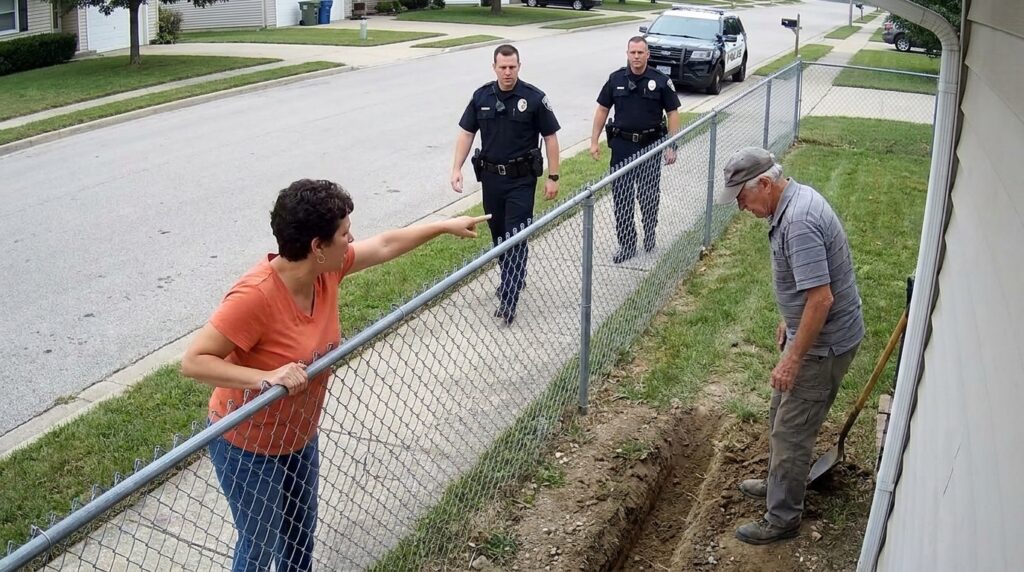
The spade split a dry root with a short, metallic snap that vibration traveled right through Arthur’s calloused palms, but he didn’t look up until the heavy door of the Ford Interceptor clicked open at the curb. The heat off the asphalt was thick, smelling of old oil and parched Kentucky bluegrass. He kept his boots planted four inches down in the fresh, narrow trench, his weight resting squarely on the iron tread of the shovel.
“Sir, put the shovel down and step back from the fence.”
The voice belonged to the stocky one. A primary responder with a wide utility belt that creaked like dry leather every time he shifted his heels in the loose gravel of the driveway. Behind him, the second officer already had his boots spread wide near the bumper, a bald head catching the harsh glare of the midwestern afternoon sun.
Arthur didn’t drop the spade. He lowered it slowly, letting the steel blade rasp against the exposed limestone shelf at the bottom of the cut earth. He kept his hands resting on the worn ash handle, his gray ball cap tilted just enough to shield his eyes from the glare.
“You cannot just come onto my side and start digging there,” Evelyn yelled from behind the wire. Her knuckles were white where they hooked into the zinc-coated chain-link mesh. The bright orange of her T-shirt looked violent against the parched yellow lawn. Her index finger was extended, rigid, thrust through one of the diamond gaps in the fence like a small stake. “I told you three times, Artie. This easement is flagged. You’re undermining my foundation.”
Arthur looked at the finger, then at the stocky officer. His internal clock counted the seconds by the steady tick-tick of the idling cruiser twenty feet away. He had spent forty years maintaining diesel generators in places where an incorrect measurement meant three blocks went dark; he knew exactly how much dirt he had moved. Exactly eleven cubic feet. All of it stayed on the west side of the wire.
“He’s been out here since six AM,” Evelyn continued, her voice rising to a sharp, thin register that made the bald officer glance toward the front porch blinds across the street. “Just hacking away at the line. I have the property description from my closing paperwork right inside.”
The stocky officer didn’t look at her paper. He stepped into the interaction lane between the two bungalows, his eyes fixed on the small mound of dark topsoil Arthur had piled neatly on a blue tarp. “Ma’am, let me talk to the gentleman. Sir, I asked you to step out of the excavation.”
“It’s a French drain, son,” Arthur said. His voice was sparse, dried out by age and tobacco, but it didn’t shake. He didn’t use her name. He kept his eyes on the officer’s tactical vest, checking the nameplate. Miller. “Three-quarter inch washed river stone. If I don’t lay the pipe before Tuesday’s storm, her patio runoff is going to take another half-inch of my cellar wall with it.”
“We aren’t here to grade the masonry, sir,” Officer Miller said. He stepped closer, his boot heel coming down on a fresh survey string Arthur had pinned between two iron spikes. The string went taut, singing a low note. “We have a complaint of criminal trespass and property damage. Step up onto the grass.”
Arthur felt the weight of his seventy years in the hinge of his left knee as he hoisted himself out of the trench. His work pants were caked with dark gray clay at the shins. He reached into his back pocket, his fingers tracking the smooth, sweat-stained plastic of the city permit folder. But as his hand cleared the denim, his thumb caught on something else down in the ditch—a dull, green-crusted edge of old brass that hadn’t been there when he cleared the sod three hours ago. It was an old municipal tap casing, completely flattened by the shifting weight of the earth above it.
“He’s reaching for something,” Evelyn barked, her body slamming harder against the fence until the posts groaned in their concrete footings.
Arthur stopped, his hand still inside the pocket, his eyes locked on the green metal protruding from the bottom of his trench. The orientation was completely wrong. If that valve belonged to the city main, the entire line of the fence was running dead through a public right-of-way.

CHAPTER 2: THE FRICTION OF THE RESTRAINT
“Keep your hand out of your pocket, sir,” Officer Miller said, his palm dropping automatically to the hard polymer butt of his Glock. The utility fabric of his vest made a sharp, synthetic scratch against his uniform shirt. “Slowly.”
Arthur didn’t pull his hand back. He simply kept his fingers anchored to the heavy municipal permit folder, his thumb pressing into the sweat-softened cardboard. His gaze remained downward, tracking the sharp angle where the dry clay sloped away from the green-crusted brass rim. The metal was stamped with a faded number—74—barely legible beneath the oxidation and the packed silt. It wasn’t standard residential copper. It was thick-walled water district iron, the kind meant to bear four hundred pounds of pressure per square inch before the county lines divided the valley into quarter-acre lots.
“The folder’s in my right pocket, Officer,” Arthur said, his voice flat, retaining the gray, unhurried cadence of a man who spent his life waiting for engines to cool down before adjusting the valves. “I’m pulling it out now. No sudden moves.”
He extracted the yellowed plastic sleeve with two fingers. The corner was split, held together by a strip of gray duct tape that had dried out and turned brittle at the edges. He didn’t offer it forward; he held it close to his thigh, letting the wind catch the edge of the blue layout paper inside.
Behind the chain-link mesh, Evelyn’s sneakers squeaked against the sun-baked dirt as she shifted her weight, her floral blouse rustling with every jagged breath. “Don’t look at his papers, Miller. He probably drew those himself. He’s been encroaching on my property line since he put up that detached garage five years ago. He thinks because he’s old, the rules don’t apply to him.”
The bald officer—the one whose name tape read Hendricks—stepped closer to the fence line, his broad chest nearly touching the zinc wire. He looked down into the trench, his shadow falling across the exposed brass valve like a cold tarp. “Artie, is it? You said you’re laying river stone?”
“French drain,” Arthur muttered, pointing the tip of his boot toward the limestone shelf. “Evelyn’s patio slab has a four-inch pitch toward my foundation. Every time the rain comes off her roof, it pools right against my sill plate. Look at the mud under that bottom wire. That’s her runoff, not mine.”
“It’s my easement!” Evelyn snapped, her fingernails scraping the galvanized coating of the fence with a dry, metallic screech. “The developer told me when I bought the place in ninety-eight that everything within five feet of the line belongs to the drainage grid for Block C. You’re digging in the public right-of-way, Artie. That’s a county violation.”
Officer Miller took the folder from Arthur’s hand. The paper inside crackled as his thick fingers unfolded the 1994 municipal infrastructure layout. His eyes scanned the blue lines, his brow furrowing as he tracked the cross-hatched boundary sectors. “This is a valid residential utility waiver, ma’am. Stamped by the clerk’s office three weeks ago.”
“I don’t care what his stamp says,” Evelyn said, her voice dropping into a hard, transactional hiss. “He’s undermining the grading. If my concrete cracks because he’s digging a ditch three inches from the post, he’s paying for the replacement. I’ve already called code enforcement. They’re sending an inspector out on Monday.”
“Monday’s too late,” Arthur said, his eyes still fixed on that buried green rim. The friction of the earth had shifted it slightly over the winter; he could see the tiny hairline fracture where the lead solder met the iron pipe casing. It was directly beneath the outer edge of Evelyn’s unpermitted concrete slab. Every pound of her heavy patio was bearing down on a pipe that hadn’t been mapped since the Carter administration. “You want to talk about concrete, Evelyn? Look at the bottom of the cut.”
Officer Miller lowered the paper, his eyes following the line of Arthur’s boot. The bald officer, Hendricks, took a small flashlight from his vest, clicking the beam onto the dark silt inside the trench. The yellow light danced across the rusted iron flange.
“What is that?” Hendricks asked, his voice losing its authoritative edge, replaced by the mechanical curiosity of a city employee who recognizes a problem that involves public works. “That looks like an old main bypass.”
“It’s a nineteen-seventy-four isolation valve,” Arthur said, his thumb tracking the edge of his faded ball cap. “The whole sector used to be an orchard before they laid the asphalt. If that’s the main bypass, Evelyn, your entire concrete patio isn’t just on the line. It’s sitting dead-center on top of the municipal high-pressure feed.”
Evelyn’s hand dropped from the wire. Her face didn’t soften; it hardened, the skin around her jaw tightening until the tendons looked like thin cords under her tanned skin. “That’s ridiculous. The patio was poured by licensed contractors. They cleared it with the county.”
“There’s no easement code listed on your title for a concrete pour, ma’am,” Miller said, his tone shifting as he looked back at the blue sheets in his hand, then at the physical layout of the bungalows. The two houses sat less than fourteen feet apart, a narrow strip of gray gravel and scorched grass separating their destinies. “If this pipe is active, nobody should have poured four inches of reinforced aggregate over it.”
Arthur knelt down in the grass, the dry blades pricking through his work pants as he reached down to clear a handful of loose stones from the valve rim. The grit was hot, catching under his fingernails as he worked. He could feel the faint, rhythmic thrumming of water moving under immense pressure through the iron beneath his knuckles—a deep, industrial pulse that had nothing to do with residential plumbing.
But as his fingers cleared the final layer of silt near the fence post, his knuckles struck something else. Not iron. Not brass. A smooth, square block of red granite buried six inches deeper than the valve, completely hidden behind the concrete footings of Evelyn’s fence line.
Arthur stopped, his fingers freezing in the dirt. He knew that stone. Every old township map from the standard geological survey used red granite blocks to mark the zero-point baseline for the county section lines. And this block was sitting a full twenty-four inches onto his side of the wire.
“Miller,” Hendricks said, his flashlight beam dropping lower into the hole, highlighting the clean, machined edge of the granite. “Look at the marker.”
The stocky officer stepped forward, the gravel crunching under his soles as the silence between the two houses became heavy, broken only by the distant hum of a lawnmower three blocks over. Evelyn didn’t move; her eyes were fixed on the square red stone emerging from the dark earth like an old tooth.
CHAPTER 3: THE CHISELED GEOMETRY OF MALICE
Arthur didn’t use his fingers anymore. The gray, sandy soil beneath the chain-link fence was mixed with sharp limestone aggregate that had already torn a thin line of red across his thumb, so he used the flat tip of a steel trowel he pulled from his side pocket. The tool made a dry, rhythmic scritch-scritch against the side of the red granite block. The stone was cold, maintaining the temperature of deep groundwater despite the mid-afternoon heat beating down on his neck.
“Move back from that footing, Artie,” Evelyn said, but the sharp, commanding edge in her voice had lost its anchor. Her body remained pressed against the zinc mesh, but she had shifted her grip downward, her fingers hooking lower into the links as if her center of gravity had dropped two inches. “Miller, he’s messing with the structural support of my fence line. He’s deliberately trying to destabilize the posts.”
Officer Miller didn’t look up from the spot. He knelt on one knee in the yellowed weeds of the side yard, his black uniform fabric straining against his thighs. The heavy utility vest shifted up toward his chin as he leaned down into the narrow trench. “Hendricks, give me that beam again.”
The bald officer clicked the light back on, the narrow circle of high-intensity white glare cutting across the dark hollow. The illumination settled on the top face of the granite block. There, deeply etched into the stone and filled with forty years of packed black silt, was a chiseled crosshair centered within a circle, flanked by the letters U.S.G.S. BM 412.
“That’s a Geological Survey benchmark,” Arthur said, his hand remaining steady as he wiped the remaining grit away with the sleeve of his striped polo. The fabric was coarse, scraping over the raw stone. “The township surveyor set these every half-mile back when the whole ridge was nothing but timber and gravel pits. It’s the baseline anchor for the entire block grid. If this stone is here, Evelyn, your fence isn’t just two feet over. Your entire concrete driveway is sitting on county right-of-way land.”
“That’s a lie,” she said, but her voice didn’t rise this time. It flattened out, becoming thin and defensive. Her gaze flicked toward the front of her house, toward the wide, smooth sweep of gray aggregate that ran from the street all the way down the narrow lane between their foundations. “The builder had the layout verified by the title company in ninety-eight. I paid four thousand dollars for the title insurance policy alone. They don’t make mistakes like that.”
“Builders don’t look for stones, ma’am,” Officer Miller said, his tone dropping into the objective, clinical register of a state trooper examining a skid mark. He reached into Arthur’s yellowed permit folder, pulling out the secondary document—a municipal right-of-way easement description from 1974. His fingers traced the faded type. “They look at the iron pins left by the last crew. And if the pins were pulled during the grading…”
He didn’t finish the sentence. He stood up slowly, his joints popping with a dry, mechanical sound that seemed to mimic the ticking of the cruiser’s engine at the curb. He looked down the line of the fence, tracing the long, slightly warped run of the wire toward the backyard gate.
Arthur watched the officer’s eyes. He knew exactly what Miller was calculating. The fence wasn’t straight. It had a subtle, nearly imperceptible three-degree belly that bowed inward toward Arthur’s property line, right where Evelyn’s unpermitted concrete patio slab reached its thickest point. The heavy, four-inch-thick mass of aggregate didn’t stop at her back door; it extended like a gray tongue right down to the edge of the wire, its weight pressing against the galvanized posts.
“Look here,” Arthur pointed the trowel tip toward the base of the fence post nearest the green-crusted brass valve. The dark clay was damp there, stained with an oily, iridescent sheen that smelled faintly of old iron and stagnation. “The soil’s giving way because the valve under her slab is leaking. The weight of that unpermitted pour has been crushing the main copper line since last July. That’s why my cellar wall is sweating. It’s not ground moisture, Miller. It’s city water under sixty pounds of pressure, looking for an exit.”
Hendricks stepped around the post, his boots sinking slightly into the soft, spongy sod on Evelyn’s side of the line. He kicked at a tuft of crabgrass near the concrete edge. A tiny, circular bubble of gray water rose from the dirt, popped, and sank back into the silt. “Miller. We’ve got an infrastructure breach here. This isn’t just a boundary dispute.”
“Get off my grass,” Evelyn said, her arm snapping back through the fence link, her fingers curling into a tight fist against her hip. Her orange shirt was damp at the collar now, the heat finally breaking through her composure. “You don’t have a warrant to be on my property, Hendricks. This is a civil matter. My lawyer told me last year that if the city wants to look at the drainage, they have to notify me thirty days in advance by registered mail.”
“Not for an active utility line rupture, ma’am,” Miller said, his hand moving to his shoulder mic with a slow, deliberate motion that carried the full weight of county authority. He clicked the toggle. “Dispatch, this is Unit Twelve. We need a supervisor from public works out at forty-four twelve Elm Street. Active main leak under an unpermitted residential structure. And dispatch—tell them to bring the historical section maps from seventy-four. We’ve got a benchmark discrepancy at the boundary.”
Arthur stayed on his knees, his hands resting on his thighs as he looked at the green valve edge. The deep, rhythmic thrumming through the iron seemed louder now, an industrial heartbeat buried under four inches of illegal concrete, steadily wearing away the earth beneath their feet. He could see a tiny fissure in the clay right near his trowel tip—a dark, widening gap where the dry topsoil was being pulled downward into the hollow below.
CHAPTER 4: THE SUBTERRANEAN VOID
A sharp, hollow crack split the air between the two bungalows, distinct and heavy enough to vibrate through the soles of Arthur’s work boots. It didn’t come from the sky, and it didn’t come from the chain-link fence. The sound came from directly beneath the northern edge of Evelyn’s aggregate patio slab.
Arthur stayed down, his palms pressing flat against the exposed grass strip as the earth beneath the wire gave a microscopic shudder. The narrow fissure he had been watching near the trowel tip suddenly widened by a half-inch, swallowing a loose handful of dry limestone gravel with a soft, subterranean hiss. The oily, iridescent sheen on the mud grew thicker, bubbling as the pressure inside the trench began to vent.
“Get back from there, Miller,” Hendricks said, his broad hand reaching out to grab his partner’s shoulder vest, hauling the stocky officer back onto the dry gravel of Arthur’s driveway. “The soil’s slumping under the post footing. Look at the fence line.”
The galvanized steel post right beside the buried red granite block tilted three degrees to the west, its zinc links groaning as they went taut under the sudden displacement of weight. Evelyn didn’t jump back. She froze, her white knuckles still wrapped around the wire, though her sneakers slipped an inch into the widening patch of damp, spongy turf on her side of the line. Her gaze remained pinned to the chiseled markings on the granite stone, her mouth slightly open, showing the rigid line of her teeth.
“It’s just settling,” she said, her voice dropping into a tight, defensive rumble that lacked any of her previous volume. She looked across the boundary at Arthur, her eyes tracking the grey mud caked onto his knuckles. “The house has been here for nearly thirty years, Artie. It’s not going anywhere because you dug a two-foot ditch. You’re causing this. Your excavation is pulling the lateral support away from my foundation.”
“The ditch didn’t crush the isolation valve, Evelyn,” Arthur said. He stood up slowly, the joint of his bad knee giving a dull, familiar click. He wiped his hands on the sides of his trousers, the dried clay leaving long, chalky streaks across the fabric. “That nineteen-seventy-four main bypass has been weeping into the subgrade since the frost broke in March. Every gallon of your unpermitted concrete pour loaded another three hundred pounds onto an unmapped joint. The water didn’t have anywhere to go but into my cellar wall.”
Officer Miller didn’t look at either of them. He kept his shoulder mic held close to his jaw, his thumb tightening on the transmission toggle as a low hiss of static cut through the afternoon heat. “Dispatch, upgrade that utility request to an emergency main isolation. We have an active sinkhole forming along the property line between forty-four twelve and forty-four fourteen Elm. Structural integrity of an adjacent slab is compromised. Tell the public works crew to bypass the residential shut-off and drop the gate valve at the corner of Orchard Lane.”
“You can’t touch that valve,” Evelyn said, her voice rising again, catching on a sharp breath as she pointed toward the driveway entrance where the police SUV sat idling. “If they shut off the block main, my salon clients can’t wash out their treatments. I’m running a licensed business out of my basement suite, Miller. The county clerk verified my occupancy code last winter.”
Arthur took a step closer to his trench, his eyes tracing the line where the wet clay met the raw, unpolished edge of the red granite benchmark. The stone hadn’t Budged. Even with the soil slumping around its base, the old chiseled crosshair remained perfectly level, anchored deep into the limestone shelf below the topsoil. It was the only stable object between the two houses, a permanent piece of history that refused to yield to the weight of the encroaching development.
But as the flashlight beam from Hendricks’s hand flickered over the widening gap under the fence footing, Arthur noticed a secondary layer of iron emerging from the deep shadow beneath Evelyn’s patio edge. It wasn’t part of the 1974 water valve. It was an old, rusted iron pipe cap—the kind used by industrial drillers to seal off abandoned natural gas test wells back in the late fifties. The cap was welded directly to a heavy steel casing that disappeared horizontally under Evelyn’s living room foundation.
“Miller,” Arthur said, his hand reaching out to tap the officer’s sleeve, his voice dropping into the sparse, transactional cadence he used when an engine block showed an unmapped fracture. “Look under the lip of her slab. Behind the water lead.”
The stocky officer leaned forward again, his hand resting on the grip of his utility belt to keep his gear from dragging in the wet silt. He squinted into the dark, hollow space where the earth had cleared away. The yellow beam from Hendricks’s light highlighted the rough, flaked surface of the iron cap.
“That’s a four-inch high-pressure casing,” Miller muttered, his brow furrowing as he compared the physical metal with the blue sheets inside Arthur’s yellowed permit folder. “That’s not listed on the township utility overlay. Hendricks, check the seventy-four master map description again. Does the county road easement mention an industrial testing line?”
The bald officer flipped through the brittle, cross-hatched pages held against his clipboard, his thumb tracking the margin notes written in faded red ink by a long-dead surveyor. He stopped at the bottom of the third page, his eyes widening slightly as he read the handwritten addendum.
“No,” Hendricks said, his voice flat, stripped of its authoritative edge. He looked up from the paper, his gaze moving past the fence, past Evelyn’s orange T-shirt, directly toward the center of her front porch. “The seventy-four map says the line was abandoned because the entire block layout was shifted forty feet north during the highway expansion. Artie… the benchmark stone down there isn’t just marking your side yard. It’s the zero-point anchor for the old section line. If this stone is where the county says it is, the entire property line doesn’t run down the fence.”
Evelyn’s fingers finally loosed their grip on the chain-link mesh. She took a half-step back, her sneakers leaving two deep, wet impressions in the soft turf. “What are you talking about? The line is right here. The developer put the fence up on the original pins.”
“The pins were wrong, ma’am,” Miller said, his tone shifting from clinical to grim as he tucked Arthur’s folder securely under his arm. “According to this historical section note, the builder used the highway stakes instead of the geological benchmark. This stone down here is the true legal boundary. And if the crosshair is centered…”
He didn’t finish the thought. A low, rhythmic rumbling started down at the end of Elm Street—the heavy, diesel vibration of a public works utility truck turning the corner with its yellow strobe lights flashing against the suburban treetops. The ground beneath the trench gave another soft, wet sigh, and the green brass rim of the crushed 1974 valve sank another two inches into the dark, rising water.
CHAPTER 5: THE UNRAVELING GRID
“Unfold the bottom sheet, Miller,” Hendricks said, his throat dry as he pressed his thumb against the heavy spring of his clipboard. The metal gate snapped down with a sharp, iron report that caused a nesting sparrow to bolt from Evelyn’s gutters. “Not the ninety-four revision. Go back to the seventy-four master plot. Look at the coordinates for the county meridian.”
Officer Miller didn’t look back at the street, even as the heavy diesel brakes of the public works flatbed squealed forty yards away, their rhythm vibrating down through the limestone ridge. His fingers, gray with the fine silt of Arthur’s trench, unclipped the bottom-most vellum map from the weather-beaten folder. The old blueprint gave a crisp, brittle crackle as it caught the hot midday breeze, shedding forty years of dried starch and chalky blue dust onto the yellowed grass.
“Hold that corner,” Miller muttered, his boot scraping against an exposed tree root as he dropped his weight to match Arthur’s stance.
Arthur leaned over the paper, his shadow obscuring the tightly packed ink annotations. His thumb, still rough from forty years of industrial maintenance, pinned the left margin where the original township surveyor had signed his name in faded iron-gall script. “The baseline doesn’t start at the curb line, son. Look at the offset note from seventy-four. The county surveyor used the old railway grade as his primary marker before the concrete highway tore through Block C.”
“This is ridiculous,” Evelyn said, her voice jagged as she paced the two-foot strip of surviving grass on her side of the wire. The bright floral pattern of her blouse looked incongruous against the rising cloud of gray dust. “You’re reading old garbage. The building department issued my occupancy permit based on the eighty-eight plan. My patio isn’t an encroachment if the city inspector signed off on the footer layout.”
“He signed off on a plan that didn’t include the Geological Survey stone, ma’am,” Hendricks said, his broad frame blocking her path at the fence line. He pointed a thick finger down into the hollow where the chiseled granite crosshair caught the direct glare of the sun. “Look at the ink on this seventy-four grid. The whole block—every lot from forty-four-ten down to forty-four-twenty—was shifted forty feet north to clear the state highway easement during construction. But the builder’s crew didn’t measure from the stone. They measured from the new asphalt curb.”
Arthur felt the air go completely still between the two houses. It was a specific kind of silence he had learned to recognize during his years in the service—the cold, dead space that opens up right before a heavy flywheel shears its mounting bolts. “If they used the curb as the zero-point, Miller, the entire grid drifted.”
“It drifted exactly twenty-four inches,” Miller said, his voice flat, completely stripped of its professional neutrality as his eyes tracked the blue lines against the physical dirt. He looked up from the vellum, his gaze cutting straight through the chain-link mesh toward the neat, vinyl-sided corner of Evelyn’s house. “The error didn’t stop at the driveway, ma’am. It carried right through the foundation.”
“Don’t look at my house,” Evelyn hissed, her fingers dropping into the pockets of her blue jeans, her shoulders hunching as if she could physically shield the building from the officer’s calculation. “My house is standard construction. The bank held the escrow until the boundary survey cleared. You’re telling me the bank didn’t check their own collateral?”
“Banks don’t dig for markers, Evelyn,” Arthur said, his hand dropping back onto the ash handle of his spade. The wood was warm, greasy with his own sweat. “They trust the stamp on the plate. But the dirt doesn’t care about a notary public. That stone down there has been sitting right where the federal government put it since nineteen fifty-two, and it says my property line doesn’t end at this wire. It ends two feet inside your basement stairs.”
“No,” she said, her head shaking in a tight, rapid circle that caused her sunglasses to slip down her nose. “No, that’s not how this works. Adverse possession. I’ve been using this yard since ninety-eight. I’ve mowed every inch up to this fence line for twenty-eight years. You can’t just dig up a rock and tell me I don’t own my own house.”
Officer Miller stood up slowly, the brittle vellum paper rattling in his grip as he folded it back into the plastic sleeve. “Adverse possession requires an open, hostile claim against a known border, ma’am. It doesn’t apply when the boundary itself was obscured by an institutional mapping error. And it definitely doesn’t protect a structure that’s actively crushing a high-pressure municipal main.”
Behind them, the low rumble of the public works flatbed stopped. Two men in neon yellow vests stepped off the running boards, their heavy leather work boots crunching in the gravel as they carried an six-foot steel T-wrench toward the water box at the curb. The leader—a man with a thick gray beard and the tired eyes of someone who spent forty winters in utility trenches—looked down into the side yard, his gaze tracing the tilted fence and the dark, bubbling pool of iridescent water around Arthur’s boots.
“We got a drop in line pressure down at forty-four-twenty,” the utility worker shouted, his voice carrying the flat, transactional weight of a civil emergency. “The gate valve at the corner is showing an eleven-pound deficit. Miller, is that the main bypass leaking under the slab?”
Arthur looked down at the chiseled crosshair on the granite block. The stone remained perfectly rigid, but the dark earth on Evelyn’s side of the wire was beginning to slough away in large, greasy chunks, revealing the raw, unpolished underside of her four-inch concrete patio slab. The void beneath her foundation wasn’t a hidden secret anymore; it was an open, muddy maw, steadily widening with every gallon of pressurized water that tore through the fractured iron casing below.
CHAPTER 6: THE SHEAR OF THE SOVEREIGN FLANGE
The iron main didn’t just leak anymore; it tore. A deep, guttural thump vibrated through the floor of Arthur’s trench as the lead-solder seal on the 1974 isolation valve finally sheared under the concentrated torque of the shifting fence post. Instantly, the bubbling puddle at his feet turned into a violent, churning upwelling of gray, gravel-choked water that rose three inches up his shins in less than four seconds.
“Hendricks, clear the lane!” Miller shouted, his leather belt creaking as he lunged across the survey string to grab Arthur by the elbow. The stocky officer’s boots slid in the sudden slick of clay, his shoulder pinning Arthur against the dry siding of his own garage as the ground beneath the chain-link fence line simply went hollow.
Arthur didn’t panic, but his fingers clamped tight around the ash handle of his spade, using the iron blade as an anchor against the shifting bank. He watched the red granite benchmark stone. The block remained level, but the six feet of gray topsoil on Evelyn’s side of the line suffered a massive structural collapse. With a wet, heavy suction sound, the entire earthen ledge vanished down into the four-foot void created by the leaking main, leaving the outer edge of her concrete patio slab hanging completely in midair like a gray tooth.
“My slab!” Evelyn screamed. She didn’t drop back toward her porch; she moved sideways along the remaining strip of sod, her fingernails clawing at the air as if she could manually hold the aggregate together. A long, jagged fracture line—as wide as a man’s thumb—snapped across the center of her patio with a dry, concrete report that sounded like a rifle shot. “Miller, stop him! He’s undermining the house! The whole foundation is going to slide into his ditch!”
“Get back on your porch, ma’am!” Officer Miller roared, his voice cutting through the high-pressure hiss of the venting water main. He kept his left hand clamped on Arthur’s arm, hauling the old veteran out of the collapsing trench and onto the hard, stable gravel of the driveway. “The subgrade is completely washed out under your footings. The public works crew needs to drop the gate valve now!”
At the curb, the two utility workers didn’t wait for a formal order. The grey-bearded leader had already slammed the six-foot steel T-wrench down through the iron street grate, his shoulders twisting with heavy, mechanical strain as he fought forty years of rust inside the municipal line valve. “It’s not turning, Miller! The packing nut is seized! We need a breaker bar from the truck or the whole block pressure is going to blow right through this lateral line!”
Arthur wiped a spray of gritty mud from his chin with the back of his hand. He looked down into the crater forming between the bungalows. The rising water was swirling around the old four-inch industrial gas casing he had spotted earlier—the one that disappeared horizontally under Evelyn’s living room foundation. The rusted cap was vibrating now, a low, metallic ring traveling down its length that had nothing to do with water pressure.
“The main’s not just hitting the dirt, Miller,” Arthur said, his voice remaining sparse and hard despite the spray of muddy brine hitting his boots. He pointed the iron tip of his spade toward the vibrating casing. “The water’s jetting dead-center against that fifty-eight gas sleeve. If that old well-cap sheers off under the hydraulic force, we aren’t just looking at a flooded cellar. We’re looking at forty years of pockets of sour gas venting right next to her furnace pilot.”
The bald officer, Hendricks, froze, his flashlight beam dropping onto the iron cap. The metal was flaking away in large, dark scabs under the impact of the pressurized water. “Miller… look at the meter box on her wall. It’s rattling.”
Evelyn stopped her pacing. Her face turned a dull, chalky white that made the bright orange of her shirt look like a warning flag. She looked down at the exposed horizontal casing, then back at Arthur’s old, unyielding face under the gray cap. “That’s an old line. The builder said it was dead. They told me when they laid the basement floor that everything below the slab was solid limestone.”
“They lied to you, Evelyn,” Arthur said, his hand tightening on the spade until the wood groaned against his calluses. “They used the old survey stakes from the highway expansion because it saved them three thousand dollars in excavation costs. They poured your living room over a county zero-point and an active utility right-of-way. Your whole house is sitting on an error.”
“No,” she whispered, her hands dropping to her sides, her shoulders collapsing inward as the structural fracture line across her patio widened by another inch. A large chunk of aggregate broke free from the edge, falling into the swirling mud below with a dull, heavy splash. “The bank… the bank verified the grid.”
“The bank didn’t check the vellum sheets from seventy-four, ma’am,” Miller said, his tone turning cold as he stepped between her and the collapsing edge of the wire. “Hendricks, get the residents out of forty-four-ten. We’re evacuating the immediate side lane until public works can kill the block main. Arthur, get your truck out of the driveway.”
Arthur didn’t move toward his keys. He stood his ground on the gravel, his eyes fixed on the red granite benchmark stone. The water was rising over its top face now, but the chiseled crosshair remained perfectly visible through the clear ripple—an unyielding, permanent baseline that no amount of shifting dirt or broken concrete could erase. The victory was a false flag; the border hadn’t just been defended—the entire neighborhood grid was beginning to pull apart at the seams.
CHAPTER 7: THE RECKONING OF THE REGULATORY LINE
“Sign the lower perimeter log, ma’am, or I will place you under administrative detention right now for maintaining an active hazardous condition,” Officer Miller said, his pen hovering over the rigid yellow backing of his citation book. The cardboard template vibrated slightly as a surge of pressurized water hammered through the exposed pipe casing beneath the fence lane.
Evelyn didn’t reach for the pen. Her hands stayed frozen at her waist, her knuckles grey with a dry coating of limestone dust that had drifted up from the collapsing subgrade. The bright orange of her T-shirt was streaked with dark lines of iron-heavy muck where she had leaned too hard against the galvanized mesh. “It’s a civil matter, Miller. You can’t issue a municipal citation for a property boundary that isn’t even settled by a court referee.”
“This isn’t for the property line, Evelyn,” Arthur said. He stood four feet back on his own driveway gravel, his arms crossed over the coarse fabric of his striped polo. The wind was carrying the sharp, chemical odor of old gas-well sealant up from the hollow, a reminder of the sleeping engine they were standing on. “The officer is writing you up for a false report and obstructing an emergency public utility isolation. The county doesn’t wait for a judge when the neighborhood water pressure drops below operational limits.”
“He’s right,” the grey-bearded utility foreman shouted from the curb. He had finally jammed a steel breaker bar through the eye of his T-wrench, his leather gloves groaning against the iron handle as he threw his full weight against the seized packing nut. A sharp ping echoed down the block as the internal threads cleared forty years of mineral scale. “Miller! The gate valve is shifting! I’m getting three turns down, but the back-pressure is hunting. Tell them to stay clear of that horizontal casing!”
Arthur watched the bald officer, Hendricks, take three steps backward, his hand automatically checking the yellow nylon strap of his gas-detection monitor. The small digital readout on his vest was ticking upward, its micro-speaker emitting a faint, high-frequency click every three seconds. “The well cap is venting methane, Miller. It’s light right now, but it’s pooling under the remainder of her aggregate patio. The concrete is trapping the gas.”
“Get the exclusion tape up,” Miller commanded, his thumb tearing the yellow carbon copy from his pad with a clean, sharp snap that sounded like breaking dry pine. He didn’t offer the slip to Evelyn; he jammed it between the diamond links of the tilting fence, right beside her white-knuckled grip. “Ma’am, step back across your lawn to the sidewalk. If that patio shifts another half-inch, the friction against the iron flange is going to spark the well casing.”
Evelyn looked down at the paper fluttering against the wire. The formal text—Violation 412-A: Interference with Civil Infrastructure—was printed in bold black ink above the officer’s jagged signature. Her gaze flicked from the notice to the massive, five-foot void that now reached all the way to the corner post of her porch foundation. The neat, sanitized facade of her suburban block was gone, replaced by a raw, muddy crater that smelled of old machinery and stagnant groundwater.
“The bank… they’re going to call the note,” she muttered, her voice losing its aggressive, transactional edge, dropping into a flat, hollow drone that sounded like dry gravel sliding down a chute. She looked at Arthur, her eyes wide behind her slipping sunglasses. “If the section line is wrong, the whole title is defective, Artie. The garage, the kitchen extension… it’s all inside your legal perimeter. You knew. You’ve been waiting for this.”
Arthur adjusted the brim of his gray ball cap, his thumb catching on the worn fabric of the cap line. He didn’t look at her with satisfaction. He looked at the red granite benchmark stone, which was now fully submerged under six inches of dark, swirling water, its chiseled crosshair still visible like a sunken compass.
“I didn’t know about the surveyor’s mistake, Evelyn,” Arthur said, his voice quiet, retaining the sparse, measured weight of a man who dealt only in physical constants. “I just knew my foundation was wet. I dug the ditch to protect my own wall, not to take your stairs. But when you call the county to squeeze a neighbor, you don’t get to choose where the line lands when the dust settles.”
Hendricks ran a length of bright red barrier tape from Arthur’s garage door handle across to the street sign at the corner, creating a clear exclusion corridor that sliced right through the center of the disputed side yard. Across the asphalt, two more neighbors had come down to their curb lines, their cell phones held high to record the strobe lights of the utility truck reflecting off the yellowed grass. The public pressure had turned completely; the woman who had spent twenty years performing authority over the block was now standing behind a police barrier, her house marked as a public hazard in front of the entire block.
The diesel engine of the flatbed gave a sudden, high-pitched whine as the foreman completed the final turn on the gate valve. The violent, churning upwelling inside Arthur’s trench slowed to a sluggish, gray gurgle, the high-pressure hiss dying out until the only sound left was the steady, rhythmic clicking of Hendricks’s gas monitor against his uniform vest. The water was receding, but the structural damage was permanent; the legal border had been proven, but the ground that supported both their homes was still shifting in the dark.
CHAPTER 8: THE STABILITY OF THE PERMANENT BASELINE
“Arthur, leave the trench alone until the structural remediation team arrives with the shoring timbers,” Officer Miller said, his boots crunching heavily in the dry gravel as he hitched his utility belt. The yellow citation sheet he had wedged into the chain-link mesh was already curling under the dry, heat-sunk breeze, its carbon backing graying out.
Arthur didn’t drop his arms. He stood on the edge of the slump, his boots inches from the red barrier tape that Hendricks had strung between the foundations. His gray ball cap was pulled low, casting a sharp shadow over his lined face. “The mud is slipping into the lateral tile, Miller. If I don’t clear the intake before the city truck backs out, the sludge is going to plug my drain line down to the cellar sump.”
He turned his back on the street. He didn’t look at Evelyn as she retreated across her lawn, her neon orange shirt disappearing behind her front screen door with a dull, aluminum slap that sounded hollow against the massive void below her porch stairs. The neighborhood watchers across the asphalt had begun to tuck their phones away, their tracking lenses lowering as the flashing amber strobes of the public works flatbed shifted into low gear, the diesel roar receding down Elm Street toward the main highway.
Arthur stepped back down into the trench. The water had fallen below his ankles now, leaving a thick, greasy layer of silt over the limestone shelf. He took the steel-bladed spade shovel by its worn wood handle, his palm sliding down the oil-darkened ash until his thumb caught on the grain. The iron blade was cold, heavy with a coat of wet gray clay. He set the tread against the edge of the slumping bank and drove his boot heel down.
The metal bit into the earth with a wet, heavy clunk.
Time slowed down to the simple mechanics of friction and weight. Every muscle in Arthur’s back tracked the leverage as he hoisted the first load of wet topsoil, throwing it neatly onto the blue tarp. The heat off the bungalow walls was intense, but beneath the mud, the ancient bedrock felt like iron. He could see the red granite benchmark stone clearly now. The water had drained completely off its top face, leaving the chiseled crosshair centered inside its circle—stark, unpolished, and completely unmoved by the chaos that had just torn through the perimeter wire.
He looked across the two-foot gap where Evelyn’s fence had pulled away from its posts. The zinc links were warped, hanging like torn webbing above the exposed horizontal well casing. The true county zero-point didn’t care about the thirty years of domestic vigilance she had spent enforcing her borders; it didn’t care about the mortgage papers or the manicured sod. It was just a mark in the rock, set by a man with an iron transit seventy-four years ago, but it held the entire block in an unyielding geometric grip.
Arthur drove the shovel into the clay again. His pulse was slow, synchronized with the dull, rhythmic vibration of the soil as it settled into its new orientation. The border hadn’t just been defended; it had been re-established by the physical constants of the valley. He had spent his whole life watching things wear out—valves leaking, gaskets blowing, boundaries sliding into decay under the weight of human neglect. But here, six inches below the surface of the yard, the baseline remained unbroken.
He cleared the last handful of gravel from the French drain intake, letting the pipe clear its throat with a low, gurgling sigh. The air between the bungalows was quiet now, smelling of wet earth and turned stone. Arthur didn’t look up at the empty porch across the wire. He simply lifted the spade, wiped the steel blade clean with a handful of parched grass, and stood his ground on the dirt he actually owned.