
The Weight of the Curb: A Narrative of Iron, Land Lines, and Suburban Domain

CHAPTER 1: THE REEL AXLE

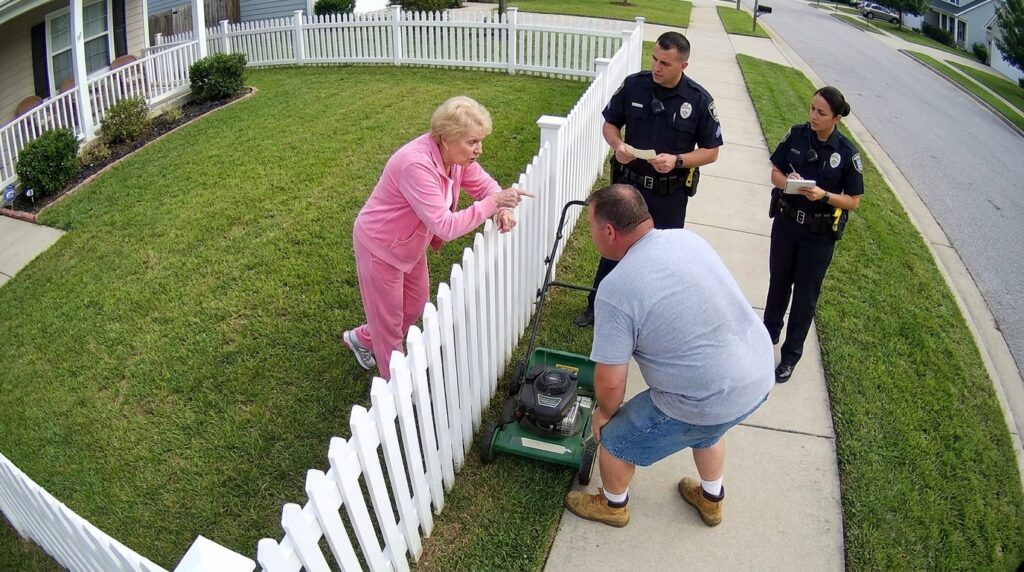
The sun didn’t shine on Elm Lane; it baked the moisture out of the dirt until the soil beneath the white pickets turned the color of spent ash. David didn’t look up when the screen door slammed. He kept his weight centered over the crossbar of the green push mower, his thumbs pressed against the worn black plastic of the throttle lever until the cable went taut. Under his boots, the narrow strip of grass outside the fence felt like dry wire. It was exactly twenty-two inches wide, a useless ribbon of city-owned dirt that sat between Evelyn’s white-painted pine pickets and the cracked concrete of the gutter.

To the rest of the block, it was nothing. To David, it was the final forty yards of a Tuesday shift that had already cost him an alternator belt and two gallons of sweat.

“You’re tracking that grey dust onto the lower tier!”

The voice came over the fence before her boots hit the turf. Evelyn didn’t walk down her steps; she descended them like an inspector tracking a violation through a warehouse floor. The bright pink synthetic fabric of her tracksuit swished with a dry, electric friction, the sound cutting through the low, mechanical idle of David’s truck parked twenty feet back. Her sunglasses—huge, dark discs that reflected the flat glare of the sky—stayed fixed on the left wheel of the mower. In her hand, a small plastic folder with a yellow notepad inside was clutched against her ribs like a shield.

David didn’t clear his throat. He dropped the throttle an inch, letting the blade rhythm settle into a heavy, dull thud against the hard-packed earth. “Afternoon, Mrs. Vance. Just clearing the easement line before the rain hits tonight.”

“The city doesn’t own the topsoil, David. My husband put those posts down in eighty-four, four feet into the limestone,” she said, her finger already rising, pointing straight at the rusted axle of his machine. Her silhouette was short, heavy-set, and unyielding against the backdrop of her immaculate porch. “You’re pulling the roots loose with that low deck. Look at that edge. That’s scalping.”

David looked down at the blade path. The cut was clean, five inches above the stone, leaving a dark, precise line that ran perfectly parallel to the bottom rail of her fence. He could feel the heat radiating off the white latex paint of her pickets—sharp, chemical, and close. His palm throbbed where the throttle wire had left its gray grease stain, but he didn’t lift his hands from the grips. If he let go now, the engine would die, and on a hot restart, the pull-cord would take another layer of skin off his knuckles.

“The deck is at standard county clearance, ma’am,” David said. His voice was flat, rhythmic, used to the cadence of complaints that came with three-dollar-a-foot maintenance contracts. He didn’t look her in the eye; he looked at the little gap between her two front teeth where the air hissed when she grew impatient. “The truck’s full. I’ve got two more blocks before the dump closes at six.”

Evelyn didn’t move from the gatepost. Her hand dipped into the pink pocket of her jacket, her knuckles turning white against the plastic casing of her phone. “We’ll see what the district supervisor says about the easement definition. I’ve already logged the noise signature from last Thursday.”

Behind her, across the asphalt lane, the curtains of number 417 shifted slightly, a pale face appearing for a second before the fabric settled back into the shadow. The block was watching, the way it always did when the pink tracksuit crossed the threshold.


CHAPTER 2: THE SPLIT GRAIN

“The local precinct has the license plate on file, David,” Evelyn said. Her voice didn’t rise in pitch; it simply hardened, a dry rattle like gravel shifting in a chute. She stepped closer to the white pickets, her knuckles brushing against the uncalibrated tension-spring of her side gate. The spring was a coil of oxidized iron, dark and flaking with rust that left a red-brown smudge against the bright pink sleeve of her tracksuit. “They know the registration for that flatbed. They know who owns the insurance on the deck.”

David didn’t look up from the green housing of the mower. He reached down with his right hand, his fingers tracking the grease-slicked casing of the throttle cable where it met the engine block. The heat off the cooling fins was direct, a dry wave that smelled of unwashed oil and old grass. “The plate’s current, Mrs. Vance. The county clerk handled the renewal back in January.”

He could hear the rhythmic click-shirr of her sandals on the concrete walkway inside the boundary line. She wasn’t just watching him; she was measuring the distance between his work boots and the lower rail of her fence. Every movement she made had the rigid, deliberate pacing of a property owner who believed the dirt beneath her feet was an extension of her own skin. Her shadow, distorted and long under the flat afternoon sun, stretched across the dry turf and touched the front wheel of his machine.

“The county clerk doesn’t clear code violations on residential frontage,” she countered, her thumb tapping the edge of her yellow notepad. The plastic folder clicked against her ribs. “The ordinance is clear about commercial operations within four feet of a historical structure. This fence is pine, David. Selected heart-pine. Every time that deck throws a flint, it pits the grain. I have three separate gouges near the corner post from your crew’s work last month.”

“My crew hasn’t touched the north corner since April,” David said. His tone remained low, locked into the steady, unhurried cadence of a man who knew that any spike in his volume would be logged as a threat in her next call to the city. He shifted his grip on the mower handle, his calloused palm catching on the split rubber of the left grip. “And that’s not flint damage, ma’am. That’s dry rot from the gutter leak at the back of your garage. The runoff drops right into the post footings.”

Evelyn stopped. Her mouth thinned into a pale line, her chin tilting upward until the large, dark discs of her sunglasses caught the glare of his truck’s cracked windshield across the lane. “My gutters are copper, installed by Miller’s boys before the zoning changed. They don’t leak.”

“They’re backing up because the oak over the driveway drops its mast every October,” David muttered. He didn’t say it to provoke her; it was simply a structural fact, one of fifty micro-details he’d mapped over three years of working the block. He knew which porches had soft joists, which driveways were cracking from silver maple roots, and exactly which yards would flood if the storm drain at the corner took more than an inch of rain in an hour.

He reached into his back pocket, his fingers brushing the sweat-dampened edge of his layout folder. Inside, beneath the carbon copies of his billing receipts, sat a copied page from the 1998 municipal surveyor’s index—a piece of paper he’d pulled from the county records office when the first harassment notices started arriving at his house. He didn’t pull it out yet. The time wasn’t right. In his business, you didn’t show your hand while the customer was still trying to find their glasses.

Evelyn’s phone chimed once in her pocket—a sharp, digital bird-chirp that broke the low rumble of a distant cement mixer three streets over. She didn’t look at the screen. She kept her eyes on the narrow strip of grass, her face tightening as she watched a tiny line of black ants swarm over a split section of the lower fence rail.

“The police cruiser just cleared the bypass on Route 4,” she said, her voice dropping into a flat, satisfied register. She adjusted the collar of her pink tracksuit, the synthetic fabric whispering against her throat. “Officer Miller knows this block. He knows what happens to the property values when independent rigs start treating the easement like a commercial staging area.”

David finally let go of the throttle. The engine died with a wet, heavy cough, the blade spinning down until the silence of Elm Lane rushed back into the gap. The metal shroud of the mower began to tick as the heat expanded against the steel casing. He stood up straight, his spine popping twice under his gray shirt.

“Let ’em come,” David said, his boots settling into the dry crabgrass right at the edge of the concrete curb. “The line’s exactly where it was last Tuesday, Mrs. Vance. It hasn’t moved an inch toward your house.”

Across the street, the front door of number 417 clicked open. A heavy-set man in an grease-stained undershirt stepped out onto the porch, a cold can of soda in his hand, his eyes locked onto the pink tracksuit standing at the white picket fence line. The neighborhood audience was setting its anchors.

CHAPTER 3: THE STRAP AND THE BELT

The crown of Elm Lane didn’t favor heavy vehicles; it forced the twin black-and-white cruisers to roll in a single, low-geared file, their front suspensions dipping into the deep limestone ruts near the sewer inlet. The lead car stopped ten feet short of David’s flatbed truck, its low-frequency engine vibration sending a microscopic ripple across the puddle of stagnant coolant in the gutter.

Officer Miller emerged first. His boots made a dense, administrative crunch against the sun-checked gravel of the shoulder. The heavy polyester of his dark patrol uniform didn’t give under the midday heat; it looked rigid, holding a faint line of white salt ringed around the armpits from three hours of traffic detail on the bypass. His utility belt clinked with every second stride—the specific, heavy-gauge metallic thud of steel handcuffs bouncing against a tactical radio case. Behind him, Officer Davis stayed half a step to the rear, her eyes already tracking the perimeter of the lawn, her fingers loosely hooked over the stiff rim of her carbon-fiber clipboard.

“Afternoon,” Miller said. He didn’t unclip his holster strap, but his right hand came to rest naturally on the thick nylon web-belt just above it. His eyes ran over the green push mower, noting the exact position of the rear rubber tires against the concrete lip of the curb. “Dispatch logged a criminal trespass call for number four-fourteen. Said there was a contractor refuse-to-leave situation.”

Evelyn didn’t wait for David to answer. She cleared the latch of the side gate with a violent, synthetic jerk of her pink sleeve, her knuckles catching the flaking rust of the tension spring. “He’s been told twice since twelve o’clock, Officer. The property line runs straight through the curb-cut. He knows the ordinance on commercial noise limits after noon on a municipal holiday.”

David kept his palms flat against the rubber grips of the dead mower. The steel shroud under his fingers was still ticking, radiating the sour smell of burnt oil and cut dandelions into the space between his chest and the fence. “The crew has three hours left on the easement permit, Officer Miller. I showed her the stamped county authorization before we unloaded the decks.”

Miller looked from David’s sweat-stained gray cotton shirt down to the narrow, twenty-two-inch ribbon of crabgrass where the machine sat. His face stayed dry, fixed in that flat, unreadable mask common to county deputies who spent their days sorting out border disputes between retirees and utility crews. He tapped the paper note in his hand against his thigh. “Mrs. Vance, let’s hold on the permit for a second. Show us exactly where you say he crossed the fence line with the machinery.”

David watched Evelyn’s mouth tighten until her lips looked like two thin pieces of twine. She took half a step forward, her oversized designer sunglasses sliding down the bridge of her nose from the sudden heat. She pointed a short, thick finger over the top rail of the white picket fence, her hand shaking slightly against the glare of the wood.

“He ran the left wheel clear through the turf under the third panel,” she said, her voice dropping into that rhythmic, practiced tone she used when quoting neighborhood association bylaws. “The tire impressions are right there in the clover. He took four inches off the root system of my perennial border.”

Davis leaned forward, her tactical boots shifting into the dry grass right beside the concrete gutter. She didn’t speak, but her clipboard clip gave a loud, metallic clack as she flipped the top carbon sheet over. Her eyes didn’t look at the clover; they looked at the vertical plane where the fence pickets met the open air.

David reached into his back pocket, his thick thumb catching on the frayed denim seam. He could feel the cold edge of his layout folder, the crisp paper of the 1998 survey map waiting against his hip. He didn’t draw it. He stayed still, watching Miller walk the length of the third panel, his black leather shoes leaving zero marks on the hard, flinty earth outside the wood.

“There’s no fresh tread mark in the clover, Mrs. Vance,” Miller said. He didn’t look up when he spoke; he stayed bent at the waist, his fingers tracing the exact line where the wild dandelions grew unmanaged through the bottom slot of her fence. “The only tracks out here are from the push-reel, and they’re sitting solid on the city side of the timber.”

“He backed it up when he heard the sirens,” Evelyn snapped, her pink tracksuit rustling like dry paper as she squared her shoulders against the gatepost. “He knows the layout. He’s been trying to force this easement line since my husband passed.”

Miller stood up slow, his knee joints making a dry pop that seemed to echo in the quiet of Elm Lane. He looked across the street at number 417, where the man in the grease-stained undershirt was now leaning over his porch railing, openly watching the three-way huddle at the gate. The sun was hitting the peak of the block now, drawing the sharp smell of hot asphalt out of the ruts.

“Davis,” Miller said, his voice dropping into a lower register. “Pull the county drainage ledger for this block on the terminal. Let’s see what the easement width actually says before we start logging an infraction.”

Davis didn’t nod. She simply turned her back to the fence, her thumb already working the rubber keys of her handheld unit, the small blue screen throwing a cold, artificial light against her chin while the sun baked the white latex on the pickets three feet away.

CHAPTER 4: THE MEASURED BOUNDARY

The heat didn’t dissipate; it seemed to collect in the four-inch gap between the bottom rail of the picket fence and the hard-packed gravel of the shoulder. David didn’t shift his weight from the mower grips, but his right hand dropped away from the rubber sleeve, his fingers catching on the metal corner of his work folder. The plastic skin of the binder was slick with sweat and ground-in lawn dust, smelling of stale diesel and ancient leather.

“Davis,” Miller called out again, his eyes remaining fixed on the line of undisturbed dandelions. “What’s the ledger showing for the frontage on four-fourteen?”

Officer Davis didn’t look up immediately from the blue terminal screen. Her thumb hit a plastic key with a dry, rhythmic click that echoed against the white pine pickets of Evelyn’s fence. “Ledger shows a modification entry from June of ninety-eight, Miller. There’s a three-foot right-of-way easement from the center crown of Elm Lane for municipal utilities and drainage maintenance. It overrides the original deed description.”

Evelyn’s frame went perfectly rigid inside the bright pink tracksuit. The synthetic fabric didn’t rustle this time; it stayed taut over her shoulders as she leaned further across the pointed wooden pickets, her hand tightening around the flaking coil of the gate’s tension spring until a small line of red iron rust smeared into her skin. “That entry was for the culvert expansion, Officer. It didn’t authorize commercial machinery to tear up the sod. My husband paid the county assessment fee to clear that title back before the turn of the century.”

“The assessment paid for the concrete curb-cut, ma’am, not the dirt,” David said. His voice was low, flat, matching the steady, indifferent rhythm of his boots against the parched grass. He pulled the layout folder from his pocket, the gray carbon paper crinkling between his calloused fingers. He didn’t offer it to Evelyn; he held it out horizontally toward Miller’s clipboard. “This is the ninety-eight plot index from the county recorder’s office. Look at the western anchor. The Vance property line doesn’t terminate at the grass edge. It stops four inches inside the fence frame.”

Miller took the sheet, his heavy thumb leaving a gray smudge across the edge of the photocopied layout. He squinted against the glare of the noon sun, his boots shifting slightly until his heel hit a small, iron surveyor’s tack buried under three seasons of rotting leaf mold at the base of the corner post. The metal tack was pitted, dark with corrosion, its square head stamped with the county’s identification mark.

Evelyn looked down at the paper in Miller’s hand, her large, dark sunglasses slipping another notch down her nose. Her mouth worked silently for a second, her chin twitching as she glanced across the lane at number 417. The man in the grease-stained undershirt had stepped off his porch now, his work boots clearing the gravel of his own driveway as he moved closer to the road to hear the exchange.

“That paper is twenty-eight years old,” Evelyn said, her voice thinning into a sharp, whistling register that cut through the low rumble of the distant cement truck. “It’s a draft. It doesn’t have the final seal from the district engineer.”

“It’s got the digital locator stamp from the county surveyor, Mrs. Vance,” Davis said, her voice flat and professional as she stepped closer to the gatepost. She adjusted her grip on her carbon-fiber clipboard, the heavy zinc clip rattling once against the edge of her notepad. “And according to the terminal’s tax map, the easement isn’t just for drainage. The county has an active infrastructure hold on this entire three-foot strip. The push mower isn’t the problem here.”

David watched Miller’s face. The deputy wasn’t looking at the dandelions anymore; he was looking at the actual posts of the white picket fence, tracing the way the weathered pine frames bowed outward toward the concrete curb by an extra two inches near the water meter box. The structural reality of the block was shifting under their feet, the clean geometry of Evelyn’s private sanctuary dissolving into a mess of public utility codes and old county giveaways.

“Hold on,” Miller muttered, his fingers tracing the edge of the surveyor’s tack at his boot heel. He didn’t look at Evelyn; he looked at David’s stained gray shirt, his eyes narrowing as he calculated the physical space between the mower’s left tire and the wooden pickets. “If the ninety-eight map holds, this whole barrier isn’t just on the easement line. It’s sitting over the legal boundary by a solid four inches.”

David kept his jaw locked. He knew what was on page two of that folder—the part he hadn’t mentioned yet, the layer of municipal logic that his dad had warned him never to use unless the county was already on-site with a backhoe. He didn’t push the point. He let the silence settle back over the narrow strip of grass, the heat from his dead engine still rising in greasy waves against the white latex paint of the pickets.

Evelyn didn’t move, but her fingers slowly slipped off the rusted tension spring of the gate, leaving a dirty, dark orange outline on the bright pink cuff of her sleeve. Her eyes stayed locked on the photocopied map, her expression freezing as she realized the officers weren’t looking for tire tracks anymore—they were looking at her house.

CHAPTER 5: THE BLUEPRINT IN THE TRUCK

The metal teeth of the canvas tool bag didn’t slide cleanly; they ground against three seasons of dried grass mulch and pulverized gravel before the zipper parted. David reached into the dark interior of the truck bed, his fingers bypassing the heavy iron socket wrenches until they closed around the cold cylinder of an ungalvanized tin map tube. The metal was dull, smelling of damp scale and the stale grease he used to keep his string-trimmers from binding.

“Officer Miller,” David said, his voice flat as he stepped back down to the dusty shoulder. His heavy leather work boots kicked up a small puff of dry limestone dust that settled over the mower’s green deck. He unfastened the plastic cap of the tube with his thumb. “If you’re checking the ninety-eight ledger, you need to look at the utility attachment from October of that same year. My dad didn’t just keep the billing records. He kept the engineering variance for the main water header.”

He pulled out the rolled blueprint, the thick, heavy stock uncoiling with a stiff, rhythmic snap between his grease-stained hands. The paper was sun-faded at the margins, its clean white gridlines cutting through a field of deep blueprint blue. He flattened the page against the hood of his truck, using a rusted iron coupler block to hold down the top edge while his calloused palm smoothed out the lower seam.

Officer Miller walked away from the white picket fence line, the leather casing of his utility belt creaking as his stride widened. He leaned over the truck’s rusted side panel, his eyes following David’s blunt index finger as it stopped at a small red-ink circle marked Lot 414-B.

“This is the municipal sewer tie-in line from the old construction,” David muttered, his finger tracing a heavy black line that ran completely beneath the grass strip where his push mower sat. “When Mr. Vance signed the drainage release to avoid the city’s back-conduit suit, he didn’t just give up the right-of-way. He accepted a municipal indemnity clause. The county didn’t just take the twenty-two inches outside the pickets. They took the whole structural footing path to maintain the main junction box.”

Evelyn didn’t move from the gatepost, but her short, compact frame seemed to shrink down into the bright pink collar of her tracksuit. She didn’t look at the blueprint across the road; she looked at Officer Davis, whose thumb was still tapping out commands into the blue light of the handheld terminal.

“That folder belongs to the Vance estate,” Evelyn said, her voice rising into a sharp, dry rattle that lacked its previous administrative weight. Her hand remained clutched against her yellow notepad, but the plastic folder was shaking slightly against her ribs. “My husband’s lawyers cleared that engineering attachment before the secondary subdivision was logged. It’s an extinct easement.”

“It’s not extinct, Mrs. Vance,” Davis said, her voice cutting through the flat glare of the street with a cold, professional finality. She stopped tapping the terminal screen. Her eyes lifted, tracking the vertical line of the white pine pickets where they bowed out toward the concrete gutter by the water meter box. “The system log shows the water district verified this junction three months ago during the main line pressure drop. The county’s property assessment office has this fence marked as a non-conforming temporary obstruction. The code enforcement notice was sent to your billing address in April.”

David watched the way the large, dark discs of Evelyn’s sunglasses reflected the gray shape of his truck. She didn’t answer. Her jaw worked silently, her teeth clicking together once with a small, dry sound like two pieces of flint hitting in a pocket.

Across the lane, the man in the grease-stained undershirt had crossed his driveway completely, his heavy boots resting on the asphalt as he leaned forward to see the blueprint on the hood. Two more neighbors from number 412 had stepped out onto their front lawn, their faces pale under the bright noon sun, their eyes locked onto the two black-and-white patrol cars containing the block.

Miller reached down, his fingers catching the brass grommet at the corner of David’s blueprint. He lifted the page slightly, his eyes narrowing as he cross-referenced the technical drawings with the actual layout of the white picket fence ten feet away. The truth wasn’t hidden in the documents anymore; it was written in the physical overgrowth of the grass and the four-inch encroachment of the wooden posts into the city’s right-of-way.

“So the fence isn’t just sitting on the line,” Miller said, his tone dropping into that quiet, transactional register used when an infraction transitions from a neighborhood dispute to a county code liability. He looked back over his shoulder at Evelyn, his hand dropping to his utility belt. “It’s sitting clear inside the utility path. If the district brings the service rig down here to clear the main box, this whole timber section has to come down by noon tomorrow.”

David didn’t offer a victory. He stayed silent, his palm resting on the rusted iron coupler block, the rough texture of the metal cutting into his grease-slicked skin while the heat off his truck’s engine shroud continued to bake the dry air of the block. He had the proof, but the weight of the land lines felt heavier than the machine he’d been pushing all day.

CHAPTER 6: THE CITATION LINE

“Ma’am, calling nine-one-one because a contractor is working on a public sidewalk strip is an automatic citation next time.”

Officer Miller didn’t raise his hands from his utility belt. He took a single, dense step forward, his heavy leather sole flattening a dried clump of clay at the base of the gatepost. The clink of his handcuffs against the radio casing was sharp, a professional, heavy sound that settled the remaining air on Elm Lane. He looked through the wooden pickets at Evelyn, his reflection clear and miniature in the dark discs of her sunglasses.

“The log is clear,” Miller continued, his voice matching the dry, relentless scrape of the wind through the telephone lines overhead. “This structure is blocking a secondary county water loop. If you don’t clear the obstruction within forty-eight hours, the city sends a contract crew with a skid-steer to pull the footings. They charge by the hour, Mrs. Vance, and they don’t save the pickets.”

Evelyn didn’t move for three long seconds. Her hand stayed clamped to the yellow notepad folder, the plastic edges digging into the synthetic bright pink fabric of her sleeve until the knuckles showed white under the noon glare. The electric swish of her tracksuit was gone; she stood entirely frozen against the backdrop of her clean white porch steps. Then, slowly, her fingers released their grip on the rusted iron tension spring.

“The original deed,” she began, but her voice lacked its administrative whistle. It was small, dry, the tone of someone realizing the foundation beneath her boots was made of loose gravel. “My husband always kept the ledger…”

“Your husband signed the county waiver in October of ninety-eight, ma’am,” Officer Davis said from behind her carbon-fiber clipboard. She didn’t drop her gaze from the terminal screen. “It’s coded into the section line. The city owns the title to everything up to four inches behind these posts. This contractor isn’t trespassing on your property. Your fence is trespassing on his workspace.”

David reached down and wrapped both calloused hands around the rubber sleeves of the mower grips. The steel housing had stopped ticking, the metal cooling into a dull, grey sheen under the overhead heat. His palm still carried the dark grease indentation from the throttle cable, but the throbbing had settled into a steady, blunt ache. He didn’t look at Evelyn to witness the retreat. He looked down the long, unclipped ribbon of turf that ran toward the corner drain, calculating the remaining gas in his tank.

Across the asphalt, the man in the grease-stained undershirt slowly let go of the porch railing. He didn’t say anything, but he caught David’s eye across the divide and gave a single, slow nod of his head before turning back toward his screen door. The two neighbors from number 412 remained on their lawn, their faces shadowless under the high sun, watching the pink tracksuit turn away from the gate.

Evelyn retreated one step at a time. Her sandals made a faint, hollow slap against the concrete path inside her yard. She didn’t take off the oversized sunglasses, keeping her face guarded behind the dark plastic frames as she reached for the handle of her front door. The white picket fence stood between them, no longer an unyielding barrier of private domain, but a temporary wooden line scheduled for the county’s crowbars.

Miller watched her screen door click shut before he turned back to the flatbed truck. He handed the rolled blueprint back to David, his thumb leaving a final, gray smudge of road grime near the bottom margin. “Keep that map in the cab, David. Next time you clear this block, you run the deck straight through to the utility box. The line’s established.”

“Understood, Officer,” David said. He slid the tin tube back into the canvas tool liner, the metal teeth of the zipper closing with a heavy, dry crunch that ended the dispute.

He stepped over the concrete curb, his boots settling into the thin strip of crabgrass. He yanked the pull-cord once, the engine catching with a throbbing, iron roar that filled the empty spaces of Elm Lane with the smell of fresh oil and pulverized dandelions. David leaned his weight into the crossbar, his thumbs locking the throttle open as the machine moved forward along the exact, measured boundary of the curb.

Similar Posts

Leave a Reply

Your email address will not be published. Required fields are marked *






