The Heavy Cost of Quiet Ground: A Narrative of Fences, Friction, and Sovereign Restraint
CHAPTER 1: THE ORANGE STITCH
The heat in the valley didn’t move; it just sat on the asphalt until the tar went soft enough to hold a boot-heel print. Frank wiped his palm against the thigh of his dark shorts, leaving a grease smear that joined three others from the morning’s oil change. The anonymous orange card was still there, stapled exactly eye-high against the graying cedar of the mailbox post. Failure to mitigate nuisance vegetation. Section 40-B. The staples were clean, unrusted silver. They hadn’t been in the wood more than four hours.
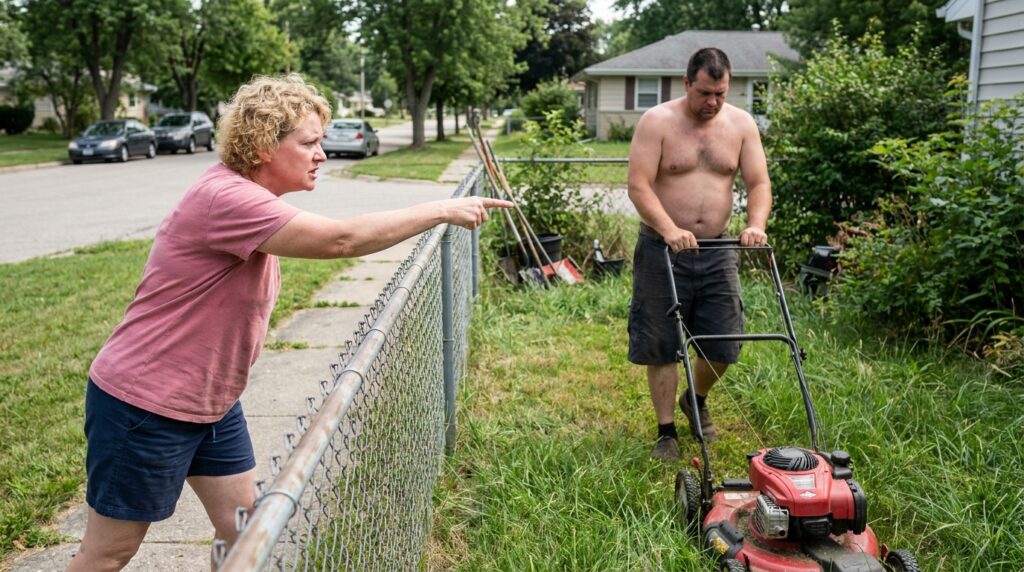
He didn’t pull the card down. If he took it off, the city clerk would just send a white sedan with a digital camera to take another set of verification frames from the curb. Instead, Frank walked back through the gap where the gate used to hang before the hinge pins sheared during the winter freeze. The front lawn was a dense, shaggy mat of dandelion heads and crabgrass that had gone to seed after five days of straight rain. It looked exactly like what it was—the property of a man who spent ten hours a day inside the cab of a flatbed diesel, leaving his own dirt to take care of itself until the weekend.
The pull-cord on the old Briggs engine was frayed down to the core thread near the rubber handle. Frank wrapped the nylon twice around his knuckles, set his left work boot against the steel deck of the mower, and yanked. The pulley groaned, a metallic rasp of dry bearings against iron, but the cylinder stayed dead. Across the narrow gravel driveway, a white vinyl slat blind in the side window of the green house twitched. It didn’t lift; it just parted wide enough to show a sliver of pink fabric and the dull reflection of a pair of oversized plastic sunglasses.
He didn’t look up. He knew the rhythm of that house better than he knew his own schedule. He knew when the water ran through the copper pipes in the wall, and he knew exactly how long the kitchen light stayed on after the local news ended at eleven.
On the third pull, the engine caught with a wet, heavy cough. The vibration traveled instantly through the black foam padding of the handlebar, hitting the bones of his wrists with a numbing, rhythmic ache that he could feel all the way behind his ears. The machine smelled of grass juice and scorched oil, the blade beneath the deck turning the dense green stalks into a wet spray that crusted against his bare shins.
He engaged the drive lever. The mower lurched forward, its front wheels sinking into a hidden dip where an old elm root had rotted out five years back. He held the machine straight by pure leverage, his back muscles tightening against the pull as he steered the first long swath down the western line, right toward the low, sagging run of chain-link fence that kept his weeds from her gravel.
As the wheels came within six inches of the iron posts, he saw the edge of her shoe. A white tennis sneaker, spotless except for a single yellow stain near the rubber toe-cap, planted flat against the narrow strip of public concrete on the other side of the wire.

CHAPTER 2: THE UNCOVERED STAKE
“You’re tracking that grease right up to the post, Frank.”
The voice didn’t come from the sidewalk; it came from the shadow of the garage overhang where the light didn’t hit the siding. Evelyn hadn’t moved three inches from the corner of her property line, but her arm was already lifting, the sleeve of her pink shirt rustling with a dry, synthetic sound like a dead leaf dragging across concrete. Her oversized sunglasses caught the white glare of the afternoon sky, turning her eyes into two flat, dark discs that reflected the outline of the lawnmower.
Frank kept his thumb clamped down on the safety bar. The engine hummed at a low, laboring idle, the deck vibrating against his boots until his shins felt numb. He didn’t lift his head all the way—just enough to clear the brim of his greasy cap. “The post is on my side of the ditch, Evelyn. Three inches inside the zinc line.”
“It was,” she said. Her voice had the thin, scraped quality of someone who had spent the morning talking to a city recorder over a bad landline. “Until you ran the heavy truck over the culvert back in April. You shifted the grade. The surveyor’s marker doesn’t lie, even if the person holding the title does.”
She stepped forward, her white tennis sneakers crunching into the dry, decorative river rock she’d dumped along the chain-link barrier to keep his dandelions from creeping across. In her right hand, she wasn’t holding a phone or a notice; she had a short, heavy length of broken rebar she used for staking her hydrangeas. She used it now to point down into the yellowed ditch where the grass met the gravel.
Frank looked where the iron pointed. Ten feet down the line, near the rotten base of the corner post, the earth had been freshly disturbed. Someone had taken a garden trowel to the sod, peeling back a three-inch square of crabgrass to expose the grey clay beneath. In the center of the small clearance, a square iron stake—rusted down to a dark, flaky orange—shone where something hard had recently struck it. The top of the metal was scarred with bright, silver grooves, the kind left by a structural hammer or a pry bar trying to force a wedge between the property boundaries.
“The city didn’t do that,” Frank said, his voice flat as a grease-plank.
“The city doesn’t have to,” Evelyn snapped, her posture tightening until her shoulders rose toward her ears. She leaned her hip against the top rail of the chain-link, her weight causing the wire mesh to groan against its aluminum ties. The heat between them smelled of scorched cylinder oil and the stagnant water sitting at the bottom of the culvert ditch. “The city takes the report and they look at the map. I know what’s under this dirt, Frank. My husband set those pins when the foundation here was still wet. You think because you own a truck you can just push three feet into the gravel whenever you have a delivery?”
Frank felt the small of his back ache from the five-hour haul he’d finished at dawn. He looked at the silver scars on the ancient iron stake. They were fresh—no rust had formed in the grooves yet, and the loose clay around the metal was still damp from being turned over within the hour. A real surveyor didn’t leave a stake look like it had been beaten with a tire iron. Someone had been looking for the true corner marker, and they hadn’t been careful about what they used to find it.
“The gravel hasn’t moved,” Frank said, his knuckles locking tighter around the black foam handlebar. “And your driveway is exactly where it was when the bank signed the papers.”
Evelyn let out a short, dry laugh that didn’t change the expression behind her dark lenses. She raised the rebar three inches, her index finger extending along the rusted steel like a barrel. “The bank doesn’t live here. I do. And you’re going to find out exactly how much this street costs if you keep that machine running against my fence.”
She turned her back to him before he could answer, her short blonde curls catching the harsh light as she marched three steps up her concrete walkway. But she didn’t go inside. She stopped on the top step, her clipboard resting against her hip, her fingers tapping a rhythmic, impatient beat against the yellow paper tucked under the clip.
Frank shifted his weight, his boots digging into the cut grass. The engine gave a short, sputtering rattle as a clump of wet clover jammed the chute, but he didn’t clear it. He looked back down at the exposed orange iron in the ditch. The tool marks were deep. Whoever had struck that pin wasn’t trying to measure the property—they were trying to verify how far down the metal went before it hit something solid beneath the dirt. He could see the pale white edge of an old plastic sheet sticking out from the side of the hole she had dug, its synthetic corner buried deep under the gravel lane where her husband had parked his old station wagon twenty years ago.
The white blind in her side window twitched again. Frank looked up, catching the briefest glimpse of a second pair of hands smoothing the vinyl slats back into place. They weren’t Evelyn’s hands; the fingers were thick, blunt-tipped, and gray with the kind of grease that didn’t come off without volcanic soap.
CHAPTER 3: THE CALLED MARCH
The blinds snapped shut before the grease-coated fingers could retreat fully into the dark of the kitchen. A heavy wooden frame dropped against the sill inside her house, a solid, blunt sound that didn’t carry past the low vibration of the Briggs cylinder but reached Frank through the soles of his boots.
Evelyn was still standing on her top step, her back to him, her fingers performing that same small, nervous dance against the corner of her aluminum clipboard. She hadn’t heard the drop of the frame inside, or if she had, she was pretending the noise belonged to the wind chimes hanging from her porch rail. The sun caught the back of her pink shirt, turning the cheap polyester into a glaring shield that forced Frank to keep his eyes fixed on the graying wood of his own gatepost.
“You’ve got company, Evelyn,” Frank said. He didn’t raise his voice. He let the flat weight of the vowels ride under the mechanical hum of the mower, steady enough to reach her but low enough that the passing mail truck wouldn’t catch it.
She didn’t turn around immediately. She took her time, adjusting the sunglasses until the wide rims were perfectly aligned with the line of her jaw. When she did look back over her shoulder, her heels didn’t shift from the lip of the concrete step. “The people who come to this house are none of your concern, Frank. Not until they’re legal representatives of the municipality. And they will be.”
“The city doesn’t usually wear eight-inch mechanic’s boots,” Frank said. He looked down at the gravel lane that ran between their properties, tracing the tire tracks left by a vehicle heavier than her old four-cylinder compact. The stone was deeply rutted near the rear of her garage, the gray gravel pushed aside to reveal the oily black soil beneath. “And they don’t usually park an unbadged dually truck in the alley with the plates scraped down to the zinc.”
A slight twitch caught the corner of her mouth, the tight muscle pulling her lip thin against her teeth. She dropped her clipboard to her side, her thumb hooking into the metal clip with enough force to turn the knuckle white. “I told you to turn that machine off, Frank. The ordinance says noon until five on weekends, and you’re five minutes past the line.”
Frank checked the heavy steel watch on his wrist. The crystal was scratched from three years of scraping against truck frames, but the numbers were clear under the glare. It was four in the afternoon. She was cutting an hour off the clock because she needed the quiet to hear whatever was happening inside her kitchen.
Instead of letting go of the throttle, he pushed the machine three feet forward, the front wheels crunching into the dry river rock she had laid out. The blade hit a stray piece of limestone, spitting a gray puff of pulverized mineral out the side chute. The small rock struck the lower wire of the chain-link fence with a sharp ping that made her jump.
“You’re destroying property now,” she said, her voice rising an octave as she took two fast, calculated steps down her walkway. Her sneakers clicked hard against the concrete, her body leaning forward until her silhouette broke the clean horizontal line of the fence. “I have a camera on the corner of the eave, Frank. I have every single time you’ve let your weeds touch my wire recorded on a hard drive.”
“The camera’s missing its lens, Evelyn,” Frank said. He leaned his weight back against the handlebar, stopping the machine exactly two inches short of the rusted iron stake she had uncovered. “It’s been dead since the ice storm two winters back. The housing is full of mud-wasp nests. We both know it.”
She stopped on the sidewalk edge, her toes right against the zinc links. Her face was less than four feet from his now, the heat radiating off her pink shirt carrying the sharp, sweet smell of floral detergent and sour sweat. She looked down at the square iron pin in the dirt, then up at his chest, her pointed finger rising until the tip of her nail was aligned with the center of his collarbone.
“You think you’re smart because you drive a truck for the county,” she whispered. The shouting tone was gone, replaced by a tight, rattling hiss that barely cleared the fence. “You think you can just look at a man’s yard and decide where the town ends. My husband gave forty years to the refinery down the river. He knew exactly what this ground could take before it gave out. You keep running that blade over his stakes, and you’re going to pull up something you can’t afford to bury.”
Frank didn’t move his hands from the foam grip. He let his thumbs stay locked over the bar, his eyes dropping from her sunglasses down to the small square of exposed gray clay around the rusted marker. The white edge of the buried plastic sheet was wider now, exposed by the stone he had displaced. It wasn’t a garbage bag. It had a heavy, woven texture like the reinforced tarp they used to cover fuel tanks during a winter teardown.
From inside her house, the sound of a heavy metal latch clicking into place echoed through the side window. A second later, the scent of stale diesel oil and old tank bottom—thick, sulfurous, and chemical—drifted out through the loose screen, overriding the smell of the cut grass.
CHAPTER 4: THE THIN WIRE GATE
The chemical odor didn’t dissolve in the heat; it went greasy, hanging over the top rail of the fence like a wet blanket. Evelyn took one more step forward, her white tennis shoes sliding an inch into the loose river stone until her dark shorts pressed directly against the galvanized wire mesh. The links groaned, a thin, metallic screech of steel twisting against steel that vibrated straight through Frank’s forearms where his hands were still locked onto the mower’s foam handle.
She snapped her arm up into a sharp, rigid line. Her index finger breached the vertical plane of the fence, pointing straight at his bare, sweat-streaked chest. The shadow of her hand fell over the vibrating steel deck of the Briggs engine.
“You don’t get to act like you know my situation!”
Her scream came out thin, cracking at the edge under the flat weight of the noon sun. She had to throw her head back to project past the steady mechanical rattle of the blades slicing through the crabgrass near her feet. Behind her oversized plastic lenses, her cheeks had gone the color of a wet brick, the skin around her mouth pinched into a grey circle.
Frank didn’t drop the drive safety. He kept his feet planted in the shaggy sod, his back arched slightly to take the strain of the engine’s pull. His gaze stayed fixed on the lower lip of the mower’s steel deck, watching a green slurry of ground dandelion leaves and dry gray soil spill out against the bottom of the wire barrier. He didn’t blink. He didn’t match the hitch in her breath. He treated her voice like a broken fan belt on the truck—something that made noise but didn’t alter the route.
“The situation is twenty-eight feet of legal frontage, Evelyn,” he said, keeping the words clipped and flat inside the lower register of the mechanical hum. “And the front left tire of that unbadged dually in your alley is currently sitting on three inches of my culvert tile.”
“You have no right to talk about what’s in my alley!” Her hand shook, the pointed finger dropping to aim at the rusted square pin in the clay ditch between them. “My husband spent forty years making sure this ground stayed clean. You think you can just run your heavy machinery right up to the line and rattle everything loose? Look at it! Look at what you’re doing to the stone!”
She wasn’t looking at the stone. She was looking over her shoulder toward the corner of her garage where the dark ruts in the gravel led back to the alleyway. The sulfurous, heavy stink of old bottom-tank sludge was growing thicker now, drifting out from the kitchen screen door in regular, hot drafts as if someone inside had opened an access hatch. It was the smell of a terminal cleanout—the kind of black, toxic muck that settled at the bottom of a home heating reservoir after thirty years of slow condensation.
Frank shifted his grip by a fraction of an inch, his thumbs numbing under the steady pulse of the handle. He saw her glance back toward the vinyl blinds. They were still drawn, but one of the slats had been broken entirely, leaving a one-inch gap of dark glass where the thick, grease-stained fingers had parted the plastic. Whoever was inside wasn’t moving. They were waiting for her to finish the scene at the curb.
“I’m finishing the line,” Frank said. He eased the mower six inches forward, the steel deck scraping against a protruding knot of chain-link wire with a dry, screeching slide.
“You aren’t finishing anything!” Evelyn’s voice went wide, her torso pivoting away from the fence with a sudden, violent twist that pulled her shirt tight across her shoulder blades. She threw her right hand down the length of the concrete sidewalk, her open palm sweeping toward the empty, sun-bleached street as if addressing a courtroom of empty parked cars and silent asphalt. “You have no idea what I deal with here! None of you do!”
She was shouting at the empty porches down the block now, her face turned toward the glare of the street while her heel remained locked against his property marker. The performance was too big for the yard; she was begging for a window to open or a screen door to slam somewhere across the street—anything to give her an audience that would turn her private panic into a neighborhood emergency.
But the block stayed dead. The only movement was the heat shimmer rising off the roofs of the sedans parked along the curb and the low, heavy thrum of the engine between Frank’s hands. She stood there with her arm extended toward the empty concrete, her breath coming in short, rattling gasps that smelled of stale coffee and mints, completely isolated in the middle of her own drama.
Frank watched the way her shoulder dropped when the silence didn’t break. The performative stiffness left her spine first, her arm sinking six inches until her hand was just hovering over the dry river rock. She was running out of script.
He let his fingers slacken on the deadman lever. The ignition wire grounded out instantly, and the loud mechanical roar of the Briggs engine died in a succession of three heavy, metallic coughs. The sudden drop in sound left her last word hanging in the air like dust—unsupported, loud, and entirely too raw for a Saturday afternoon.
Frank lifted his head all the way, the brim of his greasy cap clearing his eyes. He looked straight through her dark lenses, his face expressionless under the white light.
“Alright,” he said, his voice flat and unbothered as an invoice. “I hear you.”
CHAPTER 5: THE VACUUM SEAM
The silence didn’t settle smoothly; it dropped onto the block like a slab of wet concrete. Evelyn’s hand stayed frozen in the empty air, her fingers hooked slightly as if she were still trying to clamp onto the tail end of the scream that Frank had cut short. Her shoulders dropped three inches, the cheap pink polyester of her shirt wrinkling around the collar under the flat glare of the sky.
“You don’t listen,” she said. Her voice didn’t have the volume anymore; it was down to a gravelly rasp that barely cleared the zinc links between them. “You never did. Your father was the same way when he put the gravel in. Just took what he wanted and let the rest of us look at the fence.”
Frank didn’t shift his boots from the grass. He reached down, his fingers catching the zinc-coated cap of the corner post right above the excavated iron stake. The metal was burning hot from four hours of unshaded sun, the rough protective coating biting into the callus of his palm. As he braced his weight against the pipe to stand up straight, the top cap spun loosely under his hand. It wasn’t welded. It wasn’t even pinned.
He lifted the metal disk two inches. Inside the hollow core of the galvanized pipe, jammed tight against the inner rust scale, was a cylinder of yellowed paper protected by a sleeve of heavy, transparent fuel-line plastic. The edges of the roll were charred dark, down to a brittle, flaking charcoal color where the heat of the summer pipe had baked the paper for decades.
Before he could pull the plastic sleeve from the post, a heavy mechanical thud rattled the gravel lane behind Evelyn’s garage. It was the distinct iron-on-iron clang of a truck tailgate being dropped without its chains, followed immediately by the wet, rhythmic thumping of a high-pressure diaphragm pump cutting into gear.
Evelyn didn’t look back toward the noise. Her jaw went completely rigid, her teeth clicking together behind her lips with a fast, nervous snap. She leaned her entire weight against the top rail of the chain-link, her fingers hooking through the mesh until the wire pinched her skin into pale white diamonds.
“That’s enough for today, Frank,” she said, her voice dropping into a desperate, hurried hiss that didn’t match the performative outrage from two minutes before. She reached across the top rail, her fingers swatting at his forearm with a dry, frantic slap. “Go inside. The hour’s up. You got what you wanted. Just take the machine back to the shed.”
Frank didn’t drop his hand from the loose post cap. Through the hollow core of the pipe, the vibration of the diaphragm pump in the alley traveled straight into his fingers—a heavy, irregular pulse that meant the suction line was pulling sludge, not liquid. The bitter, rotten-egg stench of old iron sulfide and tank bottom-sediment rolled out from the gap between her garage and the fence line, so thick it left a greasy sheen on the grass blades.
“That’s a vacuum truck, Evelyn,” Frank said. His voice stayed low, locked into the flat cadence of a man reading a freight manifest. “A six-inch intake. The county doesn’t run those on residential lines without a yellow permit on the main pole.”
“It’s a private contractor,” she snapped. Her sunglasses slipped half an inch down the bridge of her nose, revealing the small, red-rimmed eyes behind them. They weren’t angry anymore; they were wide and glossy with a cold, frantic terror that looked straight past his shoulder toward the empty street. “He’s cleaning the floor drain. The old grease trap from the refinery days. It’s my property.”
“The grease traps were all filled with limestone slurry in ninety-two,” Frank said. He reached down into the hollow post, his thumb and forefinger clamping onto the edge of the plastic sleeve. The paper inside was thick, official parchment, the top border showing the faded blue seal of the County Recorder’s Office from the winter of 1982. He could see the bold black lines of a surveyor’s grid map through the plastic, but the red ink used to mark the property offsets didn’t stop at the chain-link fence. The red line sliced three feet directly through her concrete walkway, cutting her driveway in half.
A loud, hydraulic hiss cut through the air behind the green house, followed by the sound of a heavy rubber hose collapsing against itself as the pump choked on something solid. A man’s voice—rough, thick, and muffled by the garage wall—shouted a string of curses into the open alley.
“Shut it down! The bottom’s gone out! It’s leaking back into the ditch!”
Evelyn’s head snapped toward her walkway, her fingers tearing away from the chain-link fence with a sharp rasp of sliding skin. She didn’t look at Frank again. She started down her path, her white sneakers skimming over the concrete as she ran toward the side gate, her clipboard dropping face-down into the dry river rock.
Frank didn’t follow her. He pulled the yellowed map out of the post cap, the ancient paper crackling like dry bark between his greasy fingers. As he unrolled the first six inches, a gray, oily stain began to spread across the bottom of the sheet, soaking through the parchment from the very soil beneath his boots. The clay around the rusted iron stake was turning black, a thin, iridescent film of fuel oil bubbling up through the turned sod where she had dug her trowel.
Across the street, a front door finally clicked open. A retired machinist named Miller stepped out onto his porch, his hand shading his eyes as he looked down at the dark, oily puddle starting to seep out from under the gravel lane and into the public concrete gutter.
CHAPTER 6: THE SLUDGE BREAK
The oil didn’t seep; it pulsed. Every stroke of the hidden diaphragm pump in the alley sent a fresh wave of black, sulfurous muck bubbling up through the square hole Evelyn had dug around the old iron stake. The iridescent sheen caught the overhead glare, turning the turned clay into a wet, dark grease trap that slowly ate the bottom of the zinc fence line.
Frank let go of the hollow post cap. His fingers left dry, gray dust prints on the hot metal, but his eyes were fixed on the map unrolled across his palm. The gray stain had already claimed the lower corner of the parchment, turning the faded blue ink of the 1982 recorder’s seal into a blurred, translucent smudge. The lines didn’t lie, but the ground beneath them was failing. The three-foot encroachment shown on the survey map—the decoy paper that made it look like a simple matter of driveway concrete—was being drowned by a much larger liability.
“Frank! Get away from the wire!”
Miller’s voice came from three houses down, flat and gravelly from years of breathing shop air. The retired machinist was leaning over his porch rail, his hand shielding his eyes as he watched the black line creep across the public concrete gutter toward his own curb. “That stuff smells like a terminal leak, Frank! Don’t touch the sod!”
Frank didn’t move back. He stepped directly onto the low pipe rail of the chain-link, his work boot sinking an inch into the shaggy crabgrass near the engine deck. The old Briggs motor was hot, the smell of scorched oil from the cylinder head mixing with the heavier, chemical stench of the tank bottom. He could see the white corner of the buried woven tarp clearly now; the rising oil was lifting the synthetic fabric, exposing the curved, rusted flank of an old residential fuel tank buried directly beneath the gravel strip where Evelyn’s husband used to park his wagon.
It wasn’t a grease trap. It was a five-hundred-gallon storage reservoir that had been filled with bootleg industrial fuel during the refinery layoffs forty years ago, then deliberately walled in with river rock and false property markers when the environmental codes changed. The tool marks on the iron stake hadn’t been an attempt to measure the lawn; the guy in the alley had been probing with a pry bar to see if the tank casing was still thick enough to hold the vacuum pressure while they sucked it dry in secret.
From behind the green garage, a loud, metallic screech shattered the rhythm of the pump. It was the sound of a structural valve assembly splitting under suction, followed instantly by the heavy, wet slosh of two hundred gallons of emulsified crude hitting the gravel floor.
“Cut the line! Cut the line!”
The man’s voice in the alley was frantic now, his heavy boots clattering against the aluminum side-rails of his truck as he scrambled to hit the master breaker. The diaphragm pump gave one final, choking rattle and went dead, leaving only the sound of liquid dripping onto the dry gravel strip behind the fence.
Evelyn came around the corner of her kitchen path, her white sneakers completely blackened around the soles by the thick sludge. She had lost her sunglasses; her eyes were small, watery, and fixed entirely on the black pool spreading into Frank’s tall grass. Her clipboard was gone, her hands empty and shaking against the sides of her pink shirt.
“It wasn’t supposed to do this,” she whispered, her voice dropping all the way down into the gray clay. She stopped three feet from the fence line, her posture completely collapsed, the performance of neighborhood authority entirely gone. She looked at the yellowed paper in Frank’s hand, then down at the bubbling iron stake. “The papers said it was empty. My husband told the town it was filled with slurry back in ninety-two. He signed the affidavit.”
“He signed the map, Evelyn,” Frank said. He didn’t drop the unrolled parchment. He held it out over the top rail of the chain-link, the black fluid slowly tracing the boundary lines toward his own thumbs. “He used the three-foot easement to hide the tank line from the city recorders. If the fence stays here, the liability belongs to whoever holds the deeds to the grass.”
She looked up at him through the heat shimmer, her face pale under the white light of the valley sun. The silent neighborhood audience—Miller on his porch, two other watchers standing by their mailboxes down the block—was dead still, their eyes locked on the old woman stranded on her own walk. Her claim to the territory had broken wide open, not because of a lawnmower, but because the secret beneath her driveway had finally rotted through its casing.
Frank rolled the map back into a tight cylinder, the oily parchment sticking to his palm with a cold, greasy suction. He checked his heavy watch one last time. The four o’clock sun was dropping toward the rooflines of the refinery down the river, casting long, dark shadows across the fouled grass. The yard still needed mowing, but the blade wouldn’t touch this corner again.
A dark sedan with city municipal plates turned the corner at the end of the block, its tires crunching slowly over the gravel toward the black pool at the curb.
CHAPTER 7: THE TALL GRASS LINE
The door of the municipal sedan didn’t slam; it caught on a worn latch with a dry, plastic click that sounded loud against the low gurgle of the gravel ditch. The driver didn’t get out right away. He sat behind the dirty glass, his wipers sweeping once through a thin glaze of dried river dust before the engine dropped its idle and went silent.
Frank stood his ground by the dead Briggs mower, his bare chest slick with grit and the cold oil-haze drifting from the boundary line. He didn’t drop the roll of yellowed map parchment. The greasy black sludge had already crept three inches up the paper, turning the neat, hand-drawn layout lines of the 1982 survey into a dark, illegible blur. Under his boots, the tall grass felt spongy, the roots soaked through with the pungent, sulfurous muck that continued to bubble up around the base of the rusted iron post.
Evelyn hadn’t moved from her concrete step. Her hands were still flat against the sides of her pink shirt, her black-crusted sneakers leaving two identical greasy ovals on the clean masonry. Her eyes were wide, staring straight past Frank toward the dark sedan at the curb as if looking for the script she had spent thirty years rehearsing.
“They’re going to dig it all out, Frank,” she said. Her voice didn’t have the hiss left in it. It was flat, dry, and thin, like the paper tucked inside the post cap. “The whole front walk. The driveway. The foundation footings. They’ll drop the yellow tape right across the porch steps.”
“They’ll drop it where the soil is fouled, Evelyn,” Frank said. He didn’t raise his voice past a conversational murmur. He walked three steps toward the fence, his heavy boots crunching into the dry river stone she had laid down to hide the grade change. He reached over the top rail and set the rolled survey map flat on her abandoned clipboard. “The line on the map doesn’t matter anymore. The tank doesn’t care about the twenty-eight feet of frontage.”
The sedan door finally swung wide. An investigator from the state environmental division stepped onto the cracked asphalt, his boots heavy and solid as he carried a hard plastic sample case toward the ditch. He didn’t look at Frank, and he didn’t look at Evelyn. He knelt right by the exposed iron pin, his gloved fingers dipping a glass jar into the thick, iridescent film that was still rising through the turned clay.
The neighborhood remained perfectly still. Miller was still leaning over his porch rail three houses down, his grease-stained cap pulled low against the drop of the sun, his eyes tracking the way the dark stain was beginning to dry into a dull, asphalt-colored crust on the concrete gutter. Two more neighbors had stopped their trucks at the corner, their engines idling in the heat, watching the city car without a word. The performative outrage that had dominated the block for months had dissolved into the reality of a code violation that no amount of paperwork or shouting could erase.
Frank looked down at the handle of his mower. His palms were still vibrating from the four-hour run, the skin red and raw where the black foam padding had worn down to the bare steel bar. He reached down, caught the frayed nylon pull-cord, and wrapped it once around the deck housing to keep it from dragging in the dirt. The lawn was only half-finished, the tall shaggy blades of crabgrass standing sharp and green against the black, oiled perimeter he had been forced to leave behind.
“The yard still needs mowing, Evelyn,” Frank said, his voice dropping into the flat, final register of a man closing a ledger. He took hold of the handlebar and pivoted the heavy machine back toward the center of his property, away from the wire mesh and the bubbling ditch.
She didn’t answer him. She just watched the investigator lock the glass jar into his plastic case, her mouth opening slightly as the first yellow strip of municipal barrier tape was unrolled across the edge of her driveway. The false boundary she had used as a weapon for decades was gone, replaced by a thick plastic line that she didn’t control.
Frank pushed the machine toward the shade of his small wooden tool shed, his boots leaving clean green tracks in the high grass where the oil hadn’t reached. Some people only feel big when they’re making a racket at the gate, but the ground always keeps the real score.