
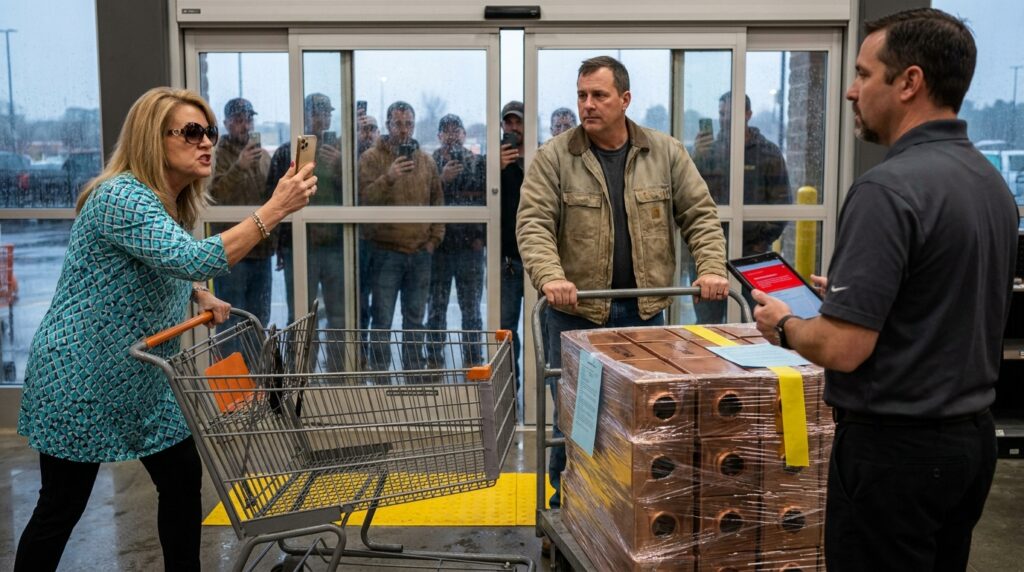
A logistics engineer outsmarts a fraudulent corporate freeze using system data to claim his cargo. 

CHAPTER 1: THE LOGISTICS OF ISOLATION

The steel handle of the flatbed cart was cold, transferring a dull, metallic chill through the fabric of Marcus Brody’s canvas jacket. He liked the cold. It was a tangible metric—predictable, consistent, and completely indifferent to human error. Behind him, the interior of Martinsburg Provisions hummed with the high-register beeping of point-of-sale terminals and the smell of freshly cut Douglas fir. In front of him, the automated glass doors of the exit vestibule were exactly four paces away.

Then came the impact.

It wasn’t a human body, but the heavy, structural rattle of a double-wide wire shopping cart ramming horizontally across the yellow safety threshold. The chrome mesh of the barrier struck the front lip of Marcus’s flatbed with a sharp, echoing crack. The three hundred pounds of commercial-grade copper manifolds stacked on his deck shifted precisely two inches, their plastic shrink-wrap groaning against the sudden deceleration.

“Don’t take another step,” a voice commanded. It was loud, vibrating with the practiced cadence of someone used to commanding suburban committee rooms.

Marcus kept his hands loose on the steel bar. He didn’t pull back. He didn’t reach for his pockets. His gray eyes narrowed, tracking the movement of a gold-encased smartphone that was currently being thrust within three feet of his face. The lens of the camera caught the overhead fluorescent glare, a tiny black eye recording his features.

Connie Henderson stood behind the barricade of her cart. Her turquoise geometric tunic was pristine, her styled blonde hair frozen in place by a heavy layer of lacquer. Even indoors, her oversized designer sunglasses remained perched on her nose, casting a predatory shadow across her cheekbones. Behind her flanks, two middle-aged men in matching polo shirts moved into the remaining gaps of the vestibule, their arms crossed, their bodies forming a secondary human wall against the glass doors.

“We’ve been tracking you since you hit the plumbing aisle,” Connie said, her voice rising to capture the attention of the contractors queuing at the adjacent registers. “You didn’t go through the central lines. You thought because the lumber yard gates were clear, you could just wheel fourteen hundred dollars in raw copper straight to your truck. I’m letting everyone in this community see exactly what you are.”

Marcus did not look at the crowd that was already starting to stall behind him. He didn’t look at the cashiers who had stopped sliding items across their scanners. Instead, his left hand drifted down inside his jacket pocket, his thumb finding the hard, ridged edge of his military-issue inspection coin. He rolled it once against his knuckle. His heart rate stayed at a flat sixty-four beats per minute.

“The cart is stationary,” Marcus said, his voice dropping into a transactional, low register that forced Connie to lean forward to hear it. “My hands are visible on the bar. Please call the general manager to scan the thermal receipt currently in my possession so these families can clear the lane.”

“There is no receipt,” Connie snapped, her thumb tapping the screen of her phone to lock the recording. “You’re a professional. I know the contractor scams. You use an old print-out or a fake digital wallet to bypass the floor staff. Tyler! Get over here right now!”

A young floor guard in a oversized security vest broke away from the service desk, his boots squeaking frantically against the polished concrete. Marcus watched the kid’s face—pale, out of his depth, his hand twitching near a plastic radio casing. Tyler looked at Connie’s expensive jewelry, then at Marcus’s faded canvas cuffs. The calculation in the kid’s eyes took less than a second.

“Sir,” Tyler said, his voice cracking slightly as he stepped into Marcus’s peripheral vision. “I need you to step away from the flatbed. We need to move this into the back office until we can verify the inventory logs.”

Marcus kept his hands flat on the steel. He didn’t look at Tyler; his eyes remained locked on the gold edge of Connie’s phone. In the reflection of the glass doors, he could see the blinking green status light of an Axis Communications dome camera mounted directly above Register Three. It was pointed straight down at his back.

“I am not moving this cart to a private room,” Marcus said calmly. “And if you touch these boxes before the manager verifies the terminal sync, you will be violating corporate loss-prevention protocol section four.”

Connie let out a sharp, jagged laugh that caused the contractors in the front queue to lower their tool belts. “He’s quoting the manual. That’s the decoy they always use when they’re cornered. Check his right jacket pocket, Tyler. He’s got the digital spoofer in there right now.”

Marcus felt the weight of his old corporate betrayal flare behind his eyes—the memory of an executive’s missing ledger that had almost cost him his freedom. He suppressed it, his fingers tightening just enough to lock his posture into iron. He knew the parameters of the room. He knew the exact second his transaction had cleared the banking mainframe. He was simply waiting for the store manager to arrive with the tablet.

But as Tyler took a hesitant step closer, his hand reaching for the corner of the first copper box, Marcus noticed a discrepancy. Connie wasn’t looking at the copper anymore. Her eyes were flicking rapidly toward the service counter’s monitor, where a single blue slip of paper was currently sticking out of the employee printer—a slip that shouldn’t have existed for a standard cash-and-carry pickup.


CHAPTER 2: THE INVENTORY LOCKOUT

“Tyler, look at the service monitor,” Connie said, her fingernail tapping a sharp, plastic arc against the glass casing of her smartphone. The sound was a rhythmic clicking, like a beetle trapped in a dry box. “That printer isn’t running a standard sales log. Marcus knows exactly what’s on that blue sheet. That’s an automated flag from the regional compliance queue.”

Marcus did not turn his head toward the counter. His gaze remained anchored on the top edge of his flatbed cart, where the raw, red-gold circles of the copper manifolds sat under heavy plastic sheeting. The air in the vestibule was growing warm, trapped between the outer automatic sliders and the main floor’s HVAC currents. It smelled of industrial adhesive and the wet, ozone tang of a summer storm rolling across the asphalt outside. He felt his left thumb shift, rolling the brass inspection coin against his palm. Two rotations. His breathing was deep, measured through his nose, drawing in the dry dust of the hardware bins to keep his throat clear.

“The manager handles the queue flags,” Tyler muttered, though the kid’s shoulder had dropped three inches. He was leaning away from Marcus now, his boots pivoting on the yellow safety strip toward the counter. “Ma’am, if there’s a compliance hold on the contractor account, the register wouldn’t have cleared the transaction barcode.”

“Unless the checkout terminal was manually overridden,” Connie countered. She took a step closer, the heavy turquoise fabric of her tunic catching the cold glare of the overhead lighting. The geometric lines across her chest looked like a stylized cage. “Marcus used to design logistics pipelines for the county supply depot before they liquidated his unit for structural deficits. He knows every back-door code in the inventory system. He knows which cashiers don’t check the bulk-lot verification signatures.”

The accusation hung in the space between them, sharp and metallic. Marcus registered the specific phrasing: structural deficits. It was the exact euphemism the board had used five years ago when the regional distribution ledger had been shorted forty thousand dollars in industrial valves, pointing the blame directly at his desk because his initials were on the clearance sheets. He had spent three weeks in a basement records room proving that a senior VP had signed the digital transport slips from a remote terminal in Chicago. The scar wasn’t red or angry; it was a gray, quiet cold that settled into his joints whenever a person with a plastic badge assumed he was a target because he carried a wrench instead of a briefcase.

“The cashier at Register Three was named Elena,” Marcus said. His voice was flat, dry, devoid of the defensive volume Connie was trying to draw from him. “Employee ID forty-two, twelve. She verified the bulk-lot release code via the warehouse terminal before she ran the commercial account card. The blue paper currently printing at the service desk is a re-routing slip. It isn’t a flag.”

“You don’t get to dictate what that machine prints,” Connie said, her phone raised higher now, the lens angled slightly down to catch the canvas shoulders of his jacket. “My nephew works the logistics desk at the north branch, Marcus. I know what an internal audit looks like when it hits the floor. You’re locked out.”

Gregory Vance’s boots made a distinct, heavy strike against the concrete as he rounded the customer service desk. The general manager wasn’t wearing a store vest; he was in a short-sleeved charcoal shirt with a silver company pin pinned precisely one inch above the pocket. His administrative tablet was held flat against his ribs like a shield. His eyes went from Connie’s raised phone to the crisp white thermal receipt resting on Marcus’s copper boxes.

“What’s the hold-up in the vestibule?” Vance asked. His tone wasn’t angry; it was tired—the specific fatigue of a retail manager dealing with an active contractor rush on a humid Saturday morning. “Tyler, we have six commercial flatbeds backed up past the tool cages. Clear the exit.”

“Mr. Vance,” Connie said, her voice dropping into a smooth, familiar register that Marcus recognized from the county zoning board recordings he had studied over the winter. “We have a clear compliance deviation here. Mr. Brody has twelve units of commercial manifolds on a non-vetted account. The system just generated an internal override slip at Register Three.”

Vance stopped. He looked at Connie, his eyebrows drawing down into a hard, professional line. He didn’t look at Marcus yet. He walked straight to the service counter, his hand reaching out to tear the blue slip from the small thermal printer before the feeder could finish its cycle. The paper made a sharp, clean zip as it parted from the roller.

Marcus watched Vance’s face. He watched the manager’s pupils track the printed lines from left to right, his thumb holding the edge of the blue sheet against the screen of his digital tablet. A small discrepancy appeared in the symmetry of Vance’s jaw—a tightening of the muscle near the ear.

“Connie,” Vance said, his voice dropping an octave as he turned back toward the blocked door. “Where did you get the log reference for this specific contractor pickup?”

“It’s a matter of public safety for the Ridge district,” Connie said, her chin lifting slightly so the oversized sunglasses caught the reflection of the high-definition dome camera above them. “We monitor the commercial registry to ensure unvetted trade vehicles aren’t pulling materials for unauthorized structural work inside the residential lines. The flag came from the system, Gregory. It’s right there on the paper.”

“This paper isn’t a store flag,” Vance said. He held the blue sheet out, his fingers steady, but his eyes were fixed on Connie with a cold, administrative intensity that made Tyler take another step back. “This is a manual inventory alteration request. It was submitted through the regional employee portal at seven-thirty this morning using an access code assigned to the north branch logistics office. It didn’t come from the system. Someone entered Mr. Brody’s commercial account number manually and flagged his materials as ‘damaged warehouse drift’ to trigger an automatic security stop at the exit.”

Marcus let his hands drop from the steel bar of his cart. The cold gray weight behind his eyes shifted into something hard and calculated. He looked at the blue paper in Vance’s hand, then at the small, glitter-rimmed edge of Connie’s phone case. The trap had a false bottom, and Connie had just pulled the wire herself.

CHAPTER 3: THE VESTIBULE TRAP

“Gregory, check the transaction origin block again,” Connie said, her forearm extending until the gold edge of her smartphone casing tapped against Vance’s charcoal sleeve. The movement was crisp, calculated to interrupt his scan. “My family has held an active retail advisory seat with the corporate regional council for six years. We don’t make logging errors. The contractor account has a high-value manual freeze because the logistics line from the north warehouse was compromised.”

Marcus stayed perfectly still. He didn’t adjust his grip on the steel flatbed bar. His gray eyes tracked the tiny reflection of the green dome camera status light bouncing off the polished surface of a brass valve beneath the shrink-wrap. The vestibule was becoming tighter; three more customers had backed into the glass partition behind his cart, their heavy tool belts clinking against the aluminum frame of the automatic door sensor. The humidity outside was pressing hard against the glass, blurring the outline of the concrete loading lane into a gray, featureless wall.

“The log source isn’t an corporate auto-freeze, Connie,” Vance said. He didn’t pull his tablet back, but his finger tapped the screen three times, the glass clicking under his manicured nail. “The access signature belongs to terminal seven in the north branch loading office. That’s a terminal requiring physical card-swipe validation before an entry can hit the live queue. Tyler, match the timestamp on this blue sheet with the master ledger log on register three.”

The young guard took a half-step forward, his eyes darting from Marcus’s unblinking stance to the sharp geometric patterns on Connie’s tunic. He looked down at the paper, his fingers shaking slightly as he pulled his utility radio from his belt to clear the line. “Register three cleared at ten forty-two,” Tyler whispered into the receiver. “We have an overlay. Terminal seven logged the asset hold at ten thirty-nine. That’s a three-minute lead before the cashier even processed the plastic.”

Marcus watched the calculation clear in Vance’s eyes. A three-minute lead meant the entry had been seeded before he had even wheeled his flatbed out of the plumbing stacks. This wasn’t a sudden observation by an overzealous neighborhood enforcer; it was a pre-meditated administrative strike designed to lock his inventory before he could clear the outer threshold.

“Marcus,” Connie said, her tone sharpening into a hard, professional edge that cut through the low buzz of the nearby register transformers. “You spent twelve years managing the municipal supply yards. You know exactly how the priority asset queues shift when a district audit is pending. You used an old terminal login to override the regional lot allocation before the store manager could update the system.”

“The municipal supply yards utilized a dual-signature ledger,” Marcus said, his voice level, low, dropping into the cold cadence of an operations brief. “Every manual re-routing required a physical print manifest from the loading foreman’s desk. The system in this store relies on an automated regional replication loop. A terminal seven entry from the north branch cannot override a live point-of-sale barcode scan unless the regional coordinator manually pushes the exception block through the administrative portal.”

He paused, letting the silence settle into the narrow space between their carts. “The entry terminal seven used wasn’t an audit. It was an executive override code. And the only people with regional coordinator credentials who live inside the Ridge boundaries are members of the Henderson development group.”

Connie’s hand dropped two inches, the lens of her gold smartphone tracking down toward the floor before she snapped her wrist back to lock the frame on his face. The muscles near her mouth didn’t shift, but her sunglasses slid slightly down the bridge of her nose, revealing two dark, calculated pupils that showed no intention of retreating.

“The Henderson group doesn’t handle retail compliance, Marcus,” she said, her voice dropping into a transactional murmur meant only for the inner circle of the vestibule. “But we do handle property valuation. And a contractor running unvetted commercial copper into a residential zone without a verified county project number is an automatic code violation under section twelve. Gregory, call the municipal detail. Let the county police verify who signed that terminal seven log.”

Vance didn’t answer immediately. He turned the tablet toward the light, his thumb scrolling through a long column of gray data fields that reflected across the lenses of his glasses. The crowd behind Marcus was growing restless; a man in a dirt-stained canvas vest leaned over the steel divider, his phone raised to capture Connie’s profile against the exit doors.

“The county detail doesn’t handle internal store overrides, Connie,” Vance said, his face hardening as he turned the screen away from her. “But I do. And the terminal seven log shows the physical card used to validate that entry was registered to your nephew, Arthur. He’s currently on vacation. The digital token was generated from a mobile device using a virtual private network that maps straight back to the Ridge neighborhood alliance office.”

The trap had just flipped, but Marcus knew the layout too well to move before the secondary lines were clear. He looked at the blue paper still gripped in Vance’s hand. There was a secondary code printed at the bottom—a fifteen-digit hex string that shouldn’t have been present on a standard inventory hold. It was a liquidation tracking sequence used for bank-ordered asset seizures.

Connie didn’t flinch. She took a slow, deliberate breath, her fingers tightening around the edges of her phone until the plastic casing creaked. “Arthur’s credentials are secure, Gregory. If his token was used, it was because the compliance department flagged a pattern of unauthorized inventory drift from this specific contractor. Marcus has three other flatbeds sitting in his yard right now, all pulled from commercial accounts that don’t match his home address.”

Marcus felt the gray chill behind his eyes drop into his chest. She had been watching his house. The flatbeds in his driveway weren’t stolen; they were salvaged frames from the old municipal yard liquidation that he had bought at public auction three months ago to rebuild the community center’s utility trailers. But to a suburban zoning board looking for an excuse to freeze a local property owner’s assets, those steel frames were the perfect visual anchor for a grand larceny charge.

“The frames in my yard are certified under state auction receipt number eighty-four, twenty,” Marcus said. He didn’t look at Tyler, who was now backing completely out of the vestibule lane, his radio held loose at his side. “The registration numbers were logged with the county clerk before the first block was poured. If your alliance has been filing asset reports against my address, you’ve been doing it using the corporate portal’s non-verified public complaint form.”

“We file what the community requires to maintain structural integrity,” Connie said, her voice rising again, reclaiming her stance as her two associates shifted their weight against the outer glass doors. “And right now, this store is allowing an unverified account to remove critical building infrastructure from the district during a regional shortage. If you won’t hold the cart, Gregory, I’ll let the board know the north branch is actively participating in inventory manipulation.”

Vance’s jaw set into an unyielding line. He took one step forward, his charcoal-clad shoulder blocking Connie’s line of sight to the tablet. “The north branch doesn’t take orders from the Ridge alliance, Connie. And your nephew’s credentials just got suspended for data policy violations. Tyler, step outside. Clear the loading lane for the sheriff’s vehicle. We have a malicious system entry to document.”

But before the guard could move toward the automatic slider, a sudden loud crack of thunder vibrated through the high concrete walls of the building, followed by the dry, high-pitched squeal of the store’s primary power transformer failing behind the warehouse partition. The fluorescent tubes overhead flickered twice, turned a dull, sickly orange, and then went completely dark, leaving the vestibule lit only by the gray, stormy daylight filtering through the glass doors.

In the sudden darkness, the automated locks on the exit doors gave a heavy, motorized thunk, sealing Marcus inside the glass box with Connie’s cart still wedged across the yellow line.

CHAPTER 4: THE RESISTANCE AND DOUBLEDOWN

The emergency sirens at the front end of the warehouse didn’t wail; they groaned, powered by a dying auxiliary capacitor that cut out after three seconds. In the dead pocket of space that followed, the gray afternoon light pushing through the glass doors turned the vestibule into a desaturated container. The heat rose instantly, an oppressive, static-heavy weight that smelled of damp asphalt and heated copper.

Marcus kept his fingers dead-still on the flatbed handle. The automatic doors had settled into their tracks with a concrete-shaking thud, the deadbolts driven home by a mechanical spring backup that triggered whenever the grid dropped. He didn’t look back at the shoppers currently pressing against the inner glass panels behind him, their voices muffled through the thick, polycarbonate seals.

“The auxiliary lines are down,” Connie said. Her phone screen flared bright against her cheek, casting a stark, bluish pallor across her cheekbones. She didn’t drop the camera angle. Even in the gloom, her posture remained an unbending column of turquoise silk. “Gregory, the regional protocol for a facility blackout dictates an immediate perimeter lockdown. Nobody moves inventory past the threshold until the physical logs are hand-verified against the master ledger.”

Vance’s tablet screen flickered, its battery icon shifting to a deep amber as the store’s local network vanished. He didn’t look at Connie. He leaned his weight against the customer service counter, his charcoal sleeve scraping against the cold stainless-steel trim. “The physical ledger is locked in the main administrative cage, Connie. And right now, the terminal seven override signature takes precedence. If that log was generated under fraudulent credentials, the inventory on this flatbed isn’t subject to a facility hold.”

“It’s subject to a county seizure,” Connie countered. She reached into her handbag, her manicured fingers emerging with a secondary document—not a store form, but a folded, heavy-gauge sheet of blue legal bond paper with a notched county clerk seal at the margin. She didn’t hand it to Vance; she pressed it flat against the glass of Marcus’s flatbed cart, directly over the plastic wrap of the top manifold box. “The terminal seven block was pushed because the Henderson group filed an expedited lien against Marcus Brody’s commercial registration at eight o’clock yesterday evening. The fifteen-digit hex string at the bottom of your printout isn’t a retail liquidation code, Gregory. It’s a civil asset tracking identifier.”

Marcus looked down at the paper. The blue bond sheet was clean, the type-wheel alignment perfect. His eyes tracked the hex string: 04-LX-8420-RIDGE. It wasn’t an internal store log. It was a pre-filed public nuisance declaration mapping to his exact parcel coordinates. The trap hadn’t just been set at the register; it had been engineered through the county probate registry while he was still loading his truck.

“A civil lien requires a judicial signature before it can hit a private commercial entity,” Marcus said. His voice was lower now, a flat, rhythmic rasp that didn’t vibrate in the narrow air of the vestibule. “The county clerk doesn’t issue asset tracking numbers for code violations unless the property owner has failed to respond to three consecutive administrative summonses.”

“The summonses were delivered to your registered corporate address, Marcus,” Connie said, her sunglasses sliding down an inch as she leaned over her cart’s steel frame. “The old municipal logistics office on Eleventh Street. The one that’s been boarded up since the restructuring. If your legal agent failed to forward the paperwork to your rural pasture, that’s an operational oversight on your end. The ledger closed at midnight.”

The realization hit Marcus with the cold precision of a physical blow—not a failure of logic, but a total systemic failure of his defenses. The old office. He had kept that location listed as his primary statutory seat because the corporate lease was paid through the end of the fiscal cycle, using it as an administrative buffer. Connie hadn’t found a loophole in his transaction; she had used his own historical records to create a legal ghost lane, sending the warning notices to an empty room until the clock ran out.

“Tyler,” Connie commanded, her phone lens pivoting back to the young guard, who was now pinned against the emergency exit door by the crowd’s forward pressure. “The store is under a mandatory asset hold. If you don’t take physical custody of these boxes, you’re willfully interfering with a certified county enforcement action. My associates have already logged the vehicle description with the district detail outside.”

Tyler didn’t move his hand toward his belt. He looked through the glass doors at the parking lot, where the heavy summer downpour was now bouncing off the hoods of the contractor trucks. The yellow bollards at the edge of the concrete lane looked like dull markers in the gray twilight. “The store manager hasn’t authorized the release,” the kid stammered, his eyes flickering toward Vance. “I can’t… I don’t have the key for the manual override gate when the power’s out.”

“I have the key,” Vance said. He reached down to his belt, pulling a long, heavy steel ring that clinked against his silver company pin. His face was gray, his jaw locked into a tight, professional mask that showed the strain of the shifting legal ground beneath him. “But I’m not inserting it until I see the electronic docket validation on my local screen. Connie, if this lien isn’t updated in the state circuit court portal, this document is nothing but an unverified civil claim.”

“The portal is down because the regional hub lost power three minutes ago,” Connie said, her voice rising to carry over the mounting murmurs of the contractors trapped behind the inner partition. “The paper document is the prime record under state code section forty. You have thirty seconds to secure this lane, Gregory, or I will file an institutional non-compliance report with the corporate board before the emergency generator kicks over.”

Marcus looked at the dome camera above Register Three. The green light was dead, its lens a featureless black eye reflecting nothing but the dim daylight. The digital proof—his synchronized smartphone log, his timestamped receipt—was entirely useless without the mainframe to validate the signature trail. He was back in the basement records room, his words completely weightless against a pre-printed sheet of blue bond paper.

His thumb pressed hard against the brass coin in his pocket, the metal edge cutting into his skin until he felt the steady, regular throb of his pulse. He had built defenses against mortars, against system lockouts, against corporate restructuring. But Connie hadn’t attacked his transaction; she had attacked his identity under the law, and right now, the law was a dark screen in a windowless room.

“The state circuit court portal utilizes a dual-redundant server base in Richmond,” Marcus said. He stepped away from the flatbed bar, his canvas jacket drawing tight across his shoulders as he turned his body to face Connie directly. “The regional power grid doesn’t drop the Richmond database. If the docket was updated at midnight, the administrative transaction token would be embedded in the barcode at the top of that blue sheet.”

He reached out, his hand steady, his fingers stopping exactly two inches from the surface of the paper Connie held. “Scan the barcode with your own camera, Vance. Let the local cache verify the signature before the light goes completely out.”

CHAPTER 5: THE DIGITAL VERDICT

“The local cache won’t clear an unverified barcode, Marcus,” Connie said, her knuckles turning a bloodless, stark white against the casing of her raised device. The glare from her screen was a harsh, blue geometric slash cutting across her designer lenses. “Gregory, do not touch that document. A manual scan while the main server node is offline will corrupt the transaction log on register three completely.”

Marcus didn’t move his hand away from the blue sheet. His fingers remained perfectly horizontal, suspended exactly two inches above the crisp, heavy bond paper. “Scan it, Vance,” he repeated. His voice was a flat, low-frequency command that seemed to anchor itself beneath the low hum of the rain striking the roof. “The regional database isn’t blind. If this is a legitimate asset tracking block, the local cache will display the county clerk’s authorization hash. If it isn’t, the barcode will read as a closed internal loop.”

Vance didn’t speak. His charcoal-clad shoulder blocked Connie’s forward lean as he tilted his tablet down, using the device’s manual optical lens to catch the edge of the blue paper. The red laser line from the scanner slit cut across the black lines of the barcode with a sharp, electronic chirp.

The tablet screen stayed dark for two agonizing seconds. Then, a column of gray diagnostic numbers cascaded down the pane, followed by an aggressive, red-bordered exception block that pulsed against the glass.

Marcus watched Vance’s face. The general manager’s eyebrows flattened, his jaw muscles clenching into a hard, rigid knot as he zoomed into the hex code string at the base of the readout.

“This code doesn’t map to the county clerk’s registry, Connie,” Vance said. His tone was dangerously quiet, stripped of the standard customer-service neutrality he had maintained all morning. He held the tablet screen up, pressing it flat against the glass door partition so the surrounding contractors could see the bright red text pulsing in the gloom. “The encryption token belongs to a private commercial entity listed as H-Alliance Real Estate Holdings. This isn’t a county lien. Someone uploaded a private debt-collection notification into our contractor queue, masked it using Arthur’s employee profile, and used our exit loss-prevention protocol to execute a civil freeze.”

A collective, sharp intake of air rattled through the vestibule. The contractors behind Marcus surged forward by six inches, their heavy tool pouches scraping hard against the steel divider rails. The young guard, Tyler, snapped his head down toward his radio, his fingers flying across the channel keys to lock out the service desk line.

“That’s a falsified corporate enforcement entry,” Marcus said, his voice dropping into the clinical rhythm of an inventory audit. He looked past Connie’s shoulder, his gray eyes locking onto the two polo-shirted associates who were now backed flat against the automatic outer doors. “You didn’t use the county registry to freeze my pasture because you couldn’t get a judge to sign the order. You used an internal store override to create a public scene, hoping I’d liquidate the copper inventory right here on the concrete floor to settle a non-existent code violation.”

Connie didn’t drop her phone. Her hand remained rock-steady, the lens still pointed at Marcus’s chin, but her mouth twisted into a tight, defensive snarl that destroyed the carefully lacquered symmetry of her face. “The debt is verified by the community association, Marcus! You’ve been running unregistered commercial machinery through our access corridors for three months. If the store’s corporate server logs a private lien as an exception block, that is an internal categorization error, not a false report. Tyler, hit the manual release valve on that door frame! We are holding this asset until the district detail arrives.”

“I’m not hitting anything, Ms. Henderson,” Tyler said, his voice dropping into a hard, defensive register as he stepped completely into her line of sight, his body shielding the emergency manual air release. “The manager handles the threshold keys. Step back from the flatbed.”

“Connie,” Vance said, his hand reaching into his pocket to pull the heavy steel ring. He didn’t look at her phone; he looked at the gold-plated casing of her smart device. “You have exactly five seconds to move your cart out of this exit track before I activate the terminal’s direct panic line for a felony computer trespass charge. Your nephew’s access token is already flagged on our local cache as a malicious system compromise.”

Connie’s two associates didn’t wait for the countdown. In the dim twilight of the vestibule, their arms dropped from their chests, their faces turning a slick, pasty gray under the emergency light beams. They pulled their shoulders back, slid past the edge of Connie’s horizontal cart, and hit the mechanical panic bar on the secondary exit door. The metal lock gave a loud, metallic clack, and both men vanished out into the pouring rain, their boots splashing through the puddles toward the edge of the asphalt.

Left entirely isolated behind her barricade, Connie’s hand finally began to tremble. The gold phone tilted three degrees down, its lens recording nothing but the cold, wet concrete of the threshold. She looked at Vance, then at the wall of smartphones currently recording her from behind the inner glass partition. The contractors weren’t murmuring anymore; they were laughing—a low, derisive rumble that cut through her remaining social authority like a physical blade.

“This is an institutional overreach, Gregory,” she whispered, her voice cracking as she grabbed the handles of her double-wide cart and yanked it backward with a frantic, uncoordinated jerk. The metal wheels squeaked violently against the yellow safety strip, her heels sliding through the dry dust of the doorway as she cleared the lane. “My family built the infrastructure for this entire commercial corridor. You won’t have an open account left in the Ridge by Monday morning.”

“Clear the path, Connie,” Vance said coldly. He inserted his heavy steel key into the manual override box on the frame. With a loud, high-pitched hiss of escaping air, the automatic doors slid back, locking into the open position and allowing the fresh, damp scent of the rain to flood the warm vestibule.

Marcus Brody didn’t offer a final comment. He reached down, gripped the cold steel handle of his flatbed cart, and pushed his twelve boxes of copper manifolds smoothly across the threshold. As his boots met the wet concrete of the loading lane, the contractors behind him broke into a loud, ringing cheer, their phones tracking Connie as she scrambled toward her SUV in the downpour, her turquoise tunic soaked and clinging to her shoulders. Marcus kept his eyes forward, his posture perfectly square, wheeling his paid property out into the gray daylight where his truck was waiting. The records were intact, the system had held, and the boundary had been permanently drawn.

Similar Posts

Leave a Reply

Your email address will not be published. Required fields are marked *






