
CHAPTER 4: THE RESISTANCE AND DOUBLEDOWN
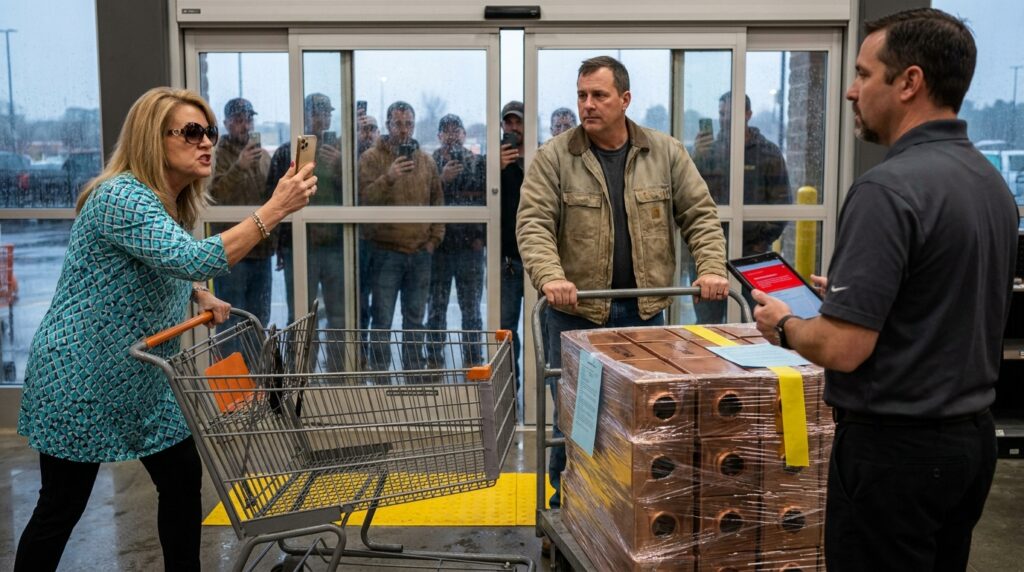
The emergency sirens at the front end of the warehouse didn’t wail; they groaned, powered by a dying auxiliary capacitor that cut out after three seconds. In the dead pocket of space that followed, the gray afternoon light pushing through the glass doors turned the vestibule into a desaturated container. The heat rose instantly, an oppressive, static-heavy weight that smelled of damp asphalt and heated copper.
Marcus kept his fingers dead-still on the flatbed handle. The automatic doors had settled into their tracks with a concrete-shaking thud, the deadbolts driven home by a mechanical spring backup that triggered whenever the grid dropped. He didn’t look back at the shoppers currently pressing against the inner glass panels behind him, their voices muffled through the thick, polycarbonate seals.
“The auxiliary lines are down,” Connie said. Her phone screen flared bright against her cheek, casting a stark, bluish pallor across her cheekbones. She didn’t drop the camera angle. Even in the gloom, her posture remained an unbending column of turquoise silk. “Gregory, the regional protocol for a facility blackout dictates an immediate perimeter lockdown. Nobody moves inventory past the threshold until the physical logs are hand-verified against the master ledger.”
Vance’s tablet screen flickered, its battery icon shifting to a deep amber as the store’s local network vanished. He didn’t look at Connie. He leaned his weight against the customer service counter, his charcoal sleeve scraping against the cold stainless-steel trim. “The physical ledger is locked in the main administrative cage, Connie. And right now, the terminal seven override signature takes precedence. If that log was generated under fraudulent credentials, the inventory on this flatbed isn’t subject to a facility hold.”
“It’s subject to a county seizure,” Connie countered. She reached into her handbag, her manicured fingers emerging with a secondary document—not a store form, but a folded, heavy-gauge sheet of blue legal bond paper with a notched county clerk seal at the margin. She didn’t hand it to Vance; she pressed it flat against the glass of Marcus’s flatbed cart, directly over the plastic wrap of the top manifold box. “The terminal seven block was pushed because the Henderson group filed an expedited lien against Marcus Brody’s commercial registration at eight o’clock yesterday evening. The fifteen-digit hex string at the bottom of your printout isn’t a retail liquidation code, Gregory. It’s a civil asset tracking identifier.”
Marcus looked down at the paper. The blue bond sheet was clean, the type-wheel alignment perfect. His eyes tracked the hex string: 04-LX-8420-RIDGE. It wasn’t an internal store log. It was a pre-filed public nuisance declaration mapping to his exact parcel coordinates. The trap hadn’t just been set at the register; it had been engineered through the county probate registry while he was still loading his truck.
“A civil lien requires a judicial signature before it can hit a private commercial entity,” Marcus said. His voice was lower now, a flat, rhythmic rasp that didn’t vibrate in the narrow air of the vestibule. “The county clerk doesn’t issue asset tracking numbers for code violations unless the property owner has failed to respond to three consecutive administrative summonses.”
“The summonses were delivered to your registered corporate address, Marcus,” Connie said, her sunglasses sliding down an inch as she leaned over her cart’s steel frame. “The old municipal logistics office on Eleventh Street. The one that’s been boarded up since the restructuring. If your legal agent failed to forward the paperwork to your rural pasture, that’s an operational oversight on your end. The ledger closed at midnight.”
The realization hit Marcus with the cold precision of a physical blow—not a failure of logic, but a total systemic failure of his defenses. The old office. He had kept that location listed as his primary statutory seat because the corporate lease was paid through the end of the fiscal cycle, using it as an administrative buffer. Connie hadn’t found a loophole in his transaction; she had used his own historical records to create a legal ghost lane, sending the warning notices to an empty room until the clock ran out.
“Tyler,” Connie commanded, her phone lens pivoting back to the young guard, who was now pinned against the emergency exit door by the crowd’s forward pressure. “The store is under a mandatory asset hold. If you don’t take physical custody of these boxes, you’re willfully interfering with a certified county enforcement action. My associates have already logged the vehicle description with the district detail outside.”
Tyler didn’t move his hand toward his belt. He looked through the glass doors at the parking lot, where the heavy summer downpour was now bouncing off the hoods of the contractor trucks. The yellow bollards at the edge of the concrete lane looked like dull markers in the gray twilight. “The store manager hasn’t authorized the release,” the kid stammered, his eyes flickering toward Vance. “I can’t… I don’t have the key for the manual override gate when the power’s out.”
“I have the key,” Vance said. He reached down to his belt, pulling a long, heavy steel ring that clinked against his silver company pin. His face was gray, his jaw locked into a tight, professional mask that showed the strain of the shifting legal ground beneath him. “But I’m not inserting it until I see the electronic docket validation on my local screen. Connie, if this lien isn’t updated in the state circuit court portal, this document is nothing but an unverified civil claim.”
“The portal is down because the regional hub lost power three minutes ago,” Connie said, her voice rising to carry over the mounting murmurs of the contractors trapped behind the inner partition. “The paper document is the prime record under state code section forty. You have thirty seconds to secure this lane, Gregory, or I will file an institutional non-compliance report with the corporate board before the emergency generator kicks over.”
Marcus looked at the dome camera above Register Three. The green light was dead, its lens a featureless black eye reflecting nothing but the dim daylight. The digital proof—his synchronized smartphone log, his timestamped receipt—was entirely useless without the mainframe to validate the signature trail. He was back in the basement records room, his words completely weightless against a pre-printed sheet of blue bond paper.
His thumb pressed hard against the brass coin in his pocket, the metal edge cutting into his skin until he felt the steady, regular throb of his pulse. He had built defenses against mortars, against system lockouts, against corporate restructuring. But Connie hadn’t attacked his transaction; she had attacked his identity under the law, and right now, the law was a dark screen in a windowless room.
“The state circuit court portal utilizes a dual-redundant server base in Richmond,” Marcus said. He stepped away from the flatbed bar, his canvas jacket drawing tight across his shoulders as he turned his body to face Connie directly. “The regional power grid doesn’t drop the Richmond database. If the docket was updated at midnight, the administrative transaction token would be embedded in the barcode at the top of that blue sheet.”
He reached out, his hand steady, his fingers stopping exactly two inches from the surface of the paper Connie held. “Scan the barcode with your own camera, Vance. Let the local cache verify the signature before the light goes completely out.”








