CHAPTER 3: THE VESTIBULE TRAP
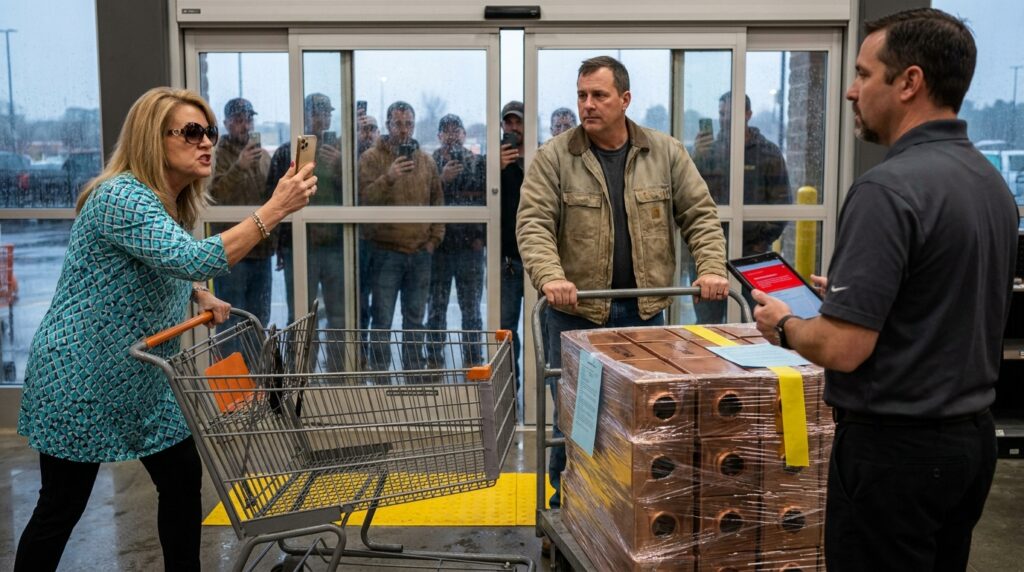
“Gregory, check the transaction origin block again,” Connie said, her forearm extending until the gold edge of her smartphone casing tapped against Vance’s charcoal sleeve. The movement was crisp, calculated to interrupt his scan. “My family has held an active retail advisory seat with the corporate regional council for six years. We don’t make logging errors. The contractor account has a high-value manual freeze because the logistics line from the north warehouse was compromised.”
Marcus stayed perfectly still. He didn’t adjust his grip on the steel flatbed bar. His gray eyes tracked the tiny reflection of the green dome camera status light bouncing off the polished surface of a brass valve beneath the shrink-wrap. The vestibule was becoming tighter; three more customers had backed into the glass partition behind his cart, their heavy tool belts clinking against the aluminum frame of the automatic door sensor. The humidity outside was pressing hard against the glass, blurring the outline of the concrete loading lane into a gray, featureless wall.
“The log source isn’t an corporate auto-freeze, Connie,” Vance said. He didn’t pull his tablet back, but his finger tapped the screen three times, the glass clicking under his manicured nail. “The access signature belongs to terminal seven in the north branch loading office. That’s a terminal requiring physical card-swipe validation before an entry can hit the live queue. Tyler, match the timestamp on this blue sheet with the master ledger log on register three.”
The young guard took a half-step forward, his eyes darting from Marcus’s unblinking stance to the sharp geometric patterns on Connie’s tunic. He looked down at the paper, his fingers shaking slightly as he pulled his utility radio from his belt to clear the line. “Register three cleared at ten forty-two,” Tyler whispered into the receiver. “We have an overlay. Terminal seven logged the asset hold at ten thirty-nine. That’s a three-minute lead before the cashier even processed the plastic.”
Marcus watched the calculation clear in Vance’s eyes. A three-minute lead meant the entry had been seeded before he had even wheeled his flatbed out of the plumbing stacks. This wasn’t a sudden observation by an overzealous neighborhood enforcer; it was a pre-meditated administrative strike designed to lock his inventory before he could clear the outer threshold.
“Marcus,” Connie said, her tone sharpening into a hard, professional edge that cut through the low buzz of the nearby register transformers. “You spent twelve years managing the municipal supply yards. You know exactly how the priority asset queues shift when a district audit is pending. You used an old terminal login to override the regional lot allocation before the store manager could update the system.”
“The municipal supply yards utilized a dual-signature ledger,” Marcus said, his voice level, low, dropping into the cold cadence of an operations brief. “Every manual re-routing required a physical print manifest from the loading foreman’s desk. The system in this store relies on an automated regional replication loop. A terminal seven entry from the north branch cannot override a live point-of-sale barcode scan unless the regional coordinator manually pushes the exception block through the administrative portal.”
He paused, letting the silence settle into the narrow space between their carts. “The entry terminal seven used wasn’t an audit. It was an executive override code. And the only people with regional coordinator credentials who live inside the Ridge boundaries are members of the Henderson development group.”
Connie’s hand dropped two inches, the lens of her gold smartphone tracking down toward the floor before she snapped her wrist back to lock the frame on his face. The muscles near her mouth didn’t shift, but her sunglasses slid slightly down the bridge of her nose, revealing two dark, calculated pupils that showed no intention of retreating.
“The Henderson group doesn’t handle retail compliance, Marcus,” she said, her voice dropping into a transactional murmur meant only for the inner circle of the vestibule. “But we do handle property valuation. And a contractor running unvetted commercial copper into a residential zone without a verified county project number is an automatic code violation under section twelve. Gregory, call the municipal detail. Let the county police verify who signed that terminal seven log.”
Vance didn’t answer immediately. He turned the tablet toward the light, his thumb scrolling through a long column of gray data fields that reflected across the lenses of his glasses. The crowd behind Marcus was growing restless; a man in a dirt-stained canvas vest leaned over the steel divider, his phone raised to capture Connie’s profile against the exit doors.
“The county detail doesn’t handle internal store overrides, Connie,” Vance said, his face hardening as he turned the screen away from her. “But I do. And the terminal seven log shows the physical card used to validate that entry was registered to your nephew, Arthur. He’s currently on vacation. The digital token was generated from a mobile device using a virtual private network that maps straight back to the Ridge neighborhood alliance office.”
The trap had just flipped, but Marcus knew the layout too well to move before the secondary lines were clear. He looked at the blue paper still gripped in Vance’s hand. There was a secondary code printed at the bottom—a fifteen-digit hex string that shouldn’t have been present on a standard inventory hold. It was a liquidation tracking sequence used for bank-ordered asset seizures.
Connie didn’t flinch. She took a slow, deliberate breath, her fingers tightening around the edges of her phone until the plastic casing creaked. “Arthur’s credentials are secure, Gregory. If his token was used, it was because the compliance department flagged a pattern of unauthorized inventory drift from this specific contractor. Marcus has three other flatbeds sitting in his yard right now, all pulled from commercial accounts that don’t match his home address.”
Marcus felt the gray chill behind his eyes drop into his chest. She had been watching his house. The flatbeds in his driveway weren’t stolen; they were salvaged frames from the old municipal yard liquidation that he had bought at public auction three months ago to rebuild the community center’s utility trailers. But to a suburban zoning board looking for an excuse to freeze a local property owner’s assets, those steel frames were the perfect visual anchor for a grand larceny charge.
“The frames in my yard are certified under state auction receipt number eighty-four, twenty,” Marcus said. He didn’t look at Tyler, who was now backing completely out of the vestibule lane, his radio held loose at his side. “The registration numbers were logged with the county clerk before the first block was poured. If your alliance has been filing asset reports against my address, you’ve been doing it using the corporate portal’s non-verified public complaint form.”
“We file what the community requires to maintain structural integrity,” Connie said, her voice rising again, reclaiming her stance as her two associates shifted their weight against the outer glass doors. “And right now, this store is allowing an unverified account to remove critical building infrastructure from the district during a regional shortage. If you won’t hold the cart, Gregory, I’ll let the board know the north branch is actively participating in inventory manipulation.”
Vance’s jaw set into an unyielding line. He took one step forward, his charcoal-clad shoulder blocking Connie’s line of sight to the tablet. “The north branch doesn’t take orders from the Ridge alliance, Connie. And your nephew’s credentials just got suspended for data policy violations. Tyler, step outside. Clear the loading lane for the sheriff’s vehicle. We have a malicious system entry to document.”
But before the guard could move toward the automatic slider, a sudden loud crack of thunder vibrated through the high concrete walls of the building, followed by the dry, high-pitched squeal of the store’s primary power transformer failing behind the warehouse partition. The fluorescent tubes overhead flickered twice, turned a dull, sickly orange, and then went completely dark, leaving the vestibule lit only by the gray, stormy daylight filtering through the glass doors.
In the sudden darkness, the automated locks on the exit doors gave a heavy, motorized thunk, sealing Marcus inside the glass box with Connie’s cart still wedged across the yellow line.