
CHAPTER 2: THE INVENTORY LOCKOUT
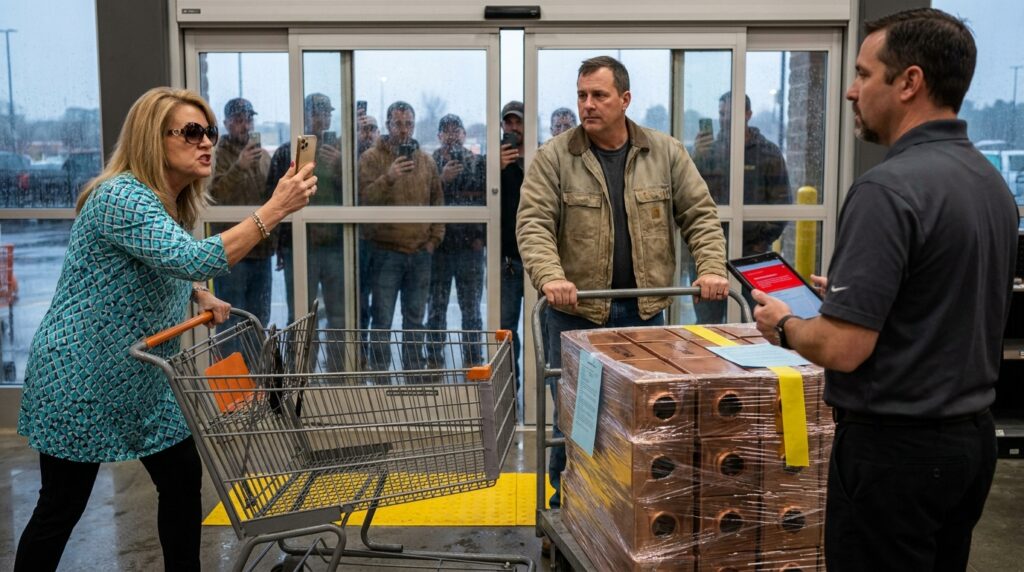
“Tyler, look at the service monitor,” Connie said, her fingernail tapping a sharp, plastic arc against the glass casing of her smartphone. The sound was a rhythmic clicking, like a beetle trapped in a dry box. “That printer isn’t running a standard sales log. Marcus knows exactly what’s on that blue sheet. That’s an automated flag from the regional compliance queue.”
Marcus did not turn his head toward the counter. His gaze remained anchored on the top edge of his flatbed cart, where the raw, red-gold circles of the copper manifolds sat under heavy plastic sheeting. The air in the vestibule was growing warm, trapped between the outer automatic sliders and the main floor’s HVAC currents. It smelled of industrial adhesive and the wet, ozone tang of a summer storm rolling across the asphalt outside. He felt his left thumb shift, rolling the brass inspection coin against his palm. Two rotations. His breathing was deep, measured through his nose, drawing in the dry dust of the hardware bins to keep his throat clear.
“The manager handles the queue flags,” Tyler muttered, though the kid’s shoulder had dropped three inches. He was leaning away from Marcus now, his boots pivoting on the yellow safety strip toward the counter. “Ma’am, if there’s a compliance hold on the contractor account, the register wouldn’t have cleared the transaction barcode.”
“Unless the checkout terminal was manually overridden,” Connie countered. She took a step closer, the heavy turquoise fabric of her tunic catching the cold glare of the overhead lighting. The geometric lines across her chest looked like a stylized cage. “Marcus used to design logistics pipelines for the county supply depot before they liquidated his unit for structural deficits. He knows every back-door code in the inventory system. He knows which cashiers don’t check the bulk-lot verification signatures.”
The accusation hung in the space between them, sharp and metallic. Marcus registered the specific phrasing: structural deficits. It was the exact euphemism the board had used five years ago when the regional distribution ledger had been shorted forty thousand dollars in industrial valves, pointing the blame directly at his desk because his initials were on the clearance sheets. He had spent three weeks in a basement records room proving that a senior VP had signed the digital transport slips from a remote terminal in Chicago. The scar wasn’t red or angry; it was a gray, quiet cold that settled into his joints whenever a person with a plastic badge assumed he was a target because he carried a wrench instead of a briefcase.
“The cashier at Register Three was named Elena,” Marcus said. His voice was flat, dry, devoid of the defensive volume Connie was trying to draw from him. “Employee ID forty-two, twelve. She verified the bulk-lot release code via the warehouse terminal before she ran the commercial account card. The blue paper currently printing at the service desk is a re-routing slip. It isn’t a flag.”
“You don’t get to dictate what that machine prints,” Connie said, her phone raised higher now, the lens angled slightly down to catch the canvas shoulders of his jacket. “My nephew works the logistics desk at the north branch, Marcus. I know what an internal audit looks like when it hits the floor. You’re locked out.”
Gregory Vance’s boots made a distinct, heavy strike against the concrete as he rounded the customer service desk. The general manager wasn’t wearing a store vest; he was in a short-sleeved charcoal shirt with a silver company pin pinned precisely one inch above the pocket. His administrative tablet was held flat against his ribs like a shield. His eyes went from Connie’s raised phone to the crisp white thermal receipt resting on Marcus’s copper boxes.
“What’s the hold-up in the vestibule?” Vance asked. His tone wasn’t angry; it was tired—the specific fatigue of a retail manager dealing with an active contractor rush on a humid Saturday morning. “Tyler, we have six commercial flatbeds backed up past the tool cages. Clear the exit.”
“Mr. Vance,” Connie said, her voice dropping into a smooth, familiar register that Marcus recognized from the county zoning board recordings he had studied over the winter. “We have a clear compliance deviation here. Mr. Brody has twelve units of commercial manifolds on a non-vetted account. The system just generated an internal override slip at Register Three.”
Vance stopped. He looked at Connie, his eyebrows drawing down into a hard, professional line. He didn’t look at Marcus yet. He walked straight to the service counter, his hand reaching out to tear the blue slip from the small thermal printer before the feeder could finish its cycle. The paper made a sharp, clean zip as it parted from the roller.
Marcus watched Vance’s face. He watched the manager’s pupils track the printed lines from left to right, his thumb holding the edge of the blue sheet against the screen of his digital tablet. A small discrepancy appeared in the symmetry of Vance’s jaw—a tightening of the muscle near the ear.
“Connie,” Vance said, his voice dropping an octave as he turned back toward the blocked door. “Where did you get the log reference for this specific contractor pickup?”
“It’s a matter of public safety for the Ridge district,” Connie said, her chin lifting slightly so the oversized sunglasses caught the reflection of the high-definition dome camera above them. “We monitor the commercial registry to ensure unvetted trade vehicles aren’t pulling materials for unauthorized structural work inside the residential lines. The flag came from the system, Gregory. It’s right there on the paper.”
“This paper isn’t a store flag,” Vance said. He held the blue sheet out, his fingers steady, but his eyes were fixed on Connie with a cold, administrative intensity that made Tyler take another step back. “This is a manual inventory alteration request. It was submitted through the regional employee portal at seven-thirty this morning using an access code assigned to the north branch logistics office. It didn’t come from the system. Someone entered Mr. Brody’s commercial account number manually and flagged his materials as ‘damaged warehouse drift’ to trigger an automatic security stop at the exit.”
Marcus let his hands drop from the steel bar of his cart. The cold gray weight behind his eyes shifted into something hard and calculated. He looked at the blue paper in Vance’s hand, then at the small, glitter-rimmed edge of Connie’s phone case. The trap had a false bottom, and Connie had just pulled the wire herself.








