
CHAPTER 5: THE DIGITAL VERDICT
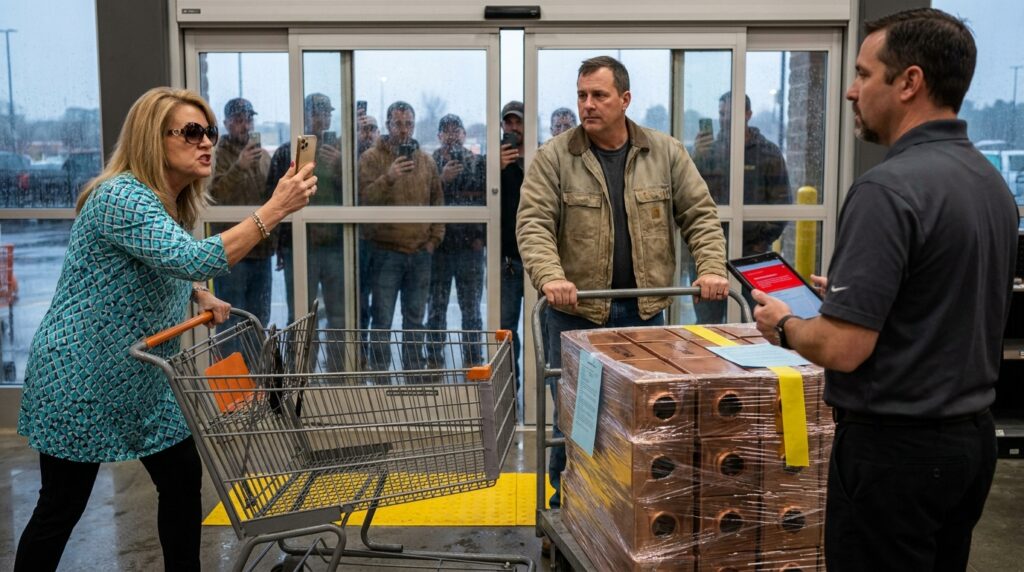
“The local cache won’t clear an unverified barcode, Marcus,” Connie said, her knuckles turning a bloodless, stark white against the casing of her raised device. The glare from her screen was a harsh, blue geometric slash cutting across her designer lenses. “Gregory, do not touch that document. A manual scan while the main server node is offline will corrupt the transaction log on register three completely.”
Marcus didn’t move his hand away from the blue sheet. His fingers remained perfectly horizontal, suspended exactly two inches above the crisp, heavy bond paper. “Scan it, Vance,” he repeated. His voice was a flat, low-frequency command that seemed to anchor itself beneath the low hum of the rain striking the roof. “The regional database isn’t blind. If this is a legitimate asset tracking block, the local cache will display the county clerk’s authorization hash. If it isn’t, the barcode will read as a closed internal loop.”
Vance didn’t speak. His charcoal-clad shoulder blocked Connie’s forward lean as he tilted his tablet down, using the device’s manual optical lens to catch the edge of the blue paper. The red laser line from the scanner slit cut across the black lines of the barcode with a sharp, electronic chirp.
The tablet screen stayed dark for two agonizing seconds. Then, a column of gray diagnostic numbers cascaded down the pane, followed by an aggressive, red-bordered exception block that pulsed against the glass.
Marcus watched Vance’s face. The general manager’s eyebrows flattened, his jaw muscles clenching into a hard, rigid knot as he zoomed into the hex code string at the base of the readout.
“This code doesn’t map to the county clerk’s registry, Connie,” Vance said. His tone was dangerously quiet, stripped of the standard customer-service neutrality he had maintained all morning. He held the tablet screen up, pressing it flat against the glass door partition so the surrounding contractors could see the bright red text pulsing in the gloom. “The encryption token belongs to a private commercial entity listed as H-Alliance Real Estate Holdings. This isn’t a county lien. Someone uploaded a private debt-collection notification into our contractor queue, masked it using Arthur’s employee profile, and used our exit loss-prevention protocol to execute a civil freeze.”
A collective, sharp intake of air rattled through the vestibule. The contractors behind Marcus surged forward by six inches, their heavy tool pouches scraping hard against the steel divider rails. The young guard, Tyler, snapped his head down toward his radio, his fingers flying across the channel keys to lock out the service desk line.
“That’s a falsified corporate enforcement entry,” Marcus said, his voice dropping into the clinical rhythm of an inventory audit. He looked past Connie’s shoulder, his gray eyes locking onto the two polo-shirted associates who were now backed flat against the automatic outer doors. “You didn’t use the county registry to freeze my pasture because you couldn’t get a judge to sign the order. You used an internal store override to create a public scene, hoping I’d liquidate the copper inventory right here on the concrete floor to settle a non-existent code violation.”
Connie didn’t drop her phone. Her hand remained rock-steady, the lens still pointed at Marcus’s chin, but her mouth twisted into a tight, defensive snarl that destroyed the carefully lacquered symmetry of her face. “The debt is verified by the community association, Marcus! You’ve been running unregistered commercial machinery through our access corridors for three months. If the store’s corporate server logs a private lien as an exception block, that is an internal categorization error, not a false report. Tyler, hit the manual release valve on that door frame! We are holding this asset until the district detail arrives.”
“I’m not hitting anything, Ms. Henderson,” Tyler said, his voice dropping into a hard, defensive register as he stepped completely into her line of sight, his body shielding the emergency manual air release. “The manager handles the threshold keys. Step back from the flatbed.”
“Connie,” Vance said, his hand reaching into his pocket to pull the heavy steel ring. He didn’t look at her phone; he looked at the gold-plated casing of her smart device. “You have exactly five seconds to move your cart out of this exit track before I activate the terminal’s direct panic line for a felony computer trespass charge. Your nephew’s access token is already flagged on our local cache as a malicious system compromise.”
Connie’s two associates didn’t wait for the countdown. In the dim twilight of the vestibule, their arms dropped from their chests, their faces turning a slick, pasty gray under the emergency light beams. They pulled their shoulders back, slid past the edge of Connie’s horizontal cart, and hit the mechanical panic bar on the secondary exit door. The metal lock gave a loud, metallic clack, and both men vanished out into the pouring rain, their boots splashing through the puddles toward the edge of the asphalt.
Left entirely isolated behind her barricade, Connie’s hand finally began to tremble. The gold phone tilted three degrees down, its lens recording nothing but the cold, wet concrete of the threshold. She looked at Vance, then at the wall of smartphones currently recording her from behind the inner glass partition. The contractors weren’t murmuring anymore; they were laughing—a low, derisive rumble that cut through her remaining social authority like a physical blade.
“This is an institutional overreach, Gregory,” she whispered, her voice cracking as she grabbed the handles of her double-wide cart and yanked it backward with a frantic, uncoordinated jerk. The metal wheels squeaked violently against the yellow safety strip, her heels sliding through the dry dust of the doorway as she cleared the lane. “My family built the infrastructure for this entire commercial corridor. You won’t have an open account left in the Ridge by Monday morning.”
“Clear the path, Connie,” Vance said coldly. He inserted his heavy steel key into the manual override box on the frame. With a loud, high-pitched hiss of escaping air, the automatic doors slid back, locking into the open position and allowing the fresh, damp scent of the rain to flood the warm vestibule.
Marcus Brody didn’t offer a final comment. He reached down, gripped the cold steel handle of his flatbed cart, and pushed his twelve boxes of copper manifolds smoothly across the threshold. As his boots met the wet concrete of the loading lane, the contractors behind him broke into a loud, ringing cheer, their phones tracking Connie as she scrambled toward her SUV in the downpour, her turquoise tunic soaked and clinging to her shoulders. Marcus kept his eyes forward, his posture perfectly square, wheeling his paid property out into the gray daylight where his truck was waiting. The records were intact, the system had held, and the boundary had been permanently drawn.








