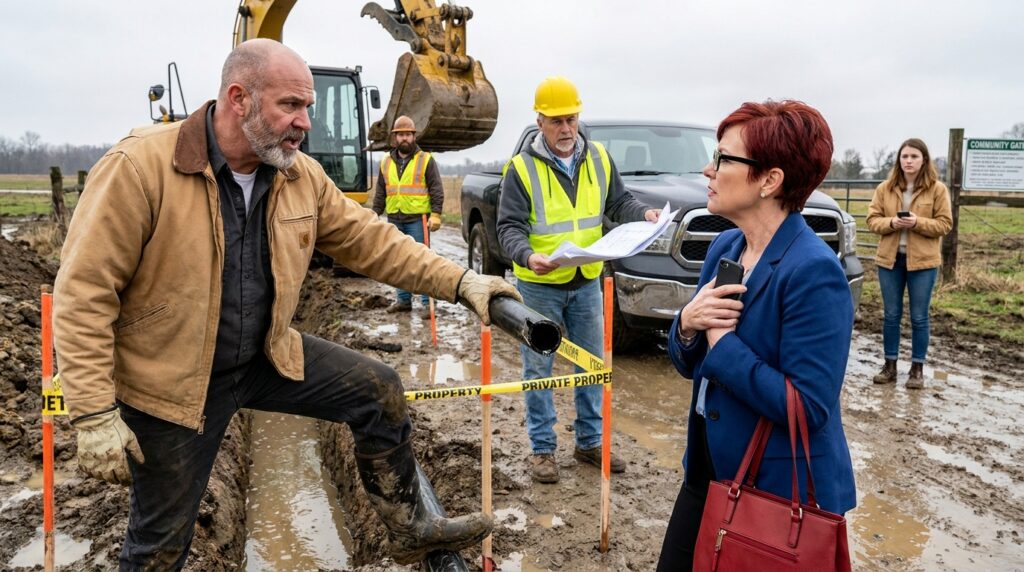
The Cost of Common Ground: A Story of Unyielding Foundations, Mud, and Rusted Truth
CHAPTER 1: THE TRENCH
“Cut the engine,” Miller said. He didn’t raise his voice over the rhythmic rattle of the diesel exhaust, but he didn’t move his boot from the yellow tracking tread either.
The operator, a burly man in an orange mesh vest that smelled of stale tobacco and cold grease, blinked down from the cab. His hands remained wrapped around the hydraulic joysticks, the massive steel bucket hovering three feet above the torn sod like a suspended iron fist. Gray exhaust puffed from the stack, smelling heavily of sulfur and cold morning air.
“Look, mister,” the operator shouted over the engine’s drone. “We’re under contract for the Whispering Pines expansion. The main line goes in today. I don’t know anything about a property line.”
Miller looked down at his own split-cowhide gloves, slick with the cold, gray clay mud of his lower pasture. A four-foot trench already scarred the earth, splitting the native bluestem grass that his grandfather had planted forty years ago. The ditch was filling with murky runoff, a slow-moving pool of brown water that lapped against the raw, black skin of a thick sewer main. The steel teeth of the bucket had bitten deep, leaving jagged, grooved scars in the limestone shelf below the topsoil. The vibration of the idling engine traveled up through the rubber of Miller’s boots, a persistent, grating hum that set his teeth on edge.
He didn’t argue. Instead, Miller reached down and grabbed the edge of a bright orange utility flag pinned near the track. The plastic was brittle from the autumn frost, snapping as he yanked it free. The text printed on the vinyl strip didn’t match the county code. It was a private contractor’s stamp, fresh and cheap.
A car door slammed behind the line of vinyl privacy fences that marked the subdivision’s border. The sound was sharp, like a pistol shot in the damp valley air.
Through the gap in the temporary chain-link gate stepped a woman dressed in a crisp blue tailored blazer that looked absurd against the raw mud. Her black-framed glasses glinted under the overcast sky as she marched toward the trench, her heels sinking into the soft perimeter turf. She clutched a red leather handbag tightly against her chest, a shield against the wet wind, her fingers tapping a furious rhythm on her phone screen.
“What is the delay here?” she called out, her voice cutting through the diesel rumble with practiced, institutional sharpness. She didn’t look at Miller; she looked at the operator in the cab. “We are on a strict municipal timeline. Every hour this machinery sits idle is a direct violation of our development schedule.”
Miller turned his head slowly, his eyes tracking the mud tracking across his fence line from her pristine white shoes. He felt the cold iron weight of the old boundary pin hidden beneath the disturbed earth just six inches to her left—a secret piece of rusted iron that had held this valley together since the territory was surveyed. The air smelled of wet stone, turning earth, and the sharp, chemical tang of new plastic pipe. The conflict had arrived, and it was already sinking into the mud.

CHAPTER 2: UNDER THE SOD
The woman’s heel sank three inches into the gray clay, the leather suctioning with a wet, heavy rasp as she tried to pull her foot back. She didn’t look down. Her attention remained fixed on Miller, her teeth clicked tight behind pale lips, her large black-framed glasses trembling slightly on the bridge of her nose.
“Mr. Miller, I presume,” she said, her voice dropping into a register that had likely flattened dozens of neighborhood committees. She shook her smartphone toward the idling excavator. “I am Evelyn Vance, Director of the Whispering Pines Homeowners Association. You are actively obstructing a county-sanctioned infrastructure corridor. This equipment operates under a municipal utility waiver. Every minute you stand on that tread costs our community thousands of dollars in contractor retention.”
Miller didn’t take his boot off the yellow tracking steel. The iron links beneath his sole were coated in a fine glaze of rust and wet grit that ground against his leather work boots with every micro-movement of the machine’s chassis. He looked at her white shoes, now stained a dark, indelible charcoal by the valley silt, then up at the red handbag clutched like a small leather shield against her ribs.
“There’s no corridor here, Mrs. Vance,” Miller said. His voice was low, dry, carrying the rasp of a man who spent his mornings clearing cedar dust from his throat. “There’s only pasture. My pasture.”
“The county records indicate an emergency extension variance for Phase Three,” she snapped, her thumb flicking across her phone screen, bringing up a PDF document with a bright digital seal. She thrust the screen toward his face. The glass was misted with fine droplets of the cold afternoon drizzle. “Look at the authorization. It was logged six months ago. The easement is automatic under the municipal growth ordinance.”
Miller didn’t look at the phone. He reached into the deep canvas pocket of his tan work jacket, his fingers brushing against the cold, notched edge of his grandfather’s old fence-tightening tool before settling on a heavy, brass-bound tape measure. He pulled it out, the metal casing cold and scratched, its springs grinding with a gritty rattle as he pulled three feet of yellow blade from the housing.
He stepped off the excavator track, his boots making a heavy thud in the uncompacted sod. He walked six feet to the left of the trench, where the earth rose into a small, untamed knoll covered in dead briars and wild mustard.
“The growth ordinance covers the section line,” Miller said, his boots crunching through the frozen stalks. “The section line is forty rods back by the blacktop. This knoll belongs to the original Miller patent. 1914.”
He knelt in the grey mud, heedless of the clay soaking through the knees of his dark trousers. With his gloved hand, he began tearing away the thick, matted layers of dead grass and wet earth. The operator in the cab cut the engine down to a low, guttural throb, the sudden drop in decibels making the wind sound louder as it whistled through the vinyl privacy slats of the development forty yards away.
Evelyn Vance followed him to the edge of the clearing, her breath coming in short, ragged plumes of white vapor. “This is obstruction of a public utility, Mr. Miller. I have the sheriff’s department on speed dial. The county crew lead is already on his way with the official filing papers. You cannot simply dig up a worksite because you’re nostalgic about acreage.”
Miller didn’t answer. His fingers hit something solid beneath the mud—something cold, pitted, and unyielding. It wasn’t limestone. It was the square, hand-forged head of an iron boundary pin, driven four feet into the bedrock by a man who had broken his back to clear this valley before the roads were even gravel. The top of the iron was deeply rusted, flakey layers of orange oxide coming away against the split-cowhide of Miller’s glove.
Beside the pin, buried under two inches of loose silt, sat an old surveyor’s plastic cap, melted and warped by some ancient brush fire. Miller cleared the dirt from its face. There were numbers stamped into the plastic, but they didn’t match the standard county ledger prefix. They were irregular, erratic, carved with a heavy hand.
He stood up, his knees cracking in the cold air. He wiped the gray muck from his palms onto the flanks of his canvas jacket, leaving dark, smeary tracks across the fabric. He looked past Evelyn Vance toward the open trench, where the black sewer main sat like a giant, half-buried water moccasin in the muddy water.
“Your contractor didn’t check the markers,” Miller said, pointing a muddy finger down at the rusted iron head in the grass. “And that stamp on your orange flags doesn’t belong to the district office. It belongs to a private outfit out of the western line.”
Vance’s face didn’t soften, but her shoulders went rigid beneath the sharp lines of her blue blazer. Her fingers tightened around the handle of her red handbag until the leather creaked. “The contractor was selected through standard association procurement, Mr. Miller. The documentation is legally binding. If there is an error in the physical alignment, it will be handled through an administrative adjustment after the infrastructure is secured. The homes cannot wait for a boundary dispute.”
“The infrastructure is sitting on private earth,” Miller said. “And nobody buries anything on my land until I see the county seal on wet ink.”
From the gravel access road behind the subdivision gate, the low, heavy rumble of a commercial engine approached. A dark utility pickup truck, its door panels bearing the faded gold emblem of the County Engineering District, rolled through the gap in the fence, its tires churning the gravel into a wet paste. The brake lights flared red, reflecting off the standing pools of water in the trench.
Miller watched the driver’s side door open. A man in a yellow hardhat and a high-visibility vest stepped out, holding a thick leather folder tucked under one arm like a ledger. The game was expanding, and the ground beneath their feet was getting softer by the second.
CHAPTER 3: THE BORDER AND THE CLIPBOARD
The dark utility pickup truck didn’t just stop; it settled into the pasture’s edge like an old iron wedge dropped into a fresh log. The driver’s door groaned against its hinges as the man in the yellow hardhat stepped down, his heavy leather boots finding purchase in the crushed limestone gravel at the subdivision gate before tracking straight out into the soft, uncompacted clay.
Evelyn Vance didn’t wait for him to reach the trench. She stepped out of the high weeds, her blue blazer catching a low branch of dead briar that scraped along the synthetic fabric with a dry hiss. Her white shoes were completely caked now, turning into thick, shapeless clubs of gray silt that left jagged tracks behind her.
“Frank, thank goodness,” she called out, her phone already raised like an official summons. “We have a structural hold on the trench. Mr. Miller has physically blocked the excavator tread. I need you to produce the county clearance log for Phase Three immediately so we can clear this obstruction.”
The man she called Frank didn’t speed up. He was a thick-set man with a face like wind-scoured granite, his eyes small and watery behind squinted lids as he took in the scene. He didn’t look at Vance’s phone. He looked at the yellow machine, then down at the deep, muddy canal where the black sewer pipe lay shivering under the low vibration of the machine’s secondary hydraulic line. Under his arm, the heavy leather binder showed worn corners where the cardboard insert had begun to rot out from decades of county rain.
“Afternoon, Miller,” Frank said. His voice was a flat, unhurried rumble, the sound of a man who spent forty years interpreting tax codes and concrete grades. He stopped two feet short of the trench, his gaze dropping down to where Miller’s fingers had peeled the sod back from the hand-forged iron pin.
“Frank,” Miller nodded. He didn’t stand up all the way, remaining balanced on one boot with his split-cowhide glove resting flat against the orange oxide of the boundary marker. “Your office send out a line crew this morning?”
“We got the notification for the tie-in on the main road,” Frank said, his thumb hooking into the thick webbed strap of his high-visibility vest. He looked down at the warped plastic cap Miller had uncovered. “But we didn’t slate any ditching through the lower valley segment until the winter board meets. Not on the master grid.”
Evelyn Vance’s phone screen went dark as she dropped her hand, her knuckles turning a sharp, bloodless white against the red leather strap of her handbag. “Frank, that’s an administrative detail. The emergency utility waiver signed off six months ago by the district surveyor covers the entire corridor adjacent to the Whispering Pines perimeter fence. We have thirty-six families whose residential closings are dependent on this connection being inspected by Friday. The contractor has an expedited work order.”
“The contractor’s got a lot of things, Evelyn,” Frank said, his fingers working the rusted brass snap of his leather folder. The sound was a sharp, metallic clink that seemed to focus the quiet of the pasture. He pulled out a large, three-times-folded sheet of translucent blue drafting paper. The margins were tattered, grayed by oil stains from older trucks. “But if they’re digging sixty feet west of the road allowance, they’re not in the corridor. They’re in the tax block.”
Miller stood up then, the dry clay on his knees cracking and peeling away in thin flakes that dropped into the dead mustard stalks. He stepped closer to Frank, the space between them closing with the quiet rhythm of two men who understood the physical realities of fence lines and drainage ditches.
“Look at that cap, Frank,” Miller said, pointing down with his mud-caked thumb toward the erratic numbers stamped into the melted plastic beside the old iron pin. “That’s a 740-series registration. The county hasn’t issued a 740 prefix since old man Craddock retired from the assessment office after the county bond crisis.”
Frank squinted down at the pin, his thick leather boots sliding slightly in the slick gray silt as he leaned over the edge of the knoll. His jaw tightened, the skin around his salt-and-pepper beard turning white. He didn’t answer right away. He pulled a small, brass-rimmed magnifying loupe from his vest pocket—a tool that had belonged to his father before the county paved the main line—and held it down toward the numbers.
“Vance,” Frank said softly, not looking up from the loupe. “Who brought this specific work order down to the site crew this morning? Was it the main office or the subdivision coordinator?”
“It was processed through our development counsel,” Vance said, her posture stiffening until her shoulders appeared almost squared off against the line of houses behind her. She took half a step forward, her heel catching on a buried stone, but she didn’t look down to check her balance. Her voice maintained that precise, unyielding edge that had carried her through every zoning meeting. “The signature on the waiver is from the district surveyor’s desk. It has the county seal on the header, Frank. I reviewed the physical file myself before the track was laid.”
“The signature might be on the header,” Frank said, straightening his back with a slow, deliberate crunch of his vertebrae. He folded the blueprint back into its leather housing, the paper rustling like dry corn husks in the raw afternoon wind. “But the registration on this marker isn’t in the current county book. It’s an old provisional layout. One that was killed when the highway bypass went through twenty years ago.”
Miller looked from Frank to the open ditch, his mind already calculating the cause and effect of the line. The operator in the cab had stopped smoking; he was leaning over his console now, his gloved hands resting loosely on the black knobs of the hydraulic controllers, waiting for the word that would either turn his machine back into an installation tool or a weapon of extraction.
“That means the line crew didn’t misread the map,” Miller said, his voice dropping into the low, dangerous tone he used when a steer was pinned against a wire fence. “They used an old sheet on purpose. To miss the legal easement cost.”
Vance’s hand moved toward her handbag, her fingers slipping into the outer pocket where her car keys rattled with a small, frantic silver sound. “This is an administrative dispute, Frank. It can be settled in the county courthouse on Monday. The machinery is here now. The trench is open. We cannot simply leave a primary utility conduit exposed to the elements because of a twenty-year-old clerical error.”
“It’s not a clerical error, Evelyn,” Frank said, his voice turning as hard and cold as the limestone shelf at the bottom of the ditch. He turned his back to her, his yellow hardhat catching the gray light from the clouds as he looked at the operator. “Turn off the fuel pump. Nobody moves an inch of this earth until I get the digital transit out of the truck.”
The excavator worker didn’t hesitate. He pulled the red emergency kill-switch on his dash, and the deep, throbbing roar of the diesel engine died instantly, leaving only the sound of the wind snapping the yellow caution tape against the orange stakes.
Miller didn’t take his eyes off Evelyn Vance. Her face hadn’t changed, but her smartphone was trembling in her palm, the light from the digital seal reflecting off her dark glasses like a small, fake star trapped in the mud.
CHAPTER 4: THE DEED AND THE TRANSIT
The silence left by the dead diesel engine felt heavier than the machine itself. Without the throb of the exhaust, the raw rattle of the wind against the vinyl slats forty yards back became a rhythmic slap, carrying the smell of wet asphalt from the suburban grid across Miller’s frozen clover.
Miller didn’t stand by the open trench to watch Evelyn Vance calculate her next phrase. He turned on his heel, his heavy leather work boots tracking two-inch wedges of clay across the pasture as he walked back toward his old three-quarter-ton truck parked near the line fence. The driver’s side floorboard was littered with loose iron fence staples, spent brass casings from a varmint rifle, and the grey dust of dried limestone. Beneath the seat lay what he needed—a rectangular, scuffed green canvas case with an oil-darkened brass zipper that smelled of dry graphite and age.
He hauled the case onto the dropped tailgate. The rusted metal chain holding the gate popped and strained, grinding under the sudden shift of weight. Inside the canvas lay his father’s ledger, a leather-bound logbook from 1968, its pages thick, yellowed by tobacco smoke, and hand-ruled with waterproof iron-gall ink.
When Miller turned back to the trench, Frank had already pulled a tripod from the bed of the county pickup. The aluminum legs were nicked, covered in white spray-paint remnants from a dozen highway jobs, the iron shoes on the bottom biting into the sod with a wet crunch.
Evelyn Vance had moved closer to the dark pickup truck’s hood, her stocky frame silhouetted against the subdivision’s white entrance arches. Her fingers were still moving on her smartphone screen, but her breath came faster now, leaving thin, irregular plumes of white mist that tore apart in the wind.
“Frank, this is an administrative overreach,” she said, her voice dropping lower, trying to narrow the perimeter of the conversation so the operator in the cab couldn’t catch the rhythm of it. “The contractor has already paid the county filing fee for the development tie-in. The stamp on that sheet was cleared through the engineering clerk’s desk in May. If your office has an internal discrepancy regarding old records, that is an insurance matter for the county, not a reason to halt an active regional connection.”
Frank didn’t look up from the brass mounting screw of the digital transit he was leveling on the plate. “The filing fee went to the road commission, Evelyn. Road commission don’t clear land titles. They just clear gravel.”
Miller dropped the heavy leather logbook onto the dark hood of the county truck. The sound was a flat, dead thud that made the blueprints rustle. He flipped the cover back, the stiff binding creaking like an old saddle. He ran his mud-stained thumb down the hand-penciled margin of page forty-two until he hit the entry for the western section line.
“Look at the entry for the 1974 secondary easement request,” Miller said, his voice flat, dry, and unhurried. He pointed with a dirty fingernail at a six-digit string of numbers written in red ink. “Old man Craddock tried to run a cattle-dip line through this exact knoll fifty years ago. My father stopped him at the boundary because the county charter doesn’t allow automatic utility extensions on properties with an active homestead exemption dating before the 1920 consolidation. The 740-prefix cap you’ve got down there in the mud isn’t an authorization. It’s the rejection marker.”
Frank pulled his head back from the transit eyepiece, his squinted eyes turning toward the handwritten page. He reached down, his leather-gloved index finger tracing the red ink numbers, then shifted his gaze back to the blueprints spread across the metal hood. His jaw worked beneath his short, weathered beard, the skin around his mouth tightening into hard, dry folds.
“Where did your council get this map number, Vance?” Frank asked. His tone wasn’t loud, but it had the weight of an iron pipe dropping into sand. He tapped the blueprint’s title block with a blunt finger. “This isn’t the master grid revision from the county clerk. This is an archival plate from the old railroad appraisal office. The person who signed off on this work order didn’t get it from the district vault. They pulled it from the dead files.”
Evelyn Vance’s red handbag slipped slightly down her forearm, her wrist straining against the weight as she adjusted her grip. She didn’t look at the ledger. Her eyes stayed locked on the small, brass-rimmed loupe Frank had left on the drafting paper.
“The documentation was provided by the independent surveyor hired by the primary developer,” she said, her chest rising sharply under the blue blazer. She took a step toward the truck hood, her caked shoes sticking to the pasture turf until the leather groaned. “Mr. Craddock’s firm handled the initial layout for Whispering Pines Phase One. His signatures have been accepted by the county board for three decades. We had no reason to question the validity of an established engineering stamp.”
Miller watched her closely. He saw the subtle twitch in the corner of her jaw—not the anger of an official caught in a mistake, but the cold calculation of an investor who knew exactly how many days were left before the bank pulled the construction credit line.
“Craddock hasn’t held a county surveyor’s license since the state board revoked it for boundary cooking during the valley commercial development five years ago,” Miller said. He reached down and picked up the contractor’s orange flag he’d snapped earlier, tossing the broken plastic shaft onto her phone screen. “Your independent surveyor didn’t file this with the county because he couldn’t. He signed a private work order using a dead stamp so your crew could get the pipe in the ground before anyone looked at the deeds.”
The operator in the excavator cab leaned his elbows on the steering wheel, his head turning toward Vance as he pulled a greased rag from his pocket to wipe his fingers. He didn’t say a word, but his posture had gone loose, the posture of a hired hand who had just realized his company truck might get impounded by the state.
Frank turned back to his transit, his thumb clicking the coarse adjustment wheel through three quick notches. “I’m running the line from the road marker now, Miller. If the transit aligns with that iron head you found under the sod, this trench is thirty feet inside your line. And that means the association is sitting on a Class A civil trespass while actively operating a commercial trenching tool without a permit.”
Vance’s smartphone beeped, a sharp, electronic chime that sounded small and useless against the expanse of the gray pasture. She didn’t look down to answer it. Her mouth had thinned into a pale line that looked like a scar across her face.
“Frank,” she said, her tone dropping into a dry, whispery rasp that lacked all its earlier committee authority. “We have forty-eight hours before the utility commission pulls the system certification for the entire phase. If this main isn’t connected, the development title is frozen.”
Miller leaned his weight against the truck fender, his gloved hands tucked into his armpits against the sharpening wind. “Then you better start thinking about where you’re going to put thirty-six homes’ worth of sewage, because it isn’t crossing this grass.”
CHAPTER 5: THE ANCHOR IN THE MUD
The cold wind didn’t just rattle the caution tape; it drove a fine spray of grit straight across the rim of the open ditch, peppering the raw black polymer of the sewer main with gray pasture sand. Evelyn Vance didn’t step back toward the subdivision gate. Her stocky frame lurched forward instead, her caked shoes slipping on the wet clay incline as she lunged toward the excavator foreman’s platform, her smartphone raised high like a blunt weapon.
“Bury it,” she barked at the operator, her voice stripping down to a jagged, whistling edge that completely bypassed the county crew lead’s authority. “Start the pump, Carl. Fill the first twenty feet. We have an operational binder under the emergency clause, and no municipal transit reading overrides an active development ledger on site.”
Carl didn’t touch the fuel valve. His thick, grease-darkened hand remained wrapped around the cold rubber handle of the kill-switch, his eyes tracking the sudden shift of Miller’s weight at the edge of the knoll.
Miller moved before the wind could snap the tape again. His heavy leather work boots cut three-inch furrows into the unstable slope as he slid directly down into the four-foot trench. The gray slurry at the bottom pool surged up over his ankles, the ice-cold water instantly penetrating the lower seams of his boots with a heavy, sucking gurgle. He didn’t look at his feet. He planted his palm—the split-cowhide stiffened with dried mud and the orange flake of his grandfather’s iron pin—flat onto the curved surface of the exposed main pipe. He braced his shoulder against the raw clay wall of the ditch, his entire frame turning into a solid, human wedge between the excavator bucket and the disputed infrastructure.
“Get out of the track, Miller,” Vance shouted, her heels grinding into the lip of the pasture turf directly above him, sending loose clots of sod tumbling down onto the crown of his bald head. “You are trespassing on a utility corridor cleared by the district surveyor. Carl, drop the bucket. He won’t stay under the steel.”
“Carl,” Miller said, his voice dropping into that low, level grate that carried beneath the whistle of the wind. He didn’t look up at her. His gaze remained locked on the hydraulic pistons of the yellow machine. “You drop that iron, and you’re sealing an unpermitted line into a private patent. The county truck is parked right there, and Frank’s got the state registry on the hood. Think about who pays the impound fee when the sheriff gets here.”
Frank didn’t look through his transit eyepiece anymore. He marched down from the knoll, his aluminum tripod legs clattering together as he slung the rig over his high-visibility vest. His heavy boots pounded the pasture line until he stood at the very edge of the trench, his granite-scoured face turning dark under the yellow brim of his hardhat. He reached out with his leather clipboard, jamming the wooden corner right into the space between Vance’s shoulder and the excavator’s access ladder.
“I said cut the line, Evelyn,” Frank growled, his flat rumble rising over the rattle of the vinyl slats. “The transit don’t lie, and the red ink in Miller’s logbook matches the 1920 charter block. This pipe is thirty feet inside the Miller patent line. If that bucket moves an inch toward this ditch, I’m calling the district marshal for an intentional encroachment violation before the grease on these tracks cools down.”
Vance didn’t recoil from the clipboard, but her handbag swung hard against her blue blazer, the red leather creaking under the strain. She stood perfectly still on the slick edge, her oversized black-framed glasses sliding a fraction of an inch down her nose as she stared down at Miller’s mud-coated glove on the pipe. For three seconds, the only sound in the pasture was the low, rhythmic slosh of the brown trench water lapping against Miller’s leather boots.
Then, from the far side of the subdivision fence, the younger neighbor with the notepad moved. She didn’t stay by the gate anchor. She walked straight down to the yellow caution tape, her white shoes sinking into the silt as she held her smartphone out, the glass lens catching the desaturated light of the clouds. She wasn’t filming the pasture; she was tracking the title numbers Frank had left exposed on the dark truck hood.
“Mrs. Vance,” the girl called out, her voice thin but persistent in the cold air. “The site manifest from the subcontractor just updated on the owner portal. The registry number they logged for the district clearance doesn’t have an active county escrow bond attached to it. It’s marked ‘conditional hold’ since the spring audit.”
Miller didn’t take his hand off the pipe. He felt the cold vibration of the water moving inside the line—the dead weight of a suburban system trying to force its way into earth that had been paid for in sweat and limestone fifty years before. He looked up at Vance, seeing the small, white line of salt sweat that had broken out along her temple despite the freezing drizzle.
“The stamp was a decoy, wasn’t it?” Miller said, his fingers digging into the slick black polymer until the clay beneath his nails ground against the plastic. “You didn’t just use an old map to save the easement fee. You used it because the county wouldn’t issue a new permit to an association whose infrastructure bond is already defaulting at the bank.”
Evelyn Vance’s phone didn’t chime this time, but her thumb went entirely still on the dark screen. Her stocky frame seemed to settle into the gray clay of the pasture line, her blue blazer suddenly looking thin and frayed against the vast, indifferent expanse of the valley sky. She looked at Frank, then back down into the trench at Miller, her lips tightening into a pale, dry seam that offered no answers, only the silent, bitter logic of a modern grid that had run completely out of ground.
CHAPTER 6: THE BLUEPRINTS ON THE HOOD
Frank didn’t look down into the mud to help Miller out of the ditch. He turned away from Evelyn Vance, his heavy leather boots making a dry, crunching sound through the gravel strip as he walked back to the pickup truck. He slammed his tattered ledger onto the sheet metal of the truck’s dark hood, the heavy brass bindings throwing a dull spark as they bit into the scratched enamel.
“Get up here, Evelyn,” Frank said. His rumble didn’t carry across the pasture this time; it stayed low, pinned down by the sharpening dampness of the air. He flattened the creasing blue drafting sheets with two thick palms, his split-leather work gloves grinding coarse sand into the fine white line work of the maps.
Miller hauled himself out of the four-foot slot, his wet boots weighing fifteen pounds apiece under their coating of grey pasture clay. The mud suctioned against the raw limestone shelf with a hollow thump as he rolled his weight onto his knee, his canvas jacket stiffening with wet silt. He didn’t wipe his clothes. He walked straight to the truck fender, his jaw tight, his eyes fixed on the tattered paper block where the county registry numbers were inked.
Evelyn Vance followed him three seconds later, her gait short and awkward. One of her white shoes had lost its decorative plastic buckle to the briars, and the synthetic blue fabric of her blazer was dark with drizzle across the shoulders. She didn’t drop her red handbag. She pinned it between her ribs and the truck’s iron quarter panel, her knuckles red from the cold as she stared at the blueprint margins.
“The registry is valid, Frank,” she said, her voice dropping into a flat, whispery stubbornness that lacked the smooth projection of her boardroom tone. “Look at the seal on Section Four. It’s the official county stamp from the engineering clerk’s registry. The subdivision paid forty-five hundred dollars for the title filing.”
“The stamp is twenty-four years out of date, Vance,” Frank said, his thumb tracking a jagged white line from the county road allowance straight across the pasture grid until it hit the hand-inked square marked Miller homestead. “This map shows the old spur line for the narrow-gauge timber rail. That easement died by state sunset law during the reconstruction funding act in eighty-two. The clerk didn’t issue this out of the master book. This sheet was pulled out of the scrap files in the basement vault.”
Miller leaned his hip against the rusted wheel well of his truck, his mud-caked fingers unbuttoning his canvas coat to reach his small brass pocket rule. He didn’t pull it out. He just let his thumb trace the cold, notched metal through the lining.
“She knows it’s a dead map, Frank,” Miller said. His voice was a dry rasp that didn’t rise over the slap of the vinyl slats behind the fence. “The subcontractor didn’t have a state engineering supervisor on the ditch crew this morning. They brought an out-of-county gang because no licensed operator around here would drop bucket into an unverified patent without an escrow voucher from the county clerk.”
The younger neighbor by the gate didn’t lower her phone. She stood five feet back from the truck’s rear bumper, her tan coat flapping against her knees as she shifted the camera lens to capture the handwritten tax ID prefix on Frank’s clipboard insert.
“The owner portal just dropped the secondary notice,” the girl said, her teeth clicking slightly from the raw wind. She didn’t look at Vance; she looked at the text scrolling on her screen. “The bank put the Phase Three construction credit line on an administrative hold at noon. It says the developer’s collateral bond didn’t clear the municipal clearing house because the underlying tract registry is listed as incomplete.”
Vance’s hand moved to her glasses, her fingers catching the black frames as she pushed them back up her nose. Her face remained set in those hard, heavy folds, but her skin had turned the greyish color of cold wood ash. She didn’t look at the girl. She reached out and tapped the blue paper with her polished thumbnail, leaving a clear indent in the damp cellulose.
“We have thirty-six families who have already signed their mortgages, Frank,” she said, her voice tightening until it carried a high, thin edge like wire under tension. “The infrastructure has to loop through this section to meet the state environmental code for the low-pressure junction. If we don’t connect the line by Friday, the state defaults the association’s utility franchise. This isn’t about an old rail line. If the title freezes, the whole phase falls into municipal receivership.”
Frank pulled his magnifying loupe back from the blueprint’s ledger block and dropped it into his vest pocket with a sharp clink. He didn’t look at her. He reached out and grabbed the edge of the drafting sheet, his leather gloves tearing a three-inch split through the margin as he folded the paper back into its tattered leather jacket.
“You should’ve thought about the receivership before you hired Craddock’s old crew to bypass the district desk, Evelyn,” Frank said. His tone had no more negotiation in it than a concrete barrier. He turned his back to her and pointed his thick clipboard toward the excavator operator, who was still leaning over his console in silence. “Keep that engine cold, Carl. I’m tagging this trench as an unpermitted commercial encroachment. If I see that bucket drop an inch toward the sod before the district surveyor gets here tomorrow morning, I’m locking the tracks with a county chain.”
Miller watched the operator pull his greased rag through his belt loop and drop back into the cab seat without touching his key. The silence in the pasture expanded, hard and flat, until the only sound left was the slow dripping of muddy water from the underside of the yellow machine’s iron undercarriage into the raw trench below.
CHAPTER 7: THE CRACKED SHELL
The steady drip-drop of greasy condensation from the excavator’s underside hit the pool at the bottom of the trench with a dull, oil-slicked slap. Carl had already turned away from the panel, his heavy-set frame slumping as he reached for a tin lunchbox behind his seat. The machine was dead iron now, a cold monument of rust and yellow primer squatting on Miller’s bluestem grass.
Miller didn’t leave the truck fender. He watched Evelyn Vance’s fingers—cold, red-tipped, and trembling slightly—as she unclasped the brass frame of her red handbag. She pulled out a fresh pack of cigarettes, her thumb tearing the foil with a frantic, rhythmic scratch that sounded like a mouse behind drywall. She couldn’t get the lighter to spark against the raw wind coming down the draw.
“Frank,” she said, her voice dropping all its legislative weight, turning into a thin, sand-scoured rasp. “The low-pressure junction is already paid for. The association took out a secondary infrastructure levy from the phase-two homeowners in January. The cash is in the escrow account. This isn’t a funding failure. It’s a timing knot.”
Miller leaned forward, his mud-soaked sleeves grinding against the cold iron of the truck’s quarter panel. He didn’t look at the blueprints. He looked straight at the little printed code on the subcontractor’s manifest sheet that the neighbor girl had displayed on her phone.
“The levy didn’t go into escrow, Vance,” Miller said. His tone was level, devoid of heat, carrying only the hard, unyielding weight of a man who spent his winters counting hay bales against an unyielding frost. “If the underlying tract registry is listed as incomplete on the county audit, that means your phase-three land isn’t even legally subdivided yet. You didn’t pay for an easement because the bank wouldn’t clear the funds for a title that’s got three active mechanics’ liens on the greenbelt sector.”
Vance’s face didn’t twitch, but the unlit cigarette between her fingers snapped with a dry, white crunch, tobacco flakes spilling down onto her blue lapel. She looked at Miller, her large black-framed glasses catching the gray, desaturated glare of the sky. For the first time since she had stepped into the pasture silt, her jaw didn’t hold its structured line. It went slack, the skin under her chin looking thin and gray in the midday drizzle.
“You don’t understand how the development mechanics operate, Mr. Miller,” she said, her whisper barely carrying over the slap of the vinyl fence slats behind them. “The phase-two infrastructure has a cross-collateralization clause with the county utility district. If the tie-in isn’t logged by the state inspector before the fiscal board closes the ledger on Friday, the district triggers an automatic forfeiture on the primary development bond. It doesn’t just freeze phase-three. It liquidates the association’s maintenance reserve for the existing homes. The entire subdivision goes bankrupt by Monday.”
Frank let out a dry, rattling cough, his hand reaching down to secure his leather logbook binder with a sharp pop of the brass snap. He didn’t look surprised. He looked tired—the old, deep fatigue of a county man who had watched five different development companies try to pave over the valley’s debt with cheap lime and fast titles.
“So that’s why Craddock’s name is on the scratch sheet,” Frank said, shaking his head until his yellow hardhat caught the edge of the pickup’s side mirror. “He didn’t just give you an old map, Evelyn. He’s the one who held the original option on the greenbelt before the 2008 crash. The HOA has been playing hide-and-seek with the state treasury for eighteen months, using Craddock’s old corporate shell to sign off on utility extensions so the bank wouldn’t smell the default.”
The neighbor girl backed away two steps from the utility truck’s tailgate, her white shoes making a heavy, squelching sound in the clay. Her smartphone screen stayed bright, tracking a fresh line of text that seemed to reflect off her wide, staring eyes. “The board meeting notification just hit the resident portal,” she muttered, her voice dropping into the cold wind. “An emergency session has been called for six tonight. They’re discussing an emergency assessment… seven thousand dollars per lot to cover the infrastructure deficit.”
Miller looked back down into the trench at the black polymer main line. The pipe looked different now—not like a corporate machine cutting into his legacy, but like a long, expensive piece of garbage left behind by a crowd of people who had run out of other people’s money. He reached into his pocket and pulled out his grandfather’s old fence-tightening tool, the cold, pitted iron fitting into his palm with a familiar, greasy weight.
“You built your whole town on a ledger trick,” Miller said, his boots grinding into the limestone gravel as he stepped toward Vance, forcing her to look down at the gray clay caked over her polished white shoes. “You thought because you had a blue coat and a smartphone, the dirt would just move out of your way. But the dirt don’t owe your bank a dime, and it don’t hold a mortgage.”
Vance didn’t answer. She dropped her red handbag onto the truck hood, the leather hitting the blueprints with a heavy, dead smack. She turned her back to the pasture, her eyes tracking the long, uniform rows of identical asphalt shingles and white vinyl trim that stretched out across the ridge—thirty-six homes waiting for water that was locked behind an old iron boundary pin.
Frank slung his tripod over his shoulder, the metal legs clicking with a cold, final resonance. “Carl,” he called out to the operator, his voice rising into a flat, administrative command. “Get your rig ready to reverse out of this slot. The district marshal’s coming down with the red tags, and if this machine is still sitting inside Miller’s fence line when the clock strikes five, you’re going to be explaining that work order to a state magistrate.”
Carl didn’t say a word. He threw his grease rag onto the dashboard and reached for the ignition key, his knuckles white as he prepared to pull the yellow steel back across the border.
CHAPTER 8: THE MONUMENT OF SCARS
The key scraped against the tumbler with a sharp, dry scratch before the starter caught. When Carl threw the hydraulic levers forward, the excavator didn’t roar—it groaned, its tracks grinding together with a high, iron shriek that sent vibration rolling through the limestone shelf below Miller’s pasture.
Time seemed to slow, widening into a cold, gritty gap between the beats of the wind. Miller stood his ground on the pasture lip as the massive yellow arm rose from the ditch, its steel teeth dragging a thick, heavy slurry of grey clay up into the light. The black sewer pipe—the massive polymer snake that had tried to link thirty-six mortgages to his dirt—strained under the shifting weight. With a hollow, wet pop that sounded like bone breaking through water, the joints separated. The unpermitted conduit fractured, its severed lip dropping back into the dark pool at the bottom of the trench with a listless, heavy splash.
Every link of the tracking chain beneath the cab groaned as the machine began its slow, heavy retreat across the property boundary. Rust flakes, bright orange and dry, rained down from the undercarriage, dusting the crushed bluestem grass like dead leaves. The tracks tore the pasture turf one final time, exposing the gray limestone bedrock beneath before the iron pads rolled off Miller’s property and crossed onto the subdivision’s paved easement road.
Evelyn Vance didn’t move her feet out of the mud to dodge the tracks. She stood perfectly frozen, her stocky frame silhouetted against the manicured entrance arches of Whispering Pines. Her red handbag remained flat on the dark truck hood, forgotten on top of the damp blue drawings. Her black-framed glasses had gathered a fine glaze of freezing drizzle, completely obscuring her eyes behind two round sheets of gray mist. She wasn’t looking at the excavator anymore; she was looking past the fence line at the straight, uniform rows of identical asphalt shingles that climbed the ridge. Thirty-six homes sat silent under the heavy clouds, their dry infrastructure completely isolated by the rusted iron boundary pin at her feet.
Frank lifted his heavy clipboard from the truck fender, the wood clicking against the metal with a sharp, definitive snap that broke the silence. He didn’t offer a hand to Vance. He tucked his ledger under his high-visibility vest and turned his back to the subdivision, his heavy leather boots tracking the last of the clay toward his utility truck’s door.
“That’s the tag, Evelyn,” Frank said. His rumble was flat, dry, and clean of any administrative flexibility. He didn’t look back as he pulled the truck door open, the old hinges giving a long, metallic squeak. “The trench stays open until the county environmental crew logs the soil test. Any attempt to fill this gap before the marshal clears the title order will be processed as destruction of evidence. Tell your board they can find the master filing under the original 1920 patent ledger.”
The neighbor girl backed away through the temporary chain-link gate, her white shoes trailing long smears of pasture silt onto the pristine asphalt of the development road. Her smartphone screen stayed bright, reflecting a tiny, flashing blue light off her wet cheek as she watched the subdivision’s structural credit dissolve in real-time. She didn’t speak to Vance, and she didn’t look back at Miller. She just kept the camera pointed down at her feet, tracking the grey mud as it crossed the threshold from the old world into the new.
Miller reached down into the long grass, his split-cowhide fingers closing over the cold, hand-forged head of his grandfather’s iron boundary pin. The metal was pitted, rough, covered in decades of subterranean rust that left an orange shadow across the leather of his glove. He ran his thumb over the square top, checking the alignment against the fresh gray scar the excavator had left in the turf. The pin hadn’t budged an inch. The modern grid had run up against it, hit the limestone, and bounced back into its own narrow gates.
He stood up slowly, his knees making a dry, cracking sound in the raw valley air. He unbuttoned his heavy canvas jacket and tucked his brass pocket rule back into the lining, his fingers lingering on the cold grease of his old fence tool. He looked across the open, scarred ditch toward Evelyn Vance. Her tailored blue blazer looked thin now, the fabric dark and soaked through by the afternoon drizzle until it clung to her shoulders like old canvas.
“The line is clear, Vance,” Miller said. His voice was low, dry, carrying the rasp of stone grinding against stone. He didn’t raise his hand, and he didn’t point toward the gate. “The ditch stays just like this. Every time your people look out their back windows, they can look at the cost of trying to steal an inch of dirt.”
Vance didn’t answer him. She reached out with a stiff, red-jointed hand and picked up her red handbag, her fingers clutching the leather strap until her knuckles went gray. She didn’t look at the open trench or the broken pipe at the bottom. She turned her caked, broken shoes toward the pavement, her steps heavy and uneven as she walked back through the gate, leaving the tattered blueprints behind on the cold metal hood of Frank’s idling truck.
The diesel smoke from the reversing excavator thinned out, drifting away across the bluestem until the pasture smelled of nothing but wet grass, iron-rich silt, and the sharp, clean tang of the northern wind. Miller stayed by his boundary pin until the taillights of Frank’s pickup flared red at the blacktop, his boots buried deep in his own earth, watching the gray water settle over the stone.