The Concrete Line: A Novel of Suburban Friction, Asset Sovereignty, and Broken Compliance

CHAPTER 1: THE SCRAPE AT THE EDGE

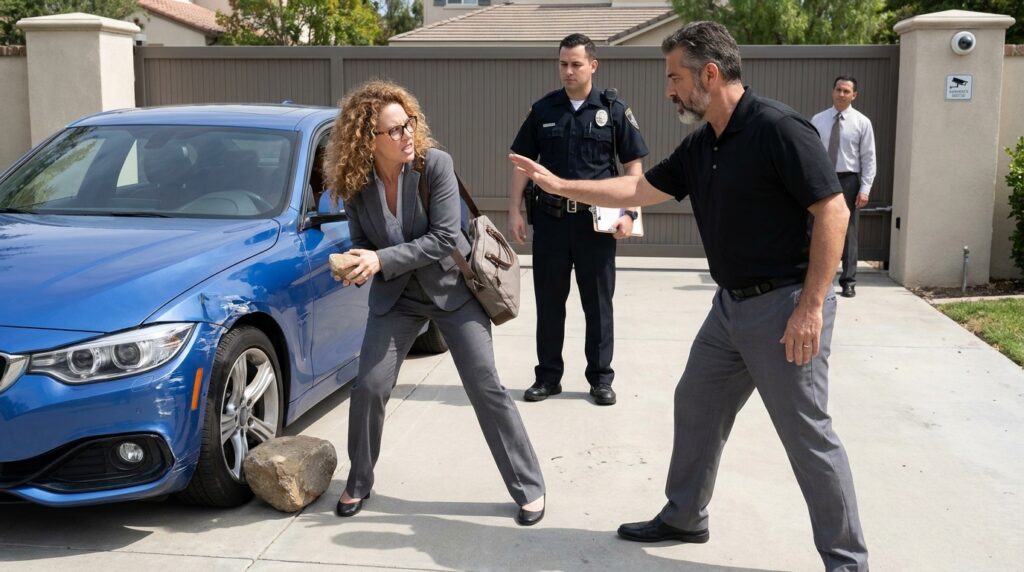
The sound of a heavy metamorphic stone scraping through five layers of factory-sealed metallic clear coat is immediate and jagged, cutting clean through the midday humid silence of the driveway. It isn’t a clean sound. It has the wet, grinding friction of raw mineral tearing into cold zinc-plated steel.

I don’t yell. Out here on the flat gray expanse of the concrete boundary, yelling is a waste of oxygen and a surrender of leverage. Instead, my shoes make a sharp, rhythmic contact against the aggregate surface as I drop the aluminum water hose nozzle. The rubber line thumps against the manicured turf behind me. Five steps. That is the distance between my front porch step and the front-left quarter panel of the blue sedan.

She is still leaning into the turn, her heavyset frame anchored uncomfortably in two-inch tan heels that press deep into my St. Augustine grass. Her fingers, small and red-knuckled under the gold-plated rings, are still white from the effort of pulling the sixty-pound decorative limestone block across the property line. Her gray business suit jacket is bunched at the shoulders, smelling faintly of synthetic lavender and old paper folders.

“I said this car doesn’t belong in my neighborhood!” Her voice is reedy, vibrating with a manic sort of civic piety that she wears like a badge. She doesn’t look at my face; she looks at the deep, white-edged furrow she has just plowed into the metallic blue paint.

I plant my right boot three inches from her toe line, my body weight shifting down, dropping my center of gravity until I am a vertical wall between her gray shoulder and the car’s damaged flank. I don’t touch her. Touching a woman like her in an enclave like this is an invitation for a municipal injunction. I lift my right palm, flat and rigid, a clean two inches from her chest fabric.

“Get back on the asphalt,” I say. My voice has the dry, flat delivery of an insurance adjuster logging a totaled frame. “You’re off the easement.”

Behind her, near the heavy black iron mailbox pillar, her shadow associate—a man in his late 30s wearing a crisp white corporate shirt and a silk tie that matches the local neighborhood association color scheme—freezes. His hand is half-extended toward his leather portfolio, a stack of unfiled compliance notices tucked beneath his armpit. He looks at the fresh white powder of ground stone dusting the blue bumper, then looks up at the brick gate column behind me.

On top of that column, nested in a matte-black weatherproof housing, the small glass lens of the security camera hums as its internal servo adjusts for the glare of the noon sun. It isn’t a standard consumer model; it’s an industrial power-over-Ethernet unit with an unblinking focal ring that has been recording since her heels first crossed the curb.

The neighbor doesn’t back away. She uses her clipboard like a shield, pressing the aluminum edge against her purse. “This vehicle violates the sub-chapter architecture guidelines for guest parking duration, Arthur. I am documenting the nuisance. Captain Scott said your family needs to align with the street’s aesthetic or face—”

“I’m recording this,” I cut in, my thumb already pressing the side button of the smartphone I’ve pulled from my slacks. The lens is three inches from her face, capturing the sweat beads pooling along the rim of her oversized designer glasses. “Send an officer for property damage now.”

She blinks, her mouth remaining half-open, a strange gray shadow of dawning liability passing beneath her pale blouse. The silent associate near the mailbox takes one deliberate step backward into the public street, his fingers releasing the corner of his leather portfolio.


CHAPTER 2: THE ANATOMY OF SURVEILLANCE

The silence that follows the word property damage doesn’t drop cleanly; it hovers over the sun-baked concrete like the exhaust of a diesel engine idling at the curb. The phone in my hand remains level, its digital iris capturing the micro-tremor in her lower eyelid. Her gray business suit jacket seems to stiffen under the midday heat, the fabric straining against her shoulders as she shifts her weight back from the blue sedan’s crumpled perimeter.

For three years, this driveway has been less of an entryway and more of a ledger. Every square foot of this aggregate concrete has been measured, signed for, and defended against the low-grade friction of the local aesthetic board. When you buy a parcel on the outer ring of the development, where the manicured berms give way to the low, rusted wire fencing of the old county line, you learn to look at every truck, every drone, and every clip-bearing neighbor as an actuarial risk.

Her fingers tighten on the plastic lip of her compliance folder. The cardboard edge is frayed from handling, its cheap black spine split to reveal the gray corrugation underneath. From my angle, two inches above her shoulder line, a single sheet of yellow carbon-copy paper slips sideways against her thumb. It isn’t the standard cream-colored neighborhood association violation notice. It is thicker, rougher, stamped at the top margin with a faded purple circular seal from the County Clerk’s Office—the specific legal watermark used for structural variances and utility grid access. A corner of a bolded number is visible: Grid-Expansion Section 4B.

“This isn’t about property damage, Arthur,” she says, her tone dropping out of its high civic trill into a dry, defensive rasp that smells faintly of cold coffee. Her glasses slide down the bridge of her nose, the thick plastic frames casting double shadows across her cheekbones. “This is an active access lane. The association has right-of-way jurisdiction over the first twelve feet from the public curb. If your guest parks a non-conforming, high-clearance foreign vehicle within the peripheral sightline of the intersection, the safety threshold is breached.”

“The sedan is ten feet inside the survey stakes,” I say. My thumb stays locked on the shutter button, the screen tracking her partner near the curb.

The associate has completely checked out of the tactical formation. His leather portfolio is tucked into the small of his back now, his fingers drumming against his thighs as he watches a crow pick at a dried grass snake near the storm drain. He knows the math. He knows that an association fine is a civil matter settled over certified letters, but a deep gouge through three panels of custom paint is a misdemeanor charge that moves through the county municipal court six miles down the road, where the benches are rusted iron and the judges don’t care about neighborhood lawn heights.

“We have the variance paperwork pending,” she shifts, her hand masking the yellow paper, pushing it deeper into the split sleeve of her folder with a quick, dry rustle of old pulp. Her tan heels grind against the edge of the turf, dislodging a small clump of dry gray earth that rolls across the concrete. “The board doesn’t need your permission to clear obstructions from the utility margins. Look at the curb line, Arthur. The iron on your mailbox is already flaking into the ditch. It’s an eye-sore. It’s a liability for the entire block.”

I don’t look at the mailbox. I know the iron is pitting; the salt from the winter treatment trucks eats through the zinc coating every December, leaving a dull, orange-brown crust along the hinges that no amount of industrial primer can permanently seal. That rust is a chronological record of how long I’ve spent keeping this half-acre from being swallowed by the soft, bureaucratic grayness of the surrounding development.

Every morning at five, before the commuter traffic starts its low roar toward the bypass, I check the gate camera logs. For fourteen months, the metadata has shown the same thing: a silver utility crossover slowing down near my property line at 5:14 AM, its passenger side window lowering just enough for a high-intensity spotlight to sweep the fence line where my acreage meets the old pine timber. They weren’t looking for unclipped hedges. They were measuring the distance between my brick columns and the county power poles that run parallel to the ditch—the ones with the weathered green porcelain insulators that haven’t been replaced since the late seventies.

She knows that history, too. Her husband sits on the regional planning commission, his name signed to the dry, single-spaced annexations that turn family timberland into uniform cul-de-sacs with French names. Her business suit isn’t for a corporate office; it’s the uniform of an advance scout who thinks a clipboard can substitute for a title deed.

“You’re thirty-four minutes late for your committee walk,” I say, my voice steady enough to make the associate look up from the storm drain. I glance at the dashboard clock visible through the blue sedan’s driver-side window. “The deputy dispatcher said five minutes. That was six minutes ago. If you want to pull that yellow variance out of your folder and show me the county signature before he gets here, I’ll log it as a civil dispute. Otherwise, stay right where the camera can see your hands.”

Her face doesn’t go red; it turns a hard, chalky white that makes the blue frames of her glasses look massive. Her fingers twitch against the clipboard, her manicured nail catching on the corner of the yellow paper, tearing a tiny triangle of the carbon sheet away. It drops down, a small yellow leaf drifting onto the gray aggregate between our boots, the letters E-A-S-E- visible on the scrap before her shoe moves to cover it.

A block away, down the long, straight asphalt of the avenue where the identical maple trees cast short, circular shadows, a low, mechanical whine begins to grow. It isn’t a resident’s vehicle; it has the heavy, unhurried rumble of an public service engine with an ungreased suspension arm. The flash of a single, non-emergency blue light reflects off the distant neighborhood entry sign.

The associate near the curb takes another step toward the public pavement, his hand completely releasing the portfolio as he clears his throat. “Mildred,” he says, his voice thin and dry like split cedar. “The county car is coming around the circle.”

Mildred doesn’t move her foot from the torn yellow scrap. Her shoulder bag slips down her forearm, the heavy leather strap cutting a deep red line into her wrist as she forces her chin up, her gaze fixing on the unblinking black glass lens mounted on the brick column above my head.

CHAPTER 3: THE DEPUTY ON THE BOUNDARY

The tires of the Ford Crown Victoria hummed against the new asphalt of the main loop before hitting the gravel-pocked transition of my private entrance. The sound was a heavy, low-frequency thud that vibrated through the concrete soles of my work boots. The car was white, stripped of municipal decals except for a faded green shield on the front door panel and a dual-beam halogen bar that sat dark against the roofline.

It stopped dead at the curb line, exactly parallel to where the silent associate stood shivering in his silk tie. The driver’s side door swung open with a dry metallic pop—the hinge spring was completely shot, a common failure in the county fleet after ten years of tracking lime-dust roads along the western transmission lines.

The deputy who stepped out didn’t look like an arbitrator. He was early 30s, lean through the hips but thick-shouldered under the dark wool blend of his municipal utility uniform. His duty belt creaked as he shifted his weight, the leather split at the belt loops from years of carrying a full iron mag-light and a heavy steel Smith & Wesson frame. He didn’t take off his broad-brimmed campaign hat; the shadow of the stiff straw brim cut straight across his cheekbones, hiding his eyes until he stepped into the white glare of my driveway.

“Afternoon, Mildred,” the deputy said. His voice was low, carrying the flat, nasal drawl of the county’s third district. He didn’t offer a hand. He stood near the rusted post of my mailbox, his boots kicking up a faint puff of yellow limestone dust from the shoulder. “Arthur.”

Mildred didn’t look back at the torn yellow scrap beneath her heel. She adjusted her shoulder bag with a short, aggressive jerk of her arm that rattled the gold-plated rings on her fingers. “Deputy Miller, thank goodness you’re around the loop. I am actively executing a compliance assessment under Section 4. This vehicle has been placed within the peripheral sightline margin, and as the standing representative of the neighborhood infrastructure council—”

“The vehicle’s inside the stakes, Miller,” I interrupted. I kept my hand low, the smartphone screen still live and processing the video file into the cloud buffer. “She dragged a sixty-pound limestone boundary marker across four feet of turf to gouge the front panel. It’s an intentional property strike under Title 7.”

The deputy didn’t answer either of us. He walked two slow steps forward, his boots crunching on the dry aggregate until he was standing directly over the front-left wheel well of the blue luxury sedan. He bent at the waist, his leather duty belt groaning under the strain. With one short, thick thumb, he traced the edge of the paint score. A tiny flake of the metallic clear coat detached under his nail, dropping down into the fresh white powder left by the stone.

He looked at the limestone block. He looked at the deep green skid marks through the turf where Mildred’s heels had torn into the grass roots to find leverage. Then, slowly, he tilted his head back, his chin lifting until his gaze settled on the brick gate column behind me. The black-cased security lens was still whirring, its internal cooling fan making a thin, high-pitched whistle against the heat of the brickwork.

“That thing functional, Arthur?” Miller asked.

“It logs twenty-four frames a second to a hard drive in my crawlspace,” I said. “The lens has a polarized filter. It captures the texture of a gray wool suit at forty yards.”

Mildred’s clipboard clicked against her side jacket. “Captain Scott explicitly stated during the May session that unvetted surveillance installations along the public frontage would be subject to removal if they—”

“Captain Scott is a civil administrator for the town council, Mildred,” Miller said, his voice flat as he straightened up. He reached into his breast pocket and pulled out a narrow, metal-backed incident booklet. A small grease pencil was clipped to the top margin, its tip worn down to a blunt, black wedge. “Out here, past the second creek bed, this is county grid line. The township boundaries stop at the black-top.”

He flipped the top page of the booklet over. I could see the document underneath—it wasn’t a standard traffic ticket. It was a grid map of the sector, the individual parcels blocked out in thick black ink, but across my western border, someone had drawn a series of diagonal red hash marks with a grease pencil. The marks didn’t follow the property lines; they cut straight through the middle of my driveway, tracking the path of the old green porcelain power lines that bordered the pine timber.

Mildred saw the map. Her hand went to her pale blouse, her fingers tightening on the small gold chain around her neck. “The variance is already through the planning office, Deputy. My husband verified the signatures on Monday morning. The utility expansion requires—”

“The variance isn’t signed until the county board holds the public hearing on the twenty-sixth,” Miller said. He didn’t look up from his booklet as he began to draw a small, precise diagram of the driveway geometry with his blunt pencil. The lead rasped against the rough paper like a match striking wood. “Until that gavel drops, this concrete belongs to the deed-holder. And right now, the deed-holder has a sixty-pound piece of county-maintained decorative stone pinned against three thousand dollars worth of imported clear coat.”

He turned his head slightly toward the sidewalk, where the associate was trying to disappear behind the shadow of a young maple tree. “Todd,” Miller called out. “You’re the secretary for the association walk today, aren’t you?”

The associate cleared his throat, his silk tie twitching against his collar. “I’m just documenting the parking logs, Deputy. I didn’t have anything to do with the physical adjustment of the markers. I told Mildred we should wait for the legal surveyor’s stakes to be dropped next month.”

“Then you’d better start walking back toward the main road,” Miller said, his pencil never stopping its methodical rasp against the page. “Because if I have to file a misdemeanor property damage report with the district clerk, your name is going down as the secondary witness on the initial scene assessment. I don’t think your firm likes its junior partners listed on criminal dockets before the grand jury convenes.”

The associate didn’t say another word. He turned on his heel, his leather shoes clicking a fast, uneven rhythm against the clean asphalt as he headed toward the entrance of the cul-de-sac without looking back once at the woman in the gray business suit.

Mildred watched him go, her lower lip finally dropping into a hard, rigid line of pure fury. Her foot shifted, and for the first time, the torn edge of the yellow carbon copy document lay exposed between us on the hot gray concrete.

CHAPTER 4: THE GLASS SCREEN DECOY

The yellow scrap of carbon paper lay flat against the hot concrete, the jagged black ink of the word E-A-S-E catching the glare of the noon sun. Mildred’s tan heel didn’t pivot away from it; instead, her weight shifted back into the dry turf, her fingers tightening on the clipboard until the structural plastic groaned against the metal clamp.

“The paperwork is fully authorized by the third-district clerk, Arthur,” she said, her voice dropping into a tight, low cadence that barely carried past the sedan’s front quarter panel. She leaned down with a sudden, jerky movement, snatching the remaining documents from the split sleeve of her folder. The papers rasped against the raw cardboard divider like dried husks. “If Deputy Miller chooses to interpret a temporary boundary easement as an actionable criminal misdemeanor, he can explain that interpretation directly to the regional planning director at five o’clock today.”

She thrust the top page toward the deputy’s chest. It wasn’t a standard neighborhood citation form. It was a yellow, three-ply document with a official county watermark—a pre-dated infrastructure variance bearing the stamped registration code for the western border grid expansion. At the bottom, where the municipal approval signatures usually sat in clear black ink, there was only a singular, bolded clerk’s validation stamp dated six days into the future.

Deputy Miller didn’t reach for the paper. He kept his blunt grease pencil poised over his scene booklet, his gaze dropping to the future-dated stamp with a slow, deliberate narrowing of his eyes. “That’s an unissued grid-clearance order, Mildred,” he said, his nasal drawl flattening out until it matched the cold temperature of the concrete underneath us. “The county commission hasn’t verified the public right-of-way reclamation for the utility lanes yet. This document doesn’t exist on the district ledger until the final vote is logged on the twenty-sixth.”

“The variance is already budgeted into the grid reconstruction project,” she snapped, her confidence surging back as she rattled the edges of the sheet. “The association signed the preliminary access agreement last November. This entire outer ring of driveways is designated as a high-voltage transition corridor. Your private entrance is a secondary easement, Arthur. The neighborhood infrastructure board has absolute authority to clear any physical obstruction that delays the utility sub-contractors from dropping the line markers.”

I stood steady beside the blue sedan’s driver-side panel, my thumb maintaining its pressure against the side casing of my phone. The digital display was still casting its white glow onto my palm, showing the live processing indicator of the gate camera feed. But my focus wasn’t on her rules anymore; it was on the small, bolded serial number printed along the margin of her yellow copy. The code matched the specific prefix used for corporate commercial development grants, not municipal public works.

The decoy was sitting right there in her hand, stamped in legal ink. She thought she was executing a legitimate, board-sanctioned property clearing under the cover of a future-dated county variance. She believed the neighborhood association was simply reclaiming its Twelve-foot sightline easement to protect the community’s structural value. But the future date on the clerk’s stamp proved the infrastructure council wasn’t following a public mandate; they were front-running it. They were clearing the physical boundary points early to present the utility developers with a compliant, uncontested strip of private concrete before the public hearing could even open its books.

“This document didn’t come from the district office,” I said, my voice cutting through the humid driveway air with a hard, quiet precision. I stepped around the sedan’s front tier, my boot heel stopping an inch from the torn scrap on the concrete. “The county clerk doesn’t pre-validate right-of-way reclaims for a residential board. Your husband didn’t verify a public signature on Monday, Mildred. He printed a commercial utility grid application from a private server and stamped it with an inactive administrative seal.”

Mildred’s hand stiffened, the yellow document trembling slightly against her gray business suit jacket. “The board has legal indemnification for all site-clearance actions within the peripheral margins, Arthur. The association counsel explicitly drafted the resolution to ensure—”

“The association counsel doesn’t have the authority to authorize a criminal trespass or an intentional property strike on a deeded parcel,” Deputy Miller interrupted, his heavy leather duty belt creaking as he stepped between her and the stone block. He didn’t use his grease pencil anymore; he slid his booklet into his side pocket and unclipped a pair of heavy steel hinges from his belt line. The metal clicked with a sharp, double-notched ring that made the neighbor take her first real step backward toward the asphalt line. “A pre-dated variance is just a piece of paper with an unearned promise on it, ma’am. Until that board vote is recorded on the twenty-sixth, this stone block is an unauthorized weapon used to deface a private asset inside a private driveway.”

He turned his head toward me, the shadow of his campaign hat brim shifting across his clean-shaven jaw. “Arthur, I need you to pull the digital file from that column camera onto your device right now. I want the exact timestamp from the moment her hands touched the stone to the moment the clear coat split. If the footage confirms she dragged that block across the survey line with prior intent, this scene moves past a standard property dispute before I even finish logging the vehicle vin number.”

I lifted the phone, my fingers navigating into the local network directory to unlock the primary video stream. But as the directory index loaded onto the small glass screen, the screen didn’t show the live thumbnail of the driveway. The feed went black, replaced by a blinking amber system alert that cut through the center of the interface: Network Timeout – External Port Disruption.

I looked up at the brick column behind her. The matte-black weatherproof housing was still mounted to the masonry, but the small blue indicator light on the base of the lens ring was dark. A thin, grey wire hung loose from the conduit beneath the pillar, its copper core clean-cut and glinting in the midday heat.

Mildred didn’t look back at the column. Her oversized designer sunglasses slid down her nose as a cold, thin smile touched the edge of her mouth, her gray-suited posture straightening up against the car hood as she pulled her clipboard back to her chest.

CHAPTER 5: THE CONCRETE LINE

The dark glass screen of my phone did not reflect the midday sky; it reflected the precise, unblinking gray silhouette of Mildred’s tailored business suit standing behind the sedan’s hood. The amber warning text blinked twice, a slow digital pulse that matched the mechanical click of Deputy Miller’s handcuffs swinging from his thumb loop.

“The infrastructure feed doesn’t rely on the gate port, Arthur,” she said, her voice dropping down into a dry, flat rasp that felt as old as the weathered cedar fence posts along the tree line. Her fingers didn’t shake as she closed the split cardboard sleeve of her folder. “The neighborhood council authorized the perimeter line maintenance three days ago. If your private contractor ran secondary low-voltage lines through the primary utility easement without an approved county trench permit, the clearance crew has a standing directive to restore the sightline threshold.”

I looked down at the gray concrete between our boots. The severed end of the cat-six cable didn’t look like an accident. The outer sheath was sheared off at a clean forty-five-degree angle, the eight tiny copper filaments inside glinting like split wires under the heavy white glare of the noon sun. This wasn’t a clearance crew’s error. This was tactical sabotage, executed forty-eight hours before she ever marched onto my aggregate to drag the limestone block. They needed the digital line dark because they knew what the camera would capture when the utility trucks rolled past the circle.

“The line isn’t routed through the easement, Mildred,” I said. My voice sounded distant to my own ears, slowed down by the heavy, humid compression of the air. “It’s drilled through four inches of solid foundation concrete inside my deeded boundary. The crew didn’t clear an obstruction. They reached over a locked iron gate with a pair of long-handled wire cutters.”

I didn’t tell her about the secondary storage drive. In a development built on constant surveillance, you don’t keep your data on a single local terminal. You build a redundant bridge. The industrial PoE unit on the column didn’t just stream to the crawlspace box; it mirrored its encryption key to a subterranean fiber link buried six feet below my garden plot—well outside the twelve-foot right-of-way that her husband’s committee had spent twelve months trying to redefine.

I reached into my slacks, my thumb finding the secondary network interface app on my backup key fob. It didn’t need the local gateway. It bounced a low-frequency signal off the auxiliary array mounted to my well-house roof. Three short vibrations against my palm confirmed the connection. The file was intact. The real-time playback from 10:14 AM was already cached in a secure off-site ledger.

Deputy Miller shifted his weight, his heavy leather duty belt groaning as he stepped over the torn yellow carbon copy sheet. He didn’t look at the severed line. He looked at Mildred, his campaign hat tilting down until the shadow of the stiff brim completely covered her gray shoulder padding. “Mildred,” he said, his drawl losing its nasal flat tone, turning into something heavy and structural. “That wire belongs to a federally registered security link. Arthur’s parcel is listed on the regional grid mapping as a priority defense line for the state water corridor. Your husband’s board doesn’t have the legal capacity to authorize an uncoupling of a utility asset on this specific coordinate.”

The enforcer’s composure didn’t just crack; it dissolved into the dry heat haze coming off the asphalt loop behind her. Her clipboard slipped sideways against her arm, the heavy leather strap of her shoulder bag cutting into the pale fabric of her blouse. “The commercial utility developer needs the driveway clear by the twenty-sixth, Deputy,” she whispered, her voice losing its civic mask entirely, revealing the raw, frightened engine of a woman who had leveraged her entire domestic estate on a hidden promise. “The high-voltage transmission extension cannot bend around his brick columns. If the easement isn’t cleared before the county commission votes, the entire development loses its infrastructure valuation. The board… my husband… we already signed the assignment deeds.”

The ultimate reality came down on the concrete floor like the drop of a hydraulic gate. This wasn’t a petty aesthetic dispute about a visiting relative’s blue sedan. It wasn’t even a local board trying to flex its unwritten rules over an unvetted guest. The neighborhood association wasn’t protecting the street’s value; they were selling it out from under us. They had partnered with a commercial energy developer to systematically devalue and reclaim the border zones of the outer parcels, using arbitrary compliance notices to force the homeowners into a structural retreat before the high-voltage lines could be legally anchored to our land.

“The assignment deeds are fraudulent, ma’am,” Miller said, his steel hinges clicking open with a final, metallic snap that ended the argument. He reached out, his thick fingers taking the yellow compliance folder from her arm before she could clamp her hand down on the papers. “The state attorney general issued a freeze on all utility corridor reclaims in this district at eight o’clock this morning. Your husband’s planning office received the notice three hours ago. If he didn’t call you before you came down here with that limestone block, it means he’s currently sitting in a deposition room six miles down the highway.”

He didn’t put her in the car. He didn’t have to. He simply took his grease pencil, drew a heavy, unbroken line across the bottom of his scene diagram, and handed me the blue carbon copy of the state property damage record.

Mildred stood entirely still against the hood of the blue luxury sedan, her tan heels frozen on the boundary line between my turf and the public asphalt. Her oversized designer glasses had slid all the way down to her lip line, her eyes wide and blank as she watched a silver utility truck slow down at the entrance of the cul-de-sac, its passenger-side window rolling up as it saw the white municipal cruiser parked across my entrance.

“Move your stone off my concrete, Mildred,” I said, my hand closing around the cool aluminum hose nozzle on the grass.

She didn’t answer. She took three slow, uncoordinated steps backward into the public street, her gray business suit looking small and wrinkled under the vast, unyielding glare of the mid-summer sun. The silent associate was already a mile away down the avenue, his silk tie invisible against the long, uniform line of identical maple trees that led out of the enclave.

Similar Posts

Leave a Reply

Your email address will not be published. Required fields are marked *