The Iron Perimeter at Blackwood Creek: A Novel of Modern Boundary Friction and Generational Defiance
CHAPTER 1: THE CHAIN AND THE PIPE
“Kill the engine,” Thomas said. He didn’t raise his voice, but the limestone dust from the access road was already coating his teeth, turning the words dry.
The operator of the yellow John Deere bulldozer didn’t move his hands from the levers. The machine sat idling at the exact seam where the county’s cracked asphalt gave way to the packed white gravel of Blackwood Road. The blade was lifted six inches off the ground, its steel edge scraped clean and gleaming like a fresh blade. Behind the machine, three orange plastic utility flags fluttered in the ditch line, stuck into the red dirt like small, bright markers of a foreign occupation.
“I got a work order from the Whispering Pines management office,” the driver shouted over the rhythmic, oily thrum of the diesel engine. He was a younger man, his yellow high-visibility vest pristine, his skin free of the deep, weathered creases that came from decades of working this specific valley. “Says this road is designated for commercial staging for Phase Two.”
Thomas reached into the pocket of his faded canvas ranch jacket. His fingers closed around the cold, crosshatched steel handle of his father’s old fencing pliers. He didn’t pull them out. Instead, he walked past the tracks of the bulldozer, his boots crunching heavily on the loose stones, until he reached the heavy latch of the black iron pipe gate. The metal was cool against his palm, holding the shadow of the live oaks overhead.
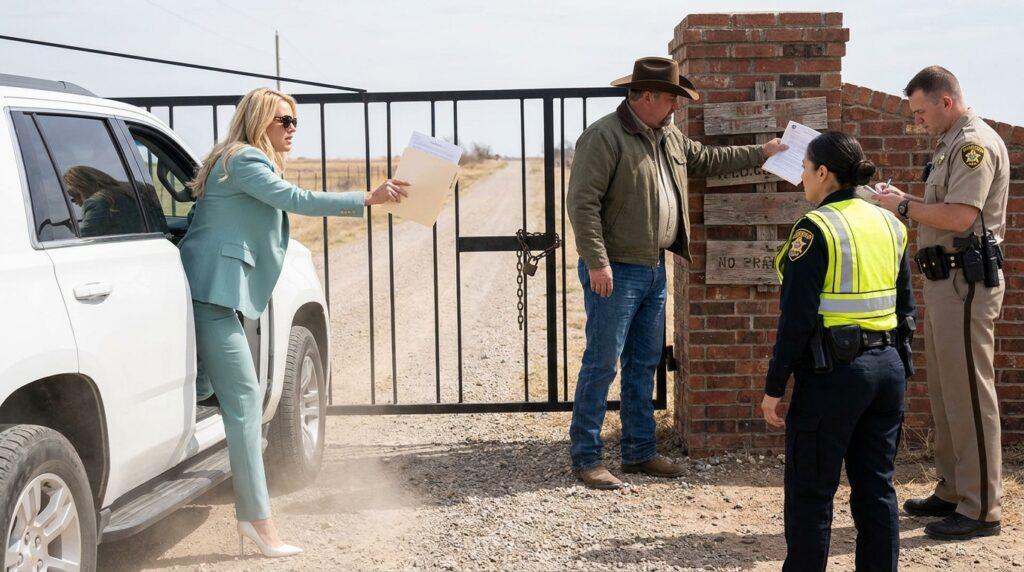
From the front seat of a white luxury SUV parked fifty yards down the shoulder, a door swung open. Evelyn Sterling stepped out onto the gravel, her white leather high heels clicking sharply against the rock before sinking slightly into the soft earth of the drainage ditch. Her light teal pantsuit was an aggressive flash of artificial color against the desaturated grays and browns of the scrub oak. She adjusted her oversized sunglasses, holding a thick, gold-embossed folder against her ribs like a weapon.
“Mr. Vance,” she called out, her voice carrying the practiced, sharp cadence of an executive accustomed to clearing resistance from a boardroom table. “We aren’t doing this today. The county planning map from seventy-four explicitly lists this corridor as an open utility easement. The contractors have a right to progress.”
Thomas didn’t look at her. He pulled a length of heavy, three-eighths-inch transport chain from the back of his belt. The links clinked together with a dull, industrial clang that cut through the low rumble of the diesel engine. He looped the steel through the iron pipe and wrapped it three times around the dark red-brick pillar his grandfather had laid by hand.
“The seventy-four map was a proposal,” Thomas said to the gate post, his thumb tracing the rough, rusted surface of the yellow-brass commercial padlock he clicked into place. The lock snapped shut with a definitive, heavy metallic bite that echoed off the white rocks. “The county never paid for the title, and my father never signed the deed. This gate stays locked.”
Evelyn marched toward the boundary line, her heels tracking white limestone dust onto the hem of her trousers. She stopped exactly two inches from the gate, the gold-embossed folder thrust forward until it hovered directly over the top rail. “Your father isn’t here to manage this property anymore, Thomas. The estate tax records show exactly how precarious your position is. If you block these trucks, the association will file for an emergency injunction before the bank opens tomorrow.”
Thomas pulled his hands from the gate and finally looked at her through the dark reflection of her lenses. He could smell the clean, chemical scent of her perfume mixing with the iron smell of the gate and the dry heat of the valley. He didn’t answer her threat. He simply took one deliberate step back into the shadow of his own trees, leaving the locked iron between them.

CHAPTER 2: THE WEIGHT OF THE WATERLINE
The white SUV didn’t turn around. It reversed down the narrow limestone throat of Blackwood Road, its tires crunching over the loose rock with a heavy, rhythmic hiss that sent up a low screen of white dust. Thomas Vance didn’t watch the red tail-lights disappear past the scrub oak bend. He kept his eyes on the padlock. The brass was cold, pitted from three decades of humid river-bottom air, but the tumblers had cleared with a distinct, dry snap that stayed in his ears long after the diesel idle of the bulldozer faded down the highway.
He walked toward the mailbox at the edge of the asphalt. The cedar post was gray, split by forty years of Texas sun, leaning five degrees to the north where the ditch line had eroded during the floods of ’15. The galvanized steel box was rusted through at the floor, its hatch hanging by a single aluminum rivet that rasped like a dull saw against the housing whenever the wind came out of the south.
Thomas reached out, his thumb catching the small brass latch. A tiny, circular stamp near the hinge caught the low noon light—a double-struck county seal, the star blurred as if the machine had slipped during the pressing. His father had put this box up the year the county surveyor first drew the straight blue lines across the old valley plat.
Inside sat a lone envelope. The paper was heavy, legal-grade stock, unaffected by the humidity that had curled the edges of the grocery circulars from three weeks ago. It didn’t have a stamp. It had been slipped in by hand, the corporate crest of the Whispering Pines Development Corporation embossed in dark teal ink across the flap.
Thomas slid his thumb under the seal. The paper tore with a clean, stiff resistance.
Notice of Intermittent Infrastructure Assessment, the header read. The font was small, modern, and clean, the kind of print that didn’t belong within ten miles of the river road. Pursuant to Section Four of the Regional Water and Access Realignment Code, notice is hereby given that the private crossing known as Blackwood Road contains utility access points essential to the stabilization of Phase Two hydrology. Failure to clear right-of-way within forty-eight hours will result in automatic municipal receivership under the County Drainage Act of 1978.
He read the lines twice, his eyes adjusting to the glare off the white limestone road. His father’s debts weren’t listed here, but they were written between the margins. When the old man had passed in the winter, he hadn’t left a clean ledger. He had left seven miles of un-mended cedar fencing, three notes at the local co-op that were six months past due, and an unrecorded line of credit with the land bank that seemed to grow by three percent every time the creek rose. The development corporation knew the numbers. Evelyn Sterling hadn’t just looked at a planning map; she had spent three months in the county records basement, measuring the exact depth of the financial mud Thomas was trying to walk through.
He folded the letter into a tight square and jammed it into the pocket of his olive ranch jacket. His fingers hit the fencing pliers. The cold steel felt grounding against his thigh.
A red dirt bike hummed somewhere along the western ridge—the sound thin and high-pitched, like a horsefly trapped against a screen door. That was the boundary line. On the other side of that ridge, the developers had already laid two miles of black poly-pipe for the subdivision’s main sewage line, the huge plastic tubes sitting in the grass like giant earthworms waiting to be buried. If they couldn’t cut through Blackwood Road, their gravity-fed drainage system would terminate forty feet short of the county main, leaving five hundred luxury homes without a functional utility drop.
Thomas turned back toward his truck, a battered ’98 Ford with a dashboard cracked by twenty summers of high heat. The driver’s side door didn’t close unless he lifted it by the handle, the hinges groaning as the latch caught the striker plate. He sat in the worn vinyl seat, the smell of old horse blankets, stale tobacco, and dry dust rising from the floorboards.
He reached into the glove box. Beneath a stack of yellowed vehicle registration receipts and three spare flashlight batteries lay a small, black iron key with a square head. It was the key to the small green strongbox his father had kept under the floorboards in the tack room—the box that hadn’t been opened since the day the old man’s heart had given out in the south pasture.
The steering wheel was hot beneath his palms as he cranked the engine. The starter whined three times before the V8 caught, a puff of blue smoke rising from the tailpipe into the live oaks. He didn’t drive down toward the gate to see if Evelyn’s crew had returned with a deputy. He shifted into first, the transmission clunking hard under the floor, and drove toward the old barn, his mind tracking the legal language of the notice against the physical layout of the creek bed.
The corporation wasn’t trying to buy the road. They were trying to call it something else—a drainage easement, a utility corridor, a municipal necessity. If they changed the name of the dirt beneath his feet, they didn’t have to pay for the right to cross it. They just had to wait for the forty-eight hours to run out.
As the truck climbed the limestone bench toward the house, Thomas looked out at the fencing along the western draw. The barbed wire was slack, two strands dipping into the wild switchgrass where a fallen mesquite limb had snapped the cedar stays three weeks ago. He had planned to fix that fence before the weekend, but now the wire looked less like a barrier and more like a line of old iron waiting to be pulled out by a machine that didn’t care about the name Vance.
CHAPTER 3: THE CORPORATE PERIMETER
“Your family’s name doesn’t change the grade of the valley, Mr. Vance,” Evelyn Sterling said.
She didn’t look up from her end of the conference table. The room smelled of fresh drywall, chemical carpet adhesive, and the sharp, sterile scent of ozone from a hidden air purification system. It was the temporary sales office for the Whispering Pines subdivision—a modular double-wide trailer set on concrete blocks just inside the cleared ridge line, its exterior disguised by synthetic stone veneer. Through the tinted double-paned glass, the skeleton of three two-story framing jobs rose like clean white ribs against the gray cedar hills.
Thomas sat in a low-backed vinyl chair that creaked under his weight. He hadn’t taken off his olive ranch jacket. The hem of his canvas coat left a thin smudge of white limestone dust along the pristine composite trim of the boardroom table. Between them lay the industrial-grade dark teal folder, open to reveal a crisp, multi-layered blueprint map dated July 1974.
“The county planning survey is clear,” Evelyn continued, her fingers tracing a faded blue line that sliced directly across the western boundary of the Vance ranch. Her short blonde bob was perfectly arranged, her sunglasses now resting on the table beside a designer glass water bottle. “The seventy-four allocation designated Blackwood Road as an arterial connector for regional water management. When the county incorporated the district, those utility parameters were transferred into the municipal charter. We aren’t asking for an extension of favor. We are notifying you that the contractor is bringing the trenchers through by Wednesday morning.”
Thomas kept his hands on his knees, his thumb rubbing the crosshatched steel grip of the fencing pliers hidden inside his coat pocket. The cold tool was a heavy counterweight to the artificial chill of the air conditioner humming overhead.
“The seventy-four plan required a county bond election to fund the acquisition,” Thomas said, his voice flat, retaining the slow, gravelly rhythm of the lower bottoms. “The bond failed in November of that year. The county never took the deed out of my father’s name, and they never paid the three hundred dollars an acre the commissioners court had agreed on. You’re building your drainage infrastructure on a line that only exists in a dead binder.”
A middle-aged man sitting to Evelyn’s left shifted his weight, making the cheap particle-board desk groan. He wore a crisp short-sleeved shirt with a local utility district patch sewn onto the sleeve, though the fabric lacked the grease stains of an active field inspector. His clipboard was stacked with un-stamped regulatory forms.
“The utility corridor code doesn’t require active compensation if the primary easement serves a critical watershed stabilization purpose, Mr. Vance,” the man said, pointing an unblemished finger at a section of the blueprint marked with yellow highlighter. “The Phase Two retention system drains directly into the Blackwood Creek tributary. If we don’t lay the twenty-four-inch concrete culvert beneath your gravel lane, the runoff from the upper asphalt will wash out the state highway approach within three seasons. The county judge has already reviewed the emergency hydrology assessment.”
It was a structured pincer movement, executed with clean paper and calculated legal terminology. Evelyn didn’t monologue; she simply waited for the utility worker to finish his delivery, her face a mask of professional certainty. She knew the exact pressure points—the reality of the property taxes Thomas hadn’t yet cleared for the fiscal year, the cost of an environmental litigation defense, and the physical isolation of the old ranch house at the end of the road.
“We are prepared to offer an administrative easement fee,” Evelyn said, sliding a typed, one-page document across the faux-grain surface. The paper was heavy, clean, and carrying a figure that would clear two of Thomas’s notes at the co-op before sundown. “Five thousand dollars for a permanent infrastructure right-of-way, limited to subsurface installation. The road surface will be restored to standard gravel specification within fourteen working days. You sign the waiver today, and the association drops the municipal receivership motion.”
Thomas looked down at the paper. The ink was dark, the corporate seal of Whispering Pines pressed into the bottom corner with machine-cut precision. It was a false flag—a tactical bribe designed to seal a structural vulnerability before he could verify the true depth of their authorization. If they truly held the legal title under the 1974 charter, they wouldn’t be offering five thousand dollars to a man they were trying to evict from his own lane.
“My father always said you don’t sell the dirt that catches the water,” Thomas said. He rose from the chair, the heavy canvas of his jacket catching the corner of the table with a dull rasp. He didn’t touch the paper. He didn’t look back at the blueprint. “The gate stays locked until the sheriff tells me otherwise.”
Evelyn’s mouth tightened into a thin, pale line, the corporate composure slipping just enough to reveal the hard, tactical edge underneath. “The sheriff works off recorded documents, Mr. Vance. By Wednesday morning, the papers won’t be in your favor.”
Thomas walked out of the double-wide trailer, the heavy door clicking shut behind him, the intense Texas heat hitting his face like a physical blow as he stepped onto the gravel staging lot.
CHAPTER 4: THE STRONGBOX IN THE FLOODPLANE
The Ford’s heavy door scraped against the caliche earth as Thomas swung his legs out. The heat in the tack room was dense, smelling of dry rot, parched leather, and the sweet, lingering musk of old alfalfa. Dust motes hung like suspended grit in the narrow shafts of yellow sunlight piercing the cedar gaps in the wall.
He didn’t waste time turning on the generator. He walked straight to the back corner behind three heavy, oil-stiffened rain slickers hanging from rusted iron railroad spikes. His boots sank into the dry dirt floor until his heel clicked against the edge of the second foundation timber.
Thomas dropped to his knees. His palms scraped over the rough, gray cedar floor planks, feeling for the uneven seam his father had cut with a dull hand saw forty winters ago. He wedged the flat tip of his fencing pliers between the boards and pried up. The wood groaned, a dry, high-pitched scream of old nails giving up their grip, before the section cleared the joist.
In the dark hollow beneath the dirt line sat the box. It was heavy, military-surplus steel painted an olive drab that had long since cracked into a thousands tiny, geometric scales. A notched brass dial lock secured the front, pitted by river-bottom dampness.
Thomas pulled the square-headed iron key from his pocket. The key slot was jammed with dried mud-wasp nests. He used the sharp wire-cutter notch of his pliers to clean out the barrel, digging out the hard, gray clay until the steel was clear. He inserted the key. The internal levers were stubborn, seized by thirty years of rust and forgotten grease, requiring the full leverage of his thumb to turn. The cylinder gave way with a heavy, ungreased mechanical thud.
He lifted the lid. The interior smell was sharp—vinegar-sour ledger paper and the heavy, sweet scent of gun oil.
Inside lay three items: a wrapped bundle of blue-line survey field notes from 1971, a spare cylinder for an old single-action Colt, and a long legal document bound by three copper rivets that had turned green with oxidation. Thomas lifted the document, the stiff, parchment-grade paper crackling loudly in the small room.
Across the top header, typed on a mechanical ribbon that had been struck so hard the letter O had cut clean through the page, were the words: Grant of Right-of-Way and Supplemental Infrastructure Access. The date was October 12, 1982.
His eyes tracked down the lines, his pulse tightening against his throat. It wasn’t an unsigned proposal. There, at the bottom of the second page, was the bold, angular signature of his father, Arthur Vance, witnessed by a notary public whose stamp had faded to a ghost-gray circle. The legal description was unmistakable: a thirty-foot wide corridor following the exact center-line of Blackwood Road, extending from the highway asphalt to the western draw.
For value received and municipal considerations, the text read, the Grantor does hereby convey to the County Road District and its corporate assigns a perpetual easement for public transit and utility management, contingent upon the allocation of annual agricultural tax credits under Subsection Nine.
Thomas sat back on his boot heels, the paper heavy between his thumbs. This was the document Evelyn Sterling’s team had been searching for. The 1974 planning map wasn’t their legal engine; it was their cover story. They had known this 1982 agreement existed, but they hadn’t been able to find the executed copy because it had never been entered into the county’s digital master files during the migration. His father had bartered away the perimeter of the ranch forty years ago to save the herd during the dry spell of ’82.
He held the evidence of his own family’s compromise. Under the terms of this page, the Whispering Pines subdivision didn’t need an emergency injunction. They didn’t need a corporate bribe. If this document was valid, Evelyn’s bulldozers had every legal right to tear the limestone road into a ditch line by Wednesday morning, and Thomas was nothing more than an unauthorized gatekeeper blocking a public easement.
He began to slide the document back into the tin folder, his fingers catching a smaller, thin scrap of paper that had been pinned behind the third page with a rusted paperclip. It was a single sheet of county letterhead, dated three years later—September 14, 1985. The text was short, only four lines, signed by the chairman of the county commissioners court, but the ink had run during a long-forgotten roof leak, leaving the final two lines a smeared, blue-gray cloud.
Thomas held the paper up to the sun gap in the wall. He could make out the words Revocation of Allocation and the name Blackwood, but the operational clause—the specific reason why his father had kept this secondary notice hidden behind the primary grant—was completely illegible, buried under the water stain.
The sound of a heavy diesel engine brake echoed through the valley, coming from the direction of the state highway. The trucks were already moving down the approach. Thomas folded both documents, shoved them deep into the inner pocket of his canvas coat, and stood up, his pliers clinking against the square key in the dark. He had the decoy in his pocket, but the truth was still locked beneath the stain.
CHAPTER 5: THE STANDOFF AT THE FIRST PERIMETER
The white SUV’s front bumper sat exactly three inches from the black iron pipe gate. The engine didn’t idle; it clicked as the manifold cooled under the relentless noon glare, sending up a heat shimmer that turned the limestone valley road wavy. Behind the vehicle, the heavy, yellow steel form of the contractor’s cement mixer blocked the approach, its massive drum turning with a low, wet, concrete crunch that shook the loose gravel beneath Thomas Vance’s boots.
“Open the lock, Mr. Vance,” Evelyn Sterling said.
She stood beside the driver’s side door, her pristine white leather heels planted on the very edge of the road’s caliche lip. Her light teal pantsuit seemed to collect the dust rising from the cement mixer’s idling tires, a thin powder coating the hem of her trousers. Her right hand clutched the gold-embossed leatherette HOA folder against her chest like an iron shield.
Thomas stood behind the latch line, his boots planted in the dirt road’s shadow. The transport chain was taut between the iron pipe and the red-brick pillar. In the inner pocket of his canvas ranch jacket, the 1982 easement agreement felt heavy against his ribs—a physical weight that felt less like a defense and more like a trap. Evelyn’s expression wasn’t the fluid anger of the double-wide office; it was the cold, fixed posture of someone who had already verified her arrival strategy with a legal authority.
“I’ve got the recorded document number from the 1982 infrastructure ledger,” Evelyn said, her voice cutting clean through the low, wet thrum of the mixer’s drum. She didn’t raise the folder. She simply pointed one manicured finger at the yellow-brass padlock. “Your father signed away the right-of-way forty years ago for three thousand dollars in municipal credits. It’s a matter of permanent record. You’re holding up a county drainage project, and that’s a class-three misdemeanor.”
Thomas kept his hand deep in his coat pocket, his thumb locked onto the crosshatched handle of his fencing pliers. “The credits were tied to a road maintenance provision the county abandoned before the winter of eighty-five. You’ve got half the paperwork, Evelyn.”
“We have the active easement, Thomas,” she snapped, stepping closer until her sunglasses caught the direct reflection of his gray Stetson hat. “The county registrar confirmed the signature this morning. The sheriff’s department is already en route to clear the obstruction. Move the gate, or the mixer goes through it.”
The crunch of limestone gravel announced the arrival of the county unit before the vehicle cleared the low cedar brush. A clean, dark brown utility cruiser slid onto the shoulder, its gold star emblem coated in a layer of fine white road dust. The driver’s door opened with a heavy, oiled click, and Officer Ramirez stepped into the lane, her heavy leather utility belt creaking sharply as she shifted her weight to clear the steering wheel. Her yellow reflective vest was a harsh, industrial glare against the muted browns of the ditch.
Behind her, a second door opened. Deputy Miller stepped out from the passenger side, his clean-shaven face set in the flat, detached mask of a man who spent his mornings reading eviction notices and boundary dispute logs. He carried a county property map folder tucked under his arm.
Evelyn immediately turned toward the officers, her heels scraping on the stones as she shifted her pincer movement. “Officer, this man is in direct violation of the regional water realignment charter. We have a certified construction crew blocked on a recorded county right-of-way.”
Officer Ramirez didn’t look at the HOA folder. She walked straight to the center of the lane, her boots planting themselves exactly on the property line where the asphalt met the gravel. She raised one open palm at chest height, freezing Evelyn two feet short of the iron gatepost.
“Step back from the latch line, ma’am,” Ramirez said. Her voice was flat, devoid of small-town familiarity or corporate deference. “We’re here to verify the boundary coordinates, not to manage your staging schedule.”
Deputy Miller walked to the red-brick pillar, his fingers tracing the permanent metal access signs bolted into the stone. He opened his folder, sliding out a modern, computer-generated plat map, and looked at Thomas. “Vance, the district office pulled an index entry from eighty-two. They’re saying there’s an executed grant on this corridor. You got something that says different?”
Thomas pulled his hand from his pocket. He didn’t offer the 1982 agreement. Instead, he pulled the smaller, water-stained 1985 letterhead from his inner pocket, the parchment crackling between his calloused thumbs. He held it against the black iron bar, his eyes fixed on the deputy’s clean uniform.
“My father kept the revocation notice pinned behind the deed,” Thomas said, his voice dropping into the low, steady register of the lower bottom land. “The commissioners court canceled the allocation when they moved the state highway route to the north ridge. The easement was pulled before the digital migration.”
Deputy Miller took the paper, his thumb catching the dry, rough texture of the water stain. He held it up against the blinding noon sun, trying to read the smeared blue-gray lines where the official county validation stamp had run into the wood pulp. Evelyn didn’t move, her sunglasses reflecting the glare off the deputy’s clipboard, her fingers tightening until the gold corners of her folder creaked against her teal suit.
“This stamp is illegible, Vance,” Miller said, lowering the page. The flat finality of his voice hit the hot air like a closing door. “Without the county clerk’s validation mark on the entry index, this letterhead is just a piece of unfiled paper. The eighty-two grant is the only active deed in the portal.”
Evelyn’s mouth curved into a tight, thin line of victory that didn’t reach her eyes. She turned back toward the mixer driver, her posture resuming its corporate dominance. “Clear the chain, Officer. The construction goes through.”
Thomas stood completely still behind the iron pipe, the weight of the water stain proving to be a devastating failure in the dust. The perimeter hadn’t held; the decoy secret had shattered against the cold machinery of the portal, and the lane was opening for the yellow blade.
CHAPTER 6: THE RUPTURED PERIMETER
“Unlock the chain, Vance,” Deputy Miller said. His tone hadn’t sharpened; it had flattened into the procedural density of a county machine that had already run the calculation. He handed the water-stained 1985 paper back over the top rail, his thumb leaving a damp smudge on the charcoal-gray fiber. “The system shows the eighty-two grant as active. If you don’t drop the padlock, I’ll clear it with the bolt cutters from the cruiser.”
Thomas didn’t reach for the paper. He let it drift down into the dry switchgrass at the base of the pillar, the wind catching the edge until it lodged against a broken piece of old flint. Beside him, Evelyn Sterling took a single, short step forward, her white high heels grinding a limestone pebble into fine, flour-like dust. The gold-embossed corners of her folder caught the glare of the noon sun like a signaling mirror aimed toward the driver of the cement mixer.
“The staging schedule is already forty minutes behind, Deputy,” Evelyn said, her voice dry, clipped, and completely free of conversational filler. “The concrete is already setting up in the drum. Every ten minutes we idle here costs the association six hundred dollars in logistical penalties. We need the lane cleared now.”
Thomas looked past her, his eyes locking onto the massive, revolving drum of the mixer. The wet mortar inside groaned—a heavy, gravelly slide of sand and lime that vibrated through the frame of the truck and shook the caliche soil between their boots. The driver was watching through his side mirror, his hand resting on the air-brake valve.
“Ramirez,” Thomas said, shifting his gaze to the county officer. Her heavy leather gear box creaked as she stood her ground on the property line, her eyes scanning the structural dynamic between the white SUV and the iron gate. “Look at the back of the metal marker signs bolted to the brick. Not the paper in the folder. The steel.”
Officer Ramirez frowned, her brow furrowing beneath the sweat-rimmed band of her uniform hat. She didn’t look at Evelyn, and she didn’t ask Miller for permission. She stepped around the white bumper of the SUV, her boots sinking an inch into the soft clay of the drainage ditch, and walked to the dark red-brick pillar. The permanent county access plate was bolted into the mortar with heavy four-inch lag screws, the galvanized coating long since peeled away by thirty years of valley humidity to leave dark trails of rust staining the stone.
She reached behind the plate, her gloved fingers feeling the rough, un-faced side of the steel backing.
“There’s a number stamped into the zinc,” Ramirez said. She leaned closer, using the tip of her tactical pocket knife to scrape away a thick crust of dried mud-wasp nests from the lower margin. “It’s not an index code. It’s an original county board filing number. 1985-Court-Rev-042.”
Deputy Miller paused, his plat map folder half-closed against his chest. “The migration team didn’t index the court minutes from the eighties, Ramirez. They only scanned the primary deeds. If it’s not in the portal, it doesn’t exist for the field unit.”
“It exists on the iron,” Thomas said. He took his hand out of his jacket pocket. He didn’t point the pliers at them, but the crosshatched steel handle was visible, caught in the low sunlight. “My father didn’t file the paper with the clerk because the county judge told him the court order was self-executing once the highway route shifted. The board ordered the road closed to public staging forty-one years ago. The development company didn’t buy an active easement; they bought an unmapped dead entry because their legal team didn’t check the physical markers.”
Evelyn’s face didn’t go pale; it went rigid, the corporate posture locking like un-cured cement. She turned sharply toward Miller, her fingers gripping the folder until the leatherette material buckled. “This is an administrative stalling tactic. A pencil mark on a piece of field iron doesn’t overturn a certified deed entry in the municipal database. Deputy, execute the clearance order.”
“I can’t clear a lane that has an unverified court revocation code stamped on the physical marker, ma’am,” Officer Ramirez said. She stepped back into the center of the road, her hand resting naturally on the top of her utility belt, her eyes locking onto Evelyn’s sunglasses. “If the board revoked the infrastructure access in eighty-five, this isn’t a county road easement. It’s a private residential tract under agricultural protection. If that mixer crosses the latch line, the driver is operating a commercial vehicle on private property without a title.”
The rumble of the cement mixer changed frequency—a sudden, sharp release of air pressure hiss as the operator shifted the transmission out of gear. The driver leaned out of the cab window, his face dark with grease and sun, his voice carrying over the sound of the drum.
“Hey! If this isn’t a legal county drop, I’m pulling the truck back to the highway shoulder,” the driver shouted. “The company insurance doesn’t cover property damage claims on unrecorded private lines. If the drum locks up because we’re sitting in a ditch, that’s on your association, lady.”
Evelyn turned toward the truck, her voice rising for the first time, losing its corporate polish. “You stay in the lane! The contract explicitly states—”
“The contract doesn’t cover a lawsuit from a landowner with a county sheriff standing next to his gate,” the driver yelled back. He slammed the cab door shut, and the heavy truck began to slowly reverse down the limestone road, its massive tires churning the gravel into a thick cloud of white dust that settled over the teal pantsuit and the white luxury SUV.
Evelyn stood in the middle of the receding dust, her folder clutched against her chest, her white heels completely grayed by the limestone powder. The pincer movement had failed; the structural authority had flipped against her at the very edge of the iron, leaving her to face the immediate cost of the delayed mixer alone in the valley glare.
CHAPTER 7: THE PERMANENT STAKE
The dust took five minutes to drop back into the ditch. It settled in a fine, white film over the flat leaves of the live oaks, over the cracked rubber molding of Thomas Vance’s truck, and across the polished teal shoulders of Evelyn Sterling’s suit. She didn’t get back into the white luxury SUV immediately. She stood on the caliche road shoulder, her fingers clutched so tightly around the gold-embossed HOA folder that the synthetic leather groaned under the strain, her eyes tracking the distant, massive drum of the concrete mixer as it turned onto the blacktop of the state highway.
Deputy Miller didn’t offer a closing statement. He folded his digital plat map into his leather binder, clicked the heavy plastic latch shut, and walked back to the brown cruiser without looking at the brick pillars. The heavy doors of the county unit closed with a dual, muted thud that sounded like a final judgment. Officer Ramirez stayed on the margin for three more minutes, her eyes fixed on the rusted backing plate of the county sign where the 1985 revocation code was stamped into the metal, before shifting into first gear and letting the cruiser roll out behind the mixer.
Thomas didn’t move from the gate rail. He kept his hand inside his coat pocket, his thumb resting against the heavy, cool steel of his father’s fencing pliers. The absolute reality of the dirt beneath his boots felt different now—the weight of the 1985 revocation wasn’t just a piece of unfiled paper anymore; it was an iron-clad boundary that had survived forty years of administrative neglect.
By two o’clock in the afternoon, the sound of the diesel engines had been replaced by the dry, rhythmic rasp of grasshoppers in the switchgrass. A white county utility truck with a yellow warning light on the cab roof slowed down at the approach, its tires crunching softly on the edge of the limestone lane. The door bore the official emblem of the County Surveyor’s Office.
An older man in a faded blue chambray shirt and a orange safety vest stepped down into the heat, carrying a heavy, three-foot iron T-bar driver and a bundle of four-inch steel pins that clattered together like dull bells. His face was the color of old boot leather, his nose mapped with thin red veins from thirty summers of field work.
“Vance,” the surveyor said, nodding toward the brown Stetson. He didn’t ask for the deed. He walked past the brick posts to the exact corner where the property fence line met the old ditch lane. “The district surveyor ran the coordinate check from the eighty-five minutes court ledger after Ramirez called it in. The digital plat has been updated. We’re setting the permanent recovery markers.”
Thomas walked through the gate, his boots heavy on the packed gravel. He watched the surveyor place the first iron pin against the limestone bedrock. The steel pin was scored with three parallel notches near the head—a traditional county survey marker that hadn’t changed since his grandfather laid the first corner stones.
The surveyor raised the T-bar driver. The first strike hit the iron pin with a sharp, ear-splitting ping that rang out across the parched draw, sending a small puff of dry limestone dust into the warm wind.
Ping. Ping. Ping.
The sound dilate time for Thomas. With every blow of the iron driver, the memory of the threats, the corporate double-wide boardroom, and the cold calculations of the Whispering Pines HOA board seemed to sink deeper into the caliche earth, buried under the permanent legal reality of the stake. His father hadn’t lost the road in ’82; he had defended it in ’85, leaving the physical truth of the compromise bolted directly to the iron plate where the digital systems couldn’t erase it.
Evelyn Sterling finally turned back toward her vehicle. Her white heels were completely ruined, the leather scuffed down to the gray fiberboard by the sharp limestone rock. She didn’t look at Thomas, and she didn’t issue a final threat as she swung her door shut. The luxury SUV backed down the throat of Blackwood Road for the last time, its transmission whining against the incline as it turned away from the perimeter, leaving the lane completely clear.
Thomas walked back inside his gate. He pulled the heavy yellow-brass padlock from the latch post, ran the chain through the pipe rails, and clicked the lock shut one final time. The tumblers cleared with that same dry, familiar mechanical bite. He reached into his coat pocket, pulled out the rusted fencing pliers, and turned toward the western draw where the wire was slack. The subdivision infrastructure was already re-routing two miles north, its heavy machines turning away from his perimeter, leaving the ancient limestone road to the quiet shadow of the oak trees.