The Concrete Line We Draw to Keep the Chaos Out of Our Yards

CHAPTER 1: THE DUSTY GRAY

“Stop pulling those weeds, I already called the police.”

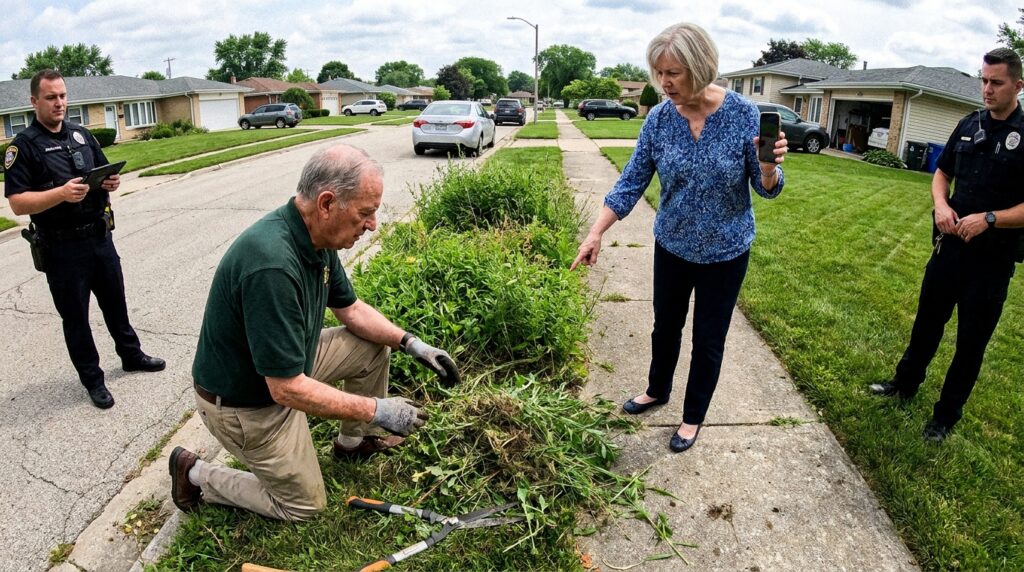
The words didn’t shatter the afternoon heat; they sank into it like iron into dry silt. Arthur didn’t look up immediately. He kept his fingers—wrapped in the stiff, graying canvas of split-cowhide work gloves—anchored around the thick, fleshy crown of a wild mustard root. The plant had forced its way through a hair-line fracture in the concrete curb, its taproot wedging deep into the dark, compressed subsoil beneath the easement strip. He gave a slow, rhythmic twist, feeling the fibrous snap beneath the dirt, before he finally let his gaze drift upward.

Mrs. Gable stood six inches from the edge of his workspace, her shadow stretching long and rigid across the broken asphalt. Her blue patterned blouse was crisp, entirely unaffected by the mid-day glare that made the horizon behind her shimmer like grease on a griddle. In her right hand, her smartphone was held at a precise forty-five-degree angle, the black square of its camera lens glinting like an insect’s eye.

“This is township property, Arthur,” she said, her voice dropping into that rhythmic, flat register she used when quoting code parameters from her binder. “You’re altering the designated neighborhood streetscape without an approved variance. I’ve already logged the incident report with local dispatch.”

Arthur let out a slow, shallow breath through his nose, smelling the bitter, peppery sap of the crushed weeds and the dry, metallic tang of the sun-baked curb. His knees, resting on a folded piece of corrugated cardboard to keep the hot concrete from blistering through his khakis, throbbed with a dull, familiar ache. He didn’t answer her. In the thirty years he’ve lived on this corner, he had learned that words exchanged across a property line were simply free data given to an adversary.

Instead, he placed the harvested weed onto the growing pile beside his left boot. The green stalks were already beginning to limp and blacken under the direct sun, their yellow blossoms folding inward. His dark green polo shirt was dark with sweat between his shoulder blades, the fabric stiff with salt. He reached down for the next stem—a multi-stalked thistle that had grown thick enough to choke the path.

“I’m recording this,” she warned, her thumb tapping the glass screen with a sharp, synthetic click. “You’re deliberately ignoring a formal notice of non-compliance.”

Arthur’s fingers tightened on the thistle’s base. He noticed the small, rhythmic tremor in her wrist—not from fear, but from the sheer physical strain of holding the heavy, armored phone casing steady for so long. She wanted an outburst. She wanted him to lift his hand trowel or swing his gloved arm toward the camera so she could file for an emergency protective order at the county clerk’s desk. He kept his shoulders low, his movements heavy and domestic, the very picture of compliance.

The distant, high-pitched whine of an engine shifted gears down the avenue. It wasn’t the white code-enforcement truck he expected. It was the low, dual-tone growl of a municipal utility vehicle, its black-painted grill cutting through the heat ripples at the end of the block.

Arthur adjusted his grip on the dirt, his eyes narrowing as he caught the glint of two distinct uniform caps through the windshield. They weren’t just checking code. They were moving too fast, their tires humming against the aggregate asphalt with a specific, heavy intent that meant they had his exact address pinned to their dashboard display.


CHAPTER 2: CODE OF THE PROPERTY LINE

The heavy, steel-reinforced door of the municipal utility truck slammed shut with a metallic crack that echoed off the garage doors across the cul-de-sac. Arthur didn’t blink. He kept his gloved hand resting flat against the coarse, heat-baked aggregate of the sidewalk, his fingers tracking a thin, faint streak of weathered yellow wax crayon marked on the edge of the curb—an old surveyor’s notch nearly swallowed by years of grime and street sweepers.

Mrs. Gable didn’t move either, though her shoulders squared slightly as the two uniform officers stepped off the asphalt and onto the concrete path. The heat ripples rising from the road made their dark black tactical vests and utility belts look heavy, almost architectural, as they approached. The friction of their thick leather boots against the grit sounded like sandpaper on wood.

“Mrs. Gable? Arthur?” The First Officer spoke first. His voice was a flat, unhurried drawl, trained to lower the temperature of suburban property wars before they spilled over into violence. He was stocky, his clean-shaven jaw tight, his eyes already scanning the layout of the yard, the tool pile, and the phone still gripped in the woman’s hand. “We received a call about an unauthorized alteration of township property.”

“He’s destroying the designated ground cover,” Mrs. Gable said immediately, her tone shifting seamlessly from an ultimatum to the practiced grievance of a taxpayer reporting an administrative failure. She didn’t lower the phone; the screen remained alive, a bright, digital grid reflecting the glare of the sky. “The neighborhood association agreement, which operates under county civic code section four, clearly states that no resident may excavate, alter, or remove vegetation from the common frontage without a structural variance. He’s pulling the root systems. It destabilizes the sidewalk bed.”

Arthur slowly shifted his weight on the corrugated cardboard pad, his knees grinding against the internal aggregate of the joint. He didn’t look at her. He looked at the First Officer’s boots, then at the Second Officer, who had taken up a flanking position near the edge of the lawn. She stood with her hands resting casually but alertly near her utility belt, her dark hair pinned back so tightly it pulled the skin at her temples. She was watching Mrs. Gable’s wrist—and the recording lens.

“Arthur,” the First Officer said, stepping closer until the toe of his boot mirrored the line of the curb. “You want to tell me what you’re doing here?”

“Cleaning the ditch line,” Arthur said. His voice was dry, raspy from the heat and the dust he’d been breathing since noon. He pointed a thick, split-cowhide finger at the pile of limp thistles and wild mustard beside his boot. “The county didn’t send the mower this month. The stalks are high enough to block the drainage during the late summer storms. If the runoff pools against the concrete, the subgrade softens. Then the whole path cracks.”

“It’s not his responsibility,” Mrs. Gable snapped, her finger tapping the back of her phone casing with a sharp, rhythmic click. “It’s a violation. I’ve already filed three separate environmental complaints with the county clerk’s office this season regarding his frontage. There’s a structural assessment pending.”

Arthur’s thumb rubbed the yellow wax mark on the curb. Three complaints. The county didn’t usually dispatch local patrol officers for simple weed pulling unless someone had used specific keywords on the non-emergency line. Structural assessment. The phrase hung in the hot air between them, dense and deliberate. A normal neighbor complained about aesthetics or property values; Mrs. Gable was using the language of engineering and municipal acquisition.

The Second Officer took a half-step forward, her eyes narrowing as she looked down at the dirt strip. “Is that why you called us out here today, ma’am? For the weeds?”

“I called because he is violating the boundary rules,” Mrs. Gable said, her voice rising slightly, losing its bureaucratic coldness for a fraction of a second. “The code exists to maintain the structural integrity of the sector. If he alters the frontage without an engineer’s sign-off, it compromises the entire block’s safety logic.”

The First Officer didn’t answer. He reached down to his utility vest, his gloved hand unclipping a rugged, matte-black digital tablet from his chest harness. The screen flared to life, casting a cold blue tint across his clean-shaven chin as he began tapping through the localized civic registry. The sound of his stylus clicking against the hardened glass was the only noise on the street, save for the distant, rhythmic hum of a central air conditioning unit hidden behind the nearest house.

Arthur watched the officer’s face. He knew the look of a man looking at a map that didn’t match the story he’d been told. There was a specific tightness that formed at the corner of a city worker’s mouth when the digital lines began to contradict the physical reality on the ground.

“Hold on a second,” the First Officer muttered, his thumb tracing a line across the tablet screen as he cross-referenced the property coordinates. He looked up, his gaze moving past Arthur, past Mrs. Gable’s shoulder, and fixing directly on the concrete foundation of her detached double-garage thirty feet away. “Ma’am, who did you say filed that structural assessment?”

The paragraph of data on the screen didn’t just contain the afternoon’s dispatch log. As the officer tilted the screen toward his partner, Arthur caught a glimpse of a red-highlighted easement boundary line—and a secondary, blue-inked municipal survey overlay that cut dangerously close to the neighbor’s own brickwork.

CHAPTER 3: THE DECOY RECORD

The glare on the First Officer’s tablet didn’t reveal the details easily; the display was mapped in dense, overlapping vectors of administrative ink, a grid of utility lines and drainage paths cutting across the property boundary. The Second Officer shifted her footing, the gravel on the concrete edge crunching under her sole with a small, sharp sound like a stone hitting an anvil. She peeked down at the glowing layout over his arm, her thumb hooking into her duty belt near her flashlight casing.

“Ma’am,” the First Officer said again, his voice dropping an octave as his eyes stayed anchored to a red-flagged entry blinking near the bottom corner of the digital plot. “This file isn’t a standard weed or nuisance complaint. This is a restricted county engineering file. It’s listed under a commercial frontage acquisition code.”

Mrs. Gable’s hand tightened on the side of her smartphone, the knuckles turning the color of wet lime against the dark blue plastic of the casing. She didn’t drop the lens. She simply drew her elbow closer to her ribs, her jaw locking into a tight, hard line that made the muscles at the base of her ear twitch under the direct sun.

“The county has been reviewing the drainage structure for this entire quadrant, Officer,” she said, her words dropping with a measured, deliberate precision that sounded like a read-out from a legal brief. “The frontage strip is designated as unstable. If the vegetation isn’t managed under an approved engineering plan, the township has the administrative authority to reclaim the grade for public utility enhancement. It’s a standard safety stabilization protocol.”

Arthur didn’t rise from the cardboard pad. He leaned his weight back onto his heels, his gloved palms flat on his knees as he listened to the technical language roll across his sidewalk. His old iron trowel lay three inches from his boot, its rusted tip caked with the dry, grey clay he’d dug out from beneath the curb fracture. He looked at the red-flagged line on the screen. He had worked thirty years in the regional maintenance yard before his knees gave out; he knew what an acquisition code looked like. It didn’t mean stabilization. It meant eminent domain—the legal mechanism the state used to wipe a property owner off the tax map to make room for wider lanes or structural right-of-ways.

“Who logged these structural structural safety filings, Mrs. Gable?” the First Officer asked. He turned the screen three inches to the left, blocking the glare of the sky with his stocky frame. “Because according to the county registry, these three anonymous complaints about foundation shifting and frontage degradation all originated from an IP address registered to this corner sector. Your sector.”

The silence that followed was heavy, filled only by the dry, metallic click of a cooling engine from the parked patrol vehicle fifty feet down the lane.

Mrs. Gable didn’t flinch. She lowered the smartphone by two inches, her pointed finger relaxing slightly against the edge of the screen, but her expression remained perfectly smooth, a varnished layer of civic righteousness that didn’t allow for a crack. “Every resident has a duty to report structural failures that threaten the common valuation, Officer. If Arthur’s frontage is sliding into the gutter line, it drags my parcel’s grade down with it. The county surveyors are simply doing their job by verifying the hazard.”

“The surveyors haven’t been out here yet,” the Second Officer observed, her eyes moving from the tablet back to the dry, hard dirt where Arthur’s pile of pulled thistles sat. “But the file shows a pre-authorization for a curb-widening assessment. It was requested three months ago. Before any of these weed complaints were even logged in our system.”

Arthur felt a cold, dull weight settle behind his ribs, distinct from the heat of the noon sun. For months, he had assumed Mrs. Gable was simply obsessed with the look of his lawn, driven by the petty, restless malice of an old neighbor with too much time and a neat binder. But the red line on the digital map showed something different. She wasn’t trying to make him pull his weeds; she was building a paper trail of neglect to prove his land was a public liability, forcing the county to step in and seize the frontage for a secondary easement road that would cut ten feet into his front porch.

“Arthur,” the First Officer said, looking down over the top of the tablet with a hard, probing look. “Did you receive a certified notice from the county engineering office regarding an easement inspection last month?”

Arthur shook his head slowly, his split-cowhide gloves dry and stiff as they scraped against the fabric of his khakis. “Nothing came in the mail but the regular utility bill and the tax assessment. No one told me about a degradation file.”

“They wouldn’t notice him until the public hearing phase is locked,” Mrs. Gable said smoothly, her posture returning to its rigid, confident baseline. She took a step backward, back toward her own driveway line where her spotless luxury sedan sat under the shade of an oak. “The administration handles the preliminary evaluation internally. I am simply ensuring the record is accurate before the formal enforcement team arrives.”

The First Officer tapped the glass screen twice with his stylus, his jaw tightening as he scrolled down into the deepest layer of the restricted document. The blue light of the screen caught a sudden, sharp discrepancy in the older layout file—a series of yellowed survey marks from forty years ago that didn’t align with the clean, red boundaries of the current county map. He stopped scrolling, his thumb freezing on the edge of the casing.

“Wait a minute,” the officer muttered, his eyes narrowing as he traced a line that ran from Arthur’s curb straight through the neat, manicured grass toward Mrs. Gable’s garage foundation. “This layout is completely inverted.”

CHAPTER 4: THE INVERTED VECTORS

“Ma’am, step back over onto your own driveway for a moment,” the First Officer directed. His voice had lost its conversational drawl entirely, replacing it with the hard, mechanical flat tone of a deputy clearing an operational lane. He didn’t look up from the display, his gloved thumb pinning the corner of the matte-black frame as he adjusted the scale.

Mrs. Gable’s heels remained glued to the concrete seam. Her chin rose another fraction of an inch, the short blonde-gray hair catching the fierce mid-day light like spun glass. “The boundary line is quite clear, Officer. If your system is failing to register the correct residential easement allocation, I have the certified hard copies from the subdivision’s original platting inside my ledger.”

“The system isn’t failing, ma’am,” the Second Officer said, her position shifting slightly to place her body directly between Mrs. Gable and Arthur’s pile of harvested weeds. Her heavy leather duty boots kicked a small clump of dry gray silt across the expansion joint. “The layout is pulling directly from the county’s historical survey database. The forty-year-old developer records are being cross-referenced with the current GPS coordinates.”

Arthur leaned forward slightly on his folded cardboard pad, his canvas gloves scraping the coarse aggregate of the walk. He watched the red line on the screen flicker as the system tried to resolve the contradiction. He knew that specific red ink; it was the standard marker for contested municipal acquisition files. But the secondary blue line—the old vector layout—was shifting drastically to the west. It didn’t stop at the edge of his weed strip. It sliced across the sidewalk, bypassed the ditch line entirely, and ran a straight, unyielding path straight under the structural foundation of Mrs. Gable’s detached double-garage.

“Arthur,” the First Officer called out, his eyes still tracked to the blinking cursor on the display. “When you bought this lot in eighty-six, did you sign a reciprocal easement waiver with the primary contractor?”

“No waivers,” Arthur said, his raspy voice scraping through the dry air. He reached down instinctively, his split-cowhide fingers brushing the cold, rusted iron neck of his hand trowel where it lay in the dirt. “The builder told me the corner plot was clean from the street curb to the rear alley fence. I checked the deed markers myself when I poured the back patio. The iron pins are still down there near the utility pole.”

“Well, the pins might be there,” the First Officer muttered, his stylus clicking rapidly against the glass. “But the layout index shows a massive calculation shift. The original road bed was mapped six inches further east than where they actually laid the asphalt.”

Mrs. Gable finally lowered her phone, the screen falling dark as she pulled her arms tightly across the blue patterned fabric of her blouse. The rigid, administrative confidence that had carried her across the street seemed to stiffen even further, her posture turning defensive, almost metallic. “The asphalt layout has been established for over three decades. It constitutes a permanent legal boundary by default use. Arthur’s ongoing refusal to maintain his frontage according to the sector standards is what triggered the current engineering assessment. The county is simply correcting a public nuisance.”

“Except this isn’t a public nuisance file anymore, ma’am,” the First Officer corrected flatly. He turned the screen toward her, his gloved thumb pointing directly to a long string of structural data highlighted in lime green. “Your anonymous complaints about Arthur’s property didn’t just ask for a weed citation. They requested a full structural re-alignment of the frontage boundary to clear an administrative easement obstruction. You were trying to get the county to absorb his strip so your own garage setback wouldn’t trigger a municipal violation during the upcoming avenue widening project.”

The revelation hung in the stifling heat like the smell of burning oil. Arthur felt the dull ache in his knees dissolve into a cold, calculating clarity. The endless months of surveillance, the constant phone calls to code enforcement, the weaponized photography—it wasn’t a petty neighborly obsession with aesthetics. It was a pre-emptive strike. Mrs. Gable had known the city was planning to widen the avenue next year, and she knew that when the county surveyors arrived with their modern transit levels, her garage would be marked as an illegal encroachment on the public right-of-way. She had tried to sacrifice Arthur’s frontage to save her own brick and mortar.

“This is an informal field assessment,” Mrs. Gable said, her voice dropping into a razor-thin whisper that barely carried over the hum of the nearby air conditioner. “Your terminal does not carry the administrative weight of a formal zoning board ruling, Officer. The engineering department will handle the final designation based on the historical files I provided.”

“The engineering department is the one that flagged this file, ma’am,” the Second Officer said, her hand resting firmly against her utility belt as she pointed to the lower quadrant of the tablet screen. “Look at the blue marker line. The system just resolved the original developer’s error.”

Arthur squinted through the dust glare. The red acquisition line—the decoy secret Mrs. Gable had built her entire harassment campaign around—suddenly blinked twice and vanished from his section of the curb. In its place, the historical blue vector locked into position with a hard, digital snap. The line didn’t just clear Arthur’s weed strip. It pushed six inches deep into the manicured lawn across the asphalt, slicing directly through the side wall of Mrs. Gable’s pristine garage.

The First Officer looked up from the glass, his expression completely blank, his stocky frame cast in the long, grey shadow of the afternoon. “Ma’am,” he said, his voice dropping with the weight of absolute administrative finality. “According to this verified plot map, you aren’t the one defending the neighborhood boundary. Your entire detached structure is sitting half a foot inside Arthur’s deeded property line.”

CHAPTER 5: THE LEGAL BOUNDARY FLIPS

“Ma’am, he can clear this strip, let him finish.”

The First Officer’s voice wasn’t loud, but it possessed the cold, mechanical weight of a ledger slamming shut on an empty table. He held the rugged tablet chest-high, tilting the screen just enough to catch the flat glare of the sky. The green digital lines didn’t flicker anymore. They were anchored across the interface, casting a faint blue tint onto his chin as he looked up.

Mrs. Gable’s pointing hand dropped instantly to her side. Her fingers curled inward, the smartphone vanishing into the shadow of her dark trousers as her arm went loose. The rigid, forward-leaning posture that had carried her across the asphalt seemed to lock into a brittle, defensive freeze. She looked at the terminal screen, then down at the dust-covered concrete seam where Arthur’s work boots were planted.

“That calculation is an administrative error,” she said. Her voice had lost its smooth, rhythmic tempo, dropping into a sharp, dry whisper that sounded like dead leaves scraping across metal. “The subdivision layout has been locked in the county record since the initial platting. A field deputy cannot alter a certified zoning designation with a software overlay.”

“The overlay isn’t ours, ma’am,” the Second Officer said, her boots shifting an inch closer to the curb line, her fingers resting casually near her belt buckle. “This is the updated GIS database from the state surveyor’s office. They re-indexed the regional coordinates when they approved the funding for the avenue expansion. The original builder’s mistake is logged right here. It’s public record now.”

Arthur slowly drew himself up, his knees popping with a dull, wet crack that sounded loud in the sudden silence of the cul-de-sac. He kept his split-cowhide work gloves on, the thick canvas fabric stiff with gray clay and the bitter green juice of the weeds he’d pulled. His shadow, short and heavy under the mid-day sun, fell squarely across the pile of thistles. He looked at Mrs. Gable’s face. For six months, he had been the target of her lens, the individual she photographed and logged into her private binders as a blight on the block’s valuation. Now, the space between them felt different. The concrete under her feet wasn’t her defensive line anymore; it was an illegal platform.

“Officer,” Mrs. Gable said, her thumb tapping the hidden casing of her phone with a small, frantic rhythm. “The permanent use rule applies here. The structure has been standing for thirty-four years without a property dispute. Arthur has never filed a notice of objection with the association or the county recorder.”

“Because he didn’t know his land went that far, ma’am,” the First Officer said flatly. He reached down to his harness, clipping the terminal back into its quick-release bracket with a heavy, plastic click. “And neither did you, until you started digging into the county’s engineering files to force an eminent domain acquisition on his frontage. You tried to push the road into his yard so the county wouldn’t notice that your own brickwork is sitting six inches inside his deeded property line.”

The air between them felt thin, dry, and heavy with the smell of scorched asphalt. Arthur looked down at the old surveyor’s wax mark on the lip of the concrete curb. The yellow crayon, nearly swallowed by thirty years of grime, suddenly made perfect sense. It wasn’t the edge of the street; it was the old contractor’s correction point—the place where the road should have shifted to keep the block straight.

“We aren’t here to issue citations for vegetation, Arthur,” the First Officer said, turning his stocky frame toward the older man. His expression remained unhurried, his clean-shaven jaw relaxed as he looked at the pile of pulled weeds. “The report filed against you is being logged as unsubstantiated. You’re completely within your rights to maintain this strip. In fact, under the municipal safety code, you’re the only one who has the legal authority to touch it.”

Arthur didn’t smile. He didn’t offer a word of vindication across the line. He simply gave a short, quiet nod, his eyes moving back to the dirt pocket between the sidewalk and the curb where the last thick thistle stalk remained rooted. He had spent his whole life working with materials that had weight—iron, stone, wet silt—and he knew that a legal victory on a digital screen didn’t move a single pound of earth.

Mrs. Gable took two slow steps backward, her leather shoes clicking awkwardly against the concrete aggregate as she moved away from the workspace. She didn’t raise her phone again. Her face had turned a dull, ash-gray under the direct sun, the blue patterned blouse suddenly looking too large for her shoulders as she crossed back over the hot asphalt toward her own driveway.

“We’re clearing the call, ma’am,” the Second Officer called out after her, her voice echoing off the double-garage doors across the lane. “But I suggest you get in touch with your title insurance company before the county crews bring the stakes out next month.”

The two officers turned back toward their patrol unit, their heavy boots thudding against the road surface as the heat ripples swallowed their silhouettes. Arthur watched them go, then looked down at his gloves. The grit under his fingernails was his own dirt now—every inch of it. He reached for his trowel.

CHAPTER 6: THE LAST ROOTS IN THE SILT

The low, dual-tone growl of the municipal utility truck’s engine shifted gears fifty feet down the lane, its tires tracking over the coarse gravel bits on the asphalt as it departed. Arthur didn’t watch the white cab shrink into the shimmering heat ripples at the end of the block. He stayed exactly where he was, his weight braced against his knees on the folded corrugated cardboard pad, his gloved palms catching the direct heat of the concrete walkway.

Across the street, the slam of a heavy front door vibrated faintly through the dense afternoon air. Mrs. Gable was gone from the driveway, her spotless luxury sedan left sitting solitary under the shade of the oak tree. The street was empty now, stripped of its sudden, brief theater, returning to the stark, silent geometry of fences and manicured lawns that defined the cul-de-sac.

Arthur drew a long, shallow breath through his nose, tasting the dry, metallic dust he had kicked up during the labor and the bitter, iron tang of the rusted trowel neck resting against his fingers. He looked down at the narrow dirt easement strip running between the concrete walkway and the curb line. The thick, multi-stalked thistle that had occupied his attention before the arrival of the local patrol uniform remained halfway pulled, its fibrous green base split open from his earlier grip.

He adjusted his canvas work gloves, the coarse material scraping against his khakis with a dry, rhythmic hush. He didn’t rush. He slipped the iron tip of the trowel down into the fractured aggregate of the curb, seeking the root’s central node, pushing through the gray, compressed clay that sat beneath the surface. His fingers closed tightly around the crown of the weed. With a slow, deliberate heave that sent a predictable, dull ache through his shoulders and lower back, he pulled.

The root came free with a sharp, wet snap, bringing a clump of caked gray subsoil out from the deep crack in the concrete.

Arthur laid the plant on top of the dark pile of pulled vegetation beside his boot. The green leaves were already turning limp, blackening into thin, brittle ribbons under the direct mid-day glare. He looked down at the old surveyor’s wax crayon mark on the lip of the curb, then traced his gaze along the invisible blue line the digital terminal had mapped across the street—the line that cut half a foot into the brick foundation of the garage opposite his lot.

He knew what would happen next month when the county construction crews arrived with their orange cones, their heavy diesel graders, and their steel transit levels to begin the avenue widening project. They wouldn’t care about neighborhood association covenants or thirty years of unrecorded landscape assumptions. They would follow the vector maps locked inside the municipal registry. They would see the encroachment, they would place their survey pins exactly where the data dictated, and the legal weight of forty years of administrative error would descend on the property across the asphalt.

Arthur reached into the pocket of his khakis and pulled out a clean rag, wiping the gray silt from the rusted iron neck of his trowel before slipping the tool into his canvas gear bucket. He didn’t feel a rush of anger or the sharp satisfaction of a short victory. In his decades of maintaining heavy equipment in the township yards, he had learned that the land always won its battles against the things humans built on top of it. Structures shifted, calculations failed, and the actual physical boundaries on the earth eventually broke through the paper records meant to contain them.

He picked up the cardboard pad, tucked it under his arm, and lifted the bucket by its wire handle, the metal clinking softly against his garden shears. As he stepped over the clean, cleared edge of the concrete walkway and moved toward his own porch, his boots left two dark, dust-stamped prints on the concrete line—the line he had drawn to keep the chaos out of his yard.

Similar Posts

Leave a Reply

Your email address will not be published. Required fields are marked *