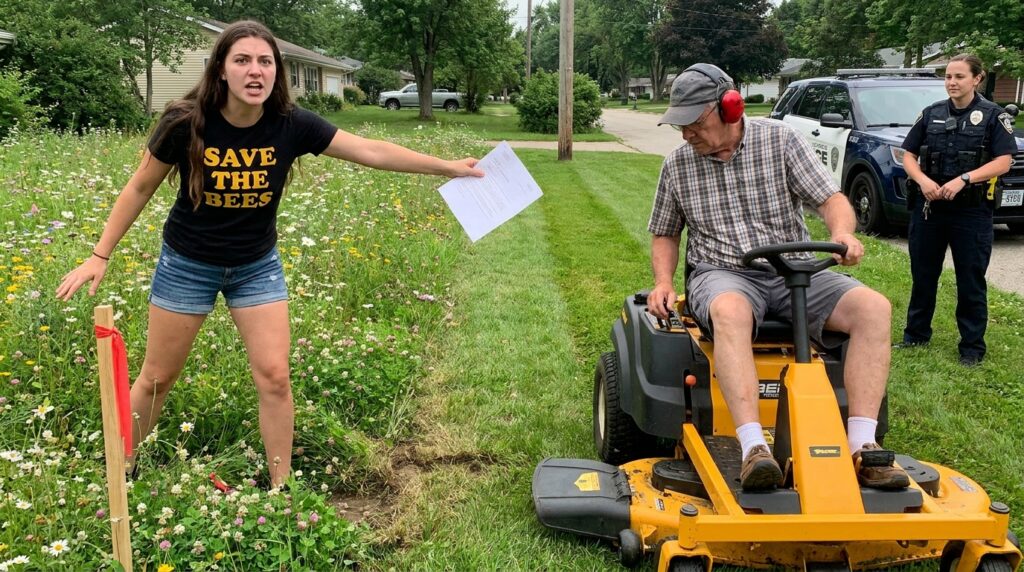
The Iron Roots of the Clover Line: A Novel of Property, Pride, and Suburban Siege
CHAPTER 1: THE FIRST SWATH
The envelope was thick, unsealed, and smelled of stale garage dust. Maya didn’t need to read the signature to know it came from the north side of the fence. The text inside was typed on an old ribbon, the letters h and e slightly elevated above the baseline like teeth missing their roots. Forty-eight hours to clear the nuisance, it read. The neighborhood has standards for drainage and sightlines. The city won’t protect an uncultivated plot.
Outside, the air was already heavy with the grey, oppressive humidity of a midwestern July. The sun hadn’t broken the tree line yet, but the ground was dry, the clay soil beneath the native clover cracking into thin, webbed fissures. Maya stepped onto the porch, her bare feet instantly collecting the fine grit that blew off the concrete curb.
Across the line, Harold Vance was already moving. He stood near his garage door, a rag in one hand and a yellow can of starter fluid in the other. His lawn was short—exactly two inches of uniform, chemical-dependent fescue, cut so low the parched brown thatch showed through like skin beneath a thinning coat. To Harold, the world was divided into what could be tamed by a straight blade and what was hostile to order.
“It’s not an uncultivated plot, Harold,” Maya called out, her voice cutting through the thick, pre-dawn silence of the subdivision. She didn’t shout; she kept her tone level, transactional, the way her father had taught her to speak when dealing with contractors who thought they could bill for unworked hours.
Harold didn’t look up from the engine deck of his John Deere. He wiped a smear of grease from the fuel cap with a slow, heavy rotation of his thumb. “The committee doesn’t look at labels, girl. They look at the curb. The weeds are catching the wind-blown trash from the turnpike. It’s an invitation for rodents.”
“They’re native milkweed and wild bergamot,” she said, stepping down from the porch onto the dry turf. Her black shirt, stiff from the wash, caught the first low glare of the sun. “The roots hold the moisture. If I cut them now, the topsoil turns to dust by August. The surveyor is coming at noon to set the iron pins. Until then, keep the deck on your side.”
Harold finally raised his head. His eyes were small behind his grease-filmed sunglasses, his gray cap pulled low enough to crease the skin above his brow. He didn’t answer. He simply reached down and pulled the red hearing protectors over his ears, sealing himself into a private world of mechanical vibration. The starter motor whined once, a sharp, metallic screech, before the two-cylinder engine caught, filling the narrow space between their houses with the thick, blue smoke of unburnt oil.
Maya watched the yellow machine crawl forward to the exact edge of his manicured green turf, its blades idling just above the soil line. Underneath the roar of the motor, a low, structural vibration seemed to rise from the ground—a dull hum that didn’t belong to the mower, but to something older, heavier, and buried deep beneath the grass.

CHAPTER 2: THE LETTER OF THE LAW
“The easement index doesn’t have a map attached, Maya. It just has a clerk’s docket number from 1984,” the county clerk’s voice sounded thin over the phone, competing with the low, dry rattle of an old air conditioning unit hummed in the background. “If there’s a rider, it’s in the dead storage vault downstairs. We don’t scan those unless someone pays the title extraction fee.”
Maya held the phone to her ear with her shoulder, her fingers tracing the stiff, yellowed edge of her original property deed spread across the kitchen table. The paper felt brittle, dry as onion skin, smelling of old basement dampness and dead ink. Outside, through the grease-filmed window, the yellow silhouette of Harold’s John Deere sat motionless on his perfect turf, its metal exhaust pipe ticking as the hot manifold cooled in the midday sun.
“How long to pull the physical folder?” Maya asked. Her thumb pressed against a faded purple stamp in the margin—Book 412, Page 88, Subject to Municipal Drainage Revision.
“Two days, maybe three,” the clerk sighed, a sound of heavy paper being shifted across a laminate desk. “But I’m telling you, those mid-eighties suburban plats are messy. Developers shifted utility lines three feet left or right depending on where they hit limestone. If your neighbor has a copy of the rider, he might actually have the legal right to clear the sightline.”
Maya disconnected without thanking her. She stood up, her joints popping slightly from the tension of sitting on the hard wooden chair. The floorboards under her sneakers felt warm; the heat was rising through the crawlspace now, baking the foundation of the old ranch house. She walked to the screen door, her eyes adjusting to the bright, overexposed glare of the yard.
Harold was sitting on a green webbing lawn chair beneath the shadow of his garage awning. He wasn’t working now. He was watching her house, a stained glass of iced tea balanced on his knee, his gray cap tilted back just enough to reveal the deep, white furrow of his brow where the sun never hit. Beside his boots lay a heavy steel pipe wrench, its iron jaws caked with dry, rust-colored mud that had flaked off onto his pristine concrete driveway.
She stepped through the door, the rusted spring screaming behind her before slamming shut with a flat wood-on-wood crack. She crossed the dry clover, the small purple flower heads crunching like dry paper under her soles.
“You knew about the eighty-four rider,” Maya said, stopping two feet short of the red-ribboned stakes she had driven into the parched earth earlier that week.
Harold didn’t shift his weight. He took a slow sip of the tea, the ice cubes clinking with a heavy, leaden sound against the glass. When he lowered it, a thin line of condensation ran down his wrinkled forearm, cutting a clean path through the gray dust and iron filings that clung to his skin.
“Your father bought this place from an estate, girl. He didn’t look at the underbelly,” Harold said, his voice a low, raspy gravel that sounded like stones turning over in an iron bucket. He pointed a thick, sun-spotted finger toward the center of her pollinator garden, where the tall wild bergamot stalks were already drooping from the noon heat. “There’s a six-inch concrete throat under that patch of weeds. If it gets choked with roots, the back-pressure doesn’t stay on your side of the line. It backs up into my cellar.”
“The city engineers looked at the topsoil last month, Harold. They said the drainage is clear,” Maya replied, her hand tightening around the folded copy of her deed. The edges of the paper were sharp, digging into her palm until she could feel her own pulse ticking against the wood-pulp fiber. “There’s no municipal line on the master plat.”
“Master plats are for the tax assessors,” Harold muttered. He reached down, his calloused fingers wrapping around the greasy handle of the pipe wrench. He didn’t lift it; he just turned it over in the dirt, the heavy iron tool leaving a dark, oil-stained crescent in the parched grass. “The people who laid the pipe didn’t talk to the people in the courthouse. You think you’re saving the world with a patch of dandelions, but you’re just pooling water where it don’t belong. When the iron rots through, nobody’s looking at your survey papers.”
Maya looked down at the wrench. The mud dried on the teeth wasn’t the pale, sandy clay of the surface lot; it was dark, rich, and carried the gray, sulfurous tint of deep underground stagnation. A micro-discrepancy clicked in her mind—Harold hadn’t been clearing his gutters that morning. He had been digging somewhere near the easement line before the sun came up, his boots still bearing the dark, wet ring of subterranean moisture despite the ninety-degree heat.
“The surveyor will be here in twenty minutes,” Maya said, her voice dropping into a hard, defensive register. She stepped directly onto the boundary line, her foot flattening a patch of native clover right beside his fence post. “He’s pulling the original iron pins out of the easement lane. Whatever you think is down there, Harold, it’s going on the map.”
Harold stood up slowly, his knees grinding with a faint, audible click. He didn’t offer a villainous speech; he simply hoisted the heavy iron wrench by its throat and walked toward his garage door, his boots leaving dry, dusty prints on the concrete.
“Maps don’t hold back the grey water,” he said over his shoulder, his voice disappearing into the dark, oil-scented shadow of the garage bay. “Make sure your man brings a heavy spade. He’s gonna hit something harder than stone.”
Maya turned back to her garden, her eyes fixing on a small, depressed circle of earth near the center of the milkweed patch where the ground had sunk two inches lower than the surrounding turf. The wild clover there was greener, strangely lush, its roots drinking from something hidden deep within the dark, calcified dirt.
CHAPTER 3: DRIVING THE IRON
The heavy steel tip of the surveyor’s drive-rod hit something beneath the milkweed patch with a flat, hollow clunk that vibrated straight through the baked July crust. It wasn’t the dense, silent thud of limestone. It sounded like iron scraping against old concrete.
“That’s not your property pin,” the surveyor said, lifting his mud-streaked yellow cap to wipe his forehead with the back of a calloused hand. His shirt was soaked through with a gray, salt-rimmed circle of sweat, and the heavy leather tool belt around his waist creaked as he shifted his weight. He was holding a magnetic locator tube, its digital display flickering with a sharp, erratic whine that rose in pitch whenever he swung it near the center of Maya’s pollinator garden. “Pins are solid three-quarter-inch rebar. This thing down here has a hollow ring to it. Big, too.”
Maya leaned over the shallow hole he had dug through her native clover. The topsoil was bone-dry, breaking apart into dusty, gray crumbs that smelled faintly of old iron scale. Beneath the loose earth, a curved, scaling grey surface was starting to show. It looked like the calcified flank of a buried boiler, its rusted seams weeping a dark, slow moisture that didn’t match the parched afternoon.
“Can you trace the line from the curb?” Maya asked, her hand tightening around the official, stamped county plat map. The heavy paper was already limp from the humidity, the black surveyor lines smudging slightly against her fingertips.
“I can trace the legal boundary,” the man muttered, dropping a heavy iron stake with a metallic clink near the fence line. He pointed toward Harold’s driveway, where the bright yellow riding mower sat idling under the metal awning. “But according to the official township pins I found at the intersection, your lot line runs exactly fourteen inches inside Harold’s existing grass strip. The problem is what’s under the dirt. My locator is pulling a massive anomaly right through your clover bed, heading straight toward his foundation. If there’s an unrecorded drainage corridor here, it’s not on the town register.”
Across the line, the screen door of Harold’s garage slammed shut with a sharp, wooden crack. Harold walked down his pristine concrete path with a deliberate, slow stride, his boots crunching on the parched blades of fescue. He wasn’t carrying his pipe wrench this time. Instead, he held a faded manila folder with a rusted metal clasp, the edges of the cardstock frayed and yellowed into the color of old pine needles.
“You’re wasting your time with that rod, son,” Harold said, stopping exactly where his low-cut grass met Maya’s overgrown wild bergamot. He didn’t look at Maya; his focus remained fixed on the surveyor’s shovel. He tapped the manila folder against his thigh, a dry, rhythmic sound like a locust in the weeds. “The township didn’t drop that iron. The old developer did, back in eighty-four, before the drainage board signed off on the phase-two plat. There’s a restricted rider in here that gives the adjoining lot the right to maintain the overflow.”
“The county clerk said that rider doesn’t have an approved map attached, Harold,” Maya said, stepping across the fresh earth of the survey pit. Her sneakers sank an inch into the soft, damp crust that surrounded the buried concrete structure. “If it’s not mapped, it’s not a legal encumbrance on my title.”
Harold let out a dry, rattling laugh that sounded like gravel shifting in an empty iron bucket. He opened the folder, revealing a single sheet of blue-lined carbon paper with a faint, purple-ink signature at the bottom—the name of the previous homeowner who had sold the house to Maya’s father.
“The signature is legal enough,” Harold said, his voice dropping into a flat, raspy drawl that seemed to mimic the low hum of his mower. He pointed a grease-stained thumb toward the gray, calcified pipe surface peaking out through the torn roots of Maya’s clover. “This paper says the drainage lane has to remain clear of deep-rooted vegetation for three yards on either side of the iron pin. Your little bee project is lifting the joints down there. When the next heavy storm comes off the turnpike, that water is going straight through my basement brick because your weeds are blocking the throat.”
The surveyor knelt down, running the magnetic tube over the exposed iron seam again. The machine didn’t emit a steady tone; it clicked rhythmically, like a geiger counter near stone. He looked up at Maya, his expression guarded, his eyes narrowing as he noticed the dark, foul-smelling moisture pooling around the tip of his boot.
“He’s right about one thing, miss,” the surveyor said quietly, his voice pitched below the low rumble of Harold’s idling machine. “This isn’t a standard storm line. The moisture coming out of this joint is gray water. It’s warm. If this pipe belongs to the city, it shouldn’t be discharging here. And if it’s private…” He let the sentence hang, his eyes drifting toward the foundation vents of Harold’s house, where a small, newly installed plastic drain line emerged from the brickwork and vanished into the parched earth right along the property boundary.
Maya felt a sudden, cold weight settle in her chest. The decoy was clear—Harold wanted her to believe he was enforcing an old, forgotten easement to protect the neighborhood’s drainage. But as she stared at the dark, oily ring of subterranean fluid slowly darkening the roots of her dying clover, she realized the surveyor’s iron rod hadn’t just found a property line. It had struck the edge of a secret that Harold had been keeping buried under her soil long before she ever bought the house.
“Drive the stakes anyway,” Maya said, her voice turning sharp as iron filings. She stepped directly between Harold and the open pit, her stance blocking his view of the leaking seam. “Set the red ribbons exactly where the county coordinates say the land ends. Whatever is under this grass, Harold, it’s about to be on the wrong side of the law.”
Harold didn’t move. He slowly closed the manila folder, the rusted metal clasp scoring a deep, gray scratch into the yellowed paper. His face remained completely unreadable under the shadow of his cap, but his hand tightened on the folder until the carbon paper inside crumpled with a brittle, dry hiss.
CHAPTER 4: THE BOUNDARY BREACH
The roar didn’t build; it slammed into the midday heat as Harold threw the engagement lever. The twin steel blades underneath the yellow deck dropped with a heavy, ungreased groan, chewing into the parched earth before the machine even cleared his driveway. Harold didn’t look down. His red hearing protectors were pinned hard against his gray cap, his gloved hands locked onto the steering rubber like iron clamps.
“Harold! Stop!”
Maya didn’t hear her own scream over the two-cylinder engine. She was already moving across the parched yard, her sneakers slipping on the loose, dry clay the surveyor had left behind. The surveyor himself had retreated to his truck to escape the ninety-degree glare, leaving his wooden stakes standing like small, fragile bone-markers along the property edge.
Harold’s front tire struck the first stake. The dry pine snapped with a sound like a pistol shot, splintering into clean, white shards that spun out from under the heavy rubber tread. The red ribbon caught on the spinning spindle of the deck, wrapping twice before the blades shredded it into fine, synthetic lint. He was fourteen inches inside her line now, his blades set to the absolute lowest notch, scalping the earth down to the grey subsoil crust.
Maya threw her body into the cut lane. She planted her right foot directly ahead of the front left tire, her hands thrusting the white, limp county survey map straight toward the grease-filmed lenses of Harold’s sunglasses. The hot, oily back-draft from the mower exhaust hit her chest, smelling of unburnt fuel and scorched grass. The yellow steel cowl was less than two feet from her shins when the tires locked, skidding across the flattened stalks of wild bergamot and native clover.
“Stop crossing my line and mowing my garden down!” she shouted, her throat raw from the dust.
The engine idled down slightly, a low, rhythmic thump-thump that rattled the metal siding of Harold’s garage behind him. Harold remained bolted to the high-backed vinyl seat, his stocky frame leaning slightly forward over the controls. He looked down toward the mower deck, where a thick, fibrous mass of wild roots and dark, sulfurous mud was wedged between the cutting spindles. Tangled in the crushed green pulp was a long strip of heavy gray PVC binding tape—the kind city utility crews used to seal high-pressure conduits.
“The county stamped it, Harold. Read the stake,” Maya said, her breath coming in shallow, ragged gaps as she gestured down at the splintered wood beneath his rear tire. Her fingers were shaking against the edge of the plat map, the paper tearing slightly under the pressure of her thumb.
Harold didn’t lift his sunglasses. He pointed a thick, gloved hand down at the fresh, raw swath he had torn through the center of her habitat plot. The blades had missed the buried grey concrete vault by less than an inch, but the vibration had cracked the dry clay seal around the joint. A slow, thin trickle of warm, grey effluent was already bubbling up into the tread marks, carrying the distinct, chemical scent of old household detergent.
“You think you’ve got a boundary, girl,” Harold raspy voice cut through the mechanical idle, low and hard. He didn’t monologue; his counter-move was already built into his stance. He tilted his cap back, exposing the cold, calculating sweat lines on his weathered forehead. “That paper don’t change what’s under the turf. If I don’t clear this throat before the clouds turn tonight, the county won’t be checking my fence line. They’ll be condemning your foundation for a grey-water hazard.”
“This is my property,” Maya said, her voice dropping into a tight, transactional stone. She didn’t step back. Her shins were close enough to the yellow bumper to feel the ambient heat of the block. “The surveyor locked the coordinates. If you pull that lever again, it’s criminal vandalism and you know it.”
Harold didn’t look at her map. His gaze shifted past her shoulder, toward the hot asphalt of the street where a white-and-black cruiser was slowing down, its tires crunching against the loose gravel at the curb. He didn’t show fear or surprise; his jaw simply set into a harder, more stubborn line, his wrinkled hands remaining heavy on the steering grips as if waiting for the next mechanical cue.
The decoy paper he had shown her earlier—the old eighty-four drainage rider—crumbled into irrelevance as the physical evidence pooled between them. Maya looked down at the shred of gray PVC tape caught in his machine’s underbelly. It wasn’t forty years old. The plastic was clean, non-biodegraded, and bore the distinct, modern manufacturing stamp of the local water district. Her victory with the surveyor’s coordinates felt hollow, a temporary shield against a deeper, heavy machinery problem that was actively bubbling through the roots of her garden.
CHAPTER 5: THE STATIC INTERRUPTION
“Sir, stop the mower, step off, and talk to me.”
Officer Alvarez’s voice didn’t carry the theatrical weight of a courtroom challenge; it had the flat, heavy cadence of someone who spent eight hours a day uncoupling neighbor-to-neighbor friction from local asphalt. Her boots sank an inch into the shredded green pulp of the wild bergamot as she walked directly into the yellow mower’s access lane. The black nylon weave of her tactical vest shimmired under the dry midday glare, and her right hand hung loose, palms lowered in a controlled, steadying gesture.
Harold didn’t move for three long seconds. His gloved hands remained clutched around the rubber handles of the John Deere, the machine’s cylinder block vibrating against his stocky thighs with a stubborn, dull rhythm. Then, with a slow, deliberate jerk of his wrist, he disengaged the blade clutch. The mechanical whine beneath the deck died down to a scraping hiss, leaving only the low, oily chug of the engine idling in the heavy air. He pulled the red hearing protectors off his ears, letting them rest around his thick neck like a plastic yoke.
“She’s blocking a recorded drainage lane, Officer,” Harold said, his voice dropping into a raspy, defensive drawl that lacked any performative panic. He reached down to turn the key, killing the ignition completely. The sudden silence over the yard was total, punctured only by the ticking of the cooling manifold and the high-frequency crackle of a dispatcher’s voice from the police SUV parked at the curb.
“I have the county survey right here,” Maya intercepted, her finger tapping the crisp edge of the plat map. The white ledger paper was damp with her own sweat, the black property lines now grey and distorted under her grip. “The stakes he just crushed were set twenty minutes ago by a licensed surveyor. He’s deliberately destroying the habitat plot to enforce an unrecorded boundary.”
Alvarez stepped between them, her body creating a hard physical block right at the edge of the freshly cut tire swath. She didn’t look at the map yet. Instead, her eyes went down to the soil. The heavy rubber tread of the mower had compressed the parched clay, and through the fractured crust, the warm, grey-tinted water was now pooling into a slick, soapy slurry. The distinct smell of old, chemical laundry detergent and stagnant subsoil lime rose through the heat, completely overpowering the scent of the crushed clover.
“Sir, step completely off the machine,” Alvarez repeated, her gaze shifting to the manila folder tucked firmly under Harold’s arm. “We’re going to look at the paperwork on the sidewalk, away from the equipment.”
Harold swung his leg over the yellow plastic cowl with a slow, stiff effort, his boots hitting the damp turf with a leaden thud. He didn’t drop his eyes; he stared straight at Maya, the sun-glare catching the grease film on his glasses. “The township didn’t put that pipe in, girl. If the code inspector sees what’s leaking out of that vault because your weeds shifted the seal, nobody’s staying on this lot.”
“Let me see the deed rider, Mr. Vance,” Alvarez said, extending her hand toward the yellowed folder. The metal clasp on the cardstock scraped against her thumb with a sharp, dry sound. She turned her back to the running grey leak, ignoring the warm moisture that was slowly darkening the leather toes of her boots, and began comparing the handwritten 1984 docket numbers with the stamped county coordinates Maya held forward.
Maya watched the officer’s pen trace the old ink lines. The decoy secret—the paper rider that Harold had used to justify his aggressive overreach—was losing its power under the steady, objective evaluation of the law. But as the warm, gray fluid continued to well up from the unpermitted conduit below, Maya knew the real tactical failure wasn’t the broken stakes or the ruined garden. The true hazard was still locked beneath the parched clay, and the legal clarity of the survey map wouldn’t stop the subterranean water from rising.
CHAPTER 6: THE RUSTED RETREAT
The earth between the two properties didn’t simply settle; it fractured with a wet, heavy suction that drew the remaining green stalks of wild bergamot down into the dark clay. The warm, sulfurous back-pressure from the gray-water bypass finally broke the calcified seal of the 1984 conduit, sending a thick, soapy bubble of mud up past the tires of Harold’s stopped mower.
Officer Alvarez stepped back, her leather boots grinding into the parched turf on Harold’s side of the line. The county plat map in her hand stayed flat, but her index finger dropped from the page to point at the exposed, broken throat of the pit. The legal boundary coordinates were perfectly clear now, but the ground itself was rejecting the neat black ink lines of the surveyor’s blueprint.
“Mr. Vance,” Alvarez said, her voice dropping into a flat, regulatory gravel that matched the heat. “The county line isn’t your issue today. That line running into the girl’s garden is a private, unpermitted bypass coming off your cellar drain. Look at the tile color.”
Maya knelt at the jagged edge of the mini-trench. The crumbling topsoil had fallen away to reveal the true subterranean reality that the old manila folder had tried to mask. It wasn’t an ancient municipal main. The pipe was a hybrid monstrosity: an official gray iron casing that had been crudely breached three decades ago with a modern, unhatched orange clay line that ran straight under the fence post toward Harold’s foundation. The gray PVC tape she had spotted earlier was wrapped around the junction like a rotten bandage, failing under the hydrostatic weight of forty-eight hours of hidden, unpermitted gray-water discharge.
Harold didn’t speak. He stood by the yellow fender of his silent machine, his wrinkled hands hanging loose at his sides, his thumbs catching on the hem of his damp plaid shirt. The authoritarian edge that had driven his straight-blade path across her garden vanished into the heavy, humid air of the afternoon, replaced by the tactical exhaustion of a property owner who had run out of terrain to defend. His gray cap cast a deep, motionless shadow over his eyes, but his jaw remained locked, a calcified hinge resisting the public turn of the neighborhood watchers who were now leaning over their porch rails across the street.
“Sir, you’re going to turn this machine around and back it onto your own turf,” Alvarez commanded, her pen making a sharp, final notation on the civil complaint form clipped to her vest. “The town code enforcement inspector is going to be out here by five o’clock to dye-test this line. If that gray water is originating from your washing cycles and hitting this open soil, you’ll be digging up your own basement slab by morning.”
Harold reached out, his thick, sun-spotted hand wrapping around the black rubber steering lever of the John Deere with an unhurried, mechanical rhythm. He climbed back onto the high-backed vinyl seat, the springs groaning under his stocky frame. He didn’t offer an excuse, and he didn’t check the broken pieces of the survey stakes beneath his tires. He restarted the engine—the starter motor whining with a dry, metallic screech before the cylinders caught—and shifted the transmission into reverse.
The yellow machine crawled backward, its heavy rear treads leaving deep, oily crescents in the ruined clover as it retreated onto the sterile, uniform turf of his own yard. Harold kept his face forward, his eyes fixed on the gray concrete of his garage bay, his fingers trembling slightly against the rubber grips as the mechanical vibration shook his shoulders.
Maya watched the yellow bumper clear the marked boundary line. The remaining native milkweed stalks stood crooked against the heat, their roots partially exposed but still anchored in the deep, dark soil. The decoy agreement from 1984 was dead, shattered by the physical revelation of the illegal bypass that Harold had spent half his retirement trying to protect from the probing roots of her conservation garden. The true depth of the territorial battle was now written in the mud between their houses—a rusted, subterranean truth that no lawn mower could ever cut down to size.
CHAPTER 7: THE CODE ENFORCEMENT INSPECTION
The neon-green powder didn’t dissolve immediately when the inspector dropped it down Harold’s cellar drain; it hissed, foaming into a vibrant, toxic chartreuse that smelled intensely of industrial mint and scale-remover. Less than five minutes later, that same artificial green began hemorrhaging through the fractured mud at the center of Maya’s pollinator garden, bright as road-flare smoke against the parched clay.
“There it is,” the city code inspector muttered. He was a lanky man named Miller, wearing a sweat-stained high-visibility vest that rattled with brass snap-buttons whenever he bent over. He knelt on a square of rubber matting right at the boundary line, his thumb pressing a digital camera lens down toward the bubbling slurry. “That’s not storm runoff. That’s pure industrial-grade tracer dye coming straight from his basement wash-basin. He’s bypassed the municipal sanitary main entirely on this side.”
Maya stood three feet back, her bare shins dusted with the white lime powder the surveyor had left behind. The heat was still radiating off the concrete curb, thick and gasoline-scented, but the conflict had shifted from a neighbor’s loud overreach to the quiet, mechanical documentation of a city citation. Across the line, Harold’s yellow riding mower sat locked behind his closed garage door, its cooling block silent, but the side curtain of his basement window twitched every time Miller’s camera flash clicked.
“Is the pipe structural?” Maya asked. Her voice was flat, her fingers tracing the tear in her county plat map where she had gripped it too hard during the confrontation.
“It’s unpermitted clay tile, probably dropped into the trench during the eighty-four subdivision grading before the inspectors signed off on the street links,” Miller said, his boots scraping against a rusted iron water-key sticking out of the turf. He stood up with a heavy grunt, his clipboard clipping against his belt. “He used your garden as a drainage field because his foundation sits three feet lower than the grade of the city main. If he had to pump it up to the street line legally, it’d cost him an eight-thousand-dollar lift station. So he just let it bleed into your topsoil.”
The screen door on Harold’s porch didn’t slam this time. It opened an inch, the rusted spring giving a low, metallic whine that cut through the idling rumble of Miller’s city utility truck. Harold didn’t come down to the grass. He remained behind the wire mesh, a shadow holding a blue plastic clipboard of his own, his gray cap a sharp, dark wedge against the interior light of his kitchen.
“The eighty-four rider allows for municipal runoff, Miller!” Harold’s voice came through the screen, more raspy and strained than it had been during the morning duel. He didn’t monologue; he was aiming for the inspector’s regulatory line. “The previous owner signed the carbon sheet. It’s an approved easement corridor!”
“Runoff is rain, Harold,” Miller called back without looking up from his citation log. His ballpoint pen made a sharp, tearing sound against the carbonless paper forms. “This is laundry discharge and cellar sump overflow. You’ve got an illegal tie-in to an abandoned transit line under this girl’s milkweed, and it’s actively undermining her foundation slab. I’m tagging this a Class II environmental violation before I clear the curb.”
The green dye continued to well up, staining the white roots of the clover a deep, permanent chemical emerald. Maya looked past the inspector’s boots toward the center of the sinkhole, where the weight of the water had exposed another three inches of the buried gray iron casing below the clay tile. A micro-discrepancy caught her eye—the iron casing didn’t terminate at Harold’s line. It had a heavy, industrial-grade flange bolted to the side that faced her house, its rusted hex-nuts covered in a thick layer of old, black pitch that hadn’t been disturbed since the day the subdivision was carved out of the limestone. Harold’s illegal orange pipe was just an amateur tap into something much larger, older, and strictly locked beneath her feet.
CHAPTER 8: THE RESTITUTION DEMAND
“We aren’t clearing the check, Miss Lin. The subsoil liability belongs to the title transfer, not the current policy year.”
The voice didn’t come from Harold, and it didn’t come from a city worker. It belonged to a man named Vance’s representative—an insurance adjuster named Gidley who stood in Maya’s gravel driveway with a glossy black leather binder pressed against his ribcage. His silver sedan was idling near the curb, its air conditioning compressor kicking on with a loud, mechanical hiss that vibrated the dry stones under Maya’s sneakers. He was holding a three-page remediation denial form, the top margin stamped with a bold purple index marker: Sub-Surface Encroachment Exclusion—Prior Knowledge Rider.
Maya didn’t back down. She kept her arm braced against the rusty iron railing of her porch, her eyes tracking the movement of a flat-bed truck rolling slowly down the block, its steel winches clanking like heavy chains. “The city code inspector logged the source forty-eight hours ago, Mr. Gidley. The grey-water bypass runs straight from Harold’s basement slab. That’s an active structural intrusion, not a title defect.”
“Look at the date on page two,” Gidley said, his thumb scraping the edge of the crisp white bond paper as he thrust the folder forward. The paper made a sharp, dry rattle in the hot breeze. “Your father accepted the deed from the previous estate with a generalized utility waiver. When Harold’s contractor tapped that old transit line in eighty-four, the owner of your lot was paid a one-time structural easement fee of twelve hundred dollars. It’s a bound covenant. Harold didn’t trespass; he used a paid drainage field that your deed legally inherited.”
Maya snatched the sheets. The texture of the paper was unnaturally smooth under her dirt-smudged thumbs, smelling of fresh laser toner and dry filing vaults. Her eyes jumped to the signature line at the bottom. It wasn’t just a handwritten name; there was a small, three-digit corporate code embossed into the fiber—V-ENG-84. The exact same code she had found stamped on the old plat map envelope in her kitchen drawers.
“Twelve hundred dollars doesn’t cover a toxic sinkhole,” Maya said, her teeth clicking together on the words. “The estimate to excavate the native garden, extract the broken clay tiles, and pour a new structural retaining wall along the fence line came back this morning at fourteen thousand six hundred. If your agency doesn’t cover the payout, I’m filing the property lien with the county magistrate before the courts close on Friday.”
Across the parched property line, the garage door stayed down, but a heavy iron scraper was working inside, the dry schreech-schreech of metal cleaning old oil stains off the floorboards echoeing through the neighborhood. Harold was in there, hidden behind the scaling vinyl panels, listening to every syllable through the vents.
Gidley reached into his breast pocket and extracted a heavy steel stapler, punching a silver wire clip through the corner of his denial logs with a loud, mechanical clack. “You can file whatever you like with the magistrate, Miss Lin. But if you break ground with a backhoe to pull those tiles without Harold’s signature on the easement release, you’re violating a forty-year-old construction rider. The title company won’t defend your boundary if you’re the one cutting the neighborhood’s drainage artery.”
He didn’t wait for her to reply. He turned on his leather-heeled loafers, his soles crunching the dry gravel into dust as he walked back to his idling sedan.
Maya looked down at the stapled pages in her hands. The corporate stamp V-ENG-84 wasn’t an insurance label; it was the short-form name of the old civil engineering firm Harold had worked for before his retirement. The decoy secret—that this was an ordinary, unfortunate title mistake inherited from her father—was falling apart under the cold arithmetic of the remediation costs. She turned her head toward her garden, where the neon-green dye was now fading into a pale, sour crust along the exposed iron flange. The flat-bed truck at the curb wasn’t here to deliver soil; it was carrying a yellow compact excavator with an iron-toothed bucket, its diesel engine ticking over as the driver waited for her signal to tear into the clay. She didn’t have the insurance money, and she didn’t have Harold’s permission, but the iron flange beneath her flowers was waiting, and the active pressure of the rising grey water meant the time for legal debate was already buried in the dirt.
CHAPTER 9: THE EXCAVATION SECRETS
The teeth of the mini-excavator’s bucket didn’t just scrape the earth; they gouged into a dense, unyielding mass of oxidized iron with a shrieking metallic squeal that sent a shockwave straight through the steel chassis. The operator instantly slammed the hydraulic levers backward, the diesel engine spitting a thick, black plume of soot into the suffocating afternoon heat.
“That’s not utility tile, lady,” the driver yelled down over the rattling hum of the block. He leaned over the side of the open cab, squinting into the deep trench his machine had torn along the fence line. “I just sheared the side off a heavy steel plate. This thing is structural, and it’s welded shut.”
Maya stood at the lip of the pit, her palms pressed flat against her denim shorts to stop the shaking. The air down in the trench was cold and foul, smelling of wet rust, ancient industrial grease, and the sharp, sulfurous stink of stagnant gray water that had been trapped under pressure for decades. The yellow bucket had ripped away the crude orange clay tile Harold had used for his cellar bypass, but beneath it lay the true skeleton of the lot line: a heavily fortified, military-surplus metal locker, its thick plates crusted with a scale of black municipal tar.
“Keep digging around the perimeter,” Maya said, her voice dropping into a hard, transactional stone. She didn’t look at Harold’s house. She didn’t need to. The side door of his garage had finally clicked open, and the old man was walking down the slope, his legs moving with a heavy, unstable hitch that made his stocky frame look smaller against the wide expanse of his sterile lawn.
“Stop the machine,” Harold said as he reached the edge of the fresh pile of clay. He wasn’t carrying his clipboard or his folder. His hands were empty, the fingers hooked tightly into the pockets of his gray shorts as if he were trying to anchor himself to the property line. His face was entirely desaturated under the brim of his gray cap, his skin the color of parched limestone. “You don’t know what you’re pulling out of that hole, girl. Leave the box where it sits.”
“The contractor says it’s on my side of the iron pin, Harold,” Maya replied, her gaze tracking a wide, horizontal fracture that had appeared across the front plate of the buried locker where the excavator’s tooth had hooked it. Through the narrow gap, the dark water wasn’t bubbling; it was leaking a dry, chalky white powder that dissolved into the sulfurous slurry. “You didn’t just tap a line. You buried a shoring box right beneath my garden.”
The excavator driver swung the boom out of the lane, the hydraulic cylinders groaning as he lowered a heavy iron pry-bar into the trench. With a single, heavy leverage crack, the rusted weld on the front of the locker snapped. The metal door didn’t slide; it fell inward with a hollow, leaden thud that shook the roots of the remaining milkweed stalks.
Inside the locker wasn’t an explosive or a municipal junction. It was a structural void—a crude, unpermitted shoring system holding up a massive, decaying municipal gray-water line that had been bypassed forty years ago during the original phase-two development. Wrapped in crumbling plastic sheets at the base of the box were bundles of original engineering blueprints bearing the bold, blue ink logo of V-ENG-84.
The final truth was exposed in the light. Harold hadn’t been fighting for his turf or his curb appeal; he had been protecting a catastrophic structural failure. The gray-water bypass he had constructed wasn’t just dumping water—it was a necessity to prevent the decaying main line underneath Maya’s garden from shifting and completely collapsing the unpermitted foundation wall he had poured for his own home decades prior. If the city inspectors found the box, his house would be condemned as a structural hazard.
Harold looked down into the open metal vault, his shoulders dropping under the weight of the noon sun. He didn’t offer a villainous speech, and he didn’t check the papers. He simply turned back toward his silent garage, his boots dragging through the dry, dead grass of his pristine lawn, his authority completely broken by the rusted machine truth that had risen from the dirt to redraw the neighborhood line forever.