
The Two-Foot Margin and the Iron Pin in the Soil

CHAPTER 1: THE LINE AT THE SIDING

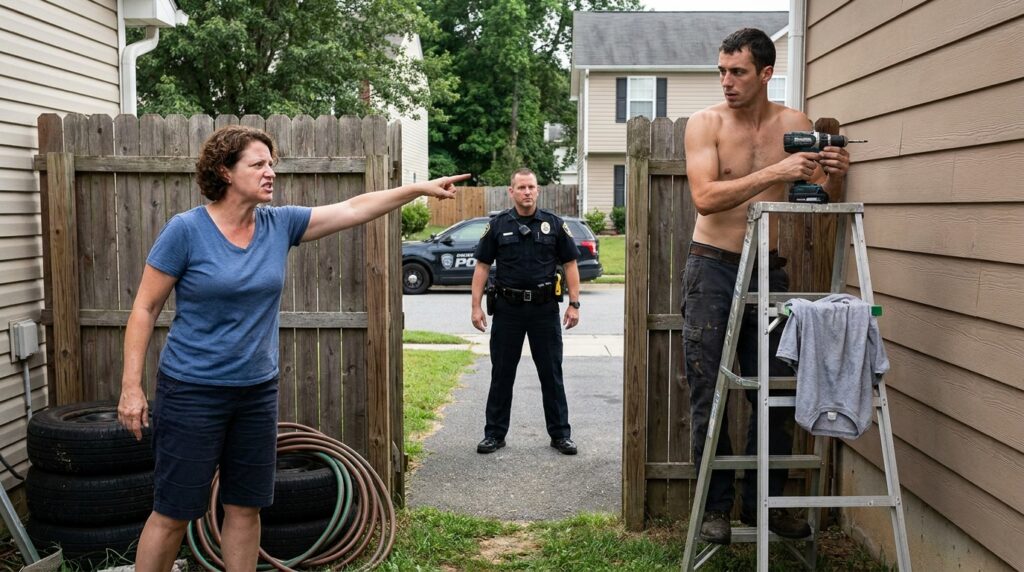
The high-pitched whine of the 18-volt motor sheared through the humid afternoon quiet, sending a spiral of pale vinyl shaving curling over the cuff of Marcus’s work sleeve. He held the drill steady with both forearms locked, his steel-toed boots planted on the third rung of the aluminum step ladder. Three inches to the left, the joint was dry-fitted, waiting for the fastener to draw the new channel flush against the house sheath.

“Stop drilling that wall, you’re on my property again!”

The voice didn’t start as a call; it landed like a dropped sheet of galvanized tin. A hand—heavy-set, fingers tipped with chipped red polish—snapped over the top rail of the six-foot privacy fence, slapping the weathered pine board until the ladder vibrated beneath Marcus’s soles.

Marcus didn’t jump. He eased his index finger off the variable trigger, letting the motor whine down to a low, metallic click. The silence that filled the narrow side yard immediately felt heavier than the tool in his grip. Sweat ran down the back of his neck, soaking into the collar of his grey work shirt, smelling faintly of sawdust and mineral spirits.

Below him, leaning hard against the fence line with her chest pressed to the vertical pickets, was Brenda Hollister. Her short brown hair was damp around her temples, her blue top creased across the shoulders as she strained to project her upper body into his workspace. In her left hand, a smartphone screen glowed hot white against the shade of the narrow lane.

“I said take the bit out of the siding, Marcus,” she spat, her breath coming in tight, raspy hitches. “You’re vibrating my foundation. I told the city inspector on Tuesday, and I’m telling you now—this fence is the legal line, and your ladder feet are sitting in my easement.”

Marcus didn’t answer right away. He lowered the drill to his hip, keeping his left hand clamped onto the top rail of the step ladder. Across the street, the steady drone of a riding mower slowed, then cut off entirely. Mr. Henderson remained seated on his John Deere at the edge of his driveway, wiping his forehead with a handkerchief while his eyes stayed locked on the side-yard gap.

“The permit is taped to the front window, Brenda,” Marcus said. His voice was low, flat, scraped clean of inflection—the tone he’d learned to use when dealing with frayed cables or stripped bolt heads. “The inspector signed off on the framing at nine this morning.”

“I don’t give a damn about a piece of paper your contractor printed out!” Her pointing finger twitched forward, hovering less than a foot from his knee. “You’re on my land. You didn’t get my permission to set foot in this alley, and you sure as hell didn’t get my clearance to drill into a shared wall structure!”

“It’s not a shared wall,” Marcus said quietly. “It’s my house.”

“We’ll see what the city says when the cruiser gets here,” Brenda snapped, pulling her phone back to check the screen. “I called the desk five minutes ago. Trespass and unpermitted structural disturbance.”

Marcus didn’t move from the ladder. He looked past her shoulder, down the narrow corridor of grass where the turf had turned brown from her daily walks along the fence line. Two inches below the bottom rail, half-buried under a clump of crabgrass and dry topsoil, a rusted iron ring glinted under the hard summer light—a discrepancy he’d measured three times before he ever bought a single box of siding nails.

A dark blue utility cruiser pulled up to the curb without a siren, its tires crunching softly against the gravel edge of the street. The driver’s door opened, and a pair of polished black boots hit the asphalt.


CHAPTER 2: THE MARGIN OF SEPARATION

The driver’s door of the Ford Utility cruiser clicked open, the heavy steel hinge groaning against its catch. Officer Miller’s boots came down hard on the dry asphalt of the curb lane, the thick rubber soles grinding a pinch of street gravel into powder before he turned into the mouth of the side driveway.

He didn’t hurry. His dark uniform shirt was stiff with starch across the shoulder blades, the fabric slightly discolored where the bulletproof vest pressed against his collarbones in the heat. His graying hair was cut tight to the crown, his face set in the flat, unreadable mold of a man who spent eight hours a day stepping between people who hated each other over three inches of dirt or an unraked pile of oak leaves.

“Hold your positions,” Miller said. His voice was a dry, gravelly baritone that didn’t rise above the ambient hum of the neighborhood, but it carried instantly down the narrow passage between the two houses. “Marcus, keep your hands where I can see them. Brenda, step two feet back from that fence rail.”

Brenda didn’t retreat. Instead, she leaned further over the weathered cedar pickets, her fingers digging into the soft, sun-rotted top grain of the wood. “He’s drilling into the structural framing, Officer! I told the dispatcher—he’s vibrating my side foundation, and he doesn’t have an easement clearance for that step ladder. Look at where those aluminum feet are resting!”

Miller crossed the front lawn line, his duty belt squeaking softly as his holster rubbed against his hip guard. He stopped right at the mouth of the side yard, his eyes sweeping over the scene with practiced, methodical disinterest. He took in the open aluminum ladder, the cordless drill resting on the third rung with its 18-volt battery pack facing out, the newly mounted vinyl siding panel dry-fitted against the house sheath, and the three feet of brown, trampled grass running along the wooden fence.

He looked at Marcus first. “You working on your own house?”

“Replacing water-damaged siding on the east elevation,” Marcus said. His hands remained open and flat against the aluminum stiles of the ladder. He stayed on the third step, his eyes level with the officer’s chest badge. “Permit’s pulled. Code inspection was signed off this morning at nine.”

“He’s trespassing to do it!” Brenda barked, her smartphone raised now, the lens pointed straight at Miller’s face. “The lot line runs straight down the center of this grass strip. Every time he sets that ladder down, his boots are on my parcel. I’ve lived in this house since 1996, Officer. I know where my land ends.”

Miller turned his head toward her, his expression unchanged. He didn’t look at her phone camera. He had seen a thousand phones held up like small glass shields. “Brenda, I’m going to ask you one time to take your chest off that fence rail and step back into your yard space. We aren’t going to yell across a timber line.”

“I am standing on my property!”

“And I’m standing in the middle of a civil complaint until I determine whether a crime occurred,” Miller replied calmly, though a small muscle tightened at the corner of his jaw. He raised one broad, gloved hand, palm out, pointing straight down the narrow center of the grass path. “Step back. Both of you. Give me the lane.”

Marcus didn’t argue. He shifted his weight slowly, testing the aluminum ladder’s stability before stepping down one rung at a time. His heavy leather work boots sank slightly into the dry soil at the base of his foundation wall. He reached out, grabbed the grey work shirt hanging over the top rung, and pulled it over his shoulders, his thumbs hooking through the belt loops of his trousers as he turned to face the officer.

Brenda let out a sharp, theatrical breath through her nose, but she pulled her arms back across the fence, her blue T-shirt catching on a stray cedar splint as she smoothed down her dark shorts. She stayed right at the edge of the pickets, her chest heaving, her eyes darting between Miller’s radio patch and Marcus’s face.

“Alright,” Miller said, taking a small leather-bound notebook from his breast pocket and flipping it open with one thumb. “Marcus, step down toward the driveway so I have a clear sightline to that wall. Brenda, stay where you are.”

As Marcus backed up three paces, his boot heel brushed against a piece of thin, yellow nylon string tied tightly between two pickets near the bottom of the fence—a makeshift line Brenda had strung three days prior. The knot was fresh, the nylon crisp, stretched tight across a small patch of dirt where the grass had completely died off.

Miller noticed the movement of the string. His eyes dropped to the dirt, following the bright yellow line as it disappeared under a mat of dry crabgrass right at the base of the fence post.

“What’s the string for?” Miller asked, pointing at the dirt with his pen.

“That’s my survey mark,” Brenda said instantly, her voice rising in pitch as she felt the focus shift. “I ran that line from the front sidewalk curb based on the original 1998 plot map the town gave me when I closed on the house. That string marks the absolute boundary. And as you can clearly see, Officer, his ladder feet are six inches on my side of that line.”

Marcus looked down at the string, then up at Miller. His face remained guarded, the skin tight over his cheekbones. “That string wasn’t there when the city surveyor dropped the permit flags in April,” Marcus said softly. “She tied that on Tuesday after the contractor dropped the siding materials in my driveway.”

“It’s based on the town sketch!” Brenda shouted, reaching into her dark pocket and pulling out a folded piece of yellowed, lined paper, covered in faint pencil marks and blue ballpoint ink. “I have the document right here! The fence was built on an informal agreement between the old owners. The real line is two feet closer to his house!”

Miller took a slow step closer to the fence, his heavy boots crushing a dry weed. He didn’t take the yellowed paper from Brenda’s hand yet. Instead, he looked at the wooden fence itself—the aged, silvered pine posts, the heavy galvanized nails, and the way the entire structure leaned slightly inward, away from Marcus’s house and toward Brenda’s yard.

“You got the official county plat map with you, Marcus?” Miller asked, his eyes still tracing the fence line down toward the back corner of the yard.

“It’s on the porch,” Marcus said, his voice flat and steady. “In the job folder. Along with the stamped permit.”

“Go get it,” Miller said. “And grab a hand trowel while you’re up there.”

Brenda’s jaw snapped shut. She glared at the officer, her smartphone slipping down an inch as her hand began to tremble. “What does he need a trowel for? The paper in my hand is from the city clerk!”

“Because city sketches aren’t legal boundaries, Brenda,” Miller said, his voice dropping into that low, unyielding register that ended conversations. “Pins in the dirt are.”

CHAPTER 3: THE WEIGHT OF THE FOLDER

Marcus didn’t turn back to look at Brenda as he walked up the two pressure-treated steps of his back porch. His boots left faint, dry dust outlines on the grain of the deck boards. Beside the screen door, resting on a weathered wooden bench next to a half-empty bucket of drywall joint compound, sat his blue canvas job folder.

He zipped it open, the brass teeth rasping against the fabric. Inside, protected by a heavy plastic sleeve, lay the original county clerk’s survey plat, the signed municipal permit card with its neon-orange inspector’s seal, and a three-page structural report from the siding manufacturer. He didn’t grab the papers alone; from the small wooden tool cradle under the bench, he picked up a narrow steel hand trowel, its blade scratched raw from years of scraping mortar and turning hard clay.

When he stepped back down into the side yard, the shift in atmosphere was immediate. Brenda had moved three steps closer to Officer Miller, her body angled to block the view of the yellow string tied near the grass line. She held out the yellowed, lined paper, her thumb pressing hard against the crease.

“Look at the corner notation, Officer!” Brenda’s voice had gained a sharp, breathless velocity. “1998. Signed by the former owner, Howard Vance—no relation to him—and witnessed by the town clerk’s assistant at the time. It explicitly marks the easement along the structural drip line! It says right here: Boundary recognized at fence rail.”

Miller didn’t take the paper by the corner. He reached out with two fingers, caught the top margin, and tilted it toward the sunlight streaming between the house eaves. His eyes narrowed as he scanned the hand-drawn ink lines.

“This is a hand sketch, Brenda,” Miller said softly. “It’s not a recorded plat.”

“It has the town seal on the back!” she insisted, her finger tapping the reverse side of the paper.

Miller flipped the sheet over. A faded blue ink stamp sat near the fold, its edges smeared by years of humidity and storage in a kitchen drawer. The top line read Township Planning Office – Informational Review Only. Below it, written in faint red ballpoint that had oxidized into a dull rust color, were two words: Variance Required. Beneath that line, the signature space was completely blank.

Marcus stopped three feet from Miller, setting the heavy plastic sleeve on the top flat rung of the aluminum ladder. He didn’t thrust the papers forward. He waited until the officer’s eyes left Brenda’s paper.

“This is the official plat from the county registry,” Marcus said, his voice flat, low, carrying no triumph, only the dull weight of documented fact. “Recorded in Book 412, Page 88, when the subdivision was platted in 1984. The coordinates were re-verified by a licensed surveyor in April when I closed on the mortgage.”

Miller took the plastic sleeve from Marcus. He pulled out the thick, high-rag paper map. The blue lines were sharp, crisp, accompanied by exact numerical bearings and degree markers that left no room for hand-drawn arrows or informal notes.

“Look at the south boundary,” Marcus pointed with the wooden handle of his trowel, taking care not to touch the paper itself. “Lot 14—that’s my parcel. The boundary doesn’t run along the wooden fence. The fence was built forty inches inside the lot boundary in 1991 to clear a root system from an old oak tree that was taken down ten years ago.”

Brenda let out a short, harsh laugh that sounded like dry gravel tumbling down a chute. “That’s ridiculous! Who builds a fence forty inches inside their own property line? You’re making up stories about a tree that isn’t even there!”

“The stump is still under your flowerbed, Brenda,” Marcus said without looking at her. He kept his eyes locked on Miller. “And the iron monument pin wasn’t moved when the tree came down. It’s still in the ground.”

Miller looked from the crisp blue lines of the county plat map down to the dead patch of crabgrass where Brenda’s yellow string was tied. The string was pulled taut, angling slightly toward Marcus’s foundation wall—an arbitrary line drawn from a hand sketch that had never passed a town board review.

“Where’s the corner pin, Marcus?” Miller asked, his thumb resting over the county surveyor’s embossed seal at the bottom of the sheet.

“Right under the fourth picket from the front post,” Marcus replied, lowering the hand trowel toward the soil. “Two inches down, under the turf she laid over the property line last autumn.”

Brenda’s phone slipped lower in her grip, her knuckles turning white as her arm dropped to her side. “You aren’t digging up my lawn, Marcus. Officer, tell him he can’t dig up my yard!”

Miller didn’t answer her. He reached to his belt, unclipped a heavy steel flashlight, and clicked the beam on despite the bright daylight. He stepped right up to the fence line, his heavy boots straddling Brenda’s yellow string, and pointed the bright circle of white light down at the dry, compacted dirt.

“Go ahead and clear the topsoil, Marcus,” Miller said quietly. “Let’s see what’s under the grass.”

CHAPTER 4: THE DECOY SKETCH DISCOVERY

Marcus dropped to one knee, the rough weave of his work trousers grinding into the dry, sun-baked earth. The heat radiating off the dark siding of his house pressed against the side of his neck, smelling of fresh pine resin and hot vinyl.

The circle of Officer Miller’s flashlight beam held rock-steady over the dead grass patch. Two inches to the right, Brenda’s yellow string vibrated slightly in the faint afternoon breeze, tied tightly around the bottom rail.

Marcus drove the tip of the steel trowel into the dirt. The soil was dense, packed hard by decades of rainfall and tread, choked with the thin, fibrous roots of invasive crabgrass. Scritch. Scritch. The metallic scrape of steel against grit cut through the heavy silence of the side yard.

“Mind the picket base,” Miller said, his boots shifting slightly as he leaned closer to track the blade’s entry. “Don’t pry against the wood.”

“I know where the footing is,” Marcus said softly.

He didn’t plunge the blade deep. He worked methodically, shaving off half-inch layers of crusty topsoil, flaking away the dried mat of lawn roots Brenda had laid down the previous autumn to cover the bare dirt. Across the fence, Brenda’s heavy breathing sounded wet, rhythmic, her body pressed so hard against the pickets that the old cedar panel groaned under her weight.

“You’re destroying my sod!” Brenda hissed, though her voice lacked its earlier, shrill volume. “Officer, he’s excavating right along my fence line without a municipal permit!”

“He’s clearing topsoil to expose a corner monument,” Miller replied without looking up from the light beam. “Keep your feet back, Brenda.”

At three inches down, the tip of Marcus’s trowel struck something unyielding. It wasn’t the soft crunch of limestone aggregate or the dull thud of a tree root. It was a sharp, ringing, high-density clink—iron against steel.

Marcus stopped instantly. He didn’t lever the trowel. He used the flat side of his thumb to sweep away a pocket of pulverized grey dirt.

Emerging from the dust was the flat, circular head of a heavy steel spike—a four-inch rebar pin, its top painted with a faint, flaking coat of yellow industrial enamel. Tied around the neck of the pin, buried under three inches of silt, was a rotted loop of thick twine that extended straight under the bottom fence board toward Brenda’s yard.

“There’s your mark,” Brenda blurted out, her arm shooting over the fence line, her finger pointing frantically at the exposed yellow iron head. “Look at it! Right there! The pin sits directly beside the fence post! That matches my 1998 sketch to the exact inch!”

Marcus stared at the yellow-painted rebar head. A cold knot formed in his stomach. The pin sat barely two inches from the wooden picket—meaning if this was the true legal corner, Brenda’s claim was correct, and his aluminum ladder feet were indeed resting past the property line.

Miller stooped lower, resting his left forearm on his knee as he brought the flashlight lens to within six inches of the ground. He reached down with two bare fingers and gently tugged on the rotted piece of twine tied around the spike’s neck.

The twine gave way instantly, pulling out of the soil under the fence. Attached to the far end of the string was a small, rusted aluminum tag, no larger than a key ring, stamped with two hand-punched numbers: 98-V.

“98-V,” Miller read aloud, his brow furrowing as he squinted at the metal tag. He unclipped his notebook with his free hand and held Brenda’s yellowed, lined paper under the beam. “Your sketch from the town clerk’s office… the variance review number in the top margin was 98-V.”

“I told you!” Brenda’s voice boomed across the side yard, a sudden surge of triumphant energy rattling her tone. She looked toward the sidewalk where Mr. Henderson was still watching from his stationary mower. “I told you all! That spike was set during the 1998 survey when Howard Vance agreed to the boundary! The yellow paint matches the sketch lines!”

Marcus remained on one knee, his eyes fixed on the yellow rebar head. His jaw set hard. He knew the history of his deed. He had spent three nights at the county land records office reviewing the chain of title before signing his mortgage. Howard Vance had attempted to file for a fence variance in 1998, but the town board had flatly rejected it because the proposed boundary encroached on the municipal utility easement.

This yellow spike wasn’t a county property monument. It was a temporary marker set by a private surveyor during a rejected variance application—a decoy boundary that Howard Vance and Brenda had used thirty years ago to justify placing the fence where it stood, leaving the true county pin still hidden somewhere beneath the earth.

Marcus slid the tip of his trowel four inches to the left, past the yellow rebar spike, into the deeper, undisturbed clay beneath his own side yard.

“That yellow pin isn’t the county marker,” Marcus said, his voice dropping into a hard, quiet register. “That’s the temporary stake from the rejected variance.”

“You’re lying!” Brenda screamed, her face flushed red as she grabbed the top rail. “The yellow pin is in the ground! The officer saw it!”

Miller raised his hand to quiet her, though his eyes remained fixed on the plastic sleeve containing the official county plat map. He looked at the crisp blue coordinates, then down at the yellow rebar head, his unreadable expression suddenly darkening with a deep, professional doubt.

“Marcus,” Miller said softly, pointing his flashlight beam three feet further out into the grass lane toward Marcus’s house wall. “If that’s a temporary stake… where is the county monument listed on page two?”

CHAPTER 5: THE DIG AT THE FENCE LINE

Marcus didn’t hesitate. He shifted his weight off his left knee, pivoting on the ball of his work boot until his hands were positioned two feet past the yellow spike, directly along the narrow strip of scorched clover running parallel to the cedar pickets.

“You’re wasting your time!” Brenda shouted, her voice tight, cracking slightly at the edge as she gripped the top rail with both hands. Her knuckles were white against the sun-bleached pine. “I lived here when Howard Vance lived here! There’s nothing in that dirt except drainage rock and taproots! Officer, he’s tearing up the ground to stall for time!”

Officer Miller didn’t move his boots. He kept the bright white beam of his flashlight focused squarely on the patch of earth where Marcus’s trowel blade met the crust. “Keep digging, Marcus. Let’s see the real corner.”

The steel trowel sliced through a mat of tangled rootwork. Unlike the loose, flaked topsoil near the yellow spike, the earth here was cold, dense clay—hardened by decades of foot traffic and heavy rains runoff from the eavestroughs above. Marcus drove the point of the trowel six inches deep, levering his wrist to pop out a thick, damp clod of clay that smelled sharply of cold iron and dead roots.

Scritch.

The blade hit solid metal. It wasn’t the hollow, ringing clink of hollow rebar like the yellow spike. It was a heavy, dead thud—a sound that carried the dense, unyielding weight of a solid inch-thick steel column driven three feet into the bedrock by a developer’s pneumatic rig forty years ago.

Marcus didn’t pry against it. He dropped the trowel into the grass, reached down with his bare hand, and dug his fingers into the cold clay surrounding the metallic head. Sweat dripped off his nose, hitting the dry grass blade beside his thumb. He scraped away the heavy silt, exposing a square copper washer seated firmly over the top of a thick, dark iron pin.

The washer was pitted with green verdigris around its rim, but stamped clearly across its flat face were six crisp numbers: RLS-1984-412.

Miller leaned down until his face was less than two feet from the soil. He reached out with his gloved index finger, brushing away a fine dusting of dry sand from the top of the pin. The metal was solid, dark, untouched by rust, driven straight down through the center of the clay line.

“RLS 1984,” Miller read softly. “County Registered Land Surveyor code. Same number stamped on page one of your county plat, Marcus.”

Marcus pulled his hand back, wiping his clay-smeared fingers against his dark work trousers. He stood up slowly, his knees popping in the quiet yard. He picked up his wooden-handled trowel and laid the straight edge of its five-inch steel blade flat against the side of the exposed iron pin.

The line extended straight back toward the street—passing two full feet inside the wooden privacy fence.

The entire cedar fence, every post, every picket, and every inch of the three-foot grass lane Brenda had been claiming for three decades sat squarely, legally, and irrefutably inside Marcus’s deeded parcel.

Brenda stood motionless on the other side of the fence. Her jaw was set, her lips pressed into a thin, white line, but her eyes were fixed on the copper washer gleaming under Miller’s light. Her hand holding the smartphone sank slowly until the screen pointed at the brown grass around her shoes.

“That… that can’t be right,” she whispered, her voice stripped of its earlier, loud authority. “The fence… Howard Vance built the fence in ninety-one…”

“Howard built the fence inside his own lot line to avoid cutting down the oak tree, Brenda,” Marcus said. His voice was quiet, even, devoid of excitement or spite. He pointed the handle of his trowel toward her side of the timber line. “He gave you two feet of his land to look at because he didn’t want to fight the town over a root system. But he never signed over the title. The deed didn’t change.”

Miller stood up to his full height, his duty belt squeaking as he adjusted his posture. He clicked off his flashlight, slipping it back into its leather ring on his belt, and picked up the plastic sleeve containing Marcus’s official county plat map.

He turned to face Brenda. The unyielding, neutral expression on his face had shifted into something cold and firm.

“Brenda,” Miller said, his voice carrying clearly down the narrow driveway toward the street where two more neighbors had stepped out onto their front steps to watch. “I’m going to explain this to you once, so we don’t have to dispatch another unit to this address.”

CHAPTER 6: THE OFFICIAL CORRECTION

Officer Miller tapped the edge of the blue plastic sleeve against his gloved palm, the heavy vinyl making a sharp thwack that seemed to echo in the narrow corridor between the two houses. Across the street, Mr. Henderson had turned off his riding mower entirely, sitting back against the yellow vinyl seat with his arms folded over his chest, watching every movement along the fence line.

“The county plat map on file with the registrar is the sole legal authority governing lot boundaries in this township,” Miller said. His voice was flat, rhythmic, carrying the dry, unyielding weight of municipal code read aloud from a bench. “The stamped iron pin exposed in Marcus’s side yard bears the 1984 developer’s license code. It sits forty inches east of this cedar fence.”

Brenda’s mouth opened, but no sound came out. Her face, flushed deep red from the afternoon heat, suddenly went pale around her cheekbones. She took a half-step back from the fence rail, her heel catching on a stray garden hose coiled in her grass.

“That means,” Miller continued, pointing his pen at the wooden pickets, “this entire privacy fence sits inside Lot 14. It belongs to Marcus Vance. Every square foot of grass between his house foundation and this timber line is his deeded property. You have zero legal standing to issue a cease-and-desist, you have zero authority to tie marker strings to his fence pickets, and you have no ground to demand a halt to his permitted siding work.”

Brenda’s hand holding the smartphone dropped completely to her side. The screen went dark, reflecting only the gray shadows of her own porch roof. “Officer… Howard Vance told me thirty years ago—”

“Howard Vance was a private citizen who built a fence where it was convenient for him,” Miller cut in cleanly. “He didn’t re-plat the lot, and he didn’t file a recorded boundary deed. What you have in your hand is an unapproved, unverified sketch from a rejected variance application. If you attempt to use it again to interfere with permitted work on this lot, or if you call the municipal dispatch line with a false trespass complaint regarding this side yard, I will personally file a report for misuse of emergency services.”

Brenda swallowed hard, her throat moving in a tight, convulsive jerk. She looked past Miller’s shoulder at Marcus, who remained standing beside his ladder, his grey work shirt dark with sweat, his face entirely expressionless.

“Marcus,” Miller said, turning his head back toward the ladder lane. “You’re clear to proceed with your siding repairs under the terms of your municipal permit. If anyone steps across this exposed survey line or tampers with the corner pin you just uncovered, call the precinct desk directly.”

“Understood, Officer,” Marcus said quietly.

Miller handed the plastic sleeve containing the county plat map back to Marcus. He didn’t offer a dramatic nod or a polite smile. He simply pulled his notebook closed, tucked his pen into his breast pocket, and turned on his heel. His heavy leather boots crunched over the gravel edge of the driveway as he walked back toward his utility cruiser, his radio clicking once with a brief, static-laced burst from dispatch.

Brenda stood frozen on her side of the fence for three full seconds after the cruiser door slammed shut. Her eyes flicked from the exposed iron pin in the dirt to the watching neighbors on the sidewalk, then back to Marcus’s guarded face. Without uttering a single word, she turned abruptly, her sneakers squeaking in the grass, and marched up her back steps, slamming her screen door so hard the glass pane rattled in its frame.

Marcus stood alone in the quiet side yard. He looked down at the four-inch iron pin gleaming under the sun, then reached for his cordless drill on the third rung of the ladder.

CHAPTER 7: THE CLEARANCE AT THE LINE

The heavy slam of the police cruiser’s door still hung in the humid air, fading behind the low, steady idle of Mr. Henderson’s riding mower across the street. The mower engine revved once, then engaged its blades, returning to its routine path along the front curb line. The watchers along the sidewalk dispersed, their steps quiet against the concrete.

In the narrow side yard, the quiet was total.

Marcus stood at the base of the open aluminum ladder. The clay under his fingernails was already drying into a chalky grey crust. Three feet away, near the base of the four-inch iron survey pin he’d exposed, the yellow string line Brenda had stretched so taut hung slack, its far end limp in the brown grass.

He didn’t kick the string. He didn’t pull it down. He left it where it lay—a useless piece of nylon tied to a fence that didn’t mark what she thought it marked.

He reached down, picked up his cordless drill from the third rung, and checked the battery indicator. Three green bars glowed steady on the housing. From his tool pouch, he pulled two stainless-steel siding screws, holding them between his lips as he reset his boots on the bottom aluminum step.

His climb was deliberate. First rung. Second rung. Third rung.

The height brought his chest back level with the dry-fitted vinyl siding panel. The heat radiating off the wall was intense, but the air felt different now—lighter, stripped of the breathless, suffocating tension that had hovered over the lane for two hours.

Across the wooden fence, Brenda’s house remained dead silent. Through the sheer kitchen curtains hanging in her side window, a pale silhouette stood motionless for a brief second before retreating deeper into the hallway shadow.

Marcus didn’t glance at the window. He positioned the siding panel flush against the channel, aligned the factory notch with his chalk line, and brought the driver bit against the screw head.

Whir-clack. Whir-clack.

The torque clutch clicked twice as the fastener drew the vinyl flush against the exterior sheath. No screaming cut through the noise. No hand reached over the top rail. No smartphone camera leaned over the pine pickets.

He slid his left hand along the top edge of the panel, testing the expansion gap with his thumb. It was quarter-inch precise, floating freely inside the channel just as the manufacturer’s specification required.

Beneath his ladder, the four-inch steel monument pin lay open to the sky, its stamped copper washer catching the steep afternoon sun. The two feet of grass between the fence and his foundation wall belonged to his deeded parcel—recorded in the county registry, verified by a municipal badge, and stamped in cold iron.

He pulled a fresh panel from the stack on his porch, hoisted it over his shoulder, and set it into the track.

The work continued.

CHAPTER 8: THE MEASURE OF THE EARTH

The final siding panel snapped into place with a crisp, uniform thwip that settled cleanly into the upper trim channel. Marcus drove the last stainless-steel screw home, the clutch of the 18-volt motor ratcheting twice before coming to a dead stop. He held the tool suspended for three seconds, his forearm muscles tight, listening to the vast, unbroken stillness of the late afternoon.

The shadow of his house had stretched long across the narrow side lane, reaching past the dry grass patch to cover the base of the wood privacy fence.

Marcus stepped down from the ladder, his heavy leather boots making solid contact with the dirt. He set the cordless drill on the porch bench, pulled a stiff wire brush from his back pocket, and walked back to the exposed corner of his lot.

He knelt in the grass. The soil around the exposed iron pin had cooled under the lengthening shade. Using the wire brush, he cleaned the remaining clay from the square copper washer, revealing every stamped digit of the 1984 surveyor’s license code. He took a heavy stainless-steel protective collar from his job folder—a standard municipal marker casing—and fitted it over the iron shaft, driving it flush with the turf using three measured blows from the flat side of his trowel.

The metal pin was no longer a hidden relic buried beneath years of aggressive assumptions. It sat visible, clean, and immovable—a permanent landmark embedded in the earth.

Across the wooden fence, the rear blinds of Brenda’s kitchen window twitched once, then fell still. No doors opened. No complaints were yelled across the rail. The hand-drawn 1998 sketch, the yellow string, and the false claims of boundary authority had dissolved against the unyielding weight of recorded facts.

Marcus stood up, his spine straight, wiping his hands against his work trousers. He looked down the full length of the side elevation. The new vinyl siding ran clean, plumb, and square from the front corner to the back eaves, sealed tight against the elements.

He picked up his aluminum step ladder, folded it with one smooth motion, and carried it toward the back deck. He didn’t look over the fence again. He didn’t need to. The math was done, the line was drawn, and the boundaries of his home were secure.

Similar Posts

Leave a Reply

Your email address will not be published. Required fields are marked *






