
CHAPTER 7: THE CLEARANCE AT THE LINE
The heavy slam of the police cruiser’s door still hung in the humid air, fading behind the low, steady idle of Mr. Henderson’s riding mower across the street. The mower engine revved once, then engaged its blades, returning to its routine path along the front curb line. The watchers along the sidewalk dispersed, their steps quiet against the concrete.
In the narrow side yard, the quiet was total.
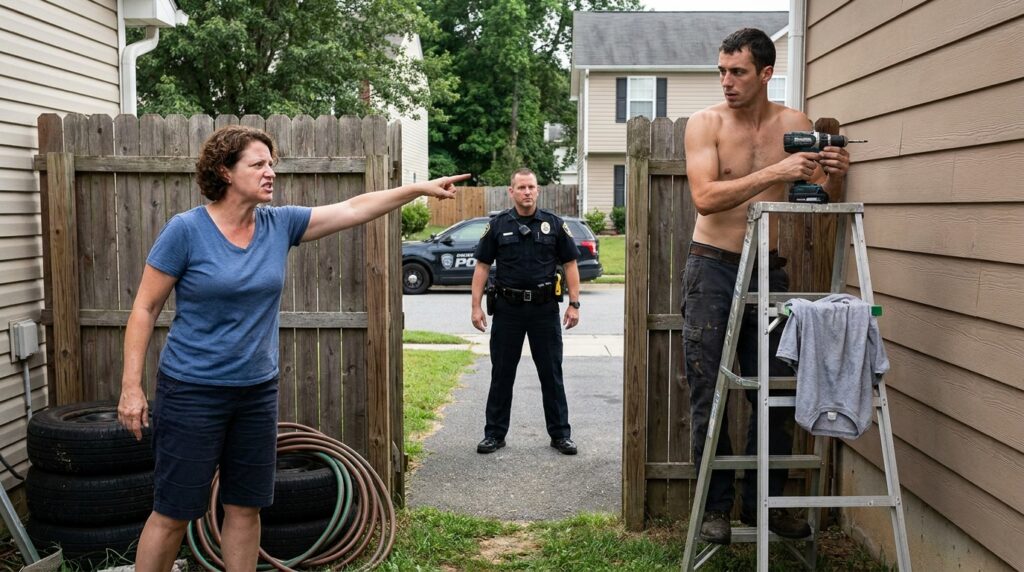
Marcus stood at the base of the open aluminum ladder. The clay under his fingernails was already drying into a chalky grey crust. Three feet away, near the base of the four-inch iron survey pin he’d exposed, the yellow string line Brenda had stretched so taut hung slack, its far end limp in the brown grass.
He didn’t kick the string. He didn’t pull it down. He left it where it lay—a useless piece of nylon tied to a fence that didn’t mark what she thought it marked.
He reached down, picked up his cordless drill from the third rung, and checked the battery indicator. Three green bars glowed steady on the housing. From his tool pouch, he pulled two stainless-steel siding screws, holding them between his lips as he reset his boots on the bottom aluminum step.
His climb was deliberate. First rung. Second rung. Third rung.
The height brought his chest back level with the dry-fitted vinyl siding panel. The heat radiating off the wall was intense, but the air felt different now—lighter, stripped of the breathless, suffocating tension that had hovered over the lane for two hours.
Across the wooden fence, Brenda’s house remained dead silent. Through the sheer kitchen curtains hanging in her side window, a pale silhouette stood motionless for a brief second before retreating deeper into the hallway shadow.
Marcus didn’t glance at the window. He positioned the siding panel flush against the channel, aligned the factory notch with his chalk line, and brought the driver bit against the screw head.
Whir-clack. Whir-clack.
The torque clutch clicked twice as the fastener drew the vinyl flush against the exterior sheath. No screaming cut through the noise. No hand reached over the top rail. No smartphone camera leaned over the pine pickets.
He slid his left hand along the top edge of the panel, testing the expansion gap with his thumb. It was quarter-inch precise, floating freely inside the channel just as the manufacturer’s specification required.
Beneath his ladder, the four-inch steel monument pin lay open to the sky, its stamped copper washer catching the steep afternoon sun. The two feet of grass between the fence and his foundation wall belonged to his deeded parcel—recorded in the county registry, verified by a municipal badge, and stamped in cold iron.
He pulled a fresh panel from the stack on his porch, hoisted it over his shoulder, and set it into the track.
The work continued.








