
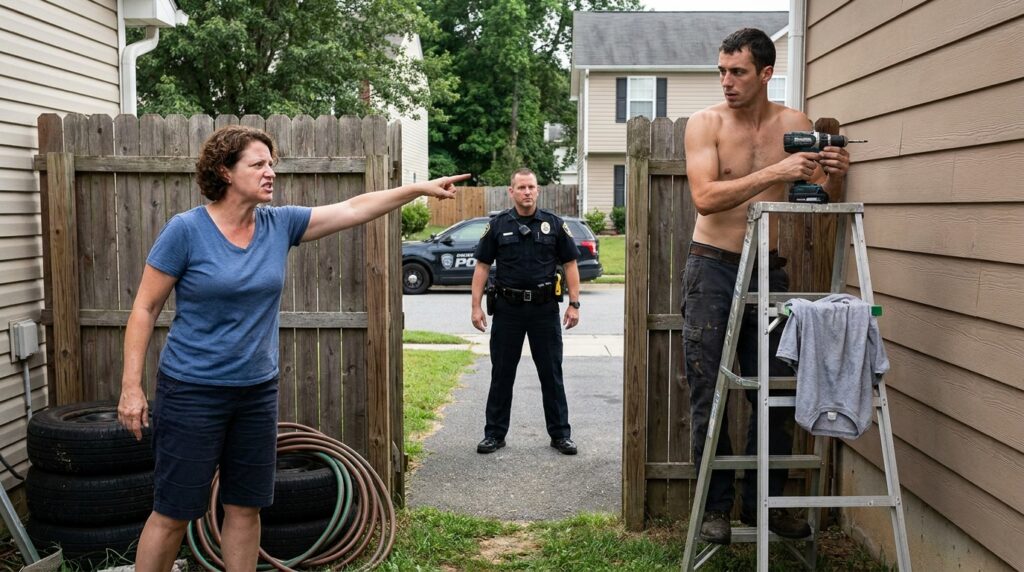
CHAPTER 5: THE DIG AT THE FENCE LINE
Marcus didn’t hesitate. He shifted his weight off his left knee, pivoting on the ball of his work boot until his hands were positioned two feet past the yellow spike, directly along the narrow strip of scorched clover running parallel to the cedar pickets.
“You’re wasting your time!” Brenda shouted, her voice tight, cracking slightly at the edge as she gripped the top rail with both hands. Her knuckles were white against the sun-bleached pine. “I lived here when Howard Vance lived here! There’s nothing in that dirt except drainage rock and taproots! Officer, he’s tearing up the ground to stall for time!”
Officer Miller didn’t move his boots. He kept the bright white beam of his flashlight focused squarely on the patch of earth where Marcus’s trowel blade met the crust. “Keep digging, Marcus. Let’s see the real corner.”
The steel trowel sliced through a mat of tangled rootwork. Unlike the loose, flaked topsoil near the yellow spike, the earth here was cold, dense clay—hardened by decades of foot traffic and heavy rains runoff from the eavestroughs above. Marcus drove the point of the trowel six inches deep, levering his wrist to pop out a thick, damp clod of clay that smelled sharply of cold iron and dead roots.
Scritch.
The blade hit solid metal. It wasn’t the hollow, ringing clink of hollow rebar like the yellow spike. It was a heavy, dead thud—a sound that carried the dense, unyielding weight of a solid inch-thick steel column driven three feet into the bedrock by a developer’s pneumatic rig forty years ago.
Marcus didn’t pry against it. He dropped the trowel into the grass, reached down with his bare hand, and dug his fingers into the cold clay surrounding the metallic head. Sweat dripped off his nose, hitting the dry grass blade beside his thumb. He scraped away the heavy silt, exposing a square copper washer seated firmly over the top of a thick, dark iron pin.
The washer was pitted with green verdigris around its rim, but stamped clearly across its flat face were six crisp numbers: RLS-1984-412.
Miller leaned down until his face was less than two feet from the soil. He reached out with his gloved index finger, brushing away a fine dusting of dry sand from the top of the pin. The metal was solid, dark, untouched by rust, driven straight down through the center of the clay line.
“RLS 1984,” Miller read softly. “County Registered Land Surveyor code. Same number stamped on page one of your county plat, Marcus.”
Marcus pulled his hand back, wiping his clay-smeared fingers against his dark work trousers. He stood up slowly, his knees popping in the quiet yard. He picked up his wooden-handled trowel and laid the straight edge of its five-inch steel blade flat against the side of the exposed iron pin.
The line extended straight back toward the street—passing two full feet inside the wooden privacy fence.
The entire cedar fence, every post, every picket, and every inch of the three-foot grass lane Brenda had been claiming for three decades sat squarely, legally, and irrefutably inside Marcus’s deeded parcel.
Brenda stood motionless on the other side of the fence. Her jaw was set, her lips pressed into a thin, white line, but her eyes were fixed on the copper washer gleaming under Miller’s light. Her hand holding the smartphone sank slowly until the screen pointed at the brown grass around her shoes.
“That… that can’t be right,” she whispered, her voice stripped of its earlier, loud authority. “The fence… Howard Vance built the fence in ninety-one…”
“Howard built the fence inside his own lot line to avoid cutting down the oak tree, Brenda,” Marcus said. His voice was quiet, even, devoid of excitement or spite. He pointed the handle of his trowel toward her side of the timber line. “He gave you two feet of his land to look at because he didn’t want to fight the town over a root system. But he never signed over the title. The deed didn’t change.”
Miller stood up to his full height, his duty belt squeaking as he adjusted his posture. He clicked off his flashlight, slipping it back into its leather ring on his belt, and picked up the plastic sleeve containing Marcus’s official county plat map.
He turned to face Brenda. The unyielding, neutral expression on his face had shifted into something cold and firm.
“Brenda,” Miller said, his voice carrying clearly down the narrow driveway toward the street where two more neighbors had stepped out onto their front steps to watch. “I’m going to explain this to you once, so we don’t have to dispatch another unit to this address.”








