CHAPTER 2: THE MARGIN OF SEPARATION
The driver’s door of the Ford Utility cruiser clicked open, the heavy steel hinge groaning against its catch. Officer Miller’s boots came down hard on the dry asphalt of the curb lane, the thick rubber soles grinding a pinch of street gravel into powder before he turned into the mouth of the side driveway.
He didn’t hurry. His dark uniform shirt was stiff with starch across the shoulder blades, the fabric slightly discolored where the bulletproof vest pressed against his collarbones in the heat. His graying hair was cut tight to the crown, his face set in the flat, unreadable mold of a man who spent eight hours a day stepping between people who hated each other over three inches of dirt or an unraked pile of oak leaves.
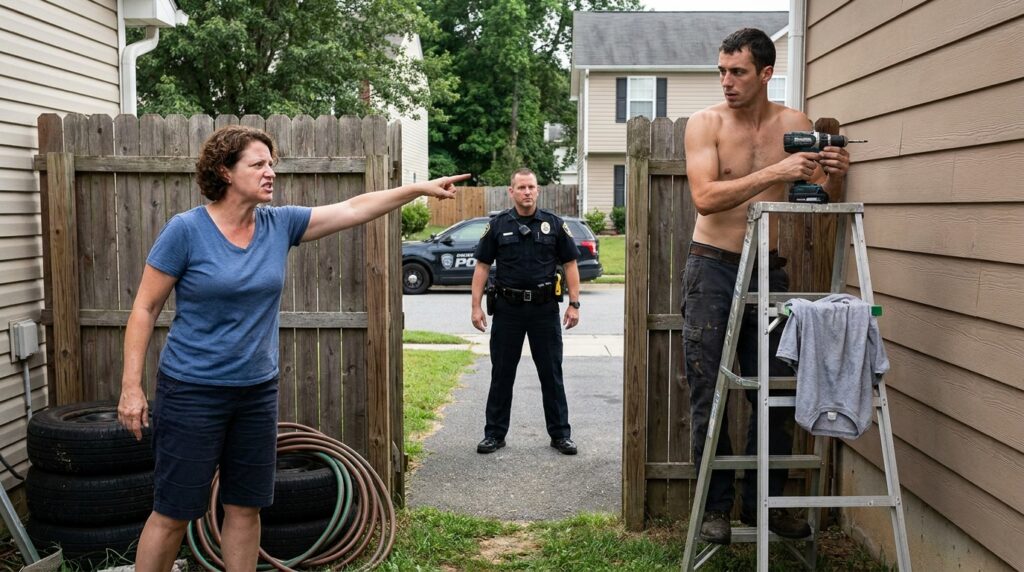
“Hold your positions,” Miller said. His voice was a dry, gravelly baritone that didn’t rise above the ambient hum of the neighborhood, but it carried instantly down the narrow passage between the two houses. “Marcus, keep your hands where I can see them. Brenda, step two feet back from that fence rail.”
Brenda didn’t retreat. Instead, she leaned further over the weathered cedar pickets, her fingers digging into the soft, sun-rotted top grain of the wood. “He’s drilling into the structural framing, Officer! I told the dispatcher—he’s vibrating my side foundation, and he doesn’t have an easement clearance for that step ladder. Look at where those aluminum feet are resting!”
Miller crossed the front lawn line, his duty belt squeaking softly as his holster rubbed against his hip guard. He stopped right at the mouth of the side yard, his eyes sweeping over the scene with practiced, methodical disinterest. He took in the open aluminum ladder, the cordless drill resting on the third rung with its 18-volt battery pack facing out, the newly mounted vinyl siding panel dry-fitted against the house sheath, and the three feet of brown, trampled grass running along the wooden fence.
He looked at Marcus first. “You working on your own house?”
“Replacing water-damaged siding on the east elevation,” Marcus said. His hands remained open and flat against the aluminum stiles of the ladder. He stayed on the third step, his eyes level with the officer’s chest badge. “Permit’s pulled. Code inspection was signed off this morning at nine.”
“He’s trespassing to do it!” Brenda barked, her smartphone raised now, the lens pointed straight at Miller’s face. “The lot line runs straight down the center of this grass strip. Every time he sets that ladder down, his boots are on my parcel. I’ve lived in this house since 1996, Officer. I know where my land ends.”
Miller turned his head toward her, his expression unchanged. He didn’t look at her phone camera. He had seen a thousand phones held up like small glass shields. “Brenda, I’m going to ask you one time to take your chest off that fence rail and step back into your yard space. We aren’t going to yell across a timber line.”
“I am standing on my property!”
“And I’m standing in the middle of a civil complaint until I determine whether a crime occurred,” Miller replied calmly, though a small muscle tightened at the corner of his jaw. He raised one broad, gloved hand, palm out, pointing straight down the narrow center of the grass path. “Step back. Both of you. Give me the lane.”
Marcus didn’t argue. He shifted his weight slowly, testing the aluminum ladder’s stability before stepping down one rung at a time. His heavy leather work boots sank slightly into the dry soil at the base of his foundation wall. He reached out, grabbed the grey work shirt hanging over the top rung, and pulled it over his shoulders, his thumbs hooking through the belt loops of his trousers as he turned to face the officer.
Brenda let out a sharp, theatrical breath through her nose, but she pulled her arms back across the fence, her blue T-shirt catching on a stray cedar splint as she smoothed down her dark shorts. She stayed right at the edge of the pickets, her chest heaving, her eyes darting between Miller’s radio patch and Marcus’s face.
“Alright,” Miller said, taking a small leather-bound notebook from his breast pocket and flipping it open with one thumb. “Marcus, step down toward the driveway so I have a clear sightline to that wall. Brenda, stay where you are.”
As Marcus backed up three paces, his boot heel brushed against a piece of thin, yellow nylon string tied tightly between two pickets near the bottom of the fence—a makeshift line Brenda had strung three days prior. The knot was fresh, the nylon crisp, stretched tight across a small patch of dirt where the grass had completely died off.
Miller noticed the movement of the string. His eyes dropped to the dirt, following the bright yellow line as it disappeared under a mat of dry crabgrass right at the base of the fence post.
“What’s the string for?” Miller asked, pointing at the dirt with his pen.
“That’s my survey mark,” Brenda said instantly, her voice rising in pitch as she felt the focus shift. “I ran that line from the front sidewalk curb based on the original 1998 plot map the town gave me when I closed on the house. That string marks the absolute boundary. And as you can clearly see, Officer, his ladder feet are six inches on my side of that line.”
Marcus looked down at the string, then up at Miller. His face remained guarded, the skin tight over his cheekbones. “That string wasn’t there when the city surveyor dropped the permit flags in April,” Marcus said softly. “She tied that on Tuesday after the contractor dropped the siding materials in my driveway.”
“It’s based on the town sketch!” Brenda shouted, reaching into her dark pocket and pulling out a folded piece of yellowed, lined paper, covered in faint pencil marks and blue ballpoint ink. “I have the document right here! The fence was built on an informal agreement between the old owners. The real line is two feet closer to his house!”
Miller took a slow step closer to the fence, his heavy boots crushing a dry weed. He didn’t take the yellowed paper from Brenda’s hand yet. Instead, he looked at the wooden fence itself—the aged, silvered pine posts, the heavy galvanized nails, and the way the entire structure leaned slightly inward, away from Marcus’s house and toward Brenda’s yard.
“You got the official county plat map with you, Marcus?” Miller asked, his eyes still tracing the fence line down toward the back corner of the yard.
“It’s on the porch,” Marcus said, his voice flat and steady. “In the job folder. Along with the stamped permit.”
“Go get it,” Miller said. “And grab a hand trowel while you’re up there.”
Brenda’s jaw snapped shut. She glared at the officer, her smartphone slipping down an inch as her hand began to tremble. “What does he need a trowel for? The paper in my hand is from the city clerk!”
“Because city sketches aren’t legal boundaries, Brenda,” Miller said, his voice dropping into that low, unyielding register that ended conversations. “Pins in the dirt are.”