The Concrete Chessboard: How Silence and Real-Time Calculation Exposed an Illusion of Unearned Stadium Privilege

CHAPTER 1: THE BOTTLENECK

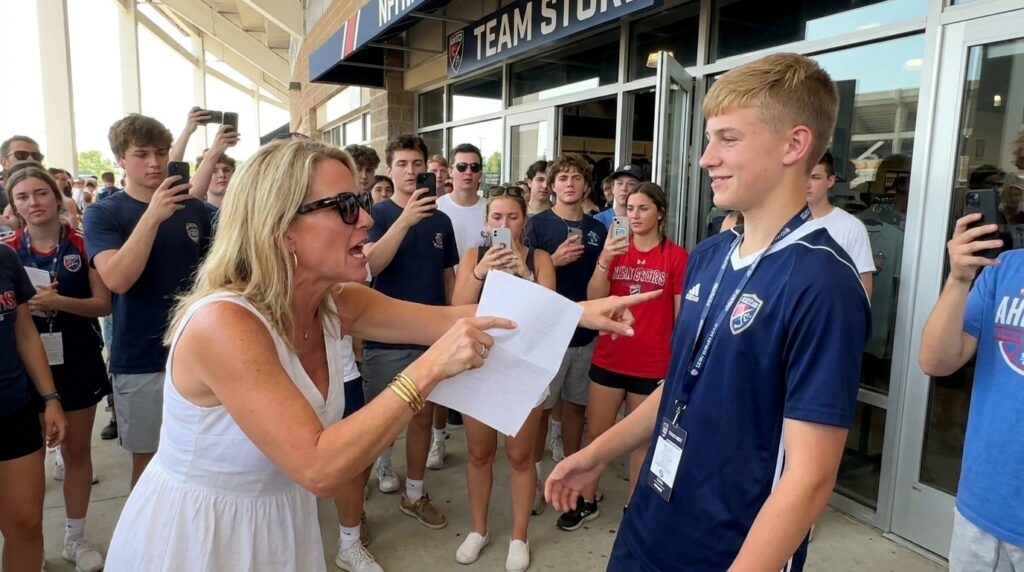
The white sleeveless dress shifted forward, a blur of clean fabric and sharp gold bracelets that clanked like small coins against one another. She smelled of expensive, heavy perfume that did not match the hot concrete or the sour scent of the crowd packed shoulder-to-shoulder under the stadium awning. Her dark designer sunglasses completely obscured her eyes, leaving only the tight, downward pinch of her mouth and the forward lean of her chin to register her intent. She didn’t look at his face; she looked at the space he occupied right next to the brass handles of the team store entrance.

“You do not get to crowd him, back up and show some respect!” Her voice had a practiced, cutting edge, pitched specifically to carry over the low rumble of the stadium public address system. She snapped a folded white document upward, the stiff paper rustling as she pinned it within inches of his chest.

The boy did not look down at the paper. He didn’t adjust his posture or allow his shoulders to drop into a defensive curve. Instead, his eyes tracked the movement of her free hand—the index finger pointed straight at his throat, her knuckles white with a tension she had spent thirty minutes building in the queue. He could see the small, rhythmic pulse in the side of her neck. She was breathing too fast, her authority entirely dependent on the crowd of fans freezing in a wide semicircle around them.

The smartphones were already up. To his left, a man in an oversized home jersey adjusted his grip on a device, the screen showing the boy’s navy soccer jersey and his short, blond hair cropped close against the heat. The lenses were a collective pressure, a wall of glass eyes waiting for him to swear, to shove, or to run. A single wrong movement would go live within three seconds, stripped of context, branded as another disruptive kid acting out on the concourse.

He shifted his weight back half an inch—not away from her, but into the solid frame of the glass door behind him. His right palm rose, fingers straight, thumb tucked, establishing a flat, unyielding plane of air between them. He felt the small metal ring-clip of his lanyard beneath the fabric of his jersey, heavy and cold against his skin. He didn’t pull it out. He wanted her to finish her move. He wanted every lens in the sector to lock onto her white dress and her extended finger before he changed the rules of the board.

“Ma’am, just step back, please,” he murmured. His voice stayed flat, ironed clean of the adrenaline that was making her bracelets rattle.

She took the invitation. She leaned closer, her sunglasses slipping down the bridge of her nose just enough to reveal the pale, wide skin around her eyes. “Don’t you dare talk down to me. I have the directive right here. You are a distraction to the VIP lane, and you’re leaving.”

Behind her, the glass doors clicked open. A man with a dark blazer and an earpiece stepped into the daylight, his eyes dropping immediately to the folded paper in the woman’s hand, his expression turning instantly rigid as he recognized the signature on the outside fold—a signature that had been revoked forty-eight hours ago.


CHAPTER 2: THE PHYSICAL EQUATION

The hiss of the automatic glass doors closing behind the supervisor cut through the humid weight of the concourse like a blade splitting silk. Marcus, the floor supervisor whose face had been hardened by twelve seasons of stadium crowd logistics, did not look at the crowd. His eyes were small, flat beads fixed entirely on the corner of the white paper the woman held. Under the harsh, direct glare of the overhead stadium lights, a sharp, triangular shadow fell across her fingers, highlighting the subtle tremor in her wrist that she was trying to mask by pressing the document closer to the boy’s chest.

“Is there a problem with the premium entry lane, ma’am?” Marcus asked. His tone was a calculated instrument—perfectly polite, entirely hollow, engineered to sound like assistance while establishing a physical barrier. As he leaned forward slightly, the lapel of his dark blazer shifted. For a fraction of a second, the boy caught sight of a tiny, notched silver emblem pinned to the underside of Marcus’s collar—not the standard blue security rotation clip for this shift, but a specialized, older insignia that wasn’t supposed to be on the floor today. The boy’s eyes locked onto it, storing the anomaly away in his mind as a variable to be calculated later.

The woman didn’t notice the pin. Her focus remained entirely on the social leverage she believed she had accumulated through the forty recording smartphones surrounding them. She turned her shoulders toward Marcus, her gold bracelets striking each other with a dry, metallic rattle that sounded like gravel shifting under a boot.

“The problem is a total lack of enforcement,” she said, her index finger slicing through the air toward the boy’s chest again, her voice rising an octave to ensure the microphones captured her pitch. “This kid has been hovering by the glass doors for twenty minutes. He’s crowding the tier-one access lane, and when I told him to step back to give the executive guests room, he refused to move. I have the signed authorization directive right here. Clear him out so we can keep the lane secure.”

The boy stood perfectly still against the cold pane of the store window. Through the fabric of his jersey, the glass felt like a block of ice against his shoulder blades, a solid, grounding anchor while the social storm swirled three feet in front of him. He watched her mouth—the tight, white lines at the corners of her lips, the way her lower jaw shifted slightly to the left before she spoke. She was performing for an audience she didn’t control, throwing her weight into a corporate document because she lacked any real systemic authority of her own. She was overextending her position, exposing her flank with every syllable she shouted into the lenses.

Marcus didn’t touch the paper. He didn’t reach out his hand to take it, nor did he look at the boy for confirmation. Instead, he kept his hands clasped loosely behind his back, his posture mimicking the rigid discipline of an inspector. But his eyes remained pinned to the specific blue ink of the signature block visible on the outer fold.

“Let me see the verification stamp on that directive, ma’am,” Marcus said, his voice dropping lower, forcing her to lean in and break her expansive, crowd-facing stance.

“It’s signed by Vice President Vance himself,” she snapped, her thumb dragging along the edge of the sheet, leaving a faint, jagged crease in the heavy cardstock. “The security protocol update from the central office. It states explicitly that non-ticketed personnel are to be cleared from the glass threshold prior to kickoff. Look at the date.”

The boy monitored the exchange with a cold, analytical detachment. He knew exactly what that paper was. His phone, nestled deep in his front pocket, was currently receiving encrypted network logs from the stadium’s primary data core. He didn’t need to pull it out to know that the Vance directive had been scrubbed from the active server logs exactly forty-eight hours ago when the board finalized the emergency restructuring. The woman was holding a ghost—a piece of high-tier corporate waste that had been valid on Tuesday but was nothing more than an unauthorized liability on Friday. Yet Marcus wasn’t moving to dismiss her. He was staring at the paper with an expression that bordered on recognition, his fingers twitching behind his back near his belt line.

A low murmur rippled through the semicircle of bystanders. A young man in a white cap lowered his phone slightly, his eyes darting between the boy’s calm half-grin and the woman’s increasingly rigid posture. The collective expectation of a fast, viral humiliation was beginning to fray, replaced by the uncomfortable silence of an argument that was changing its shape in real time.

The boy let the silence stretch for exactly three seconds, allowing the weight of the crowd’s attention to settle entirely onto Marcus’s next move. He noticed the way the supervisor’s shadow intersected with the woman’s white dress, a dark, sharp angle that seemed to lock them both into the same compromised grid.

“The paper isn’t the current protocol, Marcus,” the boy said quietly. It was the first time he had used the supervisor’s name, and the syllables fell into the space between them like a heavy weight dropping onto a glass table.

Marcus stiffened, the notched silver emblem under his collar catching a flash of green light from the store’s interior digital display. The woman’s head snapped toward the boy, her dark sunglasses reflecting two identical, tiny distortions of his face.

“You don’t speak to the staff,” she hissed, her voice dropping into a raspy whisper that lacked its previous theatrical volume. “You don’t have a place in this line.”

“He does,” Marcus said. The words were short, dry, and delivered without looking at her. He finally took his hands from behind his back, his right arm rising to point not at the boy, but at the digital reader embedded in the frame of the door. “And that document isn’t an active directive anymore, ma’am. That signature was pulled from the system on Wednesday morning.”

The woman froze, her hand remaining suspended in the air, the white paper suddenly looking massive and heavy between her trembling fingers. The smartphones didn’t lower; they simply tilted, their lenses refocusing on the precise moment her constructed reality began to show its first deep, jagged fracture.

CHAPTER 3: THE STRATEGIC ALIGNMENT

“Wednesday morning is impossible,” the woman said, her voice dropping into a harsh, dry register that barely cleared the hum of the cooling units above the team store entrance. She did not lower the white cardstock. Instead, her fingers clenched the paper tighter, the edges buckling under a sudden, physical strain that sent a sharp crackle through the heavy fiber. “This was issued through the executive logistics branch. It carries the signature stamp of the vice president. You don’t override the front office at a public gate.”

Marcus didn’t flinch. His eyes remained fixed on the lower half of the sheet where the signature sat, totally indifferent to the forty smartphone cameras tracking the micro-movements of his jaw. The notched silver emblem under his collar gleamed with a cold, metallic point as he shifted his weight. “The front office changed its routing tables forty-eight hours ago, ma’am. If you don’t have the digital token synced to the glass door reader, this paper is just inventory.”

The boy observed the interaction through a completely different filter. He didn’t focus on her indignation or Marcus’s standard corporate deflection. His gaze was anchored to the precise indentation on Marcus’s collar pin—a specific three-digit serial stamp, 7-0-2, that was visible only from this exact angle against the glass. That series wasn’t part of the active contractor roster for stadium logistics. It belonged to the older infrastructure design team, an unindexed legacy tier that should have been deactivated when the main servers migrated to the cloud-linked security platform. Marcus wasn’t just a floor supervisor stuck between an entitled fan and a kid by the door; he was operating on an old manual protocol, using the woman’s distraction to keep his own position unexamined.

The boy let his fingers drop loosely past his waist, his thumb lightly grazing the edge of his jersey. In his pocket, the haptic engine of his terminal pulsed three short times—the automated system log verifying a proximity ping from Marcus’s unindexed terminal. They were sharing the same local frequency, but Marcus was completely unaware that the boy’s hardware was silently indexing every routing choice he made.

“Then call Vance,” the woman demanded, her free hand coming down hard onto her leather purse, the gold chains clinking with a rhythmic, heavy snap that drew a collective murmur from the front row of onlookers. “Call him down to the concourse. Let him explain why his premium tier accounts are being managed by a supervisor who can’t verify a corporate seal.”

“Mr. Vance is no longer on the network, ma’am,” Marcus replied. His voice was smooth, polished down by years of administrative friction, completely free of the irritation that would give the bystanders a clean viral clip. “If you’d like to step over to the main relations desk behind section 114, they can issue a temporary day pass. But this lane stays clear for the active credential holders.”

A heavy silence dropped over the semicircle of fans. The man in the home jersey who had been filming at chest height lowered his device two inches, his thumb tapping the screen to pause the recording. The narrative he had anticipated—the quick, satisfying eviction of an overeager kid crowding a VIP entrance—had collapsed into a tedious administrative breakdown. The crowd’s interest was beginning to drift, the tension evaporating into the humid afternoon air.

The boy knew that allowing the tension to dissipate now would destroy his leverage. If she walked away to section 114, Marcus would reset the glass reader, the old routing sequence would drop off the local cache, and the master system line would clear without revealing why an unindexed supervisor was handling executive lane overrides. He needed her to stay planted. He needed her entitlement to push against Marcus until the system forced a hard validation.

“She doesn’t want section 114, Marcus,” the boy said, his voice cutting through the mechanical hum of the sliding doors with a quiet, flat clarity.

The woman’s sunglasses turned sharply toward him, the glossy black lenses catching the reflection of the concrete pillars across the concourse. “I told you to keep your mouth shut. This is an administrative matter between paying tiers.”

“He’s right,” the boy continued, looking directly at Marcus, ignoring her entirely. “She can’t go to 114 because that paper came from the corporate box registry on level three, not the public pass desk. And if she checks the back of that sheet, she’ll see the terminal imprint from the old logistics router—the one that went offline when the board revoked the administrative access tokens.”

Marcus went entirely rigid. The supervisor’s left hand, which had been resting casually on his hip, dropped to his side, his fingers curling into a tight, defensive knot. The small, notched emblem under his collar caught a sudden flash of blue light from the digital scoreboard above them, the three stamped digits burning against the dark fabric of his jacket like a marker.

The woman looked down at the paper in her hand, her thumb slipping across the reverse side as if she were trying to feel the phantom imprint the boy had just described. For the first time, her confidence wavered, the sharp edges of her authority faker archetype dissolving into the stark, unforgiving light of the concrete corridor. She wasn’t just holding an outdated memo; she was holding a piece of evidence that linked her directly to a closed corporate lane that Marcus had been quietly maintaining for his own purposes.

“Where did you get that routing data?” Marcus asked, his tone losing its corporate polish, replaced by a low, hard edge that didn’t carry to the crowd but landed heavily between the three of them.

The boy didn’t answer with words. He simply shifted his posture, allowing his jersey to pull tight against his chest, bringing the laminated holographic edge of his hidden lanyard badge just close enough to the glass door reader to trigger a brief, emerald-green blink from the optical sensor.

CHAPTER 4: THE SHATTERED DECOY

The emerald blink of the optical sensor didn’t hold. Instead of the clean, continuous chug of a verified security handshake, the reader’s small glass lens let out a sharp, high-pitched buzz that rattled against its metal framing. The green light vanished, swallowed instantly by a flashing, angry amber strobe that pulsed across the boy’s face.

In his pocket, the haptic engine of his phone didn’t just pulse—it kicked violently, a rapid, continuous vibration that signaled a catastrophic failure in the data handshake. The boy’s fingers tightened against his thigh as he pulled the device into the dim space between his body and the store window. The screen didn’t show the clean, black-and-white lines of the administrative terminal; it was buried under a red cascade of flashing system exceptions.

CRITICAL OVERRIDE: SECTOR 07 CACHE PURGED BY TERMINAL 702.

The boy’s eyes flicked from the screen to Marcus. The supervisor hadn’t stepped back. His right hand was buried deep in his jacket pocket, his knuckles sharp against the dark fabric as he held something small and heavy against his side. The notched silver emblem under Marcus’s collar wasn’t glowing anymore; its polished edges had gone completely dark, matching the dead interface on the glass door.

“You’re tracking the wrong routing tables, kid,” Marcus said, his voice dropping into a flat, gravelly rasp that barely carried over the low hiss of the store’s ventilation. The corporate deflection was entirely gone, replaced by the heavy, deliberate tone of a man who had just locked the exit gates. “You think because you know Vance’s old signature block, you have a hand at this table? That paper she’s holding didn’t clear through the level-three boxes. It cleared through my terminal. Personally.”

The woman shifted her weight, her gold bracelets making a sharp, confused clatter as she looked between the flashing amber light and Marcus’s rigid profile. She could see the sudden shift in the room’s architecture; the administrative breakdown had frozen, replaced by a quiet, physical tension that turned the concrete concourse into a cage. “Marcus? What is that light doing? Reset the panel and use the directive. I am not standing out here while you debate network logs with a loiterer.”

“Shut up,” Marcus muttered without looking at her. His focus stayed pinned to the boy’s eyes, watching for the slight widening of the pupils that signaled panic.

The boy felt the cold glass window behind him seem to compress against his spine. His calculated leverage had completely vanished in the span of two network cycles. He had played the situation like a standard corporate overreach, assuming Marcus was simply a low-level worker protecting an old privilege line for an important customer. But the 7-0-2 serial stamp wasn’t a legacy contractor badge—it was a localized kill-switch. Marcus hadn’t been maintaining a closed lane for the woman; he had been using her outdated corporate box pass as a cover to manually drop the entire entrance sector off the stadium’s main network grid, isolating this specific portal from central oversight.

Behind them, the semicircle of bystanders tightened. The young man in the white cap stepped forward half a foot, his smartphone raised high, the lens catching a jagged reflection of the amber strobe. “Hey, what’s with the lock? Is the store closed or what? We’re missing the pre-game setup.”

The collective pressure of the crowd shifted, turning heavy and aggressive as the line stalled. The phone screens weren’t just recording a confrontation anymore; they were documenting a system failure, their owners growing increasingly restless as the minutes ticked closer to kickoff. The social friction was turning into physical crowding, the space between the boy and the woman shrinking as the back rows pressed forward for a better view.

The boy tried to force a command through his terminal, his thumb flying across the glass screen, but the interface remained entirely unresponsive. The local router was totally dead, completely isolated by Marcus’s pocket kill-switch. He was stripped of his digital vision, reduced to what he could see and touch within three feet of the brass handles. He had overextended his hand, trusting the systemic architecture to protect his boundary, only to find that the man across from him had already cut the cables.

“You have exactly ten seconds to hand over that device,” Marcus said, taking a slow step forward, his shadow completely erasing the woman’s white dress from the light. His free hand reached out toward the boy’s collar, his fingers hooked like iron talons. “Before I have security clear this entire lane for a technical breach.”

The boy looked at Marcus’s approaching hand, his mind spinning through the remaining variables. The decoy secret—the idea that this was just an old executive memo conflict—had been utterly shattered, revealing a deeper, darker manipulation of the stadium’s infrastructure that he didn’t understand. And for the first time since the white dress had stepped into his lane, his face lost its grin.

CHAPTER 5: THE LIVE REVERSAL

Marcus’s iron fingers never closed around the fabric.

The boy didn’t flinch, didn’t pull away, and didn’t drop his phone. Instead, he twisted his chest by a fraction of an inch, using the solid brass handle of the team store door as a pivot point. The physical movement was tight, minimal, and perfectly timed. Marcus’s hand grazed the slick nylon of the boy’s navy jersey, losing its grip as his knuckles slammed hard into the rigid glass framing. The heavy metallic click of Marcus’s ring hitting the pane echoed sharply through the sudden silence of the bottleneck lane.

“The phone stays in my hand, Marcus,” the boy said. His voice was an unyielding wire, completely devoid of youth or panic, cutting through the low-frequency electromagnetic hum that had begun to vibrate the entire glass entrance.

The woman in the white dress scrambled back half a step, her gold bracelets clashing violently against her designer purse as she nearly tripped over the concrete curb. Her dark sunglasses slid down her nose, revealing wide, panicked eyes that bounced from Marcus’s locked jaw to the flashing amber strobe on the wall. “What are you doing? I didn’t authorize a physical removal. This is supposed to be a standard policy citation. You’re ruining the feed!”

She was right about the feed. The forty smartphone lenses hadn’t lowered. The restless crowd of sports fans, initially waiting for a simple eviction, had frozen. The young man in the white cap shoved his phone forward by another three inches, his screen capturing the exact moment the floor supervisor overextended his physical reach. The collective grins of the bystanders were gone, replaced by a quiet, razor-sharp focus. They weren’t watching an entitled kid anymore; they were documenting an authority figure breaking his own regulations on live video.

The boy didn’t wait for Marcus to reset his balance. He knew the isolated local router was a trap, but every trap had a dedicated master line. He reached beneath the collar of his navy jersey and pulled.

The heavy-duty nylon lanyard slid into the harsh daylight. Dangling from the clip wasn’t a standard, entry-level staff pass or a seasonal guest ticket. It was a solid, matte-black composite plate embedded with a thick, silver-rimmed holographic shard that refracted the stadium’s overhead lights into a blinding cascade of primary colors. There were no printed names, no corporate logos, and no security shift numbers on the face of the credential. There was only a single, deeply etched white icon: a stylized triple-node terminal matrix.

Marcus froze. His breath caught in his throat, a sharp, ragged sound that was instantly caught by the nearest bystander’s microphone. His eyes widened, staring at the holographic reflection against the glass doors. He recognized the master-tier administrative bypass credential—a clearance level that didn’t belong to the stadium’s operational staff, the security contractors, or the executive board. It belonged exclusively to the primary architecture team that built the entire digital foundation of the venue.

“You’re running Terminal 702 on an unindexed cache,” the boy said, his voice dropping into a flat, surgical delivery that landed heavily between them. He didn’t look at his phone screen; he didn’t have to. “You used her outdated Vance pass to trigger a localized sector purge because you thought nobody with root access was monitoring the entrance logs today. You thought you could drop this door off the grid for fifteen minutes without a master alert hitting the central architecture core.”

“Who are you?” Marcus whispered, his hand slowly withdrawing from the door frame, his fingers trembling slightly as he tried to adjust his posture back into a defensive corporate stance. The small, notched silver emblem under his collar felt like a target now, a piece of obsolete scrap metal linking him to a systemic vulnerability he had spent months trying to exploit.

The woman stepped into the light, her hand shaking as she pointed a manicured finger at the matte-black plate. “I don’t care what kind of badge that is. My directive is signed by a vice president! You cannot override a corporate order with a plastic tag!”

“Your vice president was deleted from the network routing tables forty-eight hours ago, ma’am,” the boy said, turning his cold half-grin toward her for the first time. “And if you look at the screen on the phone behind you, you’ll see exactly what your directive is worth.”

The man in the white cap blinked, his eyes dropping to his own smartphone display. The live feed he was streaming hadn’t lagged, but the overlay interface had changed. The stadium’s automated crowd-management bot, recognizing the master-tier holographic token via the camera feeds, had pushed a real-time system notification directly to every active mobile terminal within forty yards of the team store.

The text was crisp, public, and unyielding.

NOTICE: SECTOR 07 PORTAL LOCK REVERSED BY MASTER ADMIN. ALL LOCAL PRIVILEGE CLAIMS VOIDED.

A sudden, sharp burst of laughter erupted from the back row of the crowd. The man in the home jersey lowered his device, shaking his head as he looked at the woman’s pale, frozen face. “Lady, you’re holding garbage. The kid just locked out the whole system.”

The social pressure flipped on the pavement with the speed of a falling guillotine. The smartphones didn’t drop; they simply turned. The forty recording lenses shifted their focus away from the boy, aligning their angles directly onto the woman’s trembling white dress and Marcus’s collapsing posture. The grins returned to the witness layer, but they were directed entirely at the gatekeeper who had just overextended her hand into a systemic buzzsaw.

Marcus took a step back, his boots dragging against the polished concrete as the automated glass doors behind him suddenly groaned, their amber lights dying out as a clean, continuous emerald green flooded the portal. The system had forced a hard validation, and the door was open.

CHAPTER 6: THE SECURED PORTAL

The steady, fluid hum of the emerald green light bouncing off the glass door framing was the only sound left within the bottleneck lane. The heavy, pressurized hiss of the cooling units seemed to slow down, dropping into a distant, hollow vibration that pulled the residual warmth straight out of the concrete pavement. Marcus didn’t try to look at the boy’s terminal again. He simply let his right hand drop, his fingers slipping out of his jacket pocket with a slow, heavy numbness. The small, notched silver emblem under his collar caught one final, sharp reflection from the store’s interior digital display before it sank into the deep, desaturated shadow of his lapel.

The boy stood perfectly still, his spine anchored against the structural corner of the glass entrance. He felt the cold weight of the matte-black composite plate between his fingers, the edges sharp and clean against his calloused skin. Through the thin, high-performance weave of his navy soccer jersey, the glass panel felt like an absolute border—a solid line of defense that had held its ground under forty lenses without shifting an inch. He didn’t look at the crowd. He looked at Marcus’s boots, watching the dull leather slide back half a foot across the polished floor, leaving two faint grey streaks on the concrete where the supervisor had attempted to anchor his fraudulent authority.

“The lane is clear, Marcus,” the boy said. The words were small, sharp stones dropped into the silent concourse, completely flat and free of the adrenaline that was still making the woman’s bracelets shake.

The woman in the white dress stood entirely stranded in the center of the lane. The folded white cardstock was still clutched in her right hand, but the heavy fiber looked crumpled now, the jagged crease where her thumb had dragged along the edge looking like a broken seam under the direct glare of the stadium lights. Her dark sunglasses had slipped completely down the bridge of her nose, her eyes staring blankly at the automated system notification pulsing on the smartphone screens around her. The grand, public lesson in compliance she had designed had turned into an immutable record of her own overreach. The social leverage she thought she had bought with her executive memo had vanished into a digital network routing table she couldn’t comprehend.

The young man in the white cap let out a low whistle, his device tilting slightly as he stepped out of the lane, his screen catching a desaturated reflection of the massive concrete pillars across the corridor. “Man, she really thought she had the keys. Look at her.”

The semicircle of bystanders began to dissolve, the dense, warm compression of the crowd breaking apart into small clusters of shifting jerseys and casual fan clothes. The smartphones didn’t drop immediately; they were lowered slowly, their owners tapping their screens with quick, silent motions to save the live streams before the stadium’s local cell towers became choked with pre-game traffic. The collective grins had turned into a low, mocking murmur that followed the woman as she took a tentative, uneven step away from the brass handles. She didn’t shout. She didn’t demand a phone number or a compliance report. Her shoulders dropped into a tense, defensive curve, her fingers coming up to tuck her dark sunglasses back over her face, trying to rebuild a shadow where her pride had just been completely unmasked.

The boy watched her white dress recede into the sea of incoming fans. He didn’t feel a surge of satisfaction or a flash of triumph; he felt only the quiet, systemic completion of a task. His pocket buzzed once more—a single, clean haptic pulse that signaled a remote terminal command from the main core on level three.

SYSTEM STATE: LOCK SECURED. ALL PERIPHERAL EXPLOITS PURGED.

Marcus didn’t wait for a formal security team to arrive. He turned his back to the glass threshold, his dark blazer shifting as he slipped through the narrow service door embedded in the concrete column to his left. The door clicked shut behind him with a dry, hollow snap that was instantly swallowed by the returning roar of the stadium PA system. The unindexed legacy tier he had been trying to maintain had been wiped clean from the active cache, leaving nothing behind but an empty frame and a green light.

The boy stepped away from the pane, his fingers loosening their grip on the matte-black plate. He let the lanyard slide back beneath the collar of his jersey, hiding the silver-rimmed holographic shard from the remaining eyes on the concourse. The entrance lane was completely open now, a steady stream of ticketed fans moving past the brass handles and through the glass doors without a single pause or a raised voice. He stood by the awning for exactly two more seconds, his eyes tracking the smooth, mechanical rhythm of the portal as it managed the human weight of the corridor. Then, turning his back to the bright, harsh glare of the stadium lights, he walked into the cool, silent interior of the store, the glass doors sliding shut behind him to lock out the noise of the world outside.

Similar Posts

Leave a Reply

Your email address will not be published. Required fields are marked *