
The Weight of a Laminated Line: How One Retired Soldier Defeated Suburban Tyranny Through Cold Calculation and Calm Proof
CHAPTER 1: THE IRON GATE
The ceramic mug was heavy, thick-rimmed, and warm against Marcus Vance’s scarred knuckles. Twenty-two years in uniform teaches a man to measure space in meters of exposure and seconds of cover, but out here on the forested lip of the non-HOA enclave, exposure meant only the sun cutting through the pine boughs and cover meant a two-hundred-dollar steel gate he had welded together himself.
Then came the sound.
Scrunch. Scrunch.
The rhythmic, deliberate crush of gravel under expensive loafers. It wasn’t the casual shuffle of a neighbor out for a morning stroll. It had cadence. It had jurisdiction.
Marcus didn’t turn around. He kept his knee pressed against the warped cedar board he was shimming into place on the dock, letting his hammer rest on the timber like an idle weight.
“Good morning,” the voice sang out. It was bright, surgically cheerful, and coated in the specific brand of hostility that only came from someone holding a title they had invented in their own head. “I’m Skyler. Skyler Campbell with Lakeview Serenity.”
Marcus set his hammer down. The tap was soft, precise, final.
He stood up, his spine clicking with the dull ache of a medical retirement he didn’t like to talk about, and turned to face her. She stood at the edge of his property line where the manicured asphalt gave way to wild ferns and unmanaged loam. Bob cut like a metronome, oversized sunglasses that could double as interrogation mirrors, and a clipboard clutched to her chest with color-coded tabs protruding like colorful teeth.
“Benjamin,” he said, using his middle name because his first belonged to a man who had left it in a desert ditch ten years ago. “Benjamin Vance.”
“Benjamin,” she repeated, tasting the name as if checking it for contraband. Her gaze flicked past his shoulder, sweeping over the newly bolted ‘Private Property’ sign, lingering on the small black dome of the security camera tucked into the pine bark with a polite red LED blinking a steady heartbeat. “We just love welcoming new homeowners to the community. And we have a culture of shared stewardship here. Historically, this stretch of shoreline has been used for small gatherings, community barbecues, sunset socials.”
“Historically,” Marcus said, his voice flat as slate, “this land belonged to my uncle, and now it belongs to me. No barbecues. No socials.”
Skyler’s smile shortened by precisely one millimeter. Her hand moved to her belt, where a pen sat tethered on a curly plastic string. “Technically, your parcel sits on the border of our administrative zone. We like to think of it as an honorary tier. It prevents friction.”
“Friction’s a mechanical problem,” Marcus said, leaning his weight onto his back foot. “I spent two decades fixing mechanical problems. Usually, they start because something is rubbing where it shouldn’t.”
Skyler clicked her pen. Once. The sharp plastic snap echoed off the water. “We’ll see about that.”
She turned on her heel, her sandals clicking a sharp retreat up the path, leaving behind the smell of expensive perfume that didn’t belong anywhere near wet cedar and pine sap. Marcus watched her go, his eyes tracking her silhouette until the white roof of her SUV vanished behind the birch line. He picked up his mug, took a cold sip, and walked over to the small weather-sealed box bolted to the boathouse wall. He flipped the master switch, checking the telemetry on the matte black electric hull moored silently in the slip. Ghost was charged to ninety-six percent, GPS locked, and geofenced to the exact millimeter of his legal boundary.
The system was armed, but the trap hadn’t been triggered yet. Not because she wouldn’t try, but because a true strategist never interferes when an adversary is busy constructing their own defeat.
He walked back to the dock, picked up his hammer, and struck the cedar board. The sound rang out clean and hard across the lake, an unmistakable metronome answering hers.
The morning wind shifted, carrying the faint, distant hum of tires on the outer road, and Marcus caught the subtle pulse of a text message vibrating against his thigh. He pulled out the phone without breaking his stride. It was a local ping, but the sender ID was blank—just a string of numbers originating from a cellular tower three miles down the ridge.
He tapped the screen to open it, his thumb hovering over the preview as the display flickered with a single, uninvited image taken from outside his own perimeter fence.

CHAPTER 2: THE PAPER TRAIL
The image on the screen was crisp, high-resolution, and entirely unwelcome. It showed the north corner of his perimeter fence—the exact spot where the old-growth oaks gave way to the municipal drainage ditch—with a fresh, orange survey flag stuck upright in the soft loam. Someone had crossed his line while he was asleep, planting a marker not twenty feet from his boathouse wall.
Marcus didn’t blink. He swiped the notification away, but the muscle beneath his left eye ticked once, a small, involuntary twitch he hadn’t felt since the winter of two thousand and fourteen when a supply convoy went sideways outside Kandahar.
The screen went dark, reflecting his own graying crew cut and unsmiling mouth.
He didn’t need to check the metadata to know who sent it. Beverly Campbell didn’t operate in shadows because she enjoyed them; she operated in them because she lacked the imagination to realize the light would eventually burn her. But this wasn’t just another petty flyer or a passive-aggressive note wedged under his mailbox. An orange survey flag meant someone had hired a private crew, filed a preliminary boundary dispute with the county clerk, or worse—had attempted to establish a fraudulent encroachment claim under the guise of HOA easement maintenance.
Marcus slipped his phone into his canvas jacket pocket, picked up his mug, and walked back up the gravel path toward the house. The damp morning air clung to his skin, smelling faintly of woodsmoke and old iron.
Inside the kitchen, the sunlight cut through the double-paned glass in sharp, dusty bars, illuminating the pine table where his laptop sat open in sleep mode. He tapped the spacebar. The screen woke with a low hum, displaying his custom-built security dashboard. He bypassed the live exterior feeds and opened the local municipal records portal, inputting his parcel number into the public assessor’s database.
It took twelve minutes of clicking through digitized plat maps, historical boundary deeds, and county tax assessments to find what he was looking for. There it was—a small, highly specialized addendum filed six weeks before he inherited the cabin. An administrative adjustment request submitted by the Lakeview Serenity Homeowners Association, asking the county to re-evaluate the northern thirty-foot buffer of Lot 91 as an auxiliary utility access corridor.
And right beneath it, stamped in faded digital blue: Status: Denied – Insufficient Legal Precedent.
Marcus leaned back in his chair, letting out a slow, measured breath through his nose. Denied by the county, which meant Beverly had no legal leg to stand on. Yet she had sent a crew onto his land to plant a flag anyway. People who operate inside the law don’t plant flags in the dark. They file motions, they wait for hearings, they send men in suits. People who are desperate, however—people who are frantically trying to manufacture a physical reality to cover up an institutional lie—they move fast, leave tracks, and force confrontations.
The screen flickered as an automated push alert popped up in the corner of his monitor. North Gate Motion Detected.
Marcus clicked the feed. The camera angle shifted instantly from a static wide shot to a tight, high-contrast close-up of the cedar-and-steel access point he had reinforced three days ago.
A sleek, dark gray sedan idling just outside the perimeter. The window rolled down two inches, and a gloved hand reached out, sliding a heavy, manila-colored envelope through the vertical slats of the gate directly onto the gravel below. The car didn’t linger; the moment the envelope hit the stones, the reverse lights flashed white and the vehicle backed down the lane with brisk, calculated speed.
Marcus stood up from the desk, his boots striking the hardwood floor with a dull, heavy thud. He walked out onto the front porch, his eyes locked on the spot where the envelope lay in the gray morning light. He didn’t rush. He didn’t sprint down the driveway. He walked with the slow, deliberate stride of a man who knew that walking into a trap too quickly only ruins the geometry of the defense.
When he reached the gate, he didn’t pick up the envelope with his bare hands. He knelt down, fished a small pocket multi-tool from his trousers, and used the tip of the flathead screwdriver to flip the flap open.
Inside wasn’t an HOA flyer or a polite community reminder. It was a formal, attorney-letterhead demand notice from a firm downtown, threatening immediate civil injunction proceedings for “willful obstruction of historical neighborhood transit rights,” signed by a name he didn’t recognize and backed by a terrifyingly specific list of fabricated violations.
Marcus slid the letter back into the folder with the tip of his tool, stood up, and looked out over the mist-covered surface of the lake.
Ghost sat silently in her slip, her matte-black hull catching the pale morning light like an unread book. The surface of the water was entirely smooth, unbroken by a single ripple, holding its secrets beneath a skin of glass. But somewhere across that water, behind the neat rows of manicured lawns and pastel siding, the machinery was beginning to turn faster than Beverly could control.
He pulled out his phone, dialed a direct eleven-digit number, and waited through two rings until a low, gravelly voice answered on the other end.
“Vance,” the voice said. “Tell me you aren’t calling about another stray dog.”
“Morning, Mark,” Marcus said quietly, his eyes fixed on the orange survey flag fluttering in the distance. “I’ve got a civil demand letter on my front step and an uninvited survey flag on my north line. Looks like our neighborhood president just decided to graduate from chalking tires to forging municipal paperwork.”
A short, dry laugh came through the speaker. “Paperwork forgery is a federal-adjacent headache, Ben. You sure you want to open that door?”
“I didn’t open it,” Marcus said, his voice dropping an octave as he watched the distant movement of a beige crossover slowing down near the ridge line. “She’s trying to push a door open that I welded shut three days ago. Let’s see how her hinges hold up.”
CHAPTER 3: THE SUBCOMMITTEES AUDIT
The heavy brass bell on the lakeside gate didn’t ring with the cheerful clatter of a country store greeting. It chimed once—sharp, metallic, and cold—bouncing off the birch trunks and cutting straight through the hum of Marcus’s electric drill.
He didn’t drop the tool. He finished sinking the three-inch galvanized screw into the boathouse frame, gave the wrist-clutch a final satisfying click, and set the drill down on the workbench.
Outside the wire, the morning sun was blocked by two identical pastel polo shirts and a pair of matching visors that looked like they had been ironed with a laser.
“Good morning, Benjamin,” the taller one said. Her name tag read Debbie Miller, Volunteer Committee Chair. Beside her, clutching a slim leather-bound folio with both hands like a shield against an unsanitary world, stood a woman with hair lacquered into a permanent helmet of blonde spray. “We’re here on behalf of the architectural review board. To conduct a preliminary environmental sweep.”
Marcus walked slowly down the gravel path, his boots crunching rhythmically against the stones. He stopped three feet short of the steel gate, his hands shoved deep into the pockets of his canvas jacket.
“There’s nothing environmental out here except trees and water, Debbie,” Marcus said, his voice flat. “Both of which were doing fine before humans invented committees.”
Debbie’s lips pressed into a hard, white seam. She didn’t look at Marcus; her eyes were darting past him, scanning the freshly painted trim of the boathouse, the security dome blinking its red heartbeat from the pine bough, and the matte-black bow of Ghost resting quietly in the slip.
“It’s about the aesthetic impact,” the second woman chimed in, her voice pitched high and tight. Carol Simmons, Hospitality. “The board received multiple formal inquiries regarding the visual friction of your new fortifications. A property in Lakeview Serenity—even an adjacent parcel—is expected to maintain a cohesive neighborhood rhythm.”
Marcus tilted his head, studying them the way an experienced mechanic studies a poorly wired ignition system—looking for the loose ground wire that was causing the whole dash to short out.
“Rhythm,” Marcus repeated. “That’s a funny word for trespassing.”
“We aren’t trespassing,” Debbie snapped, her professional composure fracturing for a fraction of a second before she snapped it back into place with a sharp twitch of her visor. She raised her leather folio, flipping it open to reveal a printed spreadsheet covered in neon-pink highlighter marks. “We are executing an administrative wellness check under the historical common-usage clause of the ridge line. Furthermore, President Campbell has noted three separate structural code infractions regarding your dock modifications.”
Marcus didn’t move. He let the silence stretch out, thick and heavy, until the only sound was the gentle slap of water against the cedar pilings.
“Tell me, Debbie,” Marcus said softly, his tone dropping an octave. “When Beverly hands you these folders in the morning, does she tell you which county code sections she’s violating, or do you have to guess based on the crayon color?”
Carol gasped, her hands tightening so hard on her folio the leather groaned. Debbie’s face flushed a deep, mottled red that clashed violently with her pastel pink polo.
“That language is entirely uncooperative,” Debbie said, her voice trembling slightly with suppressed rage. “We are trying to offer you a structured path to compliance. If you would simply agree to unlock the side gate on weekends for the community kayak staging events, the board is prepared to overlook the unauthorized security modifications.”
Marcus reached out, his fingers wrapping around the cold steel bar of the gate. He didn’t rattle it. He just held it.
“You want my gate unlocked so people can drag fiberglass hulls across my private timber,” Marcus said, every word measured and cold. “You want me to invite strangers onto my land to clean up the trash your committee members leave behind. And in exchange, you’re willing to overlook the fact that I fixed my own roof.”
“It’s a matter of community harmony,” Carol whispered, sounding less like an enforcer and more like someone reciting lines she didn’t believe.
“Harmony’s an acoustic term,” Marcus replied. “It requires everyone to be playing the same sheet of music. Beverly’s playing off a forged manifest, and you two are just blowing into empty jugs.”
Debbie slammed the folio shut, the snap echoing like a small pistol shot in the quiet morning air. “You’ll be hearing from our legal representation by end of day, Mr. Vance. Obstruction of community stewardship is not a minor infraction.”
“Make sure your lawyer checks the county parcel map before he files,” Marcus called out as they turned on their heels, their sneakers crunching furiously into the gravel as they marched back toward the waiting gray sedan parked up the lane. “Tell him the county assessor’s office is open until four. They love fiction down there.”
Marcus watched them go until the sedan’s taillights vanished around the bend. He waited three minutes, then walked over to the gate post where Debbie had briefly rested her folio.
Tucked neatly into the rusted iron crack of the hinge was a single sheet of paper that hadn’t been in her folio when she arrived—a loose printout bearing the official letterhead of the Lakeview Serenity HOA operating budget for the previous fiscal year, complete with handwritten red pen annotations tracking thousands of dollars in “emergency legal retainers” and “shoreline maintenance grants.”
Marcus picked up the paper, his eyes scanning the columns of numbers. The numbers didn’t add up. The maintenance grants were four times higher than the actual cost of a truckload of gravel, and the legal retainers spiked precisely during the quarters when property values along the north ridge had dipped.
He folded the paper carefully, slid it into his pocket, and walked back toward the house. The trap wasn’t just closing around Beverly anymore. She was starting to squeeze her own lines so tight the seams were beginning to split.
CHAPTER 4: THE DEPUTYS WARNING
The amber light on top of the county cruiser didn’t flash; it rotated in a slow, hypnotic arc, painting long orange stripes across the dew-soaked fern fronds lining the road.
Marcus didn’t wait for Deputy Ron Brooks to step out of the cab. He closed the gap between his porch and the gravel lane, his boots sinking a fraction of an inch into the soft mud.
Brooks pushed open the driver’s door, the metal hinge groaning in the dense morning air. He didn’t look like a man in a rush. He looked like a man who had spent twenty years mediating disputes between people who owned too much land and too little common sense. He adjusted his Smokey Bear hat, stepped down onto the asphalt, and leaned back against the door frame with a low sigh.
“Morning, Ben,” Brooks said, his hand resting casually near his utility belt. “Got a dispatch call about ten minutes ago. Escalated from civil grievance to potential property sabotage.”
Marcus didn’t smile. He pulled the folded spreadsheet page—the one Debbie Miller had accidentally left behind on the gate hinge—from his canvas jacket pocket and held it out, unfolded, between two fingers.
“Sabotage is a strong word for picking up litter, Ron,” Marcus said. “I call it municipal hygiene.”
Brooks took the paper, his eyes scanning the columns of highlighted numbers, the emergency legal retainers, and the inflated shoreline maintenance grants. A slow, quiet whistle slipped through the deputy’s teeth.
“Well, now,” Brooks murmured, tilting the paper toward the weak morning light filtering through the canopy. “That’s a mighty creative accounting department Lakeview Serenity’s got. Where’d you come across this little piece of fiction?”
“Dropped by a subcommittee member who forgot her folio,” Marcus said. “Turns out when you manufacture a crisis over a property line, you have to find a way to bill the residents for the phantom defense.”
Brooks folded the paper once, twice, and tucked it neatly into his breast pocket—not as evidence, but as contraband he didn’t want floating around a public docket just yet. He rubbed the back of his neck, his expression darkening.
“Beverly’s been busy this morning,” Brooks said, lowering his voice. “She didn’t just call dispatch, Ben. She drove down to the county commissioner’s office an hour ago. Filed an emergency petition claiming your security setup and your electric boat constitute an unregulated commercial hazard on a shared recreational waterway.”
Marcus felt the muscle beneath his left eye tick once. Not out of fear, but out of tactical calculation. “Shared waterway? The county plat map I pulled yesterday puts my entire cove outside the HOA’s legal jurisdiction by forty meters.”
“It does,” Brooks agreed, shaking his head. “And the commissioner knows it. But Beverly’s got friends on the zoning board who owe her favors from the last subdivision expansion. They aren’t going to overturn your deed, but they can issue a temporary stop-work order on any ‘unauthorized dock alterations’ until a formal survey is conducted next month.”
Marcus stared down the lane toward the main road. Down where the asphalt smoothed out, a beige sedan was parked fifty yards back, its engine running, a silhouette behind the windshield holding a long-lens camera steady against the steering wheel.
“She wants a delay,” Marcus said, the pieces snapping into place with mechanical precision. “If she stops me from finishing the dock repairs before the winter rains hit, the erosion fence fails. If the fence fails, my north shoreline washes into the municipal drainage ditch. Once it washes out, the county steps in to ‘reclaim public drainage access’—right across my property line.”
Brooks looked at him sharply, surprise flickering in his eyes. “You think she’s trying to engineer a forced easement?”
“I don’t think,” Marcus said, his voice flat as slate. “I know how military logisticians clear a blocked road when they can’t get the title transferred. They don’t win the argument; they change the geography.”
The deputy let out a long breath, watching his own condensation drift away into the fog. “She’s pushing too hard, Ben. People who run numbers like this don’t do it just to win an HOA election. If the county auditors ever open up Lakeview Serenity’s general ledger and find three years of missing improvement funds tied to those legal retainers…” He left the sentence hanging, heavy and unfinished.
“Then she won’t just lose her presidency,” Marcus finished for him. “She’ll lose her house.”
“Which is exactly why she’s desperate,” Brooks said, pushing off the cruiser door and stepping back into the driver’s seat. He tapped the roof of the car twice with his knuckles. “I can hold the county inspectors off for forty-eight hours with a jurisdiction review, but after that, you’re on your own. Keep your cameras rolling, keep your logs tight, and whatever you do—don’t let her bait you into crossing that property line first.”
The cruiser’s engine revred, a deep, muffled V8 growl that tore through the damp air before slipping into gear and turning smoothly around in the narrow turnaround.
Marcus stood alone on the gravel lane. The beige sedan down the road didn’t move; its headlights flickered once, a silent digital pulse across the hundred yards of wet asphalt, acknowledging the shift in momentum.
Marcus turned, walked back down his gravel path, and tapped the keypad on the boathouse wall. The status light on the matte-black hull of Ghost shifted from green to a hard, pulsing amber. The system was armed. The trap was set. All he had to do now was wait for her to walk right into the center of her own geometry.
CHAPTER 5: THE CAROUSEL TRAP ON THE WATER
The phone in Marcus’s pocket vibrated once—a sharp, double-pulse alert that cut straight through the low roar of his table saw.
He didn’t hesitate. He cut the power switch, letting the heavy blade whine down into silence, and pulled the device out. The screen flashed bright red against the dim interior of the workshop: Alert: Ghost System. Ignition activated without authentication code. Loop mode initiated.
Marcus walked to the open double doors of the boathouse, stepping out onto the weather-beaten planks of the dock. The damp afternoon air carried the faint, high-pitched whine of an electric motor spinning up to speed across the open water.
Out in the center of the cove, slicing through the gray, unruffled surface of the lake, the matte-black bow of Ghost was already carving a wide, flawless arc. Behind the low windscreen, a figure in a dark hoodie and pulled-down baseball cap was frantically wrestling with the steering wheel, her shoulders hunched against the wind.
Beverly Campbell had crossed the line—literally. She had bypassed the north gate, slipped down the embankment while his back was turned in the workshop, and broken into the slip to commandeer the vessel, fully believing she was seizing an “unauthorized commercial hazard” on behalf of the community. What she hadn’t anticipated was that a man who spent twenty-two years maintaining tactical motor pools doesn’t leave security keys sitting in an unencrypted ignition.
Marcus leaned back against the timber post, crossing his arms over his canvas jacket as he watched the unfolding geometry.
The moment Beverly had forced the manual override tumbler without the master digital handshake, the onboard navigation computer had locked out manual steering entirely, defaulted to a safe six-knot cruising threshold, and engaged pre-programmed loop mode. Right on cue, the electric hull leveled out of its initial turn, straightened for twenty yards, and began tracing a smooth, inescapable figure-eight pattern across the exact middle of the lake.
“What is this? Turn this machine off!” Beverly’s voice carried across the water, thin and shrill with sudden panic, as the boat smoothly curved away from the dock again, ignoring her frantic tugs on the wheel. “You cannot do this! This is state-regulated—stop turning!”
Marcus didn’t answer. He simply reached into his pocket, tapped his screen, and verified that the live telemetry feed was actively streaming straight to Deputy Ron Brooks’s direct mobile line, complete with GPS coordinates and time stamps of the illegal boarding.
Out on the water, the carousel continued. Round and round the matte-black hull glided, cutting clean silver wakes through the iron-colored water, turning Beverly’s grand crusade into an automated aquatic merry-go-round. She tried standing up to reach the manual safety hatch, but the gentle banking of the hull forced her to stumble back into the bucket seat, her hoodie whipping wildly in the slipstream.
The shoreline behind him began to rustle. Down the path, three neighbors—drawn out by the shouting and the unmistakable hum of the electric motor—had crept to the edge of the property line. They stood frozen, staring out at the spectacle, their phones lowered halfway between their pockets and their eyes as they recognized the unmistakable silhouette of their HOA president spinning helplessly in circles like a wind-up toy.
“Look at her,” muttered an elderly resident from three lots down, who had spent four years paying unjustified late fees for garbage bin placement. “She’s been telling everyone for a month she was bringing in a marine investigator.”
“That isn’t an investigator,” Marcus said, his voice quiet, carrying just enough to reach them without turning around. “That’s a pilot error.”
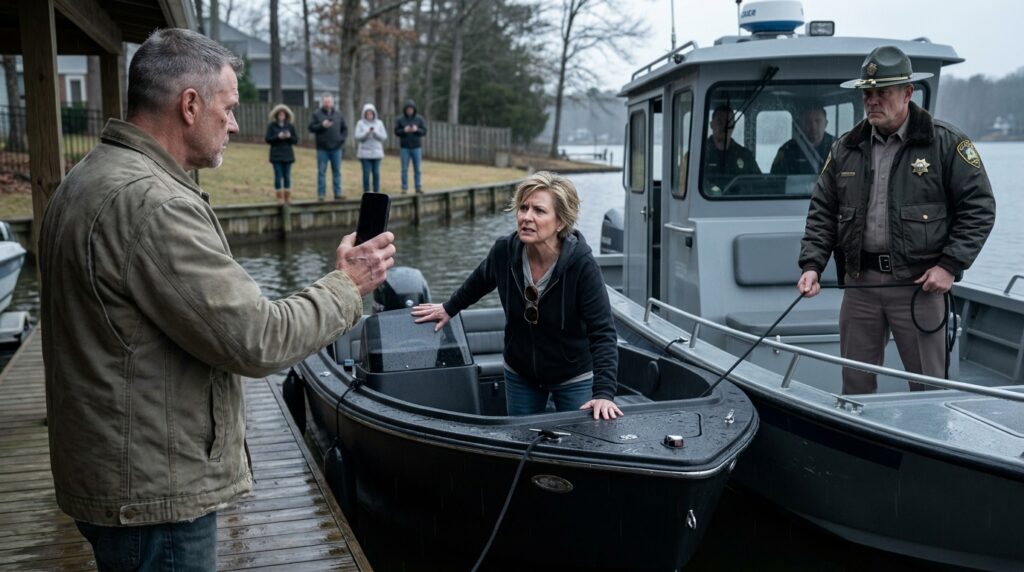
Within fifteen minutes, the heavy throaty rumble of a county patrol boat echoed around the southern point, its blue and amber lights flashing silently against the grey timberline. Deputy Brooks stood in the bow, holding onto the grab rail with an expression that balanced professional duty against profound, bottomless amusement.
The patrol boat eased alongside Ghost as she completed her twenty-fourth loop, matching speed with mathematical precision until an officer reached out and snagged the rubber mooring line, cutting the electric motor’s circuit.
The sudden silence was absolute.
Beverly sat frozen in the pilot seat, her face pale, her hair plastered to her forehead by wind and spray, clutching the steering wheel so hard her knuckles were bone-white.
“Step out of the vessel, ma’am,” Brooks called out across the water, his voice calm and level. “You’re trespassing on private property, and right now you’re riding in a vehicle you had no legal right to operate.”
“He trapped me!” Beverly shrieked, her voice cracking as she pointed a shaking finger directly at Marcus standing on the dock. “He engineered a malicious hazard! I was executing a community asset audit!”
“An audit usually involves a clipboard, Beverly,” Marcus called out across the water, his tone flat and unyielding. “Not grand theft boat.”
The neighbors on the bank exchanged a long, silent look. Across the water, the deputy extended a steady hand to help the shivering HOA president out of the slip, her dignity evaporating faster than the wake behind them. The loop was finished, but the true reckoning was only just beginning to anchor.
CHAPTER 6: THE MEDIATION ROOM COLLAPSE
The fluorescent lights in the county mediation room hummed with a flat, sterile frequency, casting long, pale shadows across the oversized walnut table. It was a table built for corporate buyouts and bitter divorce settlements, but today it served as the final resting place for a suburban empire made of paper and pretense.
Marcus Vance sat back in his chair, his hands resting easily on the armrests, a lukewarm paper cup of black coffee cooling beside his elbow. Across the long stretch of polished wood sat Beverly Campbell. She had forgone the pastel blazers and oversized designer sunglasses this time; instead, she wore a simple, severe gray wool suit, her fingers laced tightly together in her lap, knuckles bloodless. Beside her sat a young corporate attorney from downtown who looked like he had realized roughly twenty minutes into the hearing that he was defending a sinking ship with a teaspoon.
At the head of the table, Donna Carter—Marcus’s legal counsel, a former JAG officer with eyes like cold steel—flipped open a thin, immaculate manila folder. She didn’t rush. She let the silence build until the hum of the fluorescent lights felt heavy enough to crush glass.
“Let’s summarize for the record,” Donna said, her voice smooth and even, cutting through the stagnant air. “My client, Mr. Vance, has endured three weeks of coordinated trespassing, falsified municipal survey flags, unauthorized surveillance, and a malicious civil injunction filed under fraudulent administrative pretenses.”
The young attorney cleared his throat, adjusting his tie with visible discomfort. “My client reserves the right to contest—”
“Your client doesn’t have a docket left to contest on,” Donna interrupted gently, sliding a certified document across the table. “That is the county auditor’s forensic review of the Lakeview Serenity Homeowners Association general ledger for the past thirty-six months. It turns out that when you misallocate four hundred thousand dollars in emergency legal retainers and shoreline maintenance grants to hide the fact that the north ridge drainage easement was illegally leased out to a commercial developer, people tend to notice when a retired mechanic with security cameras moves in and starts asking about property lines.”
Beverly’s head snapped up. Her eyes, usually masked behind mirrored lenses, were raw, bloodshot, and wide with a sudden, suffocating realization. She looked past Donna, fixing her gaze squarely on Marcus.
“You didn’t just build a gate,” she whispered, her voice cracking, stripped of all its administrative venom. “You mapped the whole thing.”
“You don’t spend twenty-two years running supply lines in contested sectors without learning how to read a map, Beverly,” Marcus said quietly. “You wanted a controlled environment. You wanted a neighborhood where you could write the rules and collect the toll. But you forgot a fundamental rule of engineering: if you build a dam across a public waterway without checking who owns the watershed, the pressure doesn’t break the water—it breaks the dam.”
The mediator, an elderly man with glasses perched precariously on his nose, looked down at the documents, then up at Beverly. “Ms. Campbell, your attorney has already reviewed the disclosures. The civil suit you filed against Mr. Vance has been dismissed with prejudice. Furthermore, the emergency petition for the utility easement has been permanently revoked by the county commissioner’s office.”
Beverly didn’t answer. She slowly turned her head back down to look at her laced fingers, her lower lip trembling once before she clamped her jaw shut. The polished table reflected her distorted, graying image—a queen of a nonexistent kingdom staring down at an empty throne.
“The terms of our settlement are simple,” Donna added, closing her folder with a crisp, final slap. “A permanent, legally binding injunction barring Ms. Campbell or any acting board representative from coming within five hundred feet of Lot 91, a full public retraction published in the neighborhood gazette, and an immediate, unconditioned resignation from her position as HOA president.”
The young attorney looked at Beverly, waiting for an objection that never came. She simply gave a slow, microscopic nod, the last remnants of her rigid posture collapsing inward.
Forty minutes later, Marcus walked out of the county administration building into the crisp late-afternoon air. The sun was dipping low behind the ridge, spilling long amber rays across the asphalt parking lot.
Donna walked beside him, slipping her sunglasses into her breast pocket with a thin smile. “You know, Ben, most people would have just called the cops on day one.”
“Cops clear the street,” Marcus said, opening the door of his truck. “They don’t fix the alignment.”
“What are you going to do now?”
Marcus climbed into the cab, the engine turning over with a deep, reassuring purr. “Go home. Feed Dennis the raccoon. And check the battery on Ghost.”
An hour later, he was back on his porch. The lake lay before him like a sheet of hammered copper, flat, silent, and entirely unbothered. The north gate was locked, the orange survey flag was gone, and across the water, the beige SUV in Beverly’s driveway was already loaded down with cardboard boxes and a plastic-wrapped ficus tree.
Marcus took a slow sip of his coffee, feeling the warmth settle into his chest. Out in the slip, Ghost sat in absolute stillness, her matte-black hull absorbing the fading twilight. The noise was gone. The machinery of control had ground itself to dust against a boundary that refused to move.
He leaned back against the timber post, closed his eyes for a second, and listened to the wind rustling through the pines. The peace wasn’t given. It was engineered. And for the first time in months, it was completely, perfectly secure.







