
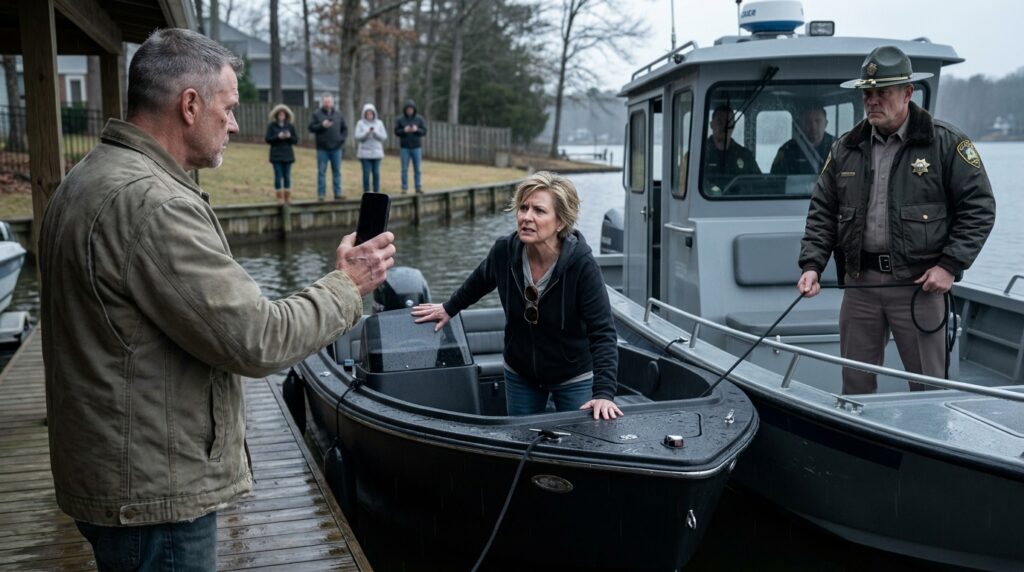
CHAPTER 4: THE DEPUTYS WARNING
The amber light on top of the county cruiser didn’t flash; it rotated in a slow, hypnotic arc, painting long orange stripes across the dew-soaked fern fronds lining the road.
Marcus didn’t wait for Deputy Ron Brooks to step out of the cab. He closed the gap between his porch and the gravel lane, his boots sinking a fraction of an inch into the soft mud.
Brooks pushed open the driver’s door, the metal hinge groaning in the dense morning air. He didn’t look like a man in a rush. He looked like a man who had spent twenty years mediating disputes between people who owned too much land and too little common sense. He adjusted his Smokey Bear hat, stepped down onto the asphalt, and leaned back against the door frame with a low sigh.
“Morning, Ben,” Brooks said, his hand resting casually near his utility belt. “Got a dispatch call about ten minutes ago. Escalated from civil grievance to potential property sabotage.”
Marcus didn’t smile. He pulled the folded spreadsheet page—the one Debbie Miller had accidentally left behind on the gate hinge—from his canvas jacket pocket and held it out, unfolded, between two fingers.
“Sabotage is a strong word for picking up litter, Ron,” Marcus said. “I call it municipal hygiene.”
Brooks took the paper, his eyes scanning the columns of highlighted numbers, the emergency legal retainers, and the inflated shoreline maintenance grants. A slow, quiet whistle slipped through the deputy’s teeth.
“Well, now,” Brooks murmured, tilting the paper toward the weak morning light filtering through the canopy. “That’s a mighty creative accounting department Lakeview Serenity’s got. Where’d you come across this little piece of fiction?”
“Dropped by a subcommittee member who forgot her folio,” Marcus said. “Turns out when you manufacture a crisis over a property line, you have to find a way to bill the residents for the phantom defense.”
Brooks folded the paper once, twice, and tucked it neatly into his breast pocket—not as evidence, but as contraband he didn’t want floating around a public docket just yet. He rubbed the back of his neck, his expression darkening.
“Beverly’s been busy this morning,” Brooks said, lowering his voice. “She didn’t just call dispatch, Ben. She drove down to the county commissioner’s office an hour ago. Filed an emergency petition claiming your security setup and your electric boat constitute an unregulated commercial hazard on a shared recreational waterway.”
Marcus felt the muscle beneath his left eye tick once. Not out of fear, but out of tactical calculation. “Shared waterway? The county plat map I pulled yesterday puts my entire cove outside the HOA’s legal jurisdiction by forty meters.”
“It does,” Brooks agreed, shaking his head. “And the commissioner knows it. But Beverly’s got friends on the zoning board who owe her favors from the last subdivision expansion. They aren’t going to overturn your deed, but they can issue a temporary stop-work order on any ‘unauthorized dock alterations’ until a formal survey is conducted next month.”
Marcus stared down the lane toward the main road. Down where the asphalt smoothed out, a beige sedan was parked fifty yards back, its engine running, a silhouette behind the windshield holding a long-lens camera steady against the steering wheel.
“She wants a delay,” Marcus said, the pieces snapping into place with mechanical precision. “If she stops me from finishing the dock repairs before the winter rains hit, the erosion fence fails. If the fence fails, my north shoreline washes into the municipal drainage ditch. Once it washes out, the county steps in to ‘reclaim public drainage access’—right across my property line.”
Brooks looked at him sharply, surprise flickering in his eyes. “You think she’s trying to engineer a forced easement?”
“I don’t think,” Marcus said, his voice flat as slate. “I know how military logisticians clear a blocked road when they can’t get the title transferred. They don’t win the argument; they change the geography.”
The deputy let out a long breath, watching his own condensation drift away into the fog. “She’s pushing too hard, Ben. People who run numbers like this don’t do it just to win an HOA election. If the county auditors ever open up Lakeview Serenity’s general ledger and find three years of missing improvement funds tied to those legal retainers…” He left the sentence hanging, heavy and unfinished.
“Then she won’t just lose her presidency,” Marcus finished for him. “She’ll lose her house.”
“Which is exactly why she’s desperate,” Brooks said, pushing off the cruiser door and stepping back into the driver’s seat. He tapped the roof of the car twice with his knuckles. “I can hold the county inspectors off for forty-eight hours with a jurisdiction review, but after that, you’re on your own. Keep your cameras rolling, keep your logs tight, and whatever you do—don’t let her bait you into crossing that property line first.”
The cruiser’s engine revred, a deep, muffled V8 growl that tore through the damp air before slipping into gear and turning smoothly around in the narrow turnaround.
Marcus stood alone on the gravel lane. The beige sedan down the road didn’t move; its headlights flickered once, a silent digital pulse across the hundred yards of wet asphalt, acknowledging the shift in momentum.
Marcus turned, walked back down his gravel path, and tapped the keypad on the boathouse wall. The status light on the matte-black hull of Ghost shifted from green to a hard, pulsing amber. The system was armed. The trap was set. All he had to do now was wait for her to walk right into the center of her own geometry.








