CHAPTER 2: THE PAPER TRAIL
The image on the screen was crisp, high-resolution, and entirely unwelcome. It showed the north corner of his perimeter fence—the exact spot where the old-growth oaks gave way to the municipal drainage ditch—with a fresh, orange survey flag stuck upright in the soft loam. Someone had crossed his line while he was asleep, planting a marker not twenty feet from his boathouse wall.
Marcus didn’t blink. He swiped the notification away, but the muscle beneath his left eye ticked once, a small, involuntary twitch he hadn’t felt since the winter of two thousand and fourteen when a supply convoy went sideways outside Kandahar.
The screen went dark, reflecting his own graying crew cut and unsmiling mouth.
He didn’t need to check the metadata to know who sent it. Beverly Campbell didn’t operate in shadows because she enjoyed them; she operated in them because she lacked the imagination to realize the light would eventually burn her. But this wasn’t just another petty flyer or a passive-aggressive note wedged under his mailbox. An orange survey flag meant someone had hired a private crew, filed a preliminary boundary dispute with the county clerk, or worse—had attempted to establish a fraudulent encroachment claim under the guise of HOA easement maintenance.
Marcus slipped his phone into his canvas jacket pocket, picked up his mug, and walked back up the gravel path toward the house. The damp morning air clung to his skin, smelling faintly of woodsmoke and old iron.
Inside the kitchen, the sunlight cut through the double-paned glass in sharp, dusty bars, illuminating the pine table where his laptop sat open in sleep mode. He tapped the spacebar. The screen woke with a low hum, displaying his custom-built security dashboard. He bypassed the live exterior feeds and opened the local municipal records portal, inputting his parcel number into the public assessor’s database.
It took twelve minutes of clicking through digitized plat maps, historical boundary deeds, and county tax assessments to find what he was looking for. There it was—a small, highly specialized addendum filed six weeks before he inherited the cabin. An administrative adjustment request submitted by the Lakeview Serenity Homeowners Association, asking the county to re-evaluate the northern thirty-foot buffer of Lot 91 as an auxiliary utility access corridor.
And right beneath it, stamped in faded digital blue: Status: Denied – Insufficient Legal Precedent.
Marcus leaned back in his chair, letting out a slow, measured breath through his nose. Denied by the county, which meant Beverly had no legal leg to stand on. Yet she had sent a crew onto his land to plant a flag anyway. People who operate inside the law don’t plant flags in the dark. They file motions, they wait for hearings, they send men in suits. People who are desperate, however—people who are frantically trying to manufacture a physical reality to cover up an institutional lie—they move fast, leave tracks, and force confrontations.
The screen flickered as an automated push alert popped up in the corner of his monitor. North Gate Motion Detected.
Marcus clicked the feed. The camera angle shifted instantly from a static wide shot to a tight, high-contrast close-up of the cedar-and-steel access point he had reinforced three days ago.
A sleek, dark gray sedan idling just outside the perimeter. The window rolled down two inches, and a gloved hand reached out, sliding a heavy, manila-colored envelope through the vertical slats of the gate directly onto the gravel below. The car didn’t linger; the moment the envelope hit the stones, the reverse lights flashed white and the vehicle backed down the lane with brisk, calculated speed.
Marcus stood up from the desk, his boots striking the hardwood floor with a dull, heavy thud. He walked out onto the front porch, his eyes locked on the spot where the envelope lay in the gray morning light. He didn’t rush. He didn’t sprint down the driveway. He walked with the slow, deliberate stride of a man who knew that walking into a trap too quickly only ruins the geometry of the defense.
When he reached the gate, he didn’t pick up the envelope with his bare hands. He knelt down, fished a small pocket multi-tool from his trousers, and used the tip of the flathead screwdriver to flip the flap open.
Inside wasn’t an HOA flyer or a polite community reminder. It was a formal, attorney-letterhead demand notice from a firm downtown, threatening immediate civil injunction proceedings for “willful obstruction of historical neighborhood transit rights,” signed by a name he didn’t recognize and backed by a terrifyingly specific list of fabricated violations.
Marcus slid the letter back into the folder with the tip of his tool, stood up, and looked out over the mist-covered surface of the lake.
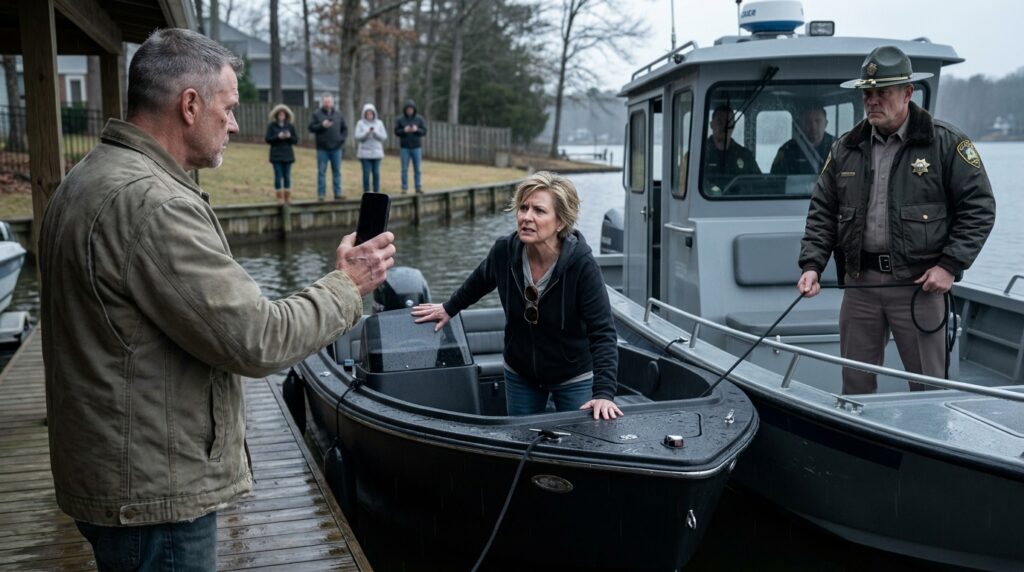
Ghost sat silently in her slip, her matte-black hull catching the pale morning light like an unread book. The surface of the water was entirely smooth, unbroken by a single ripple, holding its secrets beneath a skin of glass. But somewhere across that water, behind the neat rows of manicured lawns and pastel siding, the machinery was beginning to turn faster than Beverly could control.
He pulled out his phone, dialed a direct eleven-digit number, and waited through two rings until a low, gravelly voice answered on the other end.
“Vance,” the voice said. “Tell me you aren’t calling about another stray dog.”
“Morning, Mark,” Marcus said quietly, his eyes fixed on the orange survey flag fluttering in the distance. “I’ve got a civil demand letter on my front step and an uninvited survey flag on my north line. Looks like our neighborhood president just decided to graduate from chalking tires to forging municipal paperwork.”
A short, dry laugh came through the speaker. “Paperwork forgery is a federal-adjacent headache, Ben. You sure you want to open that door?”
“I didn’t open it,” Marcus said, his voice dropping an octave as he watched the distant movement of a beige crossover slowing down near the ridge line. “She’s trying to push a door open that I welded shut three days ago. Let’s see how her hinges hold up.”