
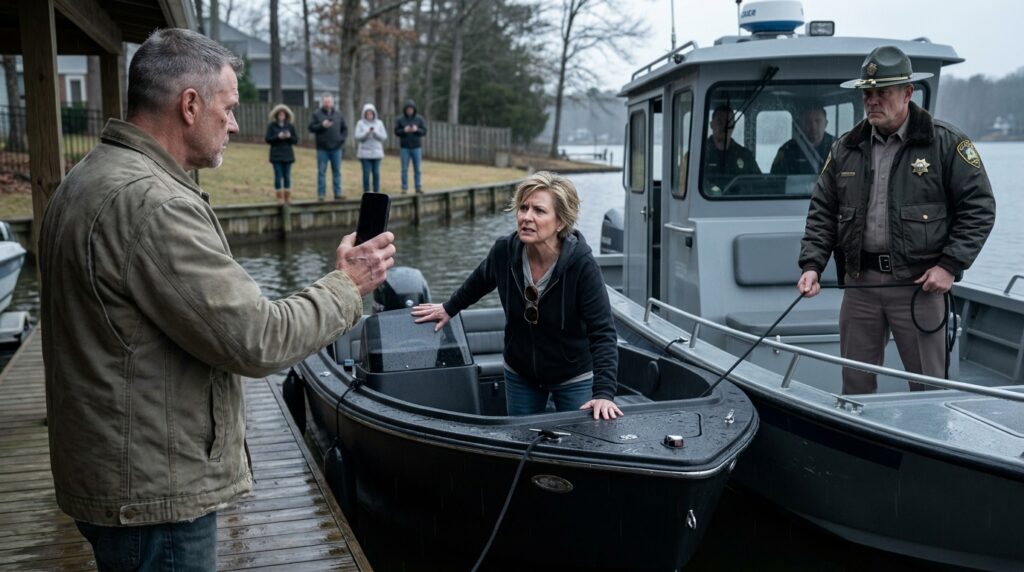
CHAPTER 1: THE IRON GATE
The ceramic mug was heavy, thick-rimmed, and warm against Marcus Vance’s scarred knuckles. Twenty-two years in uniform teaches a man to measure space in meters of exposure and seconds of cover, but out here on the forested lip of the non-HOA enclave, exposure meant only the sun cutting through the pine boughs and cover meant a two-hundred-dollar steel gate he had welded together himself.
Then came the sound.
Scrunch. Scrunch.
The rhythmic, deliberate crush of gravel under expensive loafers. It wasn’t the casual shuffle of a neighbor out for a morning stroll. It had cadence. It had jurisdiction.
Marcus didn’t turn around. He kept his knee pressed against the warped cedar board he was shimming into place on the dock, letting his hammer rest on the timber like an idle weight.
“Good morning,” the voice sang out. It was bright, surgically cheerful, and coated in the specific brand of hostility that only came from someone holding a title they had invented in their own head. “I’m Skyler. Skyler Campbell with Lakeview Serenity.”
Marcus set his hammer down. The tap was soft, precise, final.
He stood up, his spine clicking with the dull ache of a medical retirement he didn’t like to talk about, and turned to face her. She stood at the edge of his property line where the manicured asphalt gave way to wild ferns and unmanaged loam. Bob cut like a metronome, oversized sunglasses that could double as interrogation mirrors, and a clipboard clutched to her chest with color-coded tabs protruding like colorful teeth.
“Benjamin,” he said, using his middle name because his first belonged to a man who had left it in a desert ditch ten years ago. “Benjamin Vance.”
“Benjamin,” she repeated, tasting the name as if checking it for contraband. Her gaze flicked past his shoulder, sweeping over the newly bolted ‘Private Property’ sign, lingering on the small black dome of the security camera tucked into the pine bark with a polite red LED blinking a steady heartbeat. “We just love welcoming new homeowners to the community. And we have a culture of shared stewardship here. Historically, this stretch of shoreline has been used for small gatherings, community barbecues, sunset socials.”
“Historically,” Marcus said, his voice flat as slate, “this land belonged to my uncle, and now it belongs to me. No barbecues. No socials.”
Skyler’s smile shortened by precisely one millimeter. Her hand moved to her belt, where a pen sat tethered on a curly plastic string. “Technically, your parcel sits on the border of our administrative zone. We like to think of it as an honorary tier. It prevents friction.”
“Friction’s a mechanical problem,” Marcus said, leaning his weight onto his back foot. “I spent two decades fixing mechanical problems. Usually, they start because something is rubbing where it shouldn’t.”
Skyler clicked her pen. Once. The sharp plastic snap echoed off the water. “We’ll see about that.”
She turned on her heel, her sandals clicking a sharp retreat up the path, leaving behind the smell of expensive perfume that didn’t belong anywhere near wet cedar and pine sap. Marcus watched her go, his eyes tracking her silhouette until the white roof of her SUV vanished behind the birch line. He picked up his mug, took a cold sip, and walked over to the small weather-sealed box bolted to the boathouse wall. He flipped the master switch, checking the telemetry on the matte black electric hull moored silently in the slip. Ghost was charged to ninety-six percent, GPS locked, and geofenced to the exact millimeter of his legal boundary.
The system was armed, but the trap hadn’t been triggered yet. Not because she wouldn’t try, but because a true strategist never interferes when an adversary is busy constructing their own defeat.
He walked back to the dock, picked up his hammer, and struck the cedar board. The sound rang out clean and hard across the lake, an unmistakable metronome answering hers.
The morning wind shifted, carrying the faint, distant hum of tires on the outer road, and Marcus caught the subtle pulse of a text message vibrating against his thigh. He pulled out the phone without breaking his stride. It was a local ping, but the sender ID was blank—just a string of numbers originating from a cellular tower three miles down the ridge.
He tapped the screen to open it, his thumb hovering over the preview as the display flickered with a single, uninvited image taken from outside his own perimeter fence.








