
The Inventory of Living Things: A Novel of Public Reckoning and Digital Truth

CHAPTER 1: THE PRESSURIZED GRID

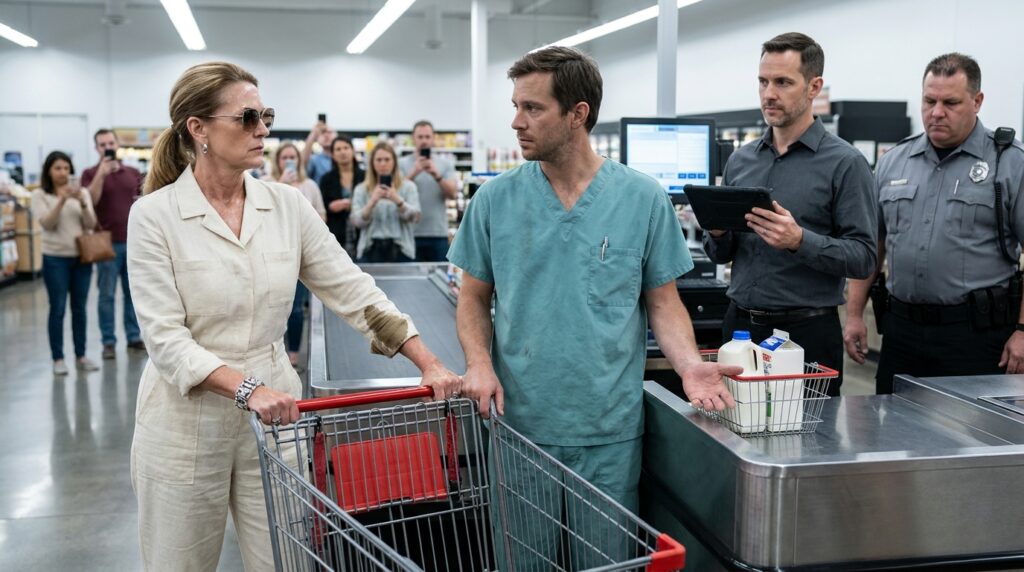
The air in the terminal smelled of industrial wax, roasted chicory, and the cold, damp condensation leaking from the premium organic dairy cases. Marcus didn’t look up from his phone screen. On the display, a small amber light pulsed every three seconds, indicating that his veterinary clinic loyalty app had successfully logged his pre-authorized transaction token for three cartons of lactose-free milk and a pre-packaged wrap. His right heel throbbed where the steel frame of the cart had bitten through his worn running shoes, but he kept his shoulders low, his spine deliberately relaxed. After twelve hours holding down a panicked, ninety-pound German Shepherd with a ruptured abdominal wall, he had learned that any sudden movement only invited the teeth.

A hand tipped with sharp, porcelain-white French extensions slammed down across the black rubber conveyor belt, halting his plastic grocery basket inches from the laser terminal.

“Do not scan those items,” Victoria Vance announced, her voice dropping through the crowded checkout corridor like a heavy iron gate. She stood completely rigid in her cream linen jumpsuit, her oversized designer sunglasses catching the harsh, shadowless glare of the overhead fluorescent grid. She didn’t look at the cashier; her eyes were locked onto the dark ultrasound grease stain on the right thigh of Marcus’s scrubs. “The worker in the veterinary rags has a specialty cold-brew growler and an artisanal cheese platter concealed in the deep cargo pockets of his pants. I watched him bypass the gourmet island display without using a basket.”

The rhythmic, electronic beep-beep of the four adjacent registers died instantly. The silence that followed was heavy and immediate, the collective, judgmental stillness of sixty affluent weekend shoppers freezing the terminal into a public gallery.

Marcus let his gaze drop to the conveyor belt. His fingers remained wrapped tightly around the plastic handle of his basket. He could feel the heat of the room shifting, the subtle, dangerous tilt of public sympathy moving away from his stained uniform before he had even spoken a syllable. Clipped to his top pocket, the small silver veterinary penlight caught the white light of the ceiling, a tiny metallic marker of his labor that Victoria was already reframing as the tool of a thief.

“The basket belongs to the store,” Marcus said, his voice dropping into the flat, transactional register he used to calm aggressive animals before a needle went in. “The items belong to me. My phone has the encrypted payment record if you have the network clearance to read it.”

“Guilt always uses technical phrasing,” Victoria snapped, her heavy silver toggle bracelet clinking violently against her wrist as she pointed a manicured finger toward his chest. “Look at him. He’s shaking. Turn on the register light, child. Call plaza security down here right now before he empties his pockets onto the floor.”

The college-aged cashier’s hand hovered over the plastic control panel, her eyes wide with a combination of corporate panic and local class deference. Above their heads, the small red indicator light began to flash, its silent rotation casting a faint, rhythmic tint across the polished concrete floor. Marcus didn’t move an inch. He simply watched the silver bracelet on Victoria’s wrist vibrate, counting the seconds until the automated platform would update its logs.


CHAPTER 2: THE SHADOW IN THE GOURMET ISLAND

Victoria’s manicured index finger remained extended, a rigid silver pointer aimed directly between Marcus’s eyes. Her chest rose and fell beneath the pristine cream linen of her jumpsuit, the heavy silver toggle bracelet on her wrist settling with a sharp, metallic clink against the edge of the conveyor belt. She didn’t blink. In the calculation of the grocery lane, she had established her perimeter, and she was waiting for him to break formation.

Marcus kept his hands flat on the cool, synthetic surface of the bagging counter. He could feel the eyes of the line-three shoppers—a couple in matching tennis whites—anchoring on him, their expressions hardening from idle curiosity into the cold, detached appraisal of a jury. To them, the faded teal of his scrubs was a confession. The grease stain from the ultrasound machine on his thigh was an indictment. In this neighborhood, you either wore the linen or you served the people who did.

“I am not going to ask you again, young lady,” Victoria said, her tone sliding into the smooth, practiced authority she used to clear zoning violations from the country club records. She tilted her head toward the cashier, her designer sunglasses catching the long, linear glare of the fluorescent tubes above. “Turn the terminal light to strobe. The plaza security contract explicitly states that any individual refusing a compliance check is to be detained at the point of sale.”

The cashier’s fingers tapped frantically against the plastic register casing. A soft, electronic chime sounded, and the overhead red light transitioned from a solid glow to a rhythmic, pulsing flash that cut through the aisle. Marcus watched the reflection of the light bounce off the chrome trim of Victoria’s shopping cart. His mind worked through the exhaustion, stripping the emotion from the room the way he stripped the panic from an injured stray on the surgery table.

He noticed the line of her posture. She was leaning slightly to the left, favoring her right hip, her weight braced against the heavy metal handle of her cart. And then he saw it—a dark, translucent smudge tracking along the inner seam of her right linen cuff. It wasn’t ink. It had the viscous, light-reverting quality of cold-pressed oil, still wet enough to catch the white glare of the register display.

“The register has an integrated scale,” Marcus said, his voice flat, cutting through the rising murmur of the express queue. He didn’t point at her cuff. He kept his eyes fixed on the metal rim of her sunglasses. “The basket contains exactly three cartons of milk and a packaged turkey wrap. The total weight is logged under my account’s pre-clearance token. If I had a sixty-dollar ceramic jar of truffles or a glass growler in these pockets, the pressure sensors in aisle eleven would have flagged the variance before I reached the concourse.”

Victoria’s mouth thinned into a pale, bloodless line. “The equipment doesn’t account for professional sleight of hand. People who spend their nights in commercial basements know exactly where the blind spots in the ceiling matrix are.”

Before Marcus could counter, a heavy, rubber-soled step crunched against the polished concrete behind him. The scent of cheap wintergreen mints and synthetic polyester pushed into the aisle. Officer Davies had arrived, his gray plaza security shirt stretched tight over a thick midsection, his utility belt shifting with a dull, plastic rattle as he stepped between Marcus and the exit gate.

“Alright, let’s clear the lane,” Davies said, his eyes scanning the crowd before settling on Victoria’s linen jumpsuit. He recognized her; everyone who worked the private plaza contracts knew the names on the regional historical board. His tone shifted instantly, losing its administrative edge and softening into deference. “Mrs. Vance. Is there a disruption with the transaction?”

“The individual is refusing a basic pocket inventory, Officer,” Victoria said, her hand dropping to her expensive leather tote, fingers curling around the strap like a soldier adjusting a sling. “He’s using corporate app phrasing to obstruct the register. I followed him from the gourmet island. He was lingering by the imported reserve shelves for six minutes without a cart.”

Davies turned his head toward Marcus. The deference vanished. “Sir, step out of the queue and place your hands on the bagging deck. We need to verify the contents of the cargo pockets before we can authorize you to leave the property.”

Marcus felt his pulse thrum against his throat, but he didn’t pull his hands back. If he reached for his phone to force the QR code display now, Davies’s hand would drop to his defensive spray. The tactical asymmetry of the aisle was absolute. The crowd was already lifting their screens, the small black lenses of three different iPhones tracking his movements from the bakery line. They weren’t recording to help him; they were recording the cleanup.

“Check the terminal log first, Officer,” Marcus said, his voice dropping an octave, cold and level. “Ask the manager to pull the unlinked register discrepancies for the last ten minutes. If there’s an inventory deficit, it isn’t in these scrubs.”

Davies frowned, his fingers twitching near his radio clip. “That’s not how the protocol works, buddy. You comply with the physical check, or we call the city dispatch.”

At that precise micro-second, the register terminal emitted a long, continuous error tone. The cashier gasped, pointing at the administrative screen as a blue alert window began to pulse over the transaction interface. A bold, white string of text cut across the display: INVENTORY MISMATCH – DELI SECTOR REGISTER 4 – ALERT CODE 500 – UNLINKED FINANCIAL LOSS.

Victoria let out a short, triumphant breath that rattled the silver charms on her wrist. “There it is. Five hundred dollars. He didn’t just take the oil, Officer. He cleaned out the reserve case.”

CHAPTER 3: THE AISLE ELEVEN OBSTRUCTION

The high, piercing frequency of the register’s error tone ricocheted off the exposed steel rafters of the concourse, embedding itself like a needle in Marcus’s temples. On the liquid-crystal display, the blue warning square continued its aggressive pulse, illuminating the letters ALERT CODE 500 with a flat, radioactive glow. The electronic scream didn’t just disrupt the space; it finalized the architecture of the trap.

Victoria Vance adjusted her stance, her ivory linen trousers shifting with a crisp, tailored whisper. The silver charms on her toggle bracelet swung in a brief, erratic arc before she flattened her palms against the top rail of her shopping cart, effectively locking Marcus into the three-foot bottleneck between the conveyor belt and the bagging deck.

“An unlinked five-hundred-dollar loss,” Victoria said, her voice dropping into a rhythmic, measured cadence that carried perfectly down the express line. She looked past Marcus’s shoulder, her eyes cutting through her dark lenses to lock onto the small circle of customers clustering near the bakery counter. “The digital inventory matrix doesn’t trigger a total register lockout for a misplaced carton of eggs. It triggers when high-margin assets cross a physical threshold without an optical confirmation scan. Officer Davies, look at the alignment of his left cargo flap. The canvas is pulling under the weight.”

Officer Davies shifted his boots, the heavy rubber soles groaning against the polished concrete. His right hand remained hooked into his utility belt, centimeters from his heavy tactical radio casing. The deference in his posture had solidified into corporate obligation; the blue light of the register screen reflected off his silver plaza badge with a cold, geometric edge.

“Step out of the lane, sir,” Davies repeated, his tone flatter now, devoid of the transactional patience he had used moments ago. He moved his bulk six inches forward, narrowing the exit gap until his synthetic shoulder patch nearly brushed the stainless-steel molding of the counter. “The administrative override requires an inventory resolution before this till can be reset. We’re moving to the holding alcove behind the customer service desk.”

Marcus didn’t shift his feet. He could feel the cold draft from the open refrigeration units behind him, washing over the dark ultrasound grease stain on his scrubs. He looked down at the dark, translucent smudge tracking along Victoria’s linen cuff. The stain had spread slightly, darkening the weave of the fabric, its light-reverting sheen contrasting sharply with the immaculate, chalky white of the rest of her garment. It was an anomaly—a physical signature left behind in a space she claimed she had only observed from a distance.

“The inventory mismatch didn’t originate from a movement in this lane,” Marcus said, keeping his hands visible, fingers spread wide against the cool plastic edge of his grocery basket. His voice remained cool, carrying the clinical flatline he used when a feral hound began to bear its teeth on the examination table. “An unlinked loss of five hundred dollars matches the exact wholesale case value of the cold-pressed reserve oils in aisle eleven. If a bottle had been removed or broken, the weight drop would register instantly on the master mezzanine board. Look at the cuff of your right sleeve, Mrs. Vance. You’ve been handling cold-pressed liquids within the last fifteen minutes.”

A sharp, collective intake of breath rippled through the bakery queue. A young man wearing a local country club polo shirt lowered his organic milk carton, his thumb tapping the recording lens on his phone to reframe the angle directly onto Victoria’s arm.

Victoria didn’t flinch. She simply turned her left wrist, allowing the heavy silver bracelet to slide down her skin with a deliberate metallic snap. “The desperation of the service class is always tedious. I was inspecting the artisanal olive display to check the expiration dates for the neighborhood garden guild. If an employee’s uniform leaks grease from a back-room task, he doesn’t get to project his lack of hygiene onto the patrons who fund this plaza’s security contract.”

“Officer,” Victoria continued, her voice sharpening as she turned her face back toward Davies, the white glare of the overhead fluorescent tubes turning her aviator lenses into two blank, golden mirrors. “He’s attempting to deflect an automated corporate alert by making personal remarks about my clothing. If your company cannot manage a basic retail search under these conditions, I will contact the regional director before the current shift logs clear.”

Davies’s face went rigid. He took a heavy black plastic notepad from his belt, the binding cracking loudly in the silent lane. “Sir, you’re now obstructing a civil property inquiry. Hands on the counter. Empty the contents of the cargo flaps right now, or we proceed with a formal trespassing restraint.”

Marcus watched the cashier’s fingers tremble against the administrative keyboard. He knew the protocol parameters. If he complied with a physical search under the duress of a private plaza guard, the digital wallet token on his screen would timeout, wiping the transaction history and locking his clinic credentials out of the store’s priority customer profile. He had to force the data transition to happen through the master terminal, where Victoria’s presence was legally documented.

“I won’t empty the pockets for a private plaza contractor,” Marcus said, his voice dropping an octave, steady and sharp as a scalpel. “Call the store manager down from the mezzanine terminal. Let him run the itemized telemetry from my loyalty account against the real-time weight sensor log for register four. If the weights match to the gram, the theft alert is a false flag, and the deficit belongs to whoever damaged the inventory in aisle eleven.”

Victoria let out a short, airy laugh that didn’t reach her eyes. “The manager is currently in a quarterly regional review. He doesn’t come down for five-dollar wraps, Miller. Officer, take the bag.”

Davies reached out, his thick, gray-uniformed arm crossing the silver trim of the conveyor belt, his fingers wrapping around the handle of Marcus’s plastic basket.

CHAPTER 4: THE ESCALATION OF THE CORPORATE GUARD

Officer Davies’s thick fingers clamped onto the red plastic rim of Marcus’s shopping basket with a sudden, heavy jerk that rattled the three cartons of milk inside. The physical boundary of the checkout lane collapsed instantly into a tight, territorial struggle. Marcus didn’t pull back with a desperate yank; instead, he rotated his wrist slightly, dropping his center of gravity to brace his forearm against the edge of the bagging station. The mechanical resistance was solid, calculated. He locked his jaw, his eyes narrowing to track the precise angle of Davies’s grip.

“Let go of the assets, sir,” Davies growled, his boots squeaking sharply as he dug his heels into the polished floor, his uniform shirt pulling tight against his tactical vest. The silver plating of his plaza badge scraped against the stainless-steel molding of register four with a harsh, grating noise that made the nearby cashier flinch. “You are actively resisting a lawful directive to preserve property during an inventory audit. This basket remains under plaza custody until your personal effects are cleared.”

“The items in this basket have already crossed into my digital account,” Marcus said, his voice dropping into a dangerous, clinical whisper that remained level despite the rapid thrumming of his pulse. He could feel the eyes of the line-three shoppers boring into the side of his face like warm needles. He used his free hand to raise his phone, forcing the screen directly between Davies’s eyes and the cash register. “Look at the terminal display. The dynamic payment token is refreshing every three seconds. If you sever the physical connection before the optical scanner registers the final token sync, you are disrupting a federal banking transaction, not a local shoplifting complaint.”

Victoria Vance took a swift step forward, her cream linen trousers catching the harsh glare of the blinking strobe light above. Her large, heavy silver toggle bracelet clinked aggressively against the side of her leather tote as she pointed down at Marcus’s screen. “It’s a decoy loop, Officer. I’ve read about these third-party medical and service apps. They freeze the store’s POS network while the user leaves the building. He’s trying to run down the internal battery of his device so the security logs can’t be pulled manually.”

Marcus glanced down at the upper right corner of his cracked glass screen. The battery indicator was flashing red, a tiny single-digit threshold remaining: four percent. The internal clock of the veterinary portal was tracking down. If the device died before the manager bypassed the administrative lock, his legal shield would turn into an empty pane of black glass, leaving him entirely at the mercy of Davies’s written report.

“The battery status is irrelevant to the barcode registry,” Marcus said, his teeth clicking together as he maintained his calculated restraint against the guard’s weight. He shifted his eyes back to Victoria, noticing that she had pulled her linen sleeve slightly higher on her forearm, an unconscious movement to conceal the dark, spreading oil smudge near her wrist. “You keep referencing the specific contents of my pockets because you need an immediate scapegoat to answer for the five-hundred-dollar unlinked loss. The store’s ceiling matrix logs everything within four frames per second. If you didn’t touch the gourmet shelf, Mrs. Vance, why is the cold-pressed reserve oil currently soaking into the fibers of your right sleeve?”

Victoria’s posture stiffened into a rigid, defensive block. She tucked her right hand into her pocket with a sharp, calculated jerk, her aviator sunglasses reflecting the cold, linear pattern of the ceiling lights like twin sheets of gold metal. “My clothing is tailored from Italian flax, Miller. If a background worker cannot distinguish the fragrance of white truffle oil from his own clinic’s refuse, he shouldn’t be allowed to manipulate electronic devices in a public space. Officer, terminate this argument. He is weaponizing a mobile device to humiliate a member of the plaza association.”

Davies tightened his hold on the plastic basket, his knuckles turning a bloodless white under the sterile fluorescent light. He leaned his mass forward, his shoulder forcing the black plastic notepad on the counter to slide onto the concrete floor with a dull slap. “That’s enough. I’m taking the phone, and we’re moving to the rear alcove. Hand it over, or I use the defensive block.”

Marcus felt the friction of the guard’s sleeve against his skin, the sharp scent of wintergreen mints overwhelming the clean aroma of the bakery. He knew that any further physical resistance would give Davies the legal pretext to initiate a takedown, a public neutralization that would wipe his visibility from the floor entirely. He let go of the basket handle. The sudden release of tension caused Davies to stumble back half a step, the plastic cartons inside clattering loudly against the conveyor belt.

“The basket is yours,” Marcus said, his hands rising slowly, fingers spread open, palm-out, completely still under the lenses of the surrounding phones. “But the data stays on the terminal. The network is already processing the audit.”

Before Victoria could speak, the glass door of the mezzanine staircase at the far end of the concourse clicked open with a heavy, magnetic snap. A man in a tailored charcoal corporate shirt, clutching a master management tablet, began to descend the stairs, his eyes fixed on the flashing red strobe light of register four.

CHAPTER 5: THE DIGITAL RECEIPT REVERSAL

“Step back from the lane immediately, Officer,” the store manager announced, his shoe leather snapping sharply against the edge of the polished concrete ramp. He didn’t check the express queue or look at the cashier’s blinking distress light. His hand remained wrapped around a thick, rubber-armored corporate tablet, its master screen displaying a live, scrolling green terminal diagnostic that illuminated the sharp, clean lines of his charcoal sleeves.

Officer Davies froze, his grip on Marcus’s plastic basket relaxing with a soft, synthetic rattle. He dropped his arm, stepping sideways into the corner of the register enclosure as his boots scraped against the metal floor barrier. “Mr. Vance,” Davies muttered, adjusting his utility belt. “We have an active Code 500 alert on the register interface. The customer is resisting an asset verification.”

“The customer is fully authenticated on our network,” the manager said, his voice level and entirely devoid of the local class deference Victoria Vance usually commanded across the plaza. He tapped the glass of his tablet twice, forcing a localized data command down the line. Register four’s electronic scream died instantly, the blue alert square on the cashier’s terminal vanishing behind a standard green payment processing window. “Mr. Miller’s mobile token cleared our corporate clearinghouse exactly four minutes ago. His total basket inventory is itemized, verified, and closed to the single gram.”

Marcus let his breath out slowly through his nose, his fingers finally lifting from the cool laminate of the bagging counter. His phone screen throbbed with a final, single flash of its red low-battery icon before clicking into a complete, black shutdown. It didn’t matter now. The cryptographic transaction ID was already embedded in the register’s master mainframe.

Victoria turned her face toward the manager, her gold-rimmed aviator lenses catching the white, shadowless glare of the overhead matrix like two cold pieces of coin. Her silver toggle bracelet clinked violently against her wrist as she clamped her right hand back onto the handle of her metal shopping cart. “The app telemetry is a superficial shield, Gregory. I stood three feet behind this man at the specialty deli island. He was deliberately manipulating his garments over the high-ticket reserve displays. If your automated checkout system chooses to process an incomplete transaction because of a network delay, the physical deficit still remains on your balance sheet.”

“The physical deficit is fully accounted for, Mrs. Vance,” the manager said. He turned the tablet around, sliding his thumb along the screen to anchor a high-definition video frame, then projected the interface onto the large, outward-facing customer terminal mounted above the express lane counter. “Our ceiling matrix uses omnidirectional weight-sensing lenses. It doesn’t track people by their uniforms. It tracks mass displacement.”

The terminal screen blinked, transitioning from a static logo to a pixelated, overhead perspective of aisle eleven from fifteen minutes prior. The wide-angle lens captured the precise geometric layout of the imported gourmet shelves, the stark white tiles below completely clear of shoppers. Then, Victoria’s cream linen jumpsuit drifted into the center of the frame. The video was sharp, capturing the frantic movement of her hands as she reached toward a multi-tiered display of limited-run cold-pressed olive oils. Her oversized leather tote bag swung forward, its heavy base striking the fragile corner of the timber shelving. On the display, three ceramic jars of white truffle extract listing at one hundred and sixty dollars apiece wobbled before sliding backward behind the partition wall, their seals fracturing instantly against the metal reinforcement brackets.

The video tracked her as she pulled her arm back with a sharp, defensive jerk—the dark, translucent liquid soaking instantly into the inner weave of her right linen cuff before she turned on her heel and pushed her cart toward the checkout concourse.

A dead, absolute silence fell over the five adjacent lines. Then, the young man in the country club polo shirt let out a sharp, mocking whistle, his phone screen lifted high to catch both the monitor display and the bloodless, white line of Victoria’s mouth. Across the aisle, a woman in the express queue lowered her organic produce box, her fingers tapping her screen rapidly as she shared the live footage to the neighborhood forum. The murmurs of the crowd shifted direction within three seconds, turning from an indictment of Marcus’s uniform into a heavy, collective circle of digital observation.

“The Code 500 alert wasn’t an act of retail concealment,” the manager said, his voice echoing flatly through the store’s PA microphone as he switched the terminal to public address. “It was an automated mechanical error triggered because four hundred and eighty dollars worth of reserve inventory was crushed out of sight behind our shelving tier. Plaza security, clear the basket from the belt. Mrs. Vance, you need to accompany Officer Davies to the administrative office to complete a standard commercial property damage report and settle the variance.”

Victoria’s posture remained rigid for one final, desperate second, her fingers turning a severe, waxen white against the metal handle of her cart. She looked at Davies, but the guard kept his head down, his hand resting flatly on his black plastic notepad as he stepped forward to take the cart from her grip. Her authority faker facade dissolved into a pale, stuttering pariah under the cold glare of forty different recording lenses. She didn’t speak. She pulled her leather tote aggressively over her right cuff, turned on her heel, and shuffled toward the sliding glass exit doors, the rhythmic click of her heels sounding small and clumsy against the vast, empty concrete of the concourse.

Marcus picked up his pre-packaged sandwich and his milk cartons, placing them carefully into a recycled brown paper bag the cashier handed him with a quiet, apologetic nod. His hands were steady now, his spine straight as he adjusted the silver veterinary penlight clipped to his top pocket. He walked past the silent checkout barrier, his boots carrying the faint scent of the clinic into the fresh weekend air outside, his visibility within the community reclaimed entirely without ever having to raise his voice.

Similar Posts

Leave a Reply

Your email address will not be published. Required fields are marked *






