The Price of the Dirt Between Us: A Novel of the Dusty Gray

CHAPTER 1: THE WEIGHT OF THE LEANTO

The grease on Miller’s knuckles was old, cooked into the creases of his skin by three straight shifts at the diesel yard. His shoulders carried the low, vibrating ache that comes from leaning over a flatbed chassis for twelve hours under high-bay lights. When he reached the latch of the corrugated metal lean-to behind his single-story house, the rusted iron resisted, scraping with a high, dry shriek that made the neighborhood dogs shift on their chains three lots down.

Inside, the air smelled of stale gasoline, rot-resistant cedar, and the damp earth creeping through the floorboards. The red push mower sat under a rotting canvas tarp. It wasn’t a modern machine; the steel deck was pitted with gray oxidation, and the wheels were caked with the dried, black mulch of three summers ago. He pulled the tarp back, the coarse fabric scratching against his calloused palms.

He didn’t want to look at the yard. He didn’t want to look at the southern line where the sun-bleached cedar fence split his lot from the manicured, green grid next door. But the heat was rising, thick and heavy with the promise of a late-afternoon thunderstorm, and the knee-high weeds along the boundary were already throwing seed into Brenda’s immaculate rye grass. Every hour those stalks stayed upright was an hour he spent waiting for the state to knock on his door.

He wheeled the machine out, the iron axle groaning. The yard was a desaturated expanse of dusty gray earth and overgrown dandelions that had survived the July drought. Across the line, Brenda’s lawn looked like a green carpet, wet from an automatic sprinkler system that ticked like a watch every morning at five.

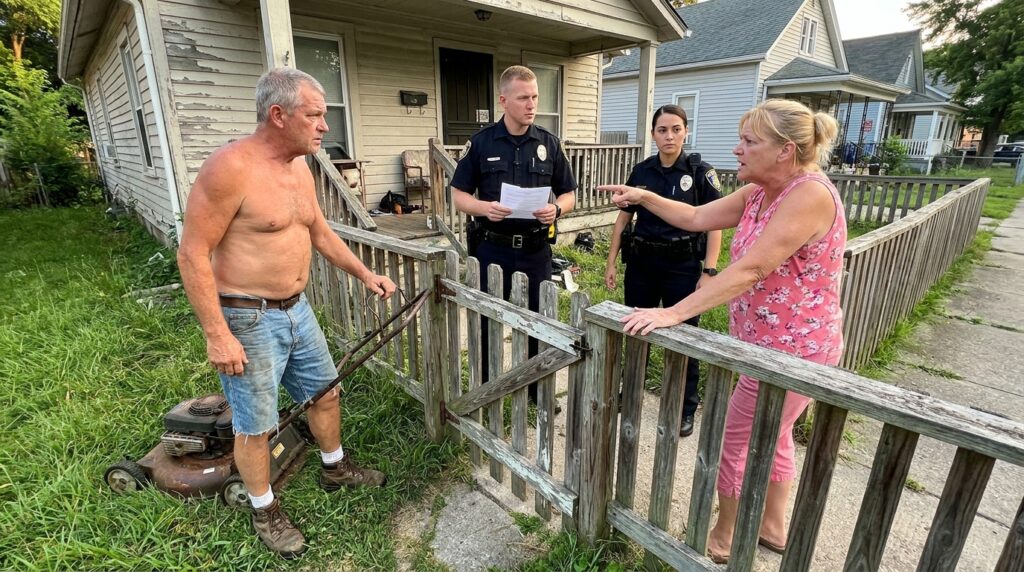
Miller stopped at the edge of his porch, his work boots heavy in the weeds. He didn’t have his shirt on; the midday sun beat directly against his stocky, weathered torso, highlighting the pale, jagged scar across his ribs from an old shop accident. He reached down and checked the fuel tank. Bone dry. He leaned his weight against the mower’s rubberized handle, staring at the gray boundary fence. Two feet inside his father’s old stakes. He knew the iron pins were down there, swallowed by the soil, waiting for someone to dig them up.

He grabbed the red plastic jerrycan from the porch step. The gas inside sloshed with a heavy, chemical gurgle. As he unscrewed the cap, the smell of unleaded fuel cut through the humid scent of damp earth and coming rain. He poured it slow, watching the dark liquid fill the tank, his eyes never leaving the white-painted porch next door.

The screen door over there didn’t slam. It clicked. A sharp, deliberate sound that meant Brenda had been standing behind the mesh, waiting for the first sign of movement. She stepped onto her top mat, her blonde hair pulled back into a tight, severe knot, her bright pink floral top standing out against the white trim of her siding like a signal flare. In her left hand, she held a clipboard.

Miller didn’t look up, but he felt the shift in the air—the friction that had been building between their properties for six months. He tightened the gas cap until the plastic clicked twice, his forearms tensing as he gripped the black rubber pull-cord. He knew what was coming before her white capri pants even cleared the bottom step of her porch.


CHAPTER 2: THE APPROACHING CLIPBOARD

“You’re two inches over, Miller,” Brenda’s voice carried across the property line, dry and sharp as a dead branch snapping.

Miller didn’t drop the pull-cord. He kept his hand wrapped around the black rubber handle, the knots of his knuckles whitening against the grime from his morning shift. He felt the heat radiating from the brick foundation of his own porch, a low, oppressive weight that seemed to trap the humidity right against his bare chest. He didn’t turn his head to look at her yet. Instead, his boots shifted in the dry earth, feeling the hard, hidden ridge of the iron surveyor’s pin beneath his left heel. He had struck that pin three times last July, the blade of the old Briggs & Stratton screaming against the metal, leaving jagged nicks in the iron that never truly healed. It was his anchor.

“I’m cutting the weeds on my side of the cedar, Brenda,” Miller said. His voice was a low, guttural rasp, thick with the soot of the diesel yard. He didn’t raise it. In this neighborhood, shouting was a tactical error; it brought the neighbors to their windows, and once the audience arrived, the performance became policy.

“Your side of the cedar doesn’t include the easement, Miller. Check your deed. Or better yet, check the notice coming down from the county,” she said, her white capris rustling as she stopped exactly one inch from where the manicured rye met his choked dandelions.

She held the clipboard against her ribs like a piece of body armor. The aluminum frame was scratched, its corners oxidized into a dull, chalky gray from years of local committee meetings and code enforcement sweeps. Her thumb was hooked over the metal spring latch, holding down a stack of yellowing paper lined with handwritten columns—dates, times, descriptions of his lawn’s infractions, logged with the obsessive precision of a clerk who lived for the margin of error.

Miller finally looked at her, his eyes narrowing against the glare of the midday sun bouncing off her white vinyl siding. The perspective was all straight lines and hard angles on her side of the fence, but between them, the wood was rotting. The bottom rails of the cedar fence were soft, green with moss where the automatic sprinklers hit them every morning, the timber fiber expanding and crumbling under the constant, artificial moisture. It smelled of wet earth and slow decay.

“My father set these posts thirty years ago,” Miller said, his arm tightening as he gave the pull-cord a slow, testing tug. The engine gave a short, metallic cough, a puff of blue exhaust leaking from the rusted muffler, smelling of old oil and unburnt fuel. “He didn’t build on your dirt.”

“Your father was a drunk who didn’t know where his own line ended,” Brenda snapped back, her head tilting, her posture straightening into a rigid, vertical line. The pink floral pattern of her top seemed to vibrate against the desaturated background of Miller’s peeling gray siding. “He signed the variance in ninety-six. Two feet from the post line. It’s on the books, Miller. It’s been on the books since before they poured my garage slab.”

The mention of the ninety-six variance hit the dirt between them like a lead weight. Miller’s grip didn’t slip, but his mind calculated the risk. His father had been many things—tired, broken by the mill closure, prone to spending his Sundays with a bottle of bonded bourbon on the back steps—but he was meticulous about the land. He had worked thirty-two years to clear the mortgage on this patch of gray earth, and he wouldn’t have given away two inches of it for a neighbor’s convenience, let alone two feet.

Miller took a step forward, his heavy work boots dragging through the knee-high weeds. The friction of the dry stalks against his denim cutoffs made a dry, whispering sound. He stopped at the handle of the mower, his shadow falling across the weathered wooden gate.

“Let’s see the paper then,” Miller said, his voice flat, transactional.

Brenda didn’t lift the clip. Her fingers tightened on the edge of the board, the metal digging into her skin until her knuckles turned the color of lard. “I don’t have to show you anything. I showed the township inspector three weeks ago. That’s why your blight citation is sitting in the municipal queue right now. You think you can just let this place rot because you work the late shift? You’re dragging down the equity of every home on this block.”

She tapped her pen against the aluminum board—a sharp, rhythmic clack-clack-clack that sounded like an old typewriter ticking down a countdown.

Behind her, the street was dead silent. The heavy, sulfurous air before a storm had driven everyone else inside, their air conditioners humming a low, continuous drone behind screened windows. But Miller knew the blinds were twitching. He could feel the eyes from the colonial-style house across the asphalt, the neighbors watching to see if the blue-collar relic with the peeling paint would finally break under the pressure of Brenda’s filing cabinet discipline.

Miller didn’t break. He leaned down, his weathered forearms straining as he grabbed the starter grip again. He didn’t look at her face; he looked at the base of her fence where the cedar met the soil. There was a discrepancy there—a small, four-inch gap where her concrete landscape edging curved slightly too far to the west, encroaching around the root of an old stump he’d been meaning to grind down for five years. A tiny detail, a micro-mystery in the dirt, but to a man who measured clearances in thousandths of an inch on diesel blocks, it looked like a structural lie.

“The county stakes are still down there, Brenda,” Miller said softly, his thumb pointing toward the weeds near the gate hinge. “They don’t move for clipboards.”

“We’ll see what the township says when they get here,” Brenda said, her voice dropping into a cold, triumphant register. She reached into her capri pocket and pulled out a small, black cell phone, her thumb already hovering over the keypad. “I told them you were operating unpermitted machinery within the disputed easement and creating a public hazard. They’re already on the route.”

Miller stood his ground, the heat of the idle engine rising between them, the first heavy drop of rain hitting the rusted top of his fuel tank with a sharp ping. He didn’t pull the cord yet. He waited, his boots planted over the iron pin, listening for the distant, high-frequency whine of a municipal siren cutting through the humid air.

CHAPTER 3: THE CODE ON THE PEELING DOOR

The paper didn’t flap in the dead air; it clung to the cedar siding like a wet leaf. It was printed on heavy, neon-orange cardstock that had already curled at the corners from the midday humidity, the adhesive tape leaving a sticky, gray residue against the blistered primer of Miller’s front door.

Miller didn’t use the copper key to open the door. He stood on the top step of his porch, his work boots grinding a fine layer of grit into the soft, sun-rotted pine boards. His thumb caught the edge of the orange card, ripping it free with a dry, fibrous tear. The bold black ink at the top read: MUNICIPAL CITATION: IMMEDIATE COMPLIANCE REQUIRED. Beneath that, typed out on an old dot-matrix printer that left faint, horizontal lines through the lettering, was the specific infraction: Section 412-B – Blight, Unauthorized Boundary Degradation, and Intentional Impediment of Public Right-of-Way.

He turned the card over. On the back, written in a cramped, left-leaning script that he recognized instantly from three decades of neighborhood association letters, was a handwritten calculation of the daily accrual fines. Brenda hadn’t just filed a complaint; she had calculated his financial exhaustion down to the penny. The fine doubled every forty-eight hours the “impediment” remained active.

Miller leaned his forehead against the door frame, the heat from the wood transferring directly to his skull. The smell of old iron and dry rot was thick here, right where the porch roof sagged three inches to the south. Through the screened window of his kitchen, he could hear the old compressor of his refrigerator kicking on with a low, metallic thud, rattling the copper lines behind the coils. It was the only sound on the block.

He walked back down the steps, the orange card folded twice and stuffed into the pocket of his denim cutoffs. He didn’t look toward Brenda’s house, but he could see her through his peripheral vision. She was still on her porch, her back straight as an iron surveyor’s rod, her fingers running along the hand-scratched notch in her aluminum railing. He’d seen that mark before—a small, V-shaped groove cut into the metal with a file, exactly aligned with the corner of her garage slab. It was a home-brewed baseline, an unofficial marker she used to justify the two feet she claimed was hers.

The grit under his boots felt thicker as he approached the mower again. He reached down and picked up an old, greasy rag from the deck of the machine, wiping the sweat and diesel carbon from his forearms. His mind was adjusting the numbers. The township office opened at seven tomorrow morning. He’d have to skip the early shift at the yard, lose four hours of flat-rate time, just to sit in a basement office waiting for a clerk named Arlene to pull a microfilm reel that might not even be in the cabinet anymore.

“You find it?” Brenda called out from her shade. She hadn’t moved an inch. Her voice had the thin, brassy ring of a cheap school bell. “The inspector doesn’t wait for independent contractors, Miller. The fine started running at midnight.”

Miller tucked the rag under the mower’s rubber handle. He didn’t answer. He didn’t give her the satisfaction of a verbal receipt. Instead, he knelt in the tall weeds near the fence line, his bare knees sinking into the damp, coarse crabgrass. The soil here was different from the rest of the lot; it was packed hard, gray with lime runoff from the concrete footer Brenda’s husband had poured for their garage back in the nineties.

He dug his fingers into the dirt near the corner post, scraping away the matted layer of dead thatch until his fingernails hit something unyielding and cold. It wasn’t the surveyor’s pin. It was a chunk of broken slag, a piece of industrial refuse used as backfill when the subdivision was graded after the war. But right beneath it, buried four inches deeper than it should have been, was the rusted edge of an old iron pipe—the original marker his father had driven into the earth with a five-pound sledge when the lot was split.

He cleared the dirt around the pipe’s rim. It was choked with rust, the orange flakes coming away in his palm like coarse cornmeal. When he looked up from the ground, tracing the line from that buried pipe to the corner of Brenda’s garage, the math didn’t work. The garage didn’t just line up with the fence; the concrete footer bulged out, its gray, rough-textured lip extending past the cedar posts, biting into his dirt like a tooth.

The wind shifted then, a cold gust from the west that brought the smell of ozone and wet asphalt from the interstate. The sky behind Brenda’s roof was turning the color of a bruised plum, the heavy, dark underbelly of the storm cloud rolling in fast over the tree line. Miller stood up, wiping his muddy hands on his shorts. He could feel the pressure dropping in his ears, a low, tightening ache that matched the knot between his shoulder blades.

He knew what Brenda was doing. The orange notice wasn’t about the weeds; it was an eviction by documentation. If he didn’t contest the citation within seventy-two hours, the municipal court would treat the boundary line listed on the complaint as an uncontested legal reality. She was using the township’s bureaucratic inertia to move the line without ever having to pay for a licensed crew to swing a transit.

He reached down for the starter cord again, his fingers locking around the rubber handle with a deliberate, slow pressure. His forearms tensed, the veins rising under the grease-stained skin. He wasn’t going to wait for seven o’clock tomorrow morning. He was going to cut this strip today, right up to the rotting cedar, and let the township cops see the dirt for themselves when they arrived.

CHAPTER 4: THE SPARK AND THE BARRIER

The black braided rope bit into Miller’s palm, dry and frayed where it rubbed against the aluminum edge of the pulley housing. He threw his weight backward, his work boots locking against the hard gray clay at the base of the fence line. The starter mechanism resisted with a heavy, internal metallic clack, the piston fighting the cold compression before the flywheel caught.

With a sharp, concussive snap, the engine fired. A dense plume of blue-gray exhaust erupted from the rusted muffler box, blanketing the overgrown dandelion heads in a chemical haze that smelled of scorched castor oil and stale unleaded fuel. The entire frame of the old red mower began to vibrate, a rhythmic, violent shaking that rattled the loose mounting bolts on the protective steel deck. The sound was an unvarnished roar, cutting through the thick, pre-storm stillness of the residential block like an iron saw.

Miller gripped the rubberized handle, his forearms absorbing the high-frequency vibration until his old joint aches flared. He didn’t look up to see Brenda’s reaction to the noise. He set his eyes on the narrow two-foot lane of choked crabgrass running alongside the gray wooden posts. He pushed the machine forward, the heavy steel blade underneath spinning up to speed, producing a wet, high-velocity thud as it sliced through the first thick cluster of wild mustard stalks.

A sharp spray of green pulp and old dirt sprayed out from the side chute, pattering against the lower cedar rails of the fence.

Before the wheels could clear the third post, a shadow broke the grey light over the handle. Brenda had descended from her porch, her pink capri pants flashing through the exhaust smoke as she stepped directly onto the narrow dirt path ahead of the machine. She didn’t drop her phone. She stood with her feet planted apart, her white sandals sinking into the very weeds Miller was attempting to clear. She didn’t scream—the roar of the Briggs & Stratton would have swallowed it anyway—but she slammed her open palm down onto the top rail of the cedar fence. The old wood groaned under the impact, a hairline fracture expanding down the length of the dry-rotted gray timber.

Miller clamped his hands onto the dead-man brake lever, pulling it tight against the handle. The engine sputtered, choked on a mouthful of wet grass, and died with a heavy, smoking hiss. The sudden silence that followed was heavy, punctuated only by the rhythmic ticking of the cooling cast-iron engine block.

“I told you to stop crossing my fence line like you own this yard,” Brenda said. Her voice wasn’t loud, but it possessed a thin, serrated edge that carried straight across the lot. Her face had flushed to a dark, mottled red under her tight blonde knot, her pointing finger coming within inches of Miller’s bare, sweat-streaked chest.

“I’m on my dirt, Brenda,” Miller said. His voice was flat, containing the dead weight of a man who spent his life dealing with stubborn machinery. He didn’t back his boots out of the tall grass. He leaned slightly forward, using his stocky bulk to crowd the handle of the idle mower. “Look down at the post base. The wood is set back four inches from the original pipe. If I don’t clear these dandelions, the county fines me for the overgrowth anyway. You can’t have it both ways.”

“The county isn’t going to fine you for this strip because this strip belongs to the estate of my husband,” she said, her fingers tightening around the aluminum clipboard until the papers crinkled. “The ninety-six filing gave us the maintenance easement. Your father took three thousand dollars in cash to sign that document, Miller. It’s registered in the municipal hall. You’re trespassing on land that was paid for before you ever crawled back from the shipyards.”

Miller looked down at her fingers, then at the scratched notch on her porch railing visible over her shoulder. The mention of three thousand dollars didn’t track with the reality of ninety-six. That was the year the foundry shut down its secondary line; his father had been desperate, yes, but he’d spent that entire winter fighting the city over a water-line assessment to keep from losing the deed entirely. If there had been three grand in cash, the taxes wouldn’t have gone into arrears.

He noticed a smear of old, black grease on the corner of the topmost yellow sheet on her clipboard—a smudge that matched the heavy, specialized industrial lubricant used on the timber company’s old milling equipment where Brenda’s husband had worked before his heart gave out. It wasn’t the clean, purple ink of a county recorder’s stamp. It was an old stain, preserved under the plastic clip.

“My father didn’t sign away the dirt under my feet,” Miller said, his teeth clicking together as he spoke. He reached out, his grease-blackened thumb pointing directly at the base of her garage foundation where the rough, unchamfered concrete lip bulged past the cedar post line. “And if he did, he didn’t give your husband permission to pour six inches of structural footer over the line either. That concrete is sitting on my deed, Brenda. Look at the angle.”

“The angle is exactly what the township approved,” she said, her chest rising as she took a sharp, shallow breath. She lifted the small black phone in her palm, pointing it toward the street as a low, dual-tone siren began to echo from the cross-street three blocks over. “That’s the code car now. We’ll see how long you stay on this side of the wood when the marshal reads you the injunction.”

The first fat drops of rain began to hit the dry earth, kicking up tiny puffs of gray dust from the bare patches along the fence line. Miller didn’t move toward his porch. He stood by the red deck of his machine, his boots steady over the buried iron pipe, watching the white nose of a municipal police cruiser round the corner of the avenue, its roof lights casting long, blue reflections across the wet asphalt.

CHAPTER 5: THE BLUE FLINT SHADOWS

The wet gravel at the road’s edge didn’t splash so much as it chewed under the heavy, reinforced tires of the lead cruiser. The Ford sedan came to a stop with a low, hydraulic sigh, its front bumper overhang hanging inches above the weeds choking Miller’s drainage ditch. The roof lights didn’t spin; they toggled in a sharp, mechanical back-and-forth rhythm that sliced the grey afternoon light into alternating blocks of red and cold cobalt.

Miller kept his right boot planted squarely over the buried iron pipe. The rain was getting heavier now, the drops larger and colder, hitting his bare shoulders and tracking down through the black grease smudges from the diesel yard. He felt the cold moisture hit the hot, black housing of the Briggs & Stratton engine between him and Brenda, sending up a thin, almost invisible curl of steam that carried the sharp odor of scorched oil.

The door of the first car swung open, the rusted hinges giving a dry, short click before the mediating officer stepped out. He was in his early thirties, his dark blue uniform pressed with a rigid, institutional crispness that defied the midday soup of humidity. His leather duty belt creaked as he shifted his weight, his right hand resting naturally but loosely near the butt of his sidearm, not with aggression, but with the practiced caution of a man entering a known flashpoint. Behind him, from the second vehicle, the supporting officer emerged—younger, her eyes tracking the perimeter, her boots making a slow, deliberate scrape against the cracked asphalt as she stepped into the interaction lane.

“Slow down,” the mediating officer said, his voice dropping into the space between the properties like a lead block. He didn’t look at Brenda’s clipboard, and he didn’t look at Miller’s bare chest. His eyes were fixed on the line where the two lawns failed to meet. “One story at a time.”

“He’s running that unpermitted commercial salvage equipment inside my registered easement line,” Brenda said instantly, her sandals sliding slightly in the grass as she took half a step toward the car door. She held the aluminum clipboard out, the sharp corner pointing directly toward the mediating officer’s chest like an extension of her authority. “The township clerk has the blight file active, officer. I have the reference numbers logged right here.”

The officer didn’t take the clipboard. He stood by the front fender of his car, his cap brim catching the first heavy run of rain before it could hit his eyes. He reached into his pocket and pulled out a small, heavy black leather folder—not a ticket book, but a standard city-issue records pouch containing a folded sheaf of white county plat maps. The paper was thick, waterproofed with a synthetic laminate that had turned a dull, ivory yellow along the creases from being kept under the dashboard clip.

“We aren’t here for a blight inspection, ma’am,” the mediating officer said. His voice was low, rhythmic, carrying the practiced flatness of a man who spent his afternoons listening to people argue over six inches of dirt. He turned his attention to Miller, his eyes taking in the weathered forearms, the grease under the fingernails, and the absolute lack of movement in Miller’s boots. “You Miller?”

“Yeah,” Miller said. He didn’t take his hand off the rubber brake handle of the mower. The cold metal of the frame was vibrating slightly as the rain hit the engine deck. “I’m just cutting the weeds on my side of the wood, officer. Like my father did for thirty years.”

“He’s crossing the ninety-six boundary,” Brenda interrupted, her spine tightening until her neck tendons showed taut against her collarbone. The pink floral pattern of her top was soaked through now, clinging to her skin in dark, irregular blotches that looked like grease spots. “My husband paid for that clearance. It’s on the plat.”

The mediating officer didn’t look at the handwritten notes on her board. He slowly unfolded the laminated map, the paper making a stiff, plastic snap as it flattened out against the hood of the cruiser. The rainwater began to pool on the ivory surface, highlighting the crisp, black surveyor lines that demarcated Section 4.

“The county assessor’s office updated the GIS registry at midnight, ma’am,” the officer said, his voice remaining level, almost conversational, but with an undercurrent of absolute finality. He didn’t look up from the map. He reached out with one gloved index finger, pointing down through the rain toward the gray clay at the base of the gate hinge where Miller’s boot was set. “Show me exactly where you think the line is.”

Brenda froze, her pointing finger still suspended in the air between them. Her thumb slipped off the spring latch of the clipboard, and the top yellow sheet—the one with the heavy black grease smudge from the old timber mill logbook—bent double under the weight of three large raindrops.

Miller didn’t shift his weight. He looked at the officer’s finger, then down at the exposed rim of the iron pipe he had dug out with his bare fingers five minutes ago. The metal was dark, choked with layers of old iron scale that had been flaking off into the dirt since the late seventies. It didn’t look like an official marker to an outsider; it looked like a piece of junk buried in the weeds. But the officer wasn’t looking at the junk. He was looking at the coordinates printed along the margin of the county seal.

The supporting officer took two steps forward, her boots coming to a halt on the edge of Brenda’s manicured rye grass. She didn’t speak, but her hand moved down to her belt, her thumb hooking into the leather loop beside her flashlight holder as she watched Brenda’s volatile shoulder movements. The entire street had gone dark now, the pre-storm sky turning a deep, iron-filing grey that made the red and blue flashes from the roof lights look twice as bright against the wet siding of the houses.

“The line is the fence,” Brenda said, her voice rising an octave, the certainty in her posture starting to fray at the edges like old canvas. “The fence has been there since the garage was poured. You can’t just come out here with a computer map and change where the wood sits.”

“The wood doesn’t dictate the deed, ma’am,” the mediating officer said softly. He tapped the map one more time, then began to fold it back into the tight, tight rectangles of the leather case. “The dirt does.”

CHAPTER 6: THE FENCE LINE STAND

The wet cedar split with a wet, splintering crunch under Brenda’s descending hand. She didn’t drop her phone, but her open palm slapped the top rail so hard that a spray of collected rainwater trapped in the grain shot straight across the wood, speckling the old red paint of Miller’s idle lawnmower deck.

“Stop crossing my fence line like you own this yard!” she barked, her arm stiffening into a rigid lever. Her index finger stabbed through the humid air, the tip stopping inches from Miller’s wet chest. “It’s over, Miller. The town has the filing. This dirt is done.”

Miller didn’t flinch. His boots remained dug into the grey clay, his heel locking the rusted rim of the buried surveyor’s pipe beneath the matted crabgrass. The storm had finally opened up above them, the rain turning from heavy drops into a dense, vertical sheet that turned the peeling siding of his house into a dark, oil-slick grey. The smell of hot cast iron from the cooling engine block rose around his knees, thick and sulfurous, mixing with the sharp scent of torn wild mustard and wet earth.

“Slow down,” the mediating officer said, his voice cutting through the rhythmic thrum-thrum of the rain on the cruiser roofs. He stepped directly between them, his heavy leather duty belt creaking as he turned his shoulder to break their line of sight. He didn’t point his flashlight; the red and blue strobes behind him were already turning the falling water into a pulsing violet mist. “One story at a time.”

Before Brenda could switch her grip on the clipboard, the officer lowered his black folder, his gloved hand moving down with a slow, deliberate weight. He didn’t look at the handwritten log sheets she tried to thrust into his field of vision. He extended his index finger, pointing it straight down through the weeds at the exact junction where the rotten cedar post met the clay near the gate hinge.

“Show me exactly where the line is,” the officer commanded.

The dynamic shifted with the speed of a breaking belt on a lathe. The forced physical assessment pinned Brenda to the geography of the dirt, a space where her municipal code citations had no weight without a legal anchor. She took a short step back, her white sandals sliding on the slick rye grass of her own lawn, her clipboard dropping three inches as the rain began to turn the topmost yellow page into pulp.

“The line is right here,” Brenda said, her voice dropping its brassy ring, replaced by a tight, defensive hiss. She tapped her sandal against her concrete landscape edging—the curved, artificial border that Miller had noticed encroaching around the old tree stump. “My husband poured this edging according to the ninety-six variance. It’s been here for thirty years. You can’t just dig up the street and change it.”

Miller leaned his weight forward against the rubberized handlebar of his mower, his calloused hands gripping the steel frame until the vibration of his own pulse matched the low hum of the neighborhood’s air conditioners. “The edging curves four inches past your garage footer, Brenda,” he said, his voice dropping into the low register he used when a diesel block wouldn’t seat right. “Your husband didn’t follow the plat map. He followed the shade of the willow tree.”

“The ninety-six paperwork has his signature, Miller!” she screamed, her hand shaking as she rattled the aluminum board against her side. “Your father took the money. He signed the easement request for the garage clearance!”

The mediating officer didn’t look up from the base of the post. He adjusted the blue vinyl folder against his hip, his fingers flipping past the standard city-issue maps until he reached a historical land-grant supplement from the county tax assessor’s ledger. The paper was different from the others; it was a duplicate copy of a thirty-year-old municipal filing, but the seal at the bottom wasn’t the standard purple ink. It was a dull, raised brass stamp that had been pressed into the fiber so hard it had distorted the grain of the paper.

Miller’s eyes caught that seal through the grey slant of the rain. It was the old logging cooperative stamp—a defunct timber company logo that had been liquidated during the foundry closures of ninety-two. It wasn’t a county record mark. His father had never worked for the timber line, but Brenda’s husband had been their chief yard foreman until the gates were chained shut.

The supporting officer took half a step closer to Brenda, her watchful eyes fixing on the way Brenda’s thumb kept working the spring latch of the clipboard, her movements turning erratic, jagged. The street around them had gone entirely dark now, the neighbors on their porches visible only as pale silhouettes against their screen doors, watching the two blue-clad figures dictate the terms of the boundary.

“Ma’am,” the mediating officer said, his voice flat as a iron bar. “We pulled the certified GIS plat from the hall before we cleared the station. The ninety-six filing you’re talking about isn’t an easement. It’s a temporary construction allowance that expired in ninety-eight.”

He shifted his grip on the ledger, the wet paper making a thick, tearing sound against the plastic sleeve. He didn’t look at Brenda’s face as the color began to drain from her cheeks, leaving her skin the color of old tallow under her tight blonde knot. He kept his finger pointed at the mud by Miller’s boot.

“According to the county deed,” the officer said, “this weathered fence wasn’t built on the line. It was built two feet inside Mr. Miller’s property. If that garage concrete extends past the wood, you aren’t holding an easement, Brenda. You’re sitting on his land.”

Brenda’s phone slipped from her hand, landing with a soft, wet thud in the tall weeds at the base of the gate, the screen flickering twice through the gray mud before going dark.

CHAPTER 7: THE MAPS AND THE PLOT LINES

The lashing rain struck the flat plastic surface of the city’s blue vinyl folder with a steady, rhythmic patter, scattering small pools of greasy water across the crisp, monochrome lines of the GIS plot. The mediating officer didn’t raise his voice to fight the thunder rolling in from the west. He tilted the folder down, letting a miniature sheet of runoff slide off the edge and splash directly into the deep tire track left by his own squad car.

“Look right here, ma’am,” the officer said, his voice flat as an iron plate. His thumb, encased in thick, non-reflective black utility leather, traced a diagonal coordinates vector marked Lot 42-Subdivision B. “This isn’t an approximation. These coordinates are pinned to the county benchmark over on Federal Way. Your cedar post line is a full twenty-four inches to the west of the true line.”

Miller leaned his weight harder against the vibrating rubber grip of the idle Briggs & Stratton, his bare chest glistening with a mixture of cold rain and old grease. The perspective filter of the yard had changed; the manicured rye grass on Brenda’s side no longer looked like an achievement of suburban order, but rather an unpermitted advance across an unyielding line. Beneath his left work boot, the top rim of the old iron surveyor’s pipe felt cold and real through the thick leather sole.

Brenda didn’t look at the map. She held her aluminum clipboard tight against her floral top like a defensive shield, the wet yellow pages turning completely translucent as the downpour melted the ink columns she had spent months logging. Her mouth worked, but the sound that came out was thin, stripped of its previous administrative authority.

“That can’t be right,” she said, her sandal heel slipping slightly in the mud near her concrete border. “My husband… he had the survey done when the foundation company came out in ninety-six. He kept the records in the basement filing cabinet. There’s a signed easement from Miller’s father right there under the house deed.”

“Your husband kept a copy of an application, Brenda,” Miller said, his voice dropping into the low, rough vibration of a diesel block under load. He wiped a streak of muddy water from his forehead with the back of his calloused forearm. “My old man never signed the final clearance. He was in the county hospital that winter with his hip. If your husband had a signature, it didn’t come from a notary.”

The supporting officer stepped closer, her boots squelching in the water-logged crabgrass as she angled her body to watch the twitching fingers of Brenda’s left hand. The red and blue strobe lights from the two cruisers parked at the curb cut through the heavy grey gloom of the storm, painting the peeling siding of Miller’s house in violent, alternating pulses of crimson and dark cobalt.

The mediating officer pulled a second sheet from the waterproof sleeve—a faded, xeroxed copy of the original 1996 building permit log. At the bottom of the page, where the property owner’s validation signature should have been, there was only a small, hand-notched emblem stamp from the old timber cooperative that had dissolved during the shipyard layoffs. It wasn’t an official state seal; it was a private corporate marking, applied with an old ink pad that had left a heavy, greasy smudge across the grid lines.

“This is the document your husband submitted to the town board,” the officer said, tapping the grey paper with the edge of his folder. “The problem is, the board rejected this easement request three weeks after it was received because it lacked a certified plat signature from the primary deed holder. The garage was poured anyway, but the boundary line remained exactly where it was in 1954.”

Miller watched Brenda’s face. The tight blonde knot of her hair had completely unraveled under the downpour, the wet strands clinging to her temples like old cobwebs. The rigid posture that had dominated the fence line for months seemed to collapse inward, her shoulders dropping three inches as the weight of thirty years of administrative bluffing dissolved into the mud.

“He told me it was handled,” she whispered, her voice nearly swallowed by a sudden crack of thunder that rattled the tin roof of Miller’s lean-to. “He told me the two feet were ours.”

“The dirt doesn’t care what he told you, ma’am,” the mediating officer said, closing the folder with a sharp, heavy snap that sounded like a pistol shot in the small space between the houses. He turned his face toward the corner of the garage, where the rough, unchamfered concrete footer extended well past the rotten cedar posts. “We’re looking at a structural encroachment here. The town isn’t going to enforce a blight citation against Mr. Miller for clearing weeds on land that legally bears his name on the county tax rolls.”

Miller reached down, his fingers wrapping around the black rubber handle of the mower’s pull-cord. He didn’t pull it yet, but his arm tensed, his stocky frame silhouetted against the pulsing blue light of the squad cars. He looked at the edge of the garage foundation, noticing for the first time a notched iron tie-back bracket buried deep in the mud beneath the concrete lip—a hidden, industrial reinforcement that had been anchored into his father’s soil to keep the building from shifting into the swampy clay of the hollow. The decoy secret of the ninety-six easement was gone, but the physical reality of the concrete was still biting into his territory, an unyielding gray weight that couldn’t be cleared with a mower blade.

The supporting officer turned her gaze from Brenda to the street, ensuring the perimeter remained quiet as two more neighbors emerged onto their porches across the wet asphalt, their pale faces illuminated by the flashing lights as they watched the neighborhood enforcer lose her grip on the block.

CHAPTER 8: THE REVERSAL AND THE CIVIL FREEZE

“This isn’t a civil boundary dispute anymore, ma’am,” the supporting officer said, her voice dropping like a heavy iron cleat onto the wet grass.

She shifted her boots, the sand-grit on the edge of Brenda’s manicured lawn grinding under her soles. Her left hand remained flat against the heavy nylon constraint strap of her holster, her fingers perfectly still despite the torrential downpour that was now streaming off the stiff brim of her service cap. Her eyes didn’t leave Brenda’s white, twitching fingers, which were still trying to scrape the melting yellow pages off the aluminum clipboard.

“You called an emergency line to report an active, violent trespassing violation,” the supporting officer continued, the cold authority in her tone cutting through the thick hum of the rain. “You signed a sworn statement in the municipal queue alleging that the deed holder was intentionally destroying property within a registered city easement. But according to the county surveyor’s live GIS feed, there is no easement. There never was. You weaponized a municipal unit to enforce a fraudulent boundary claim.”

Brenda’s mouth opened, but only a dry, whistling breath came out. The bright pink floral pattern of her top was plastered completely flat against her chest, the colors running together under the heavy lash of the storm like grease paint. She looked from the supporting officer’s silver badge to the closed blue folder in the mediating officer’s hands, her baseline confidence completely dissolving into the grey clay beneath her sandals.

“My husband… he wouldn’t have lied to the bank,” she stammered, her heels sinking deeper into the soft mud near her concrete border. “He had the timber company stamp. He showed it to the foundation foreman before they mixed the truck loads.”

Miller didn’t move from his position behind the red mower deck. His bare skin was numb now, chilled by the raw wind coming off the hollow, but inside his chest, a hard, calculated pressure was building. He looked at the edge of Brenda’s garage footer—the rough, grey mass of concrete that bulged like an old scar into his dirt. His eyes fixed on the micro-mystery he’d spotted moments before: the notched iron tie-back bracket buried in the mud. It wasn’t just a bracket; it was an industrial structural tension rod, anchored deep under his own soil to hold her building’s entire weight against the slope of the hill.

The mediating officer stepped closer to the foundation lip, his leather duty boots sinking four inches into the churned earth. He knelt down, the wet fabric of his uniform trousers pressing directly into the gray lime sludge. He reached out with a heavy flashlight, the beam cutting through the grey rain to illuminate the rusted iron bracket where it entered the concrete.

“Miller,” the officer called out, his eyes never leaving the iron rod. “You know what this is?”

“It’s an industrial deadman anchor,” Miller said, his voice low and gritty as a shovelful of gravel. He stepped forward, his boots heavy in the weeds. “The timber mill used them to tie down the high-line cables in the sorting yard. Her husband must have dragged three of them out of the scrap pile when they closed the secondary line in ninety-two.”

The mediating officer nodded slowly, his fingers tracing the coarse, pitted surface of the exposed iron. “If these rods are anchored beneath your deeded soil to support a structural load next door, we aren’t just looking at an encroachment of the footer. We’re looking at a severe engineering violation of the municipal safety code.”

The officer stood up, wiping the grey mud from his gloves onto his thighs. He pulled a heavy, bright yellow plastic clamp from the rear pouch of his folder—a municipal structural freeze tag, its brass locking pin glinting through the rain.

“Ma’am,” the mediating officer said, turning his shoulder completely away from Brenda to face Miller. “The blight citation against you is dropped. But I’m executing an immediate civil freeze on both parcels under Section 504 of the structural safety act. Because this foundation is tied into your property without a notarized easement or a certified engineering sign-off, this entire boundary strip is now a quarantined hazard zone.”

The words hit Miller like a physical blow. The victory of defeating the blight citation vanished, replaced by the cold, heavy reality of a civil lockdown.

“What does the freeze mean for my lot?” Miller asked, his hands tightening on the mower handle until the old joint injuries in his fingers flared with sharp pain.

“It means nobody touches this dirt until a structural surveyor from the capital comes out to inspect the structural integrity of that garage wall,” the officer said, his face unreadable under the flashing blue lights. “You can’t dig, you can’t clear, and you can’t run this mower within ten feet of the post line. Until the court determines if that building has to be demolished or moved, your southern boundary is locked by the state.”

Brenda let out a short, high-pitched gasp, her clipboard finally slipping from her fingers and landing with a metallic clank against the wet concrete edging. The yellow papers disintegrated instantly in the pooling water, the handwritten logs of Miller’s lawn infractions turning into grey mush that washed down into the mud around the rusted iron anchor.

Miller stood in the freezing rain, the red and blue lights of the cruisers pulsing against his bare chest, his eyes fixed on the unyielding gray concrete of the garage. He had protected his line, but the price of the dirt was an expensive, locked-down nightmare that left him holding a useless machine in a yard he wasn’t allowed to clear.

CHAPTER 9: THE QUIET IN THE WEEDS

The heavy yellow quarantine ribbon went taut with a sharp, plastic twang as the supporting officer wrapped it twice around the rusted iron hinge of Miller’s front gate. The rain had settled into a dense, grey drizzle, casting a cold film over the entire street and turning the tall, uncut crabgrass along the property line into a sodden, dark green mattress.

Miller didn’t drop his hands from the rubberized grip of the lawnmower. He stood motionless, his bare chest slick with moisture, watching the blue and red strobe lights of the cruisers toggle back and forth across the blistered grey paint of his home. The perspective of the lane had narrowed to this single ribbon of plastic. Ten feet of exclusion zone. Ten feet where his boots weren’t supposed to tread, where his blade couldn’t turn, and where Brenda’s garage stood as an institutional anchor until the state attorneys sorted through thirty years of forged timber company stamps.

The mediating officer slid his vinyl folder under his arm, the heavy leather of his jacket squeaking as he turned toward the road. He didn’t look at Brenda. He didn’t look at the dissolved yellow pulp of her clipboard log sheets, which were currently washing down into the roadside ditch like grease-stained snow.

“The formal notice will hit your mailbox within forty-eight hours, Mr. Miller,” the officer said, his voice dropping into that rhythmic, low cadence common to men who worked the county clock. He reached into his pocket, his leather glove wet as he pulled out a yellow carbon copy of the quarantine order and pressed it against the damp steel deck of the mower. “Keep your machine out of the yellow. If the township structural crew sees a tire track inside the line before the engineering audit, the fine reverts back to your deed.”

“Understood,” Miller said. His voice was raw, containing the gritty exhaustion of a fourteen-hour shift followed by a fence-line blockade. He didn’t ask for clarification. He understood the math of the gray state. The bureaucratic engine didn’t move fast, and it didn’t move for free. He had saved his dirt from a fraudulent seizure, but the prize for his survival was a dead zone—a ten-foot strip of wilderness that would sit, rot, and gather seed until the county decided whose budget would cover the demolition of a concrete footer.

Behind the yellow ribbon, Brenda was a shadow against her own white siding. The tight blonde knot of her hair had completely collapsed, the wet strands hanging straight down her cheeks like rusted wire. Her bright pink floral top was dark, soaked through, the pattern looking less like a suburban uniform and more like a oil spill. She didn’t look at Miller. Her eyes were fixed on the mud near her foundation lip where the rusted industrial deadman rod stuck out like a broken rib.

“Brenda,” the supporting officer said, her hand gesturing toward the white porch steps next door. “Go inside. The civil marshals will handle the structural service tomorrow.”

Brenda didn’t reply. Her white sandals made a wet, heavy sucking sound in the lawn as she turned her back on the fence, her frame looking small, crooked, and tired as she ascended her pristine steps. The screen door clicked—that same deliberate, small sound—but there was no force behind it this time. The lock turned from the inside, a lonely sound that died instantly in the rain.

Miller waited until the two cruiser doors slammed shut. He stood in the weeds as the engines turned over, the heavy tires churning the grey gravel of the avenue as they pulled away from the curb. The red and blue reflections faded from his windows, leaving the street in the desaturated twilight of the storm. Across the asphalt, the blinds on the colonial-style houses stopped twitching. The audience was gone. The performance was over.

Slowly, deliberately, Miller unlocked his fingers from the mower handle. His joints flared with a dull, familiar ache, the skin of his palms red and lined from the coarse grip of the rubber. He reached down and grabbed the iron axle of the red machine, tilting it back on its rear wheels. He didn’t pull the starter cord again. He began to wheel the mower backward, away from the yellow tape, away from the rotten cedar rails, guiding it through the knee-high dandelions toward the corrugated metal lean-to behind his porch.

The rain hit the rusted tin roof of the shack with a loud, hollow rattle as he pushed the machine inside. The air smelled of wet canvas, stale gas, and the deep, silent iron of his father’s old tools hanging from the joists. He didn’t drop the canvas tarp over the deck yet. He stood by the door of the lean-to, his bare shoulder leaning against the damp cedar frame, looking out at the southern boundary.

The yellow ribbon flickered in the rising wind, a bright, unnatural line through the dark weeds. He had kept his lot. He had held the stake his father had driven into the gray clay thirty years ago with a five-pound sledge. But as the dark came down over the valley, bringing the heavy scent of wet coal smoke and ozone, Miller knew the friction wasn’t settled. The concrete next door was still resting on his deed, unyielding, heavy, and waiting for the first turn of the legal wheel. He wiped a mix of rain and grease from his chest, stepped inside his kitchen, and let the old wooden door click shut against the gray.

CHAPTER 10: THE BIT IN THE CORE

The scream of the diamond-tipped core drill didn’t start with a roar; it began with a high, metal-on-stone shriek that set the teeth of every dog on the avenue on edge before the sun had cleared the tree line.

Miller sat on his top porch step, an old porcelain mug of black coffee held between his calloused palms. He hadn’t put a shirt on yet. The morning air was cold, scrubbed clean by the midnight storm, but the dampness stayed in the wood of his porch, rising up through his denim cutoffs like a chill from an old cellar. Thirty feet away, parked squarely across the yellow quarantine ribbon, a white municipal flatbed truck shuddered under the torque of its hydraulic mast.

A state structural marshal in a safety-orange slicker stood by the levers, his boots caked in the gray slime of wet lime and concrete slurry. He didn’t look like a bureaucrat; he had the thick, short neck of an ironworker and eyes that stayed fixed on the water-line feeding the rotating bore matrix. As the bit sank three inches into the rough concrete lip of Brenda’s garage footer, a thick, milky paste began to bubble out of the hole, spilling over into Miller’s uncut dandelions.

“Keep it steady at four hundred RPMs, Cory!” the marshal shouted over the mechanical rattle of the auxiliary diesel engine.

Miller took a slow sip of the coffee, his throat tight against the bitter, lukewarm liquid. The noise was an environmental disruption that made his kitchen windows rattle in their zinc tracks, but he didn’t move to stop them. He couldn’t. The yellow tape was still there, now accompanied by steel stakes driven eighteen inches into his turf, marking the boundary of the state’s quarantine zone. He was an observer on his own deed, watching three weeks of flat-rate shipyard wages evaporate while the state spent five hundred dollars an hour to measure a dead man’s lie.

Across the line, Brenda’s house was dark, but the white curtains on her kitchen window were pulled back six inches. Her face wasn’t visible, just the pale silhouette of her tight blonde knot against the interior shadow. She hadn’t come out to greet the crew. Her aluminum clipboard was gone, likely rotting in the county dump, replaced by the four-part structural summons the marshal had stapled to her garage door at six-thirty AM.

The drill note changed suddenly, dropping from a high-pitched whistle to a low, structural grunt that shook the hard clay beneath Miller’s boots. The flatbed truck tipped two inches to the left as the bore bit struck something harder than aggregate—something unyielding and metallic buried deep within the core of the concrete.

“Hold it!” the marshal yelled, throwing his weight against the primary hydraulic valve. The rotating steel pipe stopped instantly, a cloud of black diesel smoke puffing from the truck’s stack as the engine idled down into a low, rhythmic thudding.

The marshal reached into the bore hole with a long pair of steel tongs, his wet orange sleeve glistening with gray grease. When he pulled the tongs back, he didn’t have a clean cylinder of concrete. Caught in the iron teeth of the tool was a jagged, three-inch chunk of rusted steel cable—a thick, braided line that had been severed by the diamond matrix. It wasn’t standard reinforcing rebar. The wire strands were coarse, heavy, and carried the distinct, flat-ribbed texture of industrial high-line cable used in the sorting yards before the timber mill went under.

“Miller,” the marshal called out, turning his muddy boots toward the porch steps. He held the severed steel piece up between his fingers like a bone from a ditch. “You said her husband used old shipyard scrap for backfill?”

“He used whatever he could drag behind his tractor after the ninety-two liquidation,” Miller said, his voice a low rasp that didn’t carry past the drainage ditch. He stood up, setting the coffee mug on the rotted pine railing. He walked down to the edge of the yellow tape, his boots stopping an inch from the plastic ribbon. “That’s high-line rope. It runs through the whole foundation slab, doesn’t it?”

“It’s not just running through it,” the marshal said, his thumb wiping away a layer of wet gray powder to reveal a hand-stamped serial number notched into the core anchor bracket beneath the concrete lip. “It’s under tension. If your father didn’t sign the clearance for these tie-backs, Miller, this isn’t just an encroachment. This whole hill is being held up by a illegal deadman system anchored right under your kitchen floor.”

Miller looked past the marshal’s shoulder to the dark window next door. The white curtain clicked shut, the shadow behind the mesh disappearing into the cold, silent interior of the house. He felt the weight of the dirt shift again, a low, tightening friction that meant the true foundation of the block was buried much deeper than Brenda’s old notes.

CHAPTER 11: THE LOGBOOK IN THE ASBESTOS DRY

The heat in the crawlspace didn’t rise; it pressed down from the raw zinc roofing nails like an iron plate left too long over a furnace. Miller hauled his bulk through the narrow square hatch in the hallway ceiling, his work boots dragging across the dusty, fiberglass-choked joists. The air up here was dead, parched of any moisture, smelling of forty years of dry cedar rot and the fine, grey silt of blown-in insulation that coated the back of his throat with a mineral grit.

He didn’t use a modern flashlight. He carried an old shop trouble-light on an orange extension cord, its wire cage scraping against the exposed rafters as he hitched it over a rough-sawn crossbeam. The yellow bulb cast long, jagged shadows into the low eaves, illuminating decades of discarded machinery parts—rusted circular saw blades, iron pipe fittings, and the flaking green metal chassis of an old craftsman compressor his father had refused to scrap.

Miller dropped to his knees, the raw wood of the joists biting through his denim cutoffs. His hands, still stained black around the cuticles from the diesel yard, reached for a long wooden spirit level tucked between the center rafters. The level was heavy, its brass edges green with verdigris. He turned it over, his thumb pressing against the small, hollowed-out compartment behind the center glass vial.

With a dry click, the wood lid slid free. Inside lay a single, flat steel key, its bow stamped with the initials of the old municipal foundry that had closed before the shipyard line went cold.

He took the key and crawled toward the deepest recess of the roofline, where the rafters met the southern plate directly above his kitchen. Tucked behind a roll of degrading tar paper sat a heavy machinist’s chest. The iron handles were pitted with a coarse, red rust that left flaky stains on his palms as he dragged the box into the yellow light. The padlock resisted, the internal tumblers choked with thirty years of parched dust, but Miller twisted the steel key until the iron latch snapped open with a sound like a dry bone breaking.

Inside lay his father’s true ledger—not the clean, typed sheets Brenda had brandished on her aluminum board, but a heavy, canvas-bound logbook with a zinc spine.

Miller opened the book on his knees, the yellowed pages crackling under his fingers like dry leaves. The scent of old carbon paper and dried machine oil rose from the fibers. The entries were written in his father’s heavy, blocky grease-pencil script, each line cataloging every gallon of diesel fuel, every pound of welding rod, and every dollar that entered the house between the mill shutdown and the winter of ninety-six.

He flipped the pages back to November of 1994, the exact month Brenda’s husband had broken ground on the garage foundation next door.

His eyes stopped on a underlined entry dated November 14th: Loan to H. Vance. $3,000.00 cash. No bank paper. Timber yard scrap line held as collateral until spring. Harlan says the garage slab is sliding into the hollow drainage ditch.

Miller’s fingers froze on the coarse grain of the paper. The three thousand dollars Brenda had claimed was a property variance payout wasn’t a purchase at all. It was an emergency cash loan from his father to keep Harlan Vance’s foundation from slipping down the grade before the concrete could cure. His father hadn’t sold the two feet of dirt; he had financed the very structure that was now encroaching on his deed, using salvaged industrial scrap from the liquidated timber mill to anchor the retaining wall.

But as Miller read down to the bottom of the page, the true weight of the entry hit him like an uncoupled trailer.

Harlan ran the high-line cables sixty feet deep into our center lot. Anchored three deadman rods directly under our main kitchen foundation pier to catch the drift. If he doesn’t repay by ninety-six, the iron stays in the dirt.

The carbon paper smeared under Miller’s thumb as his grip tightened. The devastating reality of the marshal’s civil freeze materialized in the dry attic air. The illegal deadman anchors weren’t just touching his property line; they were structurally integrated into the very foundation piers holding up his own house. Harlan Vance hadn’t just built over the line; he had woven the structural survival of his garage into the skeleton of Miller’s home.

If the state structural marshal executed a forced demolition of Brenda’s garage footer, or if they yanked those high-line cables out of the gray clay to clear the encroachment, the southern foundation of Miller’s own kitchen would collapse into the hollow drainage ditch. The state’s quarantine wasn’t just a legal nuisance; it was a physical trap. The decoy secret of the variance had hidden a structural parasite that made Miller legally and physically liable for the destruction of his own property.

Miller looked down through the joists, his gaze penetrating the plaster ceiling toward the kitchen below. He could hear the low, distant clack-clack-clack of the municipal flatbed truck out on the asphalt, the auxiliary diesel idling as the crew prepared the secondary core drills for the morning inspection.

He closed the canvas ledger, the zinc spine scraping against the iron edge of the machinist’s box with a dry, metallic screech. He had won the battle at the fence line, but the unvarnished truth buried in his father’s logbook meant that doing the right thing—clearing the line and enforcing his deed—would bring his own roof down into the mud.

He gripped the steel box handle, his forearms tensing as he prepared to descend back into the humid light of the kitchen, his mind already calculating the cost of the next move against a neighbor who was just as trapped by the past as he was.

CHAPTER 12: THE CONCESSION AT THE YELLOW TAPE

“The county order came down an hour ago, Miller,” Brenda said.

Her voice didn’t have the thin, brassy scrape of her old committee meetings. It was flat, wet, and small, carrying over the rotting cedar rails like the sound of dry grass brushing against a boot. She stood three inches from the bright yellow plastic ribbon, her hands buried deep in the pockets of a oversized, faded oilskin jacket that had belonged to her husband. The blonde knot at the back of her head had completely unraveled, the graying strands plastered across her temples by the constant, needle-sharp drizzle.

Miller stepped off his lower porch stair, his heavy leather work boots sinking into the waterlogged clay of his path. He was holding his father’s zinc-spined logbook under his arm, wrapped tightly in a greasy piece of shop tarp to protect the parched paper from the damp air. The perspective between their properties had completely desaturated; the manicured green perfection of her yard was now split by the jagged grey trenches where the marshal’s core drills had bitten into the soil, leaving puddles of thick, white lime slurry that looked like curdled milk.

“The marshals don’t work on sentiment, Brenda,” Miller said, his voice dropping into the low, rough vibration of a cold diesel chassis. He stopped three feet from her, his stocky frame casting a wide shadow over the plastic boundary line. “They found the high-line cable under the footer. They know what Harlan did.”

“They’re giving me twenty-one days,” she whispered. Her fingers twitched inside the oilskin pockets, causing the heavy fabric to rustle with a dry, metallic crinkle. “Twenty-one days to file an engineering variance or they bring the county excavator out to yank the retaining cables. If they pull those lines, Miller… the back wall of my garage drops straight into the hollow drainage ditch.”

“If they pull those lines,” Miller said, his teeth clicking together as a cold gust of wind came up from the culvert, “the southern pier of my kitchen goes down with it. Harlan didn’t just steal two feet of my yard, Brenda. He tied the weight of your building into the skeleton of my house.”

Brenda looked down at the mud between them. Her sandal toe dragged a small, slow crescent into the gray clay, exposing the rusted edge of the old iron pipe Miller had cleared yesterday. The metal was bleeding orange oxidation into the silt, a slow, continuous leak of iron scale that had been hidden since ninety-four.

“I didn’t know about the cables,” she said, her voice dropping until it was nearly lost beneath the low, distant hum of the morning traffic on the avenue. “Harlan… he told me he bought the clearance with cash. He told me your old man needed the money for the hospital bills after the foundry shut down its secondary line. I have the ledger entries in the house, Miller. Hand-written. Every dollar.”

“He didn’t buy the land, Brenda. He took a cash loan from my old man to keep his foundation from sliding before the concrete could set,” Miller said, his thumb pressing into the grease-stained tarp wrapping the canvas book. “The timber company stamp he used on the variance request was a forge. He used his foreman’s seal because the county clerk wouldn’t clear a structural tie-back without a licensed engineer’s signature. Your whole estate is built on a thirty-year bluff.”

Brenda’s shoulders dropped, the heavy oilskin jacket shifting against her neck with a stiff, coarse rasp. She reached into her right pocket and pulled her hand out slow. She wasn’t holding a clipboard or a phone. Her fingers were wrapped around an old, heavy pair of red-handled wire-cutters—the heavy industrial shears Harlan had stolen from the mill’s maintenance locker before the gates were chained.

“If we cut the line where it enters the concrete lip,” she said, her hand trembling as she pointed the rusted nose of the tool toward the muddy gap beneath her garage footer, “if we clear the anchors ourselves before the county crew comes back tomorrow… we can tell the inspector the lines were abandoned. We can say the foundation settled on its own.”

Miller looked from the red handles of the shears to the deep, jagged hole where the marshal’s drill had severed the first braided wire strand. The raw engineering fact of the tension was unyielding. The cables were under thousands of pounds of structural load; if someone took a pair of hand-shears to those iron tendons under the mud, the stored kinetic energy would snap the braid with the force of an uncoupled winch line, ripping through the clay, the yellow tape, and whatever flesh was standing within ten feet of the post line.

Worse, the sudden release would cause the gray clay beneath his kitchen pier to shift instantly, dropping his floorboards three inches into the draft before the sun could set. Her compromise wasn’t a solution; it was a desperate, uncalculated failure that would destroy both titles to save her from a fraud charge.

“Put the iron back in your pocket, Brenda,” Miller said softly, his voice flat as a steel rule. He didn’t reach across the yellow ribbon to take the tool. He stood steady over his father’s buried pipe, his eyes fixing on the pale, hollow look in her eyes. “The state has the serial numbers from the core sample. You can’t cut your way out of a municipal deed map. Tomorrow morning, when the civil marshals return with the secondary rig, we show them the logbook. We show them the loan entry from ninety-four.”

“They’ll condemn the garage anyway, Miller,” she said, the first real tear tracking through the gray silt on her cheek.

“They’ll condemn the wall,” Miller corrected, his arm tensing as he turned back toward his porch. “But they won’t pull the cables until they underpin my kitchen. We play the clock now, Brenda. No more clipboards. No more hand-cutters. We let the town pay for the concrete your husband didn’t buy.”

He turned his back on the ribbon, his boots heavy as he carried the wrapped ledger back toward his kitchen door, leaving her standing alone in the grey pre-dawn rain with the red-handled shears heavy in her hand.

Similar Posts

Leave a Reply

Your email address will not be published. Required fields are marked *