
The Logistics of Mercy: A Novel of Unyielding Boundaries and the Weight of Enduring Care

CHAPTER 1: THE DUSTY GRIDS OF ORDER

The heat in the garage smelled of iron filings, dry pine needles, and the static electricity hum of the small portable oxygen concentrator vibrating against the workbench. Arthur Cole pulled the strap of his faded navy cap lower, his calloused thumb smoothing down the corner of an entry in his ledger. The grid lines were narrow, hand-drawn in blue ink that had started to turn gray over the years. Forty years of freight manifests had taught him that anything unaccounted for eventually turned into a liability.

Beside him, sitting in the passenger seat of the station wagon with her door open to the stagnant air, Clara was twisting the hem of her cotton skirt. Her fingers moved with a rhythmic, frantic precision, folding the fabric into tiny triangles, then smoothing them out, then folding them again.

“The truck leaves at twelve, Arthur,” she said, her voice thin, clear, and unmoored from the present. She looked past the grease-stained drywall toward a horizon only she could see. “The manifests aren’t signed.”

“Manifests are done, Clara,” Arthur said softly. He didn’t break his posture. His back remained straight, a habit from the loading docks that kept the spine from collapsing under dead weight. He reached into the footwell, checking the brass fittings on the backup regulator. The metal was cold, oxidized to a desaturated green around the threading. “Everything’s locked in. We’re on schedule.”

He checked his watch—a heavy, scratched stainless-steel piece with a canvas band that smelled of salt sweat and old diesel. 11:38 AM. The transit from their small brick ranch just outside the city limits to the Oakridge Medical Pavilion took exactly twenty-two minutes if the freight lanes near the interstate stayed clear. He had calculated the margin down to the hundredth yard. If they arrived at the clinic doorway at 12:00 PM, the curb would be clear for the shift change, and the glare from the midday sun wouldn’t hit Clara’s side of the glass directly.

He stepped to the passenger side, his work boots leaving faint, dusty prints on the concrete floor. The air was heavy, thick with the scent of unwashed asphalt from the driveway outside. When he reached down to tuck the thin plastic cannula behind her ears, her skin felt like dry parchment, cool despite the creeping temperature of the garage.

“Arthur,” she whispered, her eyes suddenly clearing, focusing on the small scar right above his left eyebrow. “The noise. Is it coming back?”

“No,” he said, adjusting the dial until the machine clicked into its steady, soft puffing rhythm. “The wall is up. Nobody’s getting through today.”

He closed her door, the latch engaging with a heavy, unyielding thud that belonged to an era when steel was still thick enough to resist a dent. He walked to the driver’s side, his hand brushing the hood—the dark blue paint was faded, desaturated by years of Southern sun until it looked like the color of wet slate.

When he climbed into the cabin, the steering wheel was warm, the worn leather rough against his palms. He plugged the tablet into the dashboard mount, its screen flickering to life with a bright green QR code—the digital manifest approved by the pavilion’s regional director. Behind the rearview mirror, the dual-lens commercial dashcam blinked its single blue light, recording the interior, the dashboard, and the gravel road leading out to the highway.

Arthur turned the key. The engine caught with a low, mechanical rattle, a predictable sequence of valves and pistons that he understood better than the shifting architecture of his own life. He shifted into reverse, his eyes scanning the mirrors, locking onto the small, rusted mailbox at the edge of the property line.

“Twelve minutes to the gate,” he murmured into the quiet of the car, his eyes tracking the dusty road ahead. “We’re on time.”


CHAPTER 2: THE IMMOVABLE OBJECT

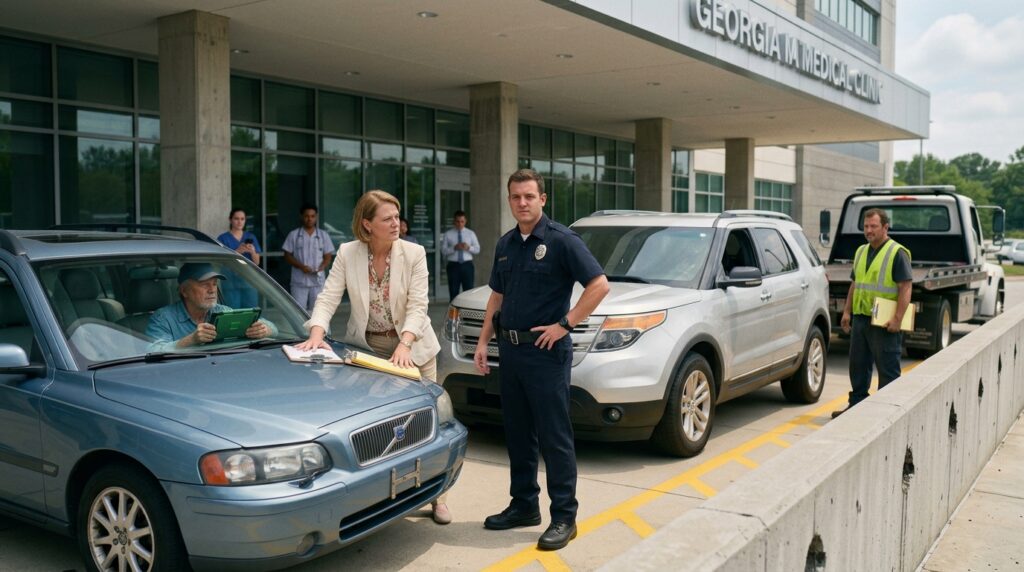
The heat radiating off the white concrete courtyard of the Oakridge Medical Pavilion did not just rise; it pressed against the chassis of the wagon like a physical weight. Arthur kept his eyes flat, tracking the reflection of the midday glare in the side-view mirror. Behind him, the dual-lens commercial dashcam hummed, a microscopic vibration against the windshield glass. Through the rolled-down gap in his window, the air tasted of scorched rubber and the sharp, chemical tang of industrial floor sanitizer venting from the basement grates.

“This is an active transit artery, not a storage yard for dead steel,” Victoria Davenport said. The heel of her designer pump came down on the asphalt with a dry, sharp crack. She didn’t look at Arthur; her sunglasses—wide, dark, and mirrored—were pointed directly at the faded blue paint of his hood. “Your nine minutes expired two ticks ago, Mr. Cole. The council has specific parameters for the courtyard lane. Visual clutter doesn’t survive the noon sweep.”

Arthur didn’t shift his hands on the wheel. The leather was split near the thumb, showing the gray foam beneath, dry and rough against his palms. “The manifest from the clinic director has us logged until 12:15, ma’am. The loading zone remains active until the passenger is secure. I’m currently at seven minutes and forty seconds.”

“The clinic doesn’t own the curb,” Victoria replied. She lifted her leather clipboard, her thumb pressing down on a thick sheet of heavy-stock paper that bore an embossed silver seal at the header. She didn’t hand it over; she simply held it at an angle where the glare obscured the text. “The District Beautification Council took over transit enforcement for the entire perimeter as of last Thursday. This corridor is restricted to commercial luxury shuttles and authorized VIP vendors. Your clinic slip is white noise.”

Arthur watched the edge of the paper. His forty years in freight logistics had trained his eye to spot the micro-discrepancies that normal drivers missed—the slight misalignment of the corporate stamps, the lack of a municipal county clerk filing number at the footer, the way the purple ink of the signature lacked the faint bleeding common to official county authorizations. It looked like an internal memo dressed up to look like an enforcement code. A proxy barrier meant to look like law.

Beside him, Clara’s fingers began to claw at the vinyl armrest. The rhythmic click-scrape of her nails against the grain was getting faster. Her breathing had gone shallow, a tiny, whistling rattle in the back of her throat that Arthur knew signaled the transition from disorientation to blind, unmanageable panic.

“Arthur,” she whispered, her head jerking toward the massive, pearl-white bumper of the SUV parked diagonally inches from their grille. “The gate’s down. They locked the yard. We’re going to be late for the counting.”

“The gate isn’t down, Clara,” Arthur said, his voice dropping into the flat, unhurried cadence he used when a shipping line collapsed at midnight. He kept his left hand on the wheel and slid his right across the bench seat, letting his palm rest flat over her trembling knuckles. The heat of her skin was brittle. “We’re just waiting for the clerk to clear the receipt. Keep your eyes on the ledger.”

He reached down with his left hand, popping the latch on the center console. Inside, the cracked screen of his old logistics tablet glowed with the bright green matrix of the state-issued QR medical transport code. It was tied directly to the state’s healthcare accessibility infrastructure, an unyielding layer of civic protection that no private merchant association could legally override.

Outside, Victoria had already turned her back, her phone raised to her ear. Her voice carried across the concrete, sharp and transactional. “Marcus? Get the cart down here now. We have an unpermitted wagon stalling the VIP lane for the boutique opening. And call Pete’s flatbed. Tell him I want this junk off the property before the regional investors pull off the expressway.”

Arthur didn’t climb out of the car. To leave the cabin was to cede the territory, to transform an active loading operation into a stationary dispute. He watched the private campus security cart rumble around the corner, its small plastic tires squealing on the sun-baked surface. Officer Marcus Vance climbed down, his uniform trousers stiff with cheap starch, his radio spitting out a burst of low-frequency static that made Clara flinch.

“Problem here, Mrs. Davenport?” Vance asked, his eyes immediately drifting to the silver seal on Victoria’s clipboard before settling on Arthur’s faded denim shirt.

“An unauthorized obstruction, Officer,” Victoria said, her manicured finger pointing toward Arthur’s windshield. “He’s been cited on the council log. He refuses to clear the transit lane for our priority guests. I want him moved to the commercial overflow deck immediately.”

Vance stepped up to Arthur’s door, his hand resting instinctively near the heavy utility belt at his waist. “Sir, you heard her. You’re blocking the aesthetic flow of the grand opening. I’m going to need you to put the vehicle in reverse and clear the courtyard.”

Arthur didn’t reach for the key. He picked up his tablet, the green light reflecting off his gray eyes as he turned the screen toward the officer’s face.

“Officer Vance,” Arthur said, his voice entirely devoid of anger, flat as an iron rail. “This unit is operating under an active federal healthcare accessibility contract, route designation 40-Alpha. If you order this vehicle to move before the medical manifest expires at 12:15, you are interfering with a federally protected transit operation on a designated clinical access route. That’s a minimum five-thousand-dollar compliance citation against the campus, and the dashcam behind my mirror has been streaming your badge number and Mrs. Davenport’s clipboard to the clinic’s risk management server for the last four minutes.”

Vance froze. His eyes dropped from the tablet screen to the tiny, unblinking blue indicator light hidden in the shadow of the rearview mirror. The sudden silence between the three of them was absolute, broken only by the heavy, rhythmic thrum of the SUV’s transmission fluid boiling in the July heat.

CHAPTER 3: THE WEAPONIZED AUTHORITY

Officer Vance didn’t take his eyes off the blinking blue light of the dashcam casing. The thin fabric of his uniform shirt clung to his shoulder blades, darkened by a wide patch of sweat that smelled faintly of the stale chicory coffee from the guard shack. He adjusted his heavy duty belt, the plastic components creaking with dry friction against his belt loops.

“Federal transit designation?” Vance muttered, his tone dropping an octave as his thumb drifted away from his radio clip. He looked at the laminated sheet in Arthur’s hand, his chin twitching as he scanned the scannable green square matrix. “Look, Mr. Cole, I don’t doubt your paperwork, but the council guidelines—”

“The council guidelines are local policy, Marcus,” Victoria broke in, her voice slicing through the mechanical rattle of her SUV’s idling engine. She stepped forward, the sharp tip of her leather clipboard catching the glare of the noon sun like a mirror slice. “This facility operates on private land leased from the commercial district holding group. Our retroactive bylaws take precedence over municipal parking variances. If this man refuses to clear the loading apron, his vehicle is a civil trespass hazard.”

Arthur watched her over the top edge of his half-rolled window. He didn’t adjust his seat. The desaturated slate-blue paint of his hood was vibrating slightly under the weight of the heat wave, but his hand stayed resting over Clara’s fingers. Her skin was dry, the small blue veins under her wrist flickering like worn-out wiring as she tried to pull her skirt back into the tight, defensive folds.

“The lease terms for the Oakridge Medical Pavilion are filed under county charter seventy-two, Mrs. Davenport,” Arthur said. His delivery was measured, devoid of any vocal inflection, the voice of a man who had spent forty winters calculating maximum axle tolerances for cross-country line hauls. “Section nine explicitly states that all perimeter curb cuts remain under municipal public-access jurisdiction so long as an active clinical license is held by the occupant. The Beautification Council can dictate the color of the mulch in the planters, but you can’t alter the transit lines without a county engineer’s signature. And your clipboard doesn’t have one.”

Victoria’s jaw tightened, the skin around her mouth turning a sharp, pale white that her tortoiseshell sunglasses couldn’t mask. “You think you know how this district is structured, Mr. Cole? You’re an operator with a lapsed commercial logbook. You don’t see the macro-logistics here.”

“I see the baseline markings,” Arthur replied, his gray eyes shifting to the low concrete retaining wall running along the eastern edge of the courtyard.

During their morning transits over the last three weeks, he had noted the fresh yellow paint layers covering the older, stamped survey benchmarks at the base of the wall. There were unmapped drainage modifications there—unauthorized core drills through the structural concrete that redirected the runoff away from the new luxury boutique development and straight into the lower foundations of the outpatient wing. It was a calculated encroachment, a physical squeeze designed to make the clinical space unusable before the winter rains hit. It wasn’t about the aesthetic flow of a grand opening; it was about establishing an unchecked operational perimeter.

The air grew heavier as the low, hydraulic groan of a heavy-duty flatbed truck vibrated through the floorboards of the wagon. The vehicle rounded the entry gate, its yellow emergency beacons rotating in silence against the tinted glass facade of the pavilion. Pete swung the long rig around with the practiced indifference of a city-contracted recovery driver, the heavy iron drop-links on his winch assembly clinking against the steel bed like old coins.

“Got the call for an abandoned structure blocking the line,” Pete said, stepping down from the cab into the greasy heat of the courtyard. His neon work vest was grayed by road grime at the seams, and his steel-toed boots left dull, charcoal smudges on the fresh white concrete as he walked toward the front bumper of the wagon. “Which one’s going to the yard?”

“The station wagon, Pete,” Victoria said, her pen tapping a rhythmic, urgent pulse against her silver clipboard seal. “It’s an unpermitted obstruction. The officer is authorizing the lift under the emergency safety protocol.”

Vance shifted his weight, his eyes darting between the live-streaming camera behind Arthur’s mirror and the large, silver logo on Victoria’s paperwork. “Wait a minute, Mrs. Davenport. If the code is tied to a federal health transport manifest, the county sheriff has to clear the impound order first. I can’t sign off on a civil lift if there’s an active clinical passenger inside.”

“I am the chair of the local corporate board, Marcus,” Victoria said, her voice dropping into a razor-thin whisper that carried clearly over the thrum of the diesel engines. She stepped close enough that the smell of her expensive floral perfume mingled with the dry dust of the asphalt. “My firm funds the security contract for this entire pavilion. If you can’t interpret a clear zoning violation, I will find a coordinator who can before the regional investment committee steps out of their transport.”

Arthur felt Clara’s hand jerk under his palm. Her eyes had widened, locking onto the heavy yellow crane arm rising from Pete’s flatbed. The steel cable was unwinding from the drum with a high-pitched, metallic hiss that sounded like a pressure leak in an air brake line.

“Arthur,” she gasped, her voice tightening into the jagged, broken rhythm of a full panic loop. “The lines are crossing. They’re taking the cargo off the manifest. Everything’s going to turn over.”

“The lines are straight, Clara,” Arthur said, his hand tightening just enough to anchor her wrist against the vinyl bench seat. He didn’t look at her; his eyes stayed locked on Vance’s face, watching the small muscle below the guard’s ear twitch as the weight of the corporate pressure hit him. “The log is verified. Nobody touches the cargo.”

Arthur turned the key in the ignition back one notch, switching the tablet screen to its secondary diagnostic display. The screen showed the real-time upload speed of the dashcam’s cellular link—a steady, unyielding column of data bits climbing toward the clinic’s risk management mainframe. He turned the screen outward, letting both Vance and the tow driver see the automated legal disclaimer scrolling across the lower boundary of the matrix.

“Pete,” Arthur said, his voice cutting through the hiss of the winch cable with the flat authority of an iron wedge. “Look at the registration tag on my lower windshield corner. That’s a class-three medical transit exemption. If your hooks touch my frame rails while that blue light is on, you’re not just executing a commercial tow for a private developer. You’re violating the state accessibility transit act, section five. That’s an automatic administrative suspension of your tow operator’s permit before your flatbed even clears the exit gate.”

Pete stopped three feet from the wagon’s bumper. His hand stayed wrapped around the iron drop-link, his fingers stationary against the rusty steel. He looked at the tag, then at the tablet screen, his mouth tightening into a hard, professional line as he calculated the risk metrics of Victoria’s order.

CHAPTER 4: THE LOGISTICAL REVERSAL

“I’m not pulling down your high-risk liabilities for a hundred-dollar street run, Victoria,” Pete said. He let go of the heavy iron hook, allowing it to drop against the courtyard pavement with a dull, hollow clunk that sent up a tiny puff of pulverized stone dust. He spat into the dry heat, wiping his greasy palms on his neon safety vest. “The old man’s rig is tagged into a federal accessibility manifest. My commercial insurance company clears out the second my lift-arms engage an active medical line. You didn’t mention this was a clinical pickup window when you rang the dispatch desk.”

Victoria’s sunglasses slipped a fraction of an inch down the bridge of her nose, her eyes flashing like dark flint behind the mirrored lenses. She didn’t look at Pete; her whole torso leaned toward Officer Vance, her tailored linen blazer wrinkling under the sudden, rigid strain of her posture. “Marcus, you are the authorized security coordinator for this perimeter. I have an explicit, silver-stamped emergency directive from the District Beautification Council right here stating that all non-commercial vehicles in this crescent are subject to immediate removal during promotional hours. Sign the private property removal log.”

She shoved the clipboard toward the guard’s chest, the metal corner of the clasp scraping against his silver badge.

Arthur reached across the front seat, his calloused thumb keeping a slow, rhythmic pulse against Clara’s knuckles. She had stopped wringing her dress, but her head was tilted back toward the roof liner, her lips moving in a silent, frantic count of the perforated ventilation holes. The cabin air was growing thin, choked by the concentrated diesel fumes drifting from the idling flatbed truck just three feet from their radiator grille.

“Officer Vance,” Arthur said, his voice flat as cold slate, cutting through Victoria’s rising cadence without a single ripple of heat. “Before you set your ink to that page, take a look at the lower margin of her authorization packet. The third sheet down is a duplicate zoning draft for the proposed west-wing conversion. It isn’t an approved city council ordinance; it’s an internal architectural plan dated six months from now.”

Vance blinked, the sweat dripping from his temple onto his blue collar as he reached out and took the clipboard from Victoria’s hand before she could yank it back. His thumbs fumbled with the clip, flipping past the silver embossed header to the raw, yellow legal stock hidden beneath.

Arthur had caught the color difference in his side mirror two minutes ago—the exact desaturated tint of unfiled corporate layout sheets used by commercial redevelopers when they mapped structural boundaries before a public clearing notice was published. The sheets detailed the removal of all long-term diagnostic units, replacing them with private, high-end wellness suites. The altered drainage marks he had noticed earlier on the baseline wall weren’t a maintenance mistake; they were the first physical step of an unpermitted structural squeeze designed to flood out the clinic’s lower level and force a lease forfeiture under the guise of an aesthetic emergency.

“What is this, Mrs. Davenport?” Vance asked, his voice losing its professional deference as his finger tracked a red-lined boundary mark labeled Phase 2: Clinical Egress Elimination. “This layout shows our emergency ambulance lane turned into a cobblestone entryway for the boutique next door. The city planning stamp on the footer is a dummy watermark.”

“It’s a district improvement blueprint under active executive review,” Victoria snapped, her manicured fingers curling into a fist against her linen skirt. “The infrastructure is being modernized to protect the real estate valuation of this entire corridor. We are replacing outdated, low-utility facilities with premium wellness investments. This station wagon is a deliberate obstruction to that progress.”

A delivery driver in a gray uniform stepped out from the clinic doors, a stack of oxygen crates balanced on his handtruck. He didn’t move toward the loading dock; he stayed by the glass entryway, his phone raised high, its lens tracking Victoria’s escalating shouting match. On the far side of the courtyard, two outpatient nurses paused under the concrete awning, their arms crossed as they watched the private security guard slowly shake his head.

“This layout hasn’t been cleared by the county engineering board,” Vance said, his face hardening as he looked from the dummy watermark to the blinking blue light of Arthur’s dual-lens dashcam. He turned toward the flatbed driver. “Pete, drop your rig lines. The white SUV is the vehicle violating the municipal fire-access code. It’s parked diagonally across a marked yellow clearance zone without an active medical manifest or an approved county transit waiver.”

Victoria took a step back, her high heel catching on the edge of a drainage grate, her body jerking as she scrambled to regain her footing on the hot asphalt. “Marcus, you don’t have the administrative authority to execute a corporate impound on my transport. I fund the security detail here.”

“The state accessibility transit act does, ma’am,” Arthur said from behind the wheel, his clock ticking over to 12:12 PM. He had exactly three minutes left on his logistical schedule, and every variable was sliding into its calculated slot. “Officer Vance is an agent of the campus, and once a fraudulent enforcement action is documented on a live risk-management broadcast, his failure to clear an actual obstruction makes the entire security company civilly liable for any medical distress caused to the passenger. He’s simply protecting his firm’s baseline.”

Pete laughed, a loud, raspy bark that smelled of tobacco and road dust. He swung himself back into the cab of his flatbed, the hydraulic controls groaning as he engaged the power take-off unit. The heavy steel lift-arms began to descend toward the front wheels of Victoria’s luxury SUV, the iron drop-links clinking against the pristine white bumper like a hammer on an anvil.

“You can’t do this!” Victoria screamed, her voice cracking as the first metal hook slipped under her front axle with a harsh, grating screech of steel on painted aluminum. She turned toward the delivery driver and the small crowd gathering along the sidewalk, her arms flailing as she tried to block the camera lenses. “Turn those off! This is private corporate business! This is an unpermitted setup!”

The delivery courier didn’t lower his hand; he adjusted his grip, his thumb sliding along the zoom track to capture the exact micro-second the heavy nylon winch straps tightened against her luxury chassis. A low, rolling murmur ran through the clinic patrons—a collective shift of weight as thirty people stepped forward into the sun to watch the self-appointed council leader lose her grip on the concrete.

CHAPTER 5: THE CLEARING PATH

The heavy iron winch on Pete’s flatbed groaned, a high-pitched, metallic scream that rattled through the floorboards of Arthur’s station wagon. The braided steel cable, greasy with dark grease, grew completely rigid under the sudden forty-thousand-pound strain. Arthur watched the suspension of Victoria Davenport’s pearl-white luxury SUV compress until the rubber bump-stops met the steel axles with a dull, rubbery crunch. The massive vehicle began to tilt, its front tires leaving the sun-baked concrete courtyard of the Oakridge Medical Pavilion, hanging suspended two feet above the yellow-striped clearance lane.

“Drop it! Pete, put the machine down right now!” Victoria’s voice wasn’t an executive order anymore; it was a thin, ragged scrape against the roar of the flatbed’s diesel engine. She lunged toward the driver’s side door of the truck, her expensive designer sunglasses slipping entirely off her face and shattering against the hot asphalt. Her linen blazer was smudged with black soot from the exhaust stack, her manicured fingers clawing uselessly at the high chrome handle of the truck cabin.

Pete didn’t look down from his lever cluster. His boots stayed planted on the iron platform, his fingers operating the valve blocks with small, practiced twitches of his wrist. “The lift is logged, Victoria. Officer Vance signed the obstruction citation under municipal fire-code emergency protocol. The data’s already hit the county transit grid. If I unhook this rig now without an official release voucher from the terminal supervisor, it’s a thousand-dollar fine out of my own pocket.”

Arthur kept his hand flat over Clara’s knuckles. The interior of the station wagon was perfectly quiet, insulated by the heavy steel doors from the worst of the courtyard’s mechanical din. Clara had stopped looking at the roof liner. Her head had tilted toward the side window, her breath leaving a faint, circular patch of mist on the glass as she watched the pearl-white SUV rise into the glare of the noon sky. Her face was calm, the frantic lines around her mouth smoothing out as the physical barrier blocking her view of the street slowly drifted out of the lane.

“The lane’s opening up, Arthur,” she said, her voice dropping into a soft, melodic rhythm that he hadn’t heard since the previous winter. She didn’t look at him; she just tracked the steady, mechanical ascent of the obstruction. “The freight’s moving.”

“The freight’s moving, Clara,” Arthur said. His voice was steady as an iron rail, his posture unyielding against the worn vinyl of the seat. He shifted his gaze to his dashboard clock. 12:15 PM. The manifest window was down to the final second. The logistics were complete.

Outside, the delivery courier with the oxygen crates had been joined by four more clinic staff members and a pair of technicians from the radiology wing. They stood in a compact formation under the pavilion’s concrete awning, their phones held steady, lenses tracking the exact moment the flatbed’s tilting deck dragged the luxury SUV entirely clear of Arthur’s front bumper. The collective murmur of the sidewalk crowd had settled into a flat, decisive weight—a public record of a boundary restored.

Victoria turned back toward Arthur’s car, her heels cracking violently against the concrete as she stumbled toward his driver-side window. Her hands came down on the desaturated slate-blue paint of his hood, leaving pale smudges on the faded surface. “You did this,” she whispered, her eyes wide, dark with the sudden, frantic realization of a developer whose entire perimeter layout had just collapsed into a public record of fraud. “The council will tie up your clinic access for the next five years, Cole. You won’t be able to log a single mile inside this district.”

Arthur rolled his window down the remaining three inches, the mechanical regulator clicking as it reached the bottom of its travel. He looked at her through the gap, his gray eyes flat and clear under the brim of his navy cap.

“The council won’t be logging anything by Monday morning, Mrs. Davenport,” Arthur said, his delivery entirely devoid of heat, as cold and heavy as a iron wedge. “The live feed from my dashcam didn’t just go to the risk management desk. It triggered an automated filing with the state healthcare accessibility board under the emergency access statute. When they look at the zoning draft you had clipped to your board, they’re going to find the unpermitted core drills through the baseline wall that were designed to flood out the lower clinic level. The county prosecutor handles structural drainage tampering under felony fraud guidelines. Your boutique opening just became a crime scene investigation.”

Victoria’s hands slid off the hood, her body swaying slightly as the flatbed truck slammed into gear, its reverse beacons letting out a sharp, rhythmic beep-beep-beep as Pete began to back the hoisted SUV out toward the main expressway gates.

Officer Vance stepped up to the side of the wagon, his hand tapping the faded door frame in a brief, silent salute of recognition. “The courtyard is clear, Mr. Cole. Your path is open to the main avenue.”

Arthur nodded once, a single, sharp tilt of his head. He didn’t offer a conversational filler; he didn’t check the rearview mirror to watch Victoria standing alone in the center of the empty, yellow-striped lane. He engaged the transmission, the blue station wagon sliding forward into the wide, concrete gap where the obstruction had sat moments before. As the car rolled past the pavilion gates, the tires transitioned from the rough asphalt of the courtyard to the smooth, continuous concrete of the open road, the rhythmic hum of the highway filling the cabin with a familiar, predictable order.

Arthur reached over, his calloused fingers locking into Clara’s hand as the desaturated white sky of Atlanta stretched out broad and empty before them. “The road is completely clear, Clara,” he said into the quiet of the car. “We’re on time.”

Similar Posts

Leave a Reply

Your email address will not be published. Required fields are marked *






