
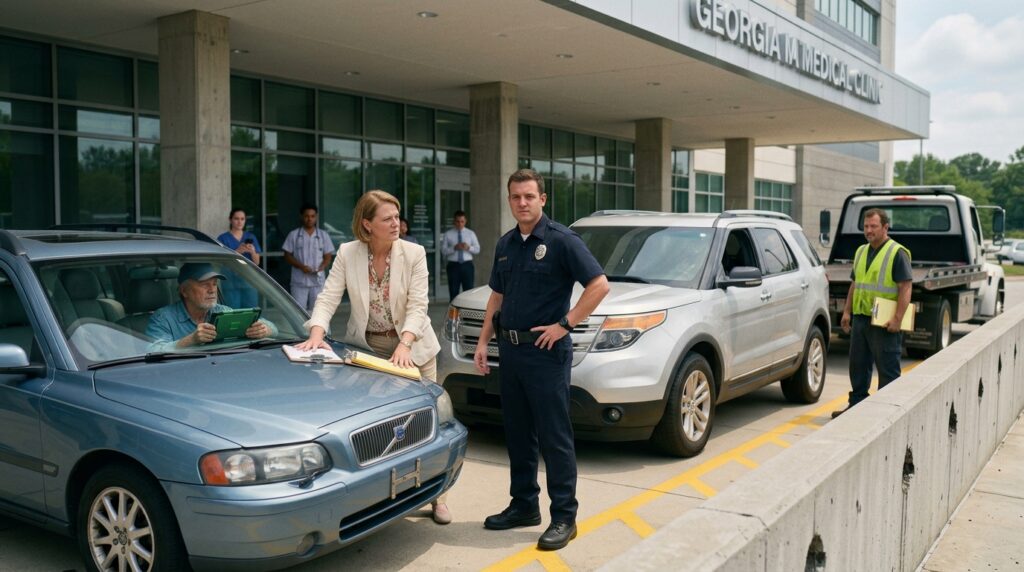
CHAPTER 3: THE WEAPONIZED AUTHORITY
Officer Vance didn’t take his eyes off the blinking blue light of the dashcam casing. The thin fabric of his uniform shirt clung to his shoulder blades, darkened by a wide patch of sweat that smelled faintly of the stale chicory coffee from the guard shack. He adjusted his heavy duty belt, the plastic components creaking with dry friction against his belt loops.
“Federal transit designation?” Vance muttered, his tone dropping an octave as his thumb drifted away from his radio clip. He looked at the laminated sheet in Arthur’s hand, his chin twitching as he scanned the scannable green square matrix. “Look, Mr. Cole, I don’t doubt your paperwork, but the council guidelines—”
“The council guidelines are local policy, Marcus,” Victoria broke in, her voice slicing through the mechanical rattle of her SUV’s idling engine. She stepped forward, the sharp tip of her leather clipboard catching the glare of the noon sun like a mirror slice. “This facility operates on private land leased from the commercial district holding group. Our retroactive bylaws take precedence over municipal parking variances. If this man refuses to clear the loading apron, his vehicle is a civil trespass hazard.”
Arthur watched her over the top edge of his half-rolled window. He didn’t adjust his seat. The desaturated slate-blue paint of his hood was vibrating slightly under the weight of the heat wave, but his hand stayed resting over Clara’s fingers. Her skin was dry, the small blue veins under her wrist flickering like worn-out wiring as she tried to pull her skirt back into the tight, defensive folds.
“The lease terms for the Oakridge Medical Pavilion are filed under county charter seventy-two, Mrs. Davenport,” Arthur said. His delivery was measured, devoid of any vocal inflection, the voice of a man who had spent forty winters calculating maximum axle tolerances for cross-country line hauls. “Section nine explicitly states that all perimeter curb cuts remain under municipal public-access jurisdiction so long as an active clinical license is held by the occupant. The Beautification Council can dictate the color of the mulch in the planters, but you can’t alter the transit lines without a county engineer’s signature. And your clipboard doesn’t have one.”
Victoria’s jaw tightened, the skin around her mouth turning a sharp, pale white that her tortoiseshell sunglasses couldn’t mask. “You think you know how this district is structured, Mr. Cole? You’re an operator with a lapsed commercial logbook. You don’t see the macro-logistics here.”
“I see the baseline markings,” Arthur replied, his gray eyes shifting to the low concrete retaining wall running along the eastern edge of the courtyard.
During their morning transits over the last three weeks, he had noted the fresh yellow paint layers covering the older, stamped survey benchmarks at the base of the wall. There were unmapped drainage modifications there—unauthorized core drills through the structural concrete that redirected the runoff away from the new luxury boutique development and straight into the lower foundations of the outpatient wing. It was a calculated encroachment, a physical squeeze designed to make the clinical space unusable before the winter rains hit. It wasn’t about the aesthetic flow of a grand opening; it was about establishing an unchecked operational perimeter.
The air grew heavier as the low, hydraulic groan of a heavy-duty flatbed truck vibrated through the floorboards of the wagon. The vehicle rounded the entry gate, its yellow emergency beacons rotating in silence against the tinted glass facade of the pavilion. Pete swung the long rig around with the practiced indifference of a city-contracted recovery driver, the heavy iron drop-links on his winch assembly clinking against the steel bed like old coins.
“Got the call for an abandoned structure blocking the line,” Pete said, stepping down from the cab into the greasy heat of the courtyard. His neon work vest was grayed by road grime at the seams, and his steel-toed boots left dull, charcoal smudges on the fresh white concrete as he walked toward the front bumper of the wagon. “Which one’s going to the yard?”
“The station wagon, Pete,” Victoria said, her pen tapping a rhythmic, urgent pulse against her silver clipboard seal. “It’s an unpermitted obstruction. The officer is authorizing the lift under the emergency safety protocol.”
Vance shifted his weight, his eyes darting between the live-streaming camera behind Arthur’s mirror and the large, silver logo on Victoria’s paperwork. “Wait a minute, Mrs. Davenport. If the code is tied to a federal health transport manifest, the county sheriff has to clear the impound order first. I can’t sign off on a civil lift if there’s an active clinical passenger inside.”
“I am the chair of the local corporate board, Marcus,” Victoria said, her voice dropping into a razor-thin whisper that carried clearly over the thrum of the diesel engines. She stepped close enough that the smell of her expensive floral perfume mingled with the dry dust of the asphalt. “My firm funds the security contract for this entire pavilion. If you can’t interpret a clear zoning violation, I will find a coordinator who can before the regional investment committee steps out of their transport.”
Arthur felt Clara’s hand jerk under his palm. Her eyes had widened, locking onto the heavy yellow crane arm rising from Pete’s flatbed. The steel cable was unwinding from the drum with a high-pitched, metallic hiss that sounded like a pressure leak in an air brake line.
“Arthur,” she gasped, her voice tightening into the jagged, broken rhythm of a full panic loop. “The lines are crossing. They’re taking the cargo off the manifest. Everything’s going to turn over.”
“The lines are straight, Clara,” Arthur said, his hand tightening just enough to anchor her wrist against the vinyl bench seat. He didn’t look at her; his eyes stayed locked on Vance’s face, watching the small muscle below the guard’s ear twitch as the weight of the corporate pressure hit him. “The log is verified. Nobody touches the cargo.”
Arthur turned the key in the ignition back one notch, switching the tablet screen to its secondary diagnostic display. The screen showed the real-time upload speed of the dashcam’s cellular link—a steady, unyielding column of data bits climbing toward the clinic’s risk management mainframe. He turned the screen outward, letting both Vance and the tow driver see the automated legal disclaimer scrolling across the lower boundary of the matrix.
“Pete,” Arthur said, his voice cutting through the hiss of the winch cable with the flat authority of an iron wedge. “Look at the registration tag on my lower windshield corner. That’s a class-three medical transit exemption. If your hooks touch my frame rails while that blue light is on, you’re not just executing a commercial tow for a private developer. You’re violating the state accessibility transit act, section five. That’s an automatic administrative suspension of your tow operator’s permit before your flatbed even clears the exit gate.”
Pete stopped three feet from the wagon’s bumper. His hand stayed wrapped around the iron drop-link, his fingers stationary against the rusty steel. He looked at the tag, then at the tablet screen, his mouth tightening into a hard, professional line as he calculated the risk metrics of Victoria’s order.








