CHAPTER 2: THE IMMOVABLE OBJECT
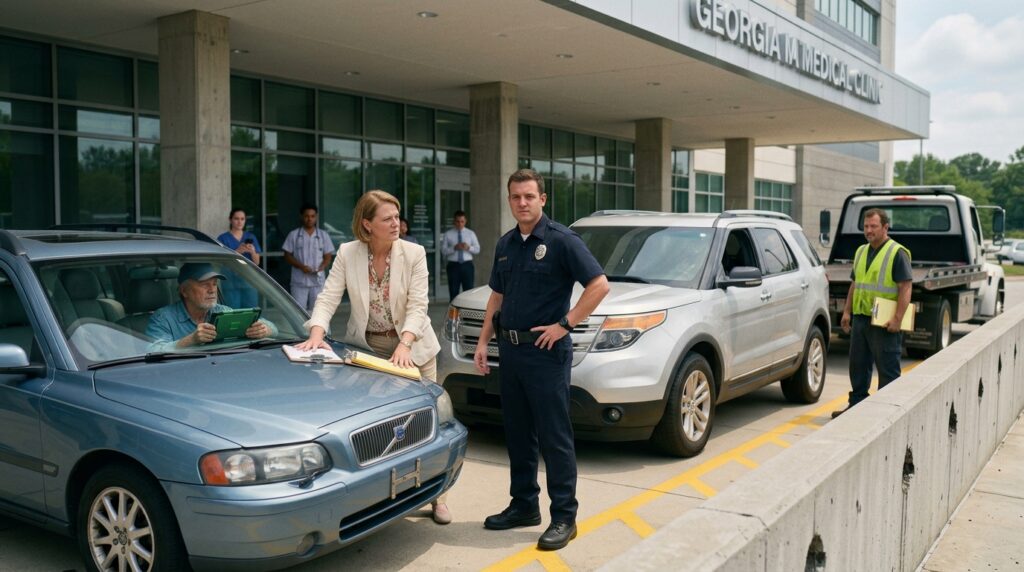
The heat radiating off the white concrete courtyard of the Oakridge Medical Pavilion did not just rise; it pressed against the chassis of the wagon like a physical weight. Arthur kept his eyes flat, tracking the reflection of the midday glare in the side-view mirror. Behind him, the dual-lens commercial dashcam hummed, a microscopic vibration against the windshield glass. Through the rolled-down gap in his window, the air tasted of scorched rubber and the sharp, chemical tang of industrial floor sanitizer venting from the basement grates.
“This is an active transit artery, not a storage yard for dead steel,” Victoria Davenport said. The heel of her designer pump came down on the asphalt with a dry, sharp crack. She didn’t look at Arthur; her sunglasses—wide, dark, and mirrored—were pointed directly at the faded blue paint of his hood. “Your nine minutes expired two ticks ago, Mr. Cole. The council has specific parameters for the courtyard lane. Visual clutter doesn’t survive the noon sweep.”
Arthur didn’t shift his hands on the wheel. The leather was split near the thumb, showing the gray foam beneath, dry and rough against his palms. “The manifest from the clinic director has us logged until 12:15, ma’am. The loading zone remains active until the passenger is secure. I’m currently at seven minutes and forty seconds.”
“The clinic doesn’t own the curb,” Victoria replied. She lifted her leather clipboard, her thumb pressing down on a thick sheet of heavy-stock paper that bore an embossed silver seal at the header. She didn’t hand it over; she simply held it at an angle where the glare obscured the text. “The District Beautification Council took over transit enforcement for the entire perimeter as of last Thursday. This corridor is restricted to commercial luxury shuttles and authorized VIP vendors. Your clinic slip is white noise.”
Arthur watched the edge of the paper. His forty years in freight logistics had trained his eye to spot the micro-discrepancies that normal drivers missed—the slight misalignment of the corporate stamps, the lack of a municipal county clerk filing number at the footer, the way the purple ink of the signature lacked the faint bleeding common to official county authorizations. It looked like an internal memo dressed up to look like an enforcement code. A proxy barrier meant to look like law.
Beside him, Clara’s fingers began to claw at the vinyl armrest. The rhythmic click-scrape of her nails against the grain was getting faster. Her breathing had gone shallow, a tiny, whistling rattle in the back of her throat that Arthur knew signaled the transition from disorientation to blind, unmanageable panic.
“Arthur,” she whispered, her head jerking toward the massive, pearl-white bumper of the SUV parked diagonally inches from their grille. “The gate’s down. They locked the yard. We’re going to be late for the counting.”
“The gate isn’t down, Clara,” Arthur said, his voice dropping into the flat, unhurried cadence he used when a shipping line collapsed at midnight. He kept his left hand on the wheel and slid his right across the bench seat, letting his palm rest flat over her trembling knuckles. The heat of her skin was brittle. “We’re just waiting for the clerk to clear the receipt. Keep your eyes on the ledger.”
He reached down with his left hand, popping the latch on the center console. Inside, the cracked screen of his old logistics tablet glowed with the bright green matrix of the state-issued QR medical transport code. It was tied directly to the state’s healthcare accessibility infrastructure, an unyielding layer of civic protection that no private merchant association could legally override.
Outside, Victoria had already turned her back, her phone raised to her ear. Her voice carried across the concrete, sharp and transactional. “Marcus? Get the cart down here now. We have an unpermitted wagon stalling the VIP lane for the boutique opening. And call Pete’s flatbed. Tell him I want this junk off the property before the regional investors pull off the expressway.”
Arthur didn’t climb out of the car. To leave the cabin was to cede the territory, to transform an active loading operation into a stationary dispute. He watched the private campus security cart rumble around the corner, its small plastic tires squealing on the sun-baked surface. Officer Marcus Vance climbed down, his uniform trousers stiff with cheap starch, his radio spitting out a burst of low-frequency static that made Clara flinch.
“Problem here, Mrs. Davenport?” Vance asked, his eyes immediately drifting to the silver seal on Victoria’s clipboard before settling on Arthur’s faded denim shirt.
“An unauthorized obstruction, Officer,” Victoria said, her manicured finger pointing toward Arthur’s windshield. “He’s been cited on the council log. He refuses to clear the transit lane for our priority guests. I want him moved to the commercial overflow deck immediately.”
Vance stepped up to Arthur’s door, his hand resting instinctively near the heavy utility belt at his waist. “Sir, you heard her. You’re blocking the aesthetic flow of the grand opening. I’m going to need you to put the vehicle in reverse and clear the courtyard.”
Arthur didn’t reach for the key. He picked up his tablet, the green light reflecting off his gray eyes as he turned the screen toward the officer’s face.
“Officer Vance,” Arthur said, his voice entirely devoid of anger, flat as an iron rail. “This unit is operating under an active federal healthcare accessibility contract, route designation 40-Alpha. If you order this vehicle to move before the medical manifest expires at 12:15, you are interfering with a federally protected transit operation on a designated clinical access route. That’s a minimum five-thousand-dollar compliance citation against the campus, and the dashcam behind my mirror has been streaming your badge number and Mrs. Davenport’s clipboard to the clinic’s risk management server for the last four minutes.”
Vance froze. His eyes dropped from the tablet screen to the tiny, unblinking blue indicator light hidden in the shadow of the rearview mirror. The sudden silence between the three of them was absolute, broken only by the heavy, rhythmic thrum of the SUV’s transmission fluid boiling in the July heat.