CHAPTER 1: THE DUSTY GRIDS OF ORDER
The heat in the garage smelled of iron filings, dry pine needles, and the static electricity hum of the small portable oxygen concentrator vibrating against the workbench. Arthur Cole pulled the strap of his faded navy cap lower, his calloused thumb smoothing down the corner of an entry in his ledger. The grid lines were narrow, hand-drawn in blue ink that had started to turn gray over the years. Forty years of freight manifests had taught him that anything unaccounted for eventually turned into a liability.
Beside him, sitting in the passenger seat of the station wagon with her door open to the stagnant air, Clara was twisting the hem of her cotton skirt. Her fingers moved with a rhythmic, frantic precision, folding the fabric into tiny triangles, then smoothing them out, then folding them again.
“The truck leaves at twelve, Arthur,” she said, her voice thin, clear, and unmoored from the present. She looked past the grease-stained drywall toward a horizon only she could see. “The manifests aren’t signed.”
“Manifests are done, Clara,” Arthur said softly. He didn’t break his posture. His back remained straight, a habit from the loading docks that kept the spine from collapsing under dead weight. He reached into the footwell, checking the brass fittings on the backup regulator. The metal was cold, oxidized to a desaturated green around the threading. “Everything’s locked in. We’re on schedule.”
He checked his watch—a heavy, scratched stainless-steel piece with a canvas band that smelled of salt sweat and old diesel. 11:38 AM. The transit from their small brick ranch just outside the city limits to the Oakridge Medical Pavilion took exactly twenty-two minutes if the freight lanes near the interstate stayed clear. He had calculated the margin down to the hundredth yard. If they arrived at the clinic doorway at 12:00 PM, the curb would be clear for the shift change, and the glare from the midday sun wouldn’t hit Clara’s side of the glass directly.
He stepped to the passenger side, his work boots leaving faint, dusty prints on the concrete floor. The air was heavy, thick with the scent of unwashed asphalt from the driveway outside. When he reached down to tuck the thin plastic cannula behind her ears, her skin felt like dry parchment, cool despite the creeping temperature of the garage.
“Arthur,” she whispered, her eyes suddenly clearing, focusing on the small scar right above his left eyebrow. “The noise. Is it coming back?”
“No,” he said, adjusting the dial until the machine clicked into its steady, soft puffing rhythm. “The wall is up. Nobody’s getting through today.”
He closed her door, the latch engaging with a heavy, unyielding thud that belonged to an era when steel was still thick enough to resist a dent. He walked to the driver’s side, his hand brushing the hood—the dark blue paint was faded, desaturated by years of Southern sun until it looked like the color of wet slate.
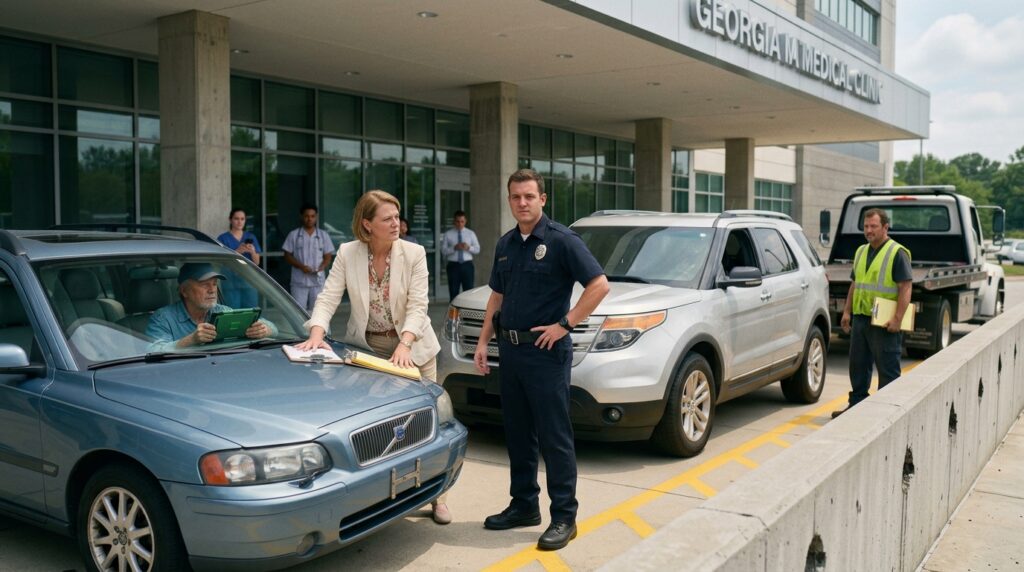
When he climbed into the cabin, the steering wheel was warm, the worn leather rough against his palms. He plugged the tablet into the dashboard mount, its screen flickering to life with a bright green QR code—the digital manifest approved by the pavilion’s regional director. Behind the rearview mirror, the dual-lens commercial dashcam blinked its single blue light, recording the interior, the dashboard, and the gravel road leading out to the highway.
Arthur turned the key. The engine caught with a low, mechanical rattle, a predictable sequence of valves and pistons that he understood better than the shifting architecture of his own life. He shifted into reverse, his eyes scanning the mirrors, locking onto the small, rusted mailbox at the edge of the property line.
“Twelve minutes to the gate,” he murmured into the quiet of the car, his eyes tracking the dusty road ahead. “We’re on time.”