
Behind the Cold Steel Cables: The Quiet Stand at the Garage Threshold

CHAPTER 1: THE LINE IN THE CONCRETE

“You touch that remote again and you’re explaining a residential breaking-and-entering to a city judge.”

The words cut through the heavy diesel idle, cold and level.

Evelyn Vance didn’t raise her voice. She didn’t have to. The acoustic vault of her two-car garage amplified every syllable, throwing her voice straight out into the damp, 6:15 AM air where the flatbed tow truck sat idling on her driveway.

Outside, the air smelled of unburnt fuel and morning dew. Inside, it smelled of dry concrete, old rubber, and the faint, lingering metallic tang of motor oil.

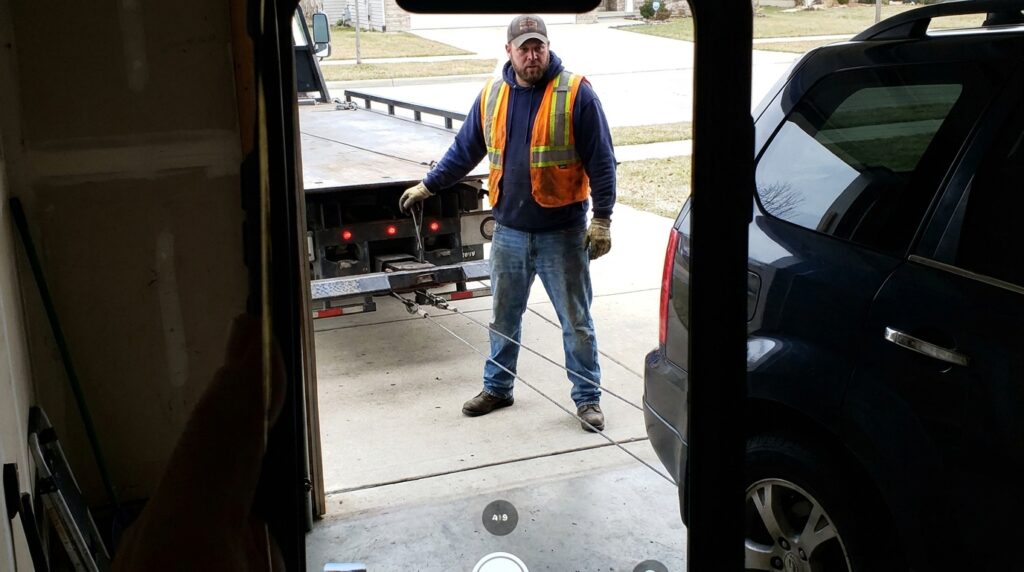
Garrett Higgins didn’t back off. He stood six feet out on the sunlit asphalt, his heavy work boots planted wide, his orange reflective vest glaring bright against the dark navy hoodie beneath it. His thumb hovered over the black rubber casing of a wireless winch controller. From the steel spool mounted behind the truck’s cab, two braided wire cables stretched across her driveway like taut clotheslines, disappearing straight into the dark interior of her garage.

The heavy steel hooks were already looped tight around the lower control arms of her dark SUV.

“Read the sign at the entrance, lady,” Garrett said. His voice was a gravelly scrape, built on years of shouting down panicked drivers at three in the morning. He tipped his baseball cap back with a gloved knuckle, letting the morning sun hit his trimmed grey beard. “Four-by-fours and oversized rigs aren’t permitted overnight in Oakridge Estates. Board signed off on the sweep at midnight.”

“My car is inside my house,” Evelyn said. She didn’t move from behind the driver’s side mirror of her SUV. Her chest-height handheld phone was already live, its lens tracking the orange vest, the truck’s commercial license plate, and the two gray lines of steel binding her axle to his bed. “The board doesn’t own this concrete. I do.”

“Rules are rules,” Garrett snapped, leaning his chest forward just enough to project authority. “Four-by-fours aren’t allowed here. You want to argue covenants, you take it up with Mr. Brody at nine o’clock. Right now, it’s a hundred and fifty bucks drop-fee on the spot, or this rig rides the bed to the impound lot in West county.”

He brought his left hand up, casual as a coin flip, pointing a thick gloved finger toward the open threshold. He was calculating the math the same way he did on every driveway: a panicked homeowner in a robe always pays the cash to avoid losing their ride to work.

Evelyn’s thumb pressed the screen. She didn’t lower the camera. She walked forward three deliberate paces until her slipper toes stopped exactly one inch short of the seam where the smooth indoor slab met the rough outdoor asphalt.

She extended her left hand flat out into the space between them, her palm facing his chest, perfectly aligned with the door jambs.

“Stop,” Evelyn said, her voice dropping an octave into pure, frictionless iron. “You’re not towing my car today.”

Garrett let out a brief, dry bark of a laugh, but his thumb stayed frozen over the winch button. He looked past her hand, peering into the shadows of the garage as if searching for a husband or a lawyer. He found neither—only the steady, unblinking green light of her phone’s recording indicator.

“You think a phone scares me?” he scoffed, though his shoulders stiffened under the hoodie. “I do twenty of these a night.”

“Then you’ve committed twenty felonies,” Evelyn said softly. She tapped the corner of her phone screen without breaking eye contact. The speakerphone beeped once, sharp and clear in the morning air.

“Nine-one-one, what is your emergency?”

Garrett’s eyes narrowed, his gaze flicking down to the phone, then back to the steel cables humming under tension near her feet. But as he opened his mouth to call her bluff, the heavy iron latch on her driver’s side door clicked—not on her SUV, but from deep within the truck’s bed—revealing a yellowed, handwritten tag attached to the winch hook that hadn’t been stamped by any commercial dispatcher.


CHAPTER 2: THE PAPER CHAIN

“Nine-one-one, what is your emergency?”

The dispatcher’s voice tinny and distant through the phone’s speaker, carried across the five feet of empty air separating the threshold of my garage from Garrett Higgins’s steel-toed boots.

Garrett didn’t flinch, but his eyes dropped. Not to the phone in my left hand, but down to the lower control arm of my SUV where the braided steel winch cable had pulled taut. Suspended right beside the heavy forged hook, tied with a greasy twist-tie, was a square of yellowed cardstock. It vibrated slightly with the low, rhythmic idle of the flatbed diesel engine out on my driveway.

It was handwritten. No printed barcode, no printed job-number manifest, no municipal towing permit stamp. Just a scribbled set of numbers in red grease pencil.

“Dispatcher,” I said, keeping my eyes locked on Garrett’s face while my thumb angled the phone camera down two inches to capture the tag. “I am standing inside my private attached garage at 114 Oakridge Drive. A commercial tow operator has backed onto my driveway, opened my door, and extended winch cables across my threshold. He is currently attempting to seize my personal vehicle from inside my dwelling.”

“Look, lady, tell ’em whatever you want,” Garrett gritted out, his voice dropping into a rasping murmur designed not to carry past the front bumper of his truck. He took half a step forward—his boot heel catching the exact outer lip of the concrete slab where the driveway met the garage frame. He didn’t cross the line, but he brought his broad, reflective-vested chest right to the plane of the threshold. “This isn’t a street impound. This is a private-covenant enforcement order under Section 4 of the Oakridge Covenants. I’m executing a signed emergency hazard seizure.”

“Sir,” the dispatcher’s voice came back, sharper now, cutting through the background static. “Are you reporting an intruder inside your home?”

“The operator is standing on my driveway, but his equipment has breached the physical structure of my home,” I said, my voice flat, measured, and entirely void of the panic he was waiting for. “The cables are inside my building. He is threatening to drag the car out unless I pay him an undocumented cash drop-fee.”

Garrett’s thumb twitched on the rubber housing of the winch remote. The steel lines groaned, a single high-pitched ping echoing off the dry drywall of the garage as the tension took up another fraction of an inch of slack. The front tires of my SUV creaked against the smooth concrete floor.

“Don’t do that,” I said quietly.

“I’m securing the load for transport,” Garrett said, though his eyes darted past my shoulder toward the dark interior behind the SUV. “You’re obstructing a lawful contractual removal. You want to pay the drop-fee, you hand over a hundred and fifty bucks cash or cashier’s check right now. Otherwise, this cable pulls.”

“Ma’am, I have an officer en route to your location,” the dispatcher interrupted. “Do not engage with the individual. Is the garage door accessible to close?”

“No,” I replied, keeping the camera dead-center on Garrett’s face. “The cables are lying flat across the sensor eye and the concrete threshold. If the door descends, it hits his wire.”

Garrett pulled a folded piece of paper from the front pocket of his navy hoodie with his free hand. The paper was crisp, bright white, sharply contrasting with the grease-stained cuff of his sleeve. He didn’t offer it to me; he held it up at eye level, two feet away, just within the frame of my phone camera.

“Signed by Marcus Brody, President of the Oakridge Homeowners Association Board at 5:45 AM,” Garrett said, his tone turning smug. “Vehicle left in an open, unmonitored structure constitutes an abandoned fire hazard under Rule 12-B. Authorizes immediate third-party removal without prior written notice to the homeowner.”

I stared at the paper. The header bore the official Oakridge Estates crest, but beneath Brody’s frantic cursive signature was a secondary line—a stamped authorization from an entity named Vance Asset Recovery LLC.

Not a towing dispatcher. An asset recovery firm.

My mind clicked through the last six months of escalating fines: the $50 penalty for my trash cans being out four hours early during a windstorm; the $200 notice for an “unauthorized exterior modification” when I replaced a rotting cedar fence panel with identical pressure-treated pine; the certified letter three weeks ago threatening an administrative lien if I didn’t submit my SUV for a “community weight-and-class audit.”

They didn’t want the $150 drop-fee. Garrett was supposed to drag the SUV out onto the asphalt before I woke up. Once the vehicle was in the county impound lot, the daily storage fees and non-compliance fines would stack until the HOA could file a summary lien against the deed of the house itself.

“That paper authorizes you to tow from common areas, Garrett,” I said, reading the fine print through the phone’s high-definition preview screen. “It doesn’t grant you right of entry into a private real estate structure. You know the difference between a parking space and an attached garage. And so does your insurance carrier.”

Garrett’s expression hardened, the cocky smirk evaporating into the cold, pragmatic realization that he was dealing with someone who knew the distinction between civil contract law and criminal entry.

From down the block, the faint, high-frequency chop of an accelerating engine echoed through the quiet suburban morning. A white sedan pulled out from a driveway three houses down, its headlights flashing once as it idling slowly toward my curb. Through the tint of the sedan’s windshield, I recognized the soft, round silhouette and thinning hair of Marcus Brody.

He wasn’t staying in his house to wait for a phone call. He was parked down the street, watching the clock, waiting to make sure the hook was set before the neighborhood woke up.

Garrett glanced over his shoulder toward the approaching sedan, then back at the winch controls in his hand. The greasy yellow tag on the cable fluttered in the morning breeze, its handwritten grease-pencil number matching the reference code on the paper in his hand.

“You got five minutes before my flatbed blocks this whole street, lady,” Garrett growled, leaning his face closer to the phone lens. “Officer or no officer, this rig is hooked. You want to settle this the easy way, or do you want your driveway turned into a crime scene in front of your neighbors?”

“It’s already a crime scene, Garrett,” I said, stepping my right foot forward until the toe of my shoe pressed directly against the steel cable resting on the concrete threshold. “And you’re standing right in the middle of it.”

CHAPTER 3: THE FORCED LEVERAGE

The rubber sole of my right sneaker pressed against the braided steel of the winch cable, feeling the faint, high-frequency shudder of the idling hydraulic pump out on the driveway. The steel didn’t yield. It was stretched piano-wire taut across the exact seam where my dry garage slab ended and the oil-stained asphalt began.

Garrett didn’t move his boot away from the line. His weight stayed centered, heavy and planted, his orange reflective vest casting a long, rectangular shadow into the dim vault of my garage. He adjusted his grip on the winch controller, his thumb hovering three millimeters above the toggle switch.

“You like playing lawyer, don’t you, Ms. Vance?” Garrett said, his voice dropping an octave, smooth and dangerous like grease on warm iron. He leaned his head forward, letting the brim of his baseball cap shade his eyes from my phone’s camera lens. “Difference between you and me is, I’m paid to haul steel, and you’re just sitting in your pajamas taking videos. Videos don’t stop a four-ton winch.”

“They do when the officer watching them reads the penal code,” I said.

My phone screen glowed inches from his face, the recording counter ticking past the three-minute mark. Out on the curb, fifty feet behind his flatbed, the white sedan’s idling engine sputtered, its driver-side window rolling down an inch. The pale, fleshy outline of Marcus Brody’s hand rested on the door frame, a silver pen tapping a rhythmic, impatient beat against the painted metal.

Brody wasn’t coming over to the driveway. He was keeping fifty feet of clear air between his fine linen shirt and the grease on Garrett’s hands. He wanted the haul executed cleanly, the SUV off the property line before the sun cleared the rooftop ridge across the street.

Garrett took a slow, deliberate breath, his chest expanding against the bright nylon of his vest. He raised the folded white document again, flicking his wrist so the bottom edge unrolled.

“Look at the bottom line, Evelyn,” he said, using my first name for the first time—a deliberate, practiced move meant to strip away my professional distance and reduce the standoff to a personal spat. “See that red stamp? That’s an administrative authorization under the Oakridge Property Preservation Rider. You signed it when you closed on the house five years ago. Article 9, Paragraph C. Gives the board emergency access rights to abate nuisance hazards.”

“An enclosed garage is not a nuisance hazard,” I said, keeping my tone clipped and ice-dry. “And a parked vehicle behind a closed overhead door isn’t an abatement target. It’s personal property inside a private residential structure.”

“Door was open,” he replied instantly, his voice flat, devoid of doubt. “I pulled up, door was raised four feet off the deck. Unattended vehicle in an open, unsecured structure during an active neighborhood theft alert. That makes it a hazard.”

A cold, sharp prickle of clarity settled behind my ribs.

My garage door hadn’t been raised four feet when I went to sleep at midnight. I had locked the interior side-latch myself after bringing in the recycling bins. For Garrett to claim the door was open, either he had used a coat hanger to reach the emergency release cord through the top weather-stripping—a classic predatory tow trick—or someone with an HOA master override key had disengaged the track from the outside.

I angled the phone lens lower, taking three seconds to sweep the top edge of the overhead door track where the emergency red pull-cord hung down.

The cord was swinging softly. A single, rhythmic arc in the still air of the garage.

It was still moving from being yanked.

“You tripped the manual trolley,” I said, pointing my index finger directly at the swinging red handle above his head. “You reached over the top panel with a rod, pulled the release latch, and manually raised the door to create the ‘hazard’ you needed for the paperwork.”

Garrett’s jaw tightened. A tiny muscle near his trim grey beard twitched once, hard. He didn’t look up at the swinging cord. He knew exactly what was up there. He had done it in less than ten seconds while his truck engine muffled the sound of the latch popping.

“Prove it,” he whispered. “You got a camera pointed at the top track at 5:45 AM? No. You got a phone pointed at my face right now. And right now, the cable is hooked to your axle, the paper is signed by the board president sitting in that car at the curb, and my truck is parked on a driveway that the HOA maintains under a master easement.”

“The driveway is an easement for access, Garrett. Not a staging ground for breaking and entering,” I said. “And the man in that white sedan isn’t a judge. He’s a board member using you to manufacture a civil default.”

I shifted my stance, bringing my foot down harder on the cable, feeling the vibration travel up my ankle. I didn’t back into the dark of the garage, and I didn’t step over his line into the light. I held the zero-point of the property line, the camera locked on his eyes, forcing him to make a choice in broad daylight.

Behind his truck, the front door of the white sedan finally swung open.

Marcus Brody stepped out onto the asphalt. He wasn’t wearing his usual pristine golf polo. He wore an oversized, dark trench coat pulled tight over unbuttoned pajama pants, his thin, greying hair combed hastily over his scalp. He carried a leather-bound clipboard tucked under his left arm, his leather loafers making a soft, scraping sound as he walked up the incline of my driveway.

“Is there a problem here, Mr. Higgins?” Brody called out, his voice sharp, thin, and pitched to sound like reasonable authority for any neighbor who might be looking through their blinds. He didn’t look at me; he looked at the steel cable running past my shoes. “We have a schedule to keep. The code enforcement sweep must be completed before seven o’clock.”

“No problem, Mr. Brody,” Garrett said without turning his head, his eyes remaining locked on mine. “Just waiting for the owner to clear the work zone so we can tension the line.”

Brody stopped three feet behind Garrett, his eyes flicking to the phone in my hand, then to the red cord still swaying gently inside the dark ceiling space of my garage. For a fraction of a second, his posture wavered—a tiny, nervous adjustment of his clipboard—before he smoothed his face back into a mask of righteous civic duty.

“Evelyn,” Brody said, his tone dripping with patronizing concern. “Please step away from the equipment. You are interfering with a contractual safety remediation. If you continue to obstruct Mr. Higgins, the board will be forced to assess an immediate administrative penalty of five hundred dollars to your account.”

“You tripped my garage door release, Marcus,” I said, turning the camera four inches to capture his face beside Garrett’s reflective vest. “That’s not a safety remediation. That’s a felony break-in.”

Brody’s eyes narrowed into hard, bitter slits. He didn’t deny it. He didn’t even address it. He simply adjusted the paper on his clipboard, his pen making a sharp, dark checkmark on a form titled Notice of Default and Immediate Seizure.

“The board operates under sovereign property covenants, Ms. Vance,” Brody said softly, his voice dropping so low the phone microphone barely caught it. “You don’t get to opt out of the neighborhood rules just because you keep your car behind a piece of sheet metal.”

CHAPTER 4: THE THRESHOLD LOCK

“I don’t need to opt out of your rules, Marcus,” I said, my voice dropping into a razor-thin calm that carried straight past his clipboard. “Because your rules stop at the threshold of my home.”

Brody’s hand tightened around the edge of his leather folder, his knuckles turning a waxy, bloodless white. He took half a step forward, his polished loafers crunching against a line of stray gravel at the edge of the driveway slab.

“You’re making a catastrophic mistake, Evelyn,” Brody said, his eyes flicking nervously toward the end of the street where a distant siren gave its first faint, warbling chop. “This isn’t a discussion. The board signed off on the emergency authorization at 5:45 AM. If you obstruct an agent of the association from executing a valid enforcement order, you assume full personal liability for the towing fees, storage surcharges, and any legal costs incurred.”

“Then show me the judicial warrant,” I replied, bringing my phone camera two inches closer to his face. “Not a self-issued piece of paper from a neighborhood committee. Show me a writ signed by a county magistrate authorizing a forced entry into a private residential dwelling.”

Garrett shifted his weight behind Brody, his boots grinding against the asphalt. His thumb tapped rhythmically on the side of his winch remote. “I don’t need a magistrate for an abandoned hazard, lady. The contract says—”

“The contract doesn’t override state penal code, Garrett,” I interrupted, shifting my left boot until the tip of my sneaker lodged directly under the taut wire cable resting on my concrete floor. “And if you press that winch switch while I’m standing over this line, you’re not just executing a civil impound. You’re committing felony assault with a motorized vehicle.”

Garrett’s jaw set into a hard, rigid block. His eyes dropped to my foot pressed against the steel cable. In the towing industry, towing an occupied vehicle or operating machinery with a homeowner physically pinned against the rigging instantly stripped away third-party contractor immunity. His company’s insurance policy would drop him before the flatbed left the neighborhood.

“She’s bluffing, Garrett,” Brody hissed, stepping closer to the tow operator’s shoulder, his voice thin and panicked under his trench coat. “Tension the cable and drag it out. She’ll move the second the tires start rolling.”

“I don’t bluff, Marcus,” I said. “And neither does the city police dispatcher.”

I tapped the screen with my right index finger, bringing the live emergency call back into the primary audio channel. The speaker echoed clear and loud through the driveway.

“Unit 4-12 arriving on scene at 114 Oakridge Drive,” the dispatcher’s voice announced over the line. “Caller, remain inside the residence. Patrol is turning onto your street now.”

At the corner of Oakridge Drive and Elm, a dark blue municipal patrol car swung around the bend, its roof lights flashing silently—a steady, hypnotic pulse of red and blue reflecting off the dew-soaked front lawns of my neighbors.

Brody’s posture instantly shattered. He took a sharp step backward, instinctively trying to put Garrett’s broad, reflective-vested back between himself and the approaching patrol car. He tucked his clipboard deeper under his trench coat, his eyes darting toward his idling white sedan parked fifty feet down the curb.

“Garrett, unhook it,” Brody muttered under his breath, his authoritative tone collapsing into a hurried whisper. “We’ll re-issue the notice at the monthly meeting.”

“Unhook it?” Garrett snapped, his head whipping around to glare at Brody. “I pulled two hundred feet of steel line into a dark garage because you guaranteed me the paperwork was ironclad! You told me she wouldn’t even be awake!”

“I said we’d handle the documentation through the office,” Brody shot back, his face flushing a dark, mottled red. “You’re the one who dragged the cable across her threshold before verifying the door latch!”

“You gave me the master release code for the overhead track!” Garrett growled, stepping into Brody’s space, his heavy work boots crowding the board president back toward the flatbed’s rear tires.

I kept the phone camera perfectly steady, panning smoothly between the two of them as their unified front collapsed into mutual accusations. Every word, every admission of the master override code, and every detail of the pre-planned 5:45 AM raid was being recorded in uncompressed high definition, uploaded straight to a secure cloud server in real time.

I took one step forward—not across the line, but planting both feet firmly at the absolute edge of the concrete threshold.

“Don’t touch that cable yet, Garrett,” I said, my voice cutting through their argument like a blade. “Leave the wire right where it is. Let’s let the officer take a look at where the steel meets my house.”

The police cruiser pulled onto my driveway, its tires crunching over the loose gravel before coming to a stop behind the flatbed, completely blocking Garrett’s tow truck from backing up or leaving the property. The driver’s door swung open, and Officer Miller stepped out into the crisp morning light, his hand resting casually on his belt near his sidearm.

Similar Posts

Leave a Reply

Your email address will not be published. Required fields are marked *






