
CHAPTER 3: THE FORCED LEVERAGE
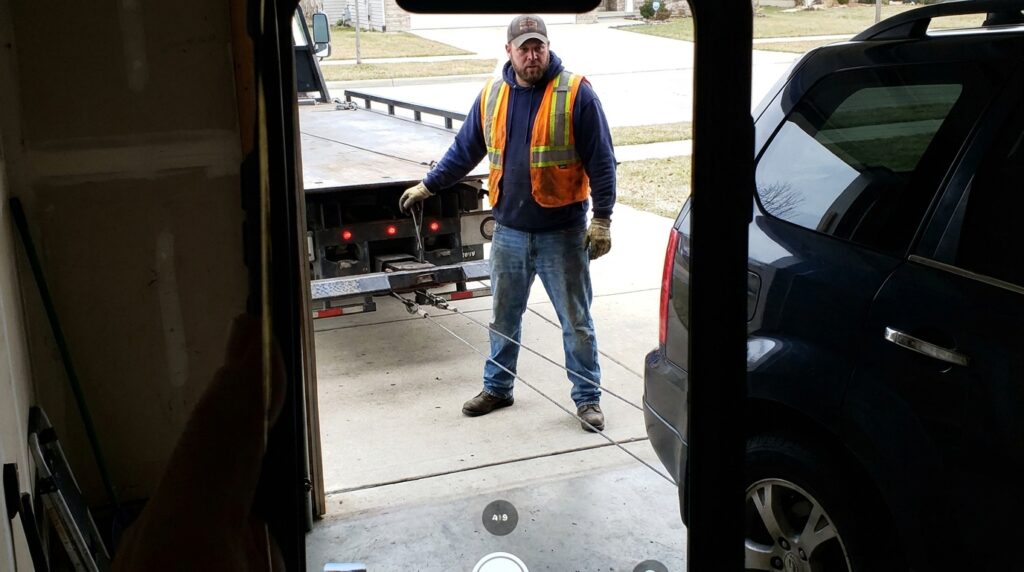
The rubber sole of my right sneaker pressed against the braided steel of the winch cable, feeling the faint, high-frequency shudder of the idling hydraulic pump out on the driveway. The steel didn’t yield. It was stretched piano-wire taut across the exact seam where my dry garage slab ended and the oil-stained asphalt began.
Garrett didn’t move his boot away from the line. His weight stayed centered, heavy and planted, his orange reflective vest casting a long, rectangular shadow into the dim vault of my garage. He adjusted his grip on the winch controller, his thumb hovering three millimeters above the toggle switch.
“You like playing lawyer, don’t you, Ms. Vance?” Garrett said, his voice dropping an octave, smooth and dangerous like grease on warm iron. He leaned his head forward, letting the brim of his baseball cap shade his eyes from my phone’s camera lens. “Difference between you and me is, I’m paid to haul steel, and you’re just sitting in your pajamas taking videos. Videos don’t stop a four-ton winch.”
“They do when the officer watching them reads the penal code,” I said.
My phone screen glowed inches from his face, the recording counter ticking past the three-minute mark. Out on the curb, fifty feet behind his flatbed, the white sedan’s idling engine sputtered, its driver-side window rolling down an inch. The pale, fleshy outline of Marcus Brody’s hand rested on the door frame, a silver pen tapping a rhythmic, impatient beat against the painted metal.
Brody wasn’t coming over to the driveway. He was keeping fifty feet of clear air between his fine linen shirt and the grease on Garrett’s hands. He wanted the haul executed cleanly, the SUV off the property line before the sun cleared the rooftop ridge across the street.
Garrett took a slow, deliberate breath, his chest expanding against the bright nylon of his vest. He raised the folded white document again, flicking his wrist so the bottom edge unrolled.
“Look at the bottom line, Evelyn,” he said, using my first name for the first time—a deliberate, practiced move meant to strip away my professional distance and reduce the standoff to a personal spat. “See that red stamp? That’s an administrative authorization under the Oakridge Property Preservation Rider. You signed it when you closed on the house five years ago. Article 9, Paragraph C. Gives the board emergency access rights to abate nuisance hazards.”
“An enclosed garage is not a nuisance hazard,” I said, keeping my tone clipped and ice-dry. “And a parked vehicle behind a closed overhead door isn’t an abatement target. It’s personal property inside a private residential structure.”
“Door was open,” he replied instantly, his voice flat, devoid of doubt. “I pulled up, door was raised four feet off the deck. Unattended vehicle in an open, unsecured structure during an active neighborhood theft alert. That makes it a hazard.”
A cold, sharp prickle of clarity settled behind my ribs.
My garage door hadn’t been raised four feet when I went to sleep at midnight. I had locked the interior side-latch myself after bringing in the recycling bins. For Garrett to claim the door was open, either he had used a coat hanger to reach the emergency release cord through the top weather-stripping—a classic predatory tow trick—or someone with an HOA master override key had disengaged the track from the outside.
I angled the phone lens lower, taking three seconds to sweep the top edge of the overhead door track where the emergency red pull-cord hung down.
The cord was swinging softly. A single, rhythmic arc in the still air of the garage.
It was still moving from being yanked.
“You tripped the manual trolley,” I said, pointing my index finger directly at the swinging red handle above his head. “You reached over the top panel with a rod, pulled the release latch, and manually raised the door to create the ‘hazard’ you needed for the paperwork.”
Garrett’s jaw tightened. A tiny muscle near his trim grey beard twitched once, hard. He didn’t look up at the swinging cord. He knew exactly what was up there. He had done it in less than ten seconds while his truck engine muffled the sound of the latch popping.
“Prove it,” he whispered. “You got a camera pointed at the top track at 5:45 AM? No. You got a phone pointed at my face right now. And right now, the cable is hooked to your axle, the paper is signed by the board president sitting in that car at the curb, and my truck is parked on a driveway that the HOA maintains under a master easement.”
“The driveway is an easement for access, Garrett. Not a staging ground for breaking and entering,” I said. “And the man in that white sedan isn’t a judge. He’s a board member using you to manufacture a civil default.”
I shifted my stance, bringing my foot down harder on the cable, feeling the vibration travel up my ankle. I didn’t back into the dark of the garage, and I didn’t step over his line into the light. I held the zero-point of the property line, the camera locked on his eyes, forcing him to make a choice in broad daylight.
Behind his truck, the front door of the white sedan finally swung open.
Marcus Brody stepped out onto the asphalt. He wasn’t wearing his usual pristine golf polo. He wore an oversized, dark trench coat pulled tight over unbuttoned pajama pants, his thin, greying hair combed hastily over his scalp. He carried a leather-bound clipboard tucked under his left arm, his leather loafers making a soft, scraping sound as he walked up the incline of my driveway.
“Is there a problem here, Mr. Higgins?” Brody called out, his voice sharp, thin, and pitched to sound like reasonable authority for any neighbor who might be looking through their blinds. He didn’t look at me; he looked at the steel cable running past my shoes. “We have a schedule to keep. The code enforcement sweep must be completed before seven o’clock.”
“No problem, Mr. Brody,” Garrett said without turning his head, his eyes remaining locked on mine. “Just waiting for the owner to clear the work zone so we can tension the line.”
Brody stopped three feet behind Garrett, his eyes flicking to the phone in my hand, then to the red cord still swaying gently inside the dark ceiling space of my garage. For a fraction of a second, his posture wavered—a tiny, nervous adjustment of his clipboard—before he smoothed his face back into a mask of righteous civic duty.
“Evelyn,” Brody said, his tone dripping with patronizing concern. “Please step away from the equipment. You are interfering with a contractual safety remediation. If you continue to obstruct Mr. Higgins, the board will be forced to assess an immediate administrative penalty of five hundred dollars to your account.”
“You tripped my garage door release, Marcus,” I said, turning the camera four inches to capture his face beside Garrett’s reflective vest. “That’s not a safety remediation. That’s a felony break-in.”
Brody’s eyes narrowed into hard, bitter slits. He didn’t deny it. He didn’t even address it. He simply adjusted the paper on his clipboard, his pen making a sharp, dark checkmark on a form titled Notice of Default and Immediate Seizure.
“The board operates under sovereign property covenants, Ms. Vance,” Brody said softly, his voice dropping so low the phone microphone barely caught it. “You don’t get to opt out of the neighborhood rules just because you keep your car behind a piece of sheet metal.”








