
CHAPTER 2: THE PAPER CHAIN
“Nine-one-one, what is your emergency?”
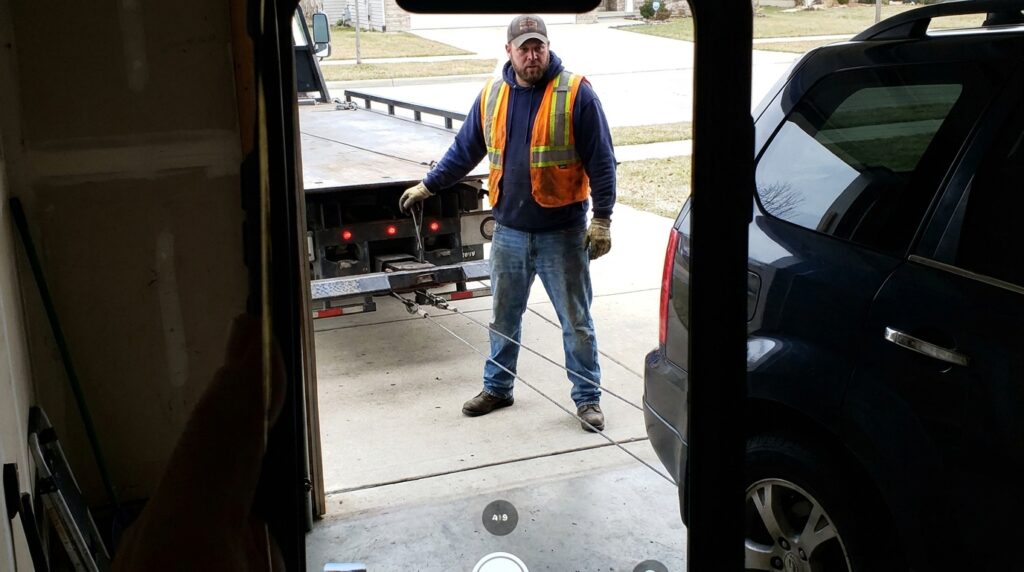
The dispatcher’s voice tinny and distant through the phone’s speaker, carried across the five feet of empty air separating the threshold of my garage from Garrett Higgins’s steel-toed boots.
Garrett didn’t flinch, but his eyes dropped. Not to the phone in my left hand, but down to the lower control arm of my SUV where the braided steel winch cable had pulled taut. Suspended right beside the heavy forged hook, tied with a greasy twist-tie, was a square of yellowed cardstock. It vibrated slightly with the low, rhythmic idle of the flatbed diesel engine out on my driveway.
It was handwritten. No printed barcode, no printed job-number manifest, no municipal towing permit stamp. Just a scribbled set of numbers in red grease pencil.
“Dispatcher,” I said, keeping my eyes locked on Garrett’s face while my thumb angled the phone camera down two inches to capture the tag. “I am standing inside my private attached garage at 114 Oakridge Drive. A commercial tow operator has backed onto my driveway, opened my door, and extended winch cables across my threshold. He is currently attempting to seize my personal vehicle from inside my dwelling.”
“Look, lady, tell ’em whatever you want,” Garrett gritted out, his voice dropping into a rasping murmur designed not to carry past the front bumper of his truck. He took half a step forward—his boot heel catching the exact outer lip of the concrete slab where the driveway met the garage frame. He didn’t cross the line, but he brought his broad, reflective-vested chest right to the plane of the threshold. “This isn’t a street impound. This is a private-covenant enforcement order under Section 4 of the Oakridge Covenants. I’m executing a signed emergency hazard seizure.”
“Sir,” the dispatcher’s voice came back, sharper now, cutting through the background static. “Are you reporting an intruder inside your home?”
“The operator is standing on my driveway, but his equipment has breached the physical structure of my home,” I said, my voice flat, measured, and entirely void of the panic he was waiting for. “The cables are inside my building. He is threatening to drag the car out unless I pay him an undocumented cash drop-fee.”
Garrett’s thumb twitched on the rubber housing of the winch remote. The steel lines groaned, a single high-pitched ping echoing off the dry drywall of the garage as the tension took up another fraction of an inch of slack. The front tires of my SUV creaked against the smooth concrete floor.
“Don’t do that,” I said quietly.
“I’m securing the load for transport,” Garrett said, though his eyes darted past my shoulder toward the dark interior behind the SUV. “You’re obstructing a lawful contractual removal. You want to pay the drop-fee, you hand over a hundred and fifty bucks cash or cashier’s check right now. Otherwise, this cable pulls.”
“Ma’am, I have an officer en route to your location,” the dispatcher interrupted. “Do not engage with the individual. Is the garage door accessible to close?”
“No,” I replied, keeping the camera dead-center on Garrett’s face. “The cables are lying flat across the sensor eye and the concrete threshold. If the door descends, it hits his wire.”
Garrett pulled a folded piece of paper from the front pocket of his navy hoodie with his free hand. The paper was crisp, bright white, sharply contrasting with the grease-stained cuff of his sleeve. He didn’t offer it to me; he held it up at eye level, two feet away, just within the frame of my phone camera.
“Signed by Marcus Brody, President of the Oakridge Homeowners Association Board at 5:45 AM,” Garrett said, his tone turning smug. “Vehicle left in an open, unmonitored structure constitutes an abandoned fire hazard under Rule 12-B. Authorizes immediate third-party removal without prior written notice to the homeowner.”
I stared at the paper. The header bore the official Oakridge Estates crest, but beneath Brody’s frantic cursive signature was a secondary line—a stamped authorization from an entity named Vance Asset Recovery LLC.
Not a towing dispatcher. An asset recovery firm.
My mind clicked through the last six months of escalating fines: the $50 penalty for my trash cans being out four hours early during a windstorm; the $200 notice for an “unauthorized exterior modification” when I replaced a rotting cedar fence panel with identical pressure-treated pine; the certified letter three weeks ago threatening an administrative lien if I didn’t submit my SUV for a “community weight-and-class audit.”
They didn’t want the $150 drop-fee. Garrett was supposed to drag the SUV out onto the asphalt before I woke up. Once the vehicle was in the county impound lot, the daily storage fees and non-compliance fines would stack until the HOA could file a summary lien against the deed of the house itself.
“That paper authorizes you to tow from common areas, Garrett,” I said, reading the fine print through the phone’s high-definition preview screen. “It doesn’t grant you right of entry into a private real estate structure. You know the difference between a parking space and an attached garage. And so does your insurance carrier.”
Garrett’s expression hardened, the cocky smirk evaporating into the cold, pragmatic realization that he was dealing with someone who knew the distinction between civil contract law and criminal entry.
From down the block, the faint, high-frequency chop of an accelerating engine echoed through the quiet suburban morning. A white sedan pulled out from a driveway three houses down, its headlights flashing once as it idling slowly toward my curb. Through the tint of the sedan’s windshield, I recognized the soft, round silhouette and thinning hair of Marcus Brody.
He wasn’t staying in his house to wait for a phone call. He was parked down the street, watching the clock, waiting to make sure the hook was set before the neighborhood woke up.
Garrett glanced over his shoulder toward the approaching sedan, then back at the winch controls in his hand. The greasy yellow tag on the cable fluttered in the morning breeze, its handwritten grease-pencil number matching the reference code on the paper in his hand.
“You got five minutes before my flatbed blocks this whole street, lady,” Garrett growled, leaning his face closer to the phone lens. “Officer or no officer, this rig is hooked. You want to settle this the easy way, or do you want your driveway turned into a crime scene in front of your neighbors?”
“It’s already a crime scene, Garrett,” I said, stepping my right foot forward until the toe of my shoe pressed directly against the steel cable resting on the concrete threshold. “And you’re standing right in the middle of it.”








