The Persistent Green: A Chronicle of Broken Earth and Shared Roots

CHAPTER 1: THE INKDARK STEMS

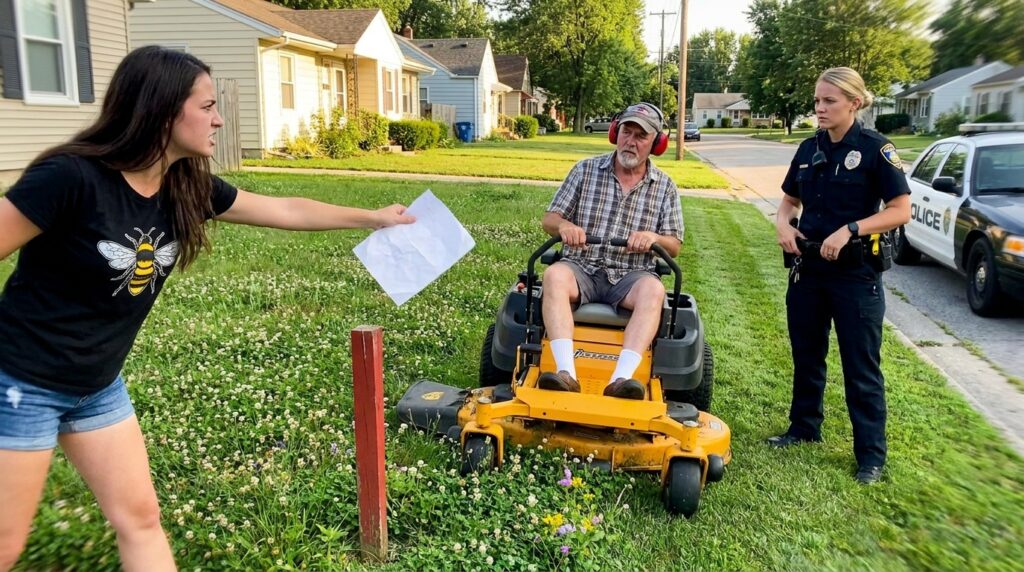
The iron-heavy hum of the zero-turn engine vibrated straight through the soles of Maya’s sneakers, a low, mechanical grinding that rattled the loose gravel at the edge of the asphalt. The air smelled of choked dust, split dandelion stems, and the sharp, sour tang of unburned diesel gasoline. Two feet ahead of her, the yellow steel deck of the mower sat paused, its blades spinning with a high, dangerous whistle that cut right through her ribs. The driver, a stocky man with a gray beard stained yellowish around his mouth from old tobacco tobacco smoke, kept his thick hands resting heavily on the steering levers, his red hearing protectors framing a face lined with a deep, professional exhaustion.

Maya held the city survey paper out between them. The edges of the white bond paper were already turning soft and grey from the sweat of her palms. Her thumb pressed hard against the crisp seal of the municipal clerk’s office, feeling the raised, embossed letters like teeth against her skin. “Look at the line,” she said, her voice small against the dull rumble of the machine but flat with an anger that had been simmering since April. “The red stake isn’t an estimate. It’s the city marker.”

The driver didn’t lean forward. He shifted his weight on the vinyl seat, the springs giving a dry, metallic squeak that reminded Maya of the old box springs her uncle used to burn in the valley. Across the blacktop, Harold Vance stood on his concrete porch, his hands tucked deep into the pockets of his crisp, pale gray slacks. He didn’t look at Maya; he looked at the uniform line of his own Kentucky bluegrass, which stopped exactly seven inches short of her wild, sprawling clover. The light of the mid-morning sun was flat, casting no shadows, making the entire street look like an old photograph that had been left too long in a damp basement.

“The old man said it was all his easement,” the driver shouted over the engine, his voice dry as corn husks. He didn’t drop the levers. The front wheels of the mower were buried four inches deep into a patch of white sweetclover Maya had planted by hand from three-dollar paper sacks. The small, white blossoms were mashed into a green paste against the yellow paint of the deck, their sweet, herbal scent crushed out into something heavy and sticky.

Before Maya could step over the red-capped stake, the blue-and-white cruiser slid to the curb, its tires crunching softly against the scattered stones. The engine didn’t turn off; it settled into a rhythmic, polite idle that seemed to absorb the aggressive roar of the mower. Officer Miller stepped out, her duty belt clicking with a heavy, administrative weight as she closed the door. Her blonde hair was pulled back into a knot so tight it smoothed the skin around her eyes, giving her the neutral, unreadable look of a state map.

She didn’t speak until she stood directly between the yellow bumper and Maya’s bare legs. She placed one palm flat out toward the driver—a gesture that had nothing to do with anger and everything to do with the momentum of an official order.

“Sir, shut the mower off,” Miller said. Her voice wasn’t loud, but it had the clear, unyielding tone of someone who spent forty hours a week untangling small-town spite. “We’re sorting this out right now.”

The driver’s shoulders dropped. He pulled the twin levers back into the neutral slots, and the mechanical scream of the deck died first, followed by the heavy throb of the engine. The sudden silence was vast and heavy, filled only by the ticking of hot metal and the distant, dry rattle of Maya’s kitchen water spigot vibrating against her foundation across the lawn. Maya looked down. At the base of the red stake, half-hidden by a clump of bruised chicory, lay a rusted brass garden trowel with the initials E.V. scratched into the throat of the metal—an object she had never seen before, its handle still wedged deep between two ancient, intertwined roots.


CHAPTER 2: THE ROOTS IN THE DUST

The heavy blue-and-white police cruiser finally backed down the driveway, its tires leaving faint, dark ribbons on the sun-baked asphalt. Officer Miller’s departure took the official shield with it, leaving behind a silence so sudden it made Maya’s ears ring. The neighborhood didn’t shift back to normal; it held its breath. Across the street, the pale gray outline of Harold Vance had vanished from his porch, leaving only the empty wicker chair and the screen door slightly ajar, a dark gap in the midday glare.

Maya knelt in the dirt, the dry heat of the ground baking through the denim of her shorts. The yellow mower had left deep, ragged trenches in the curb strip, the soil churned up into grey, clay-heavy clods that crumbled under her fingers. Everywhere lay the faded textures of her labor—the frayed, pale green stems of sweetclover, the crushed white heads of native chicory turned to a bruised, milky pulp against the dust. The air still carried the heavy, sour tang of the machine’s exhaust, but beneath it rose the scent of broken earth, old and damp and smelling faintly of minerals that hadn’t seen the light in decades.

She didn’t look at her phone. She didn’t look at the crisp survey paper now folded into a tight, sharp square in her back pocket. Instead, her eyes remained fixed on the small patch of shadow beneath the red-capped survey stake.

The rusted brass garden trowel was still wedged there, held fast in the wooden vice of two thick, gray clover roots that had grown completely around its neck over the years. Maya reached down, her fingers brushing the cool, pitted surface of the metal. The initials E.V. were shallow, scratched into the brass with what looked like a pocketknife, the edges smoothed down by decades of friction against the earth. Evelyn Vance. Harold’s wife had been dead for twelve years, her memory preserved only in the pristine, sterile perfection of Harold’s uniform lawn—a landscape that felt less like a yard and more like a well-tended cemetery plot.

Maya pulled at the trowel, but the roots wouldn’t give. They held the metal like a secret.

“He won’t stop, you know.”

The voice was thin, dry as old tissue paper, drifting over the split-rail fence from the property line to the east. Maya didn’t jump. She stood up slowly, wiping her dirt-streaked palms against her thighs, her eyes tracking the movement of Mrs. Gable. The elderly widow stood beside her overgrown hydrangea bushes, her frail frame clad in a faded floral duster that seemed to blend directly into the washing out colors of the afternoon. Her hands, spotted with pale liver marks, were tucked into her pockets, her small, pale blue eyes fixed entirely on the ruined clover strip.

“The police don’t stay past the city line, Maya,” Mrs. Gable said softly, her head tilting slightly toward the street. “They just draw the map. They don’t have to live on it.”

“The map is legal, Mrs. Gable,” Maya said, her voice carrying the flat, tight exhaustion of a three-month siege. She walked toward the fence, her sneakers crunching on the dry grass that marked the transition between her sanctuary and the widow’s unkempt yard. “Harold doesn’t own the easement. He never did. He’s just used to everyone letting him think he does.”

Mrs. Gable let out a faint, dry sound that might have been a laugh or a sigh. She reached out, her fingers catching on the fraying edge of the wooden fence rail, tracing a long, weathered split in the pine. “Harold thinks a lot of things. But he’s lived here forty-two years. When you stay in one place that long, the dirt starts to look like your own skin. You don’t take kindly to someone peeling it back.”

Maya watched the old woman’s hand. There was a smudge of violet ink on the side of Mrs. Gable’s right index finger—a dark, precise stain that didn’t match the garden or the hydrangeas. It was the specific color of the ribbon ink from the anonymous letters that had been appearing in Maya’s mailbox every Tuesday morning for six weeks. The typed notes that called her an eyesore, that threatened city code citations, that had the word TRADITION hammered into the cheap paper so hard the keys had punched through the fiber.

Maya looked from the ink stain to the woman’s face, which remained perfectly blank, soft and lined with the gentle, fading light of a life lived mostly indoors. The realization didn’t come with a shock; it arrived with the slow, heavy weight of an anchor settling into mud. The letters hadn’t been coming from across the street. Harold was the muscle, the loud mechanical roar, but the ink was right here, hiding behind the hydrangeas.

“Did you help Evelyn plant this?” Maya asked, her voice dropping, matching the soft, fading rustle of the leaves. She pointed down toward the rusted trowel still trapped in the roots at the boundary line.

Mrs. Gable’s hand stayed on the fence, her fingers tightening slightly until the skin over her knuckles went gray. She didn’t look down at the tool. She looked past Maya, toward the empty street and the pale, sun-bleached houses that lined the Clover Line like a row of teeth.

“Evelyn liked things that grew without asking,” Mrs. Gable said, her voice losing its softness, turning hard and dry as a stone in winter. “But Harold remembers what this place looked like before the developers put the numbers on the curbs. He remembers the covenants. You think you’re just growing weeds, Maya. But some things are buried so deep that if you pull them up, the whole block comes with them.”

She turned without waiting for an answer, the hem of her floral duster dragging slightly through the unclipped grass as she walked back toward her shaded back porch, the screen door clicking shut with a small, brass snap that sounded exactly like a latch dropping into place.

Maya stood alone at the fence line, the sun beginning its long, slow descent, painting the dusty suburban air in shades of copper and old gold. She looked back at the rusted trowel, then across the street at Harold’s silent house. The decoy was broken—the letters weren’t Harold’s—but the real trap was still locked in the ground beneath her feet, and the shadow of the old covenant was already stretching across her lawn.

CHAPTER 3: THE UNMASKING

The glass jars of dried lavender on Mrs. Gable’s porch didn’t rattle, but the air inside the small kitchen felt thick with the sediment of thirty years of quiet resentment. Maya didn’t wait for an invitation. She carried the small brown paper sack of native wildflower seeds like a peace offering that had already spoiled in her hands, her fingers digging through the thin paper until she felt the hard, individual kernels of milkweed and coreopsis shifting against her skin.

“You should have used a ballpoint pen, Mrs. Gable,” Maya said, her voice dropping into the quiet space between the ticking of an old sun-faded cat clock on the wall and the low, steady hum of the refrigerator.

The old woman didn’t turn around from the sink. Her thin back, curved under the faded floral duster like a dried stalk of chicory, remained perfectly rigid. The smell of vinegar and stale white toast hung heavily in the air, a domestic film that seemed to coat the yellowing linoleum floor and the frayed lace curtains. When she finally turned, her spotted hands were dripping wet, holding a damp kitchen towel with frayed blue borders. She didn’t look at Maya’s face; she looked down at the brown paper bag.

“A ballpoint leaves an indentation in the wood beneath the pad,” Mrs. Gable said, her voice thin but perfectly clear, devoid of the fragile, neighborly tremor she had used at the fence. “A Smith-Corona doesn’t lie. It just hammers the ink straight through. I bought that machine in 1978 to type my husband’s medical invoices. It’s outlived him. It’s outlived a lot of things.”

“Why?” Maya stepped closer to the laminate kitchen table. Sitting on a crocheted doily near the window was the heavy, olive-drab steel frame of the typewriter, its margins set narrow, a faint smudge of the identical violet ink staining the nickel-plated spacebar. “You told me you liked the clover. You told me you hated the noise of Harold’s mower.”

“I do hate it,” Mrs. Gable snapped, her small blue eyes flashing with a sudden, brittle energy that seemed to age her ten years in a second. She dropped the damp towel onto the counter, her fingers trembling as she pointed toward the window, where the sun was casting long, desaturated shadows across the road. “But Harold is a fool who only understands what he can see with a measuring tape. He thinks he’s protecting his lawn. He doesn’t know what’s actually holding these houses up.”

Maya frowned, the sack of seeds slipping slightly in her grip. “What are you talking about?”

“Look in the tin by the breadbox, girl. If you’re going to dig up the dirt, you might as well see what’s buried under it.”

Maya paused, her internal calculation spinning against the quiet gravity of the room. She reached out, her hand brushing against a rusted, blue tin that once held holiday shortbread, its edges worn down to the bare, gray tinplate. The lid gave way with a dry, scraping protest. Inside, nestled beneath a handful of dried lavender heads, lay a bundle of yellowing carbon-copy documents, the edges soft and fraying into dust.

She pulled out the top sheet. It wasn’t a city ordinance. It was a legal instrument from 1974, stamped by the county registrar, bearing the names of the original developers and the first buyers of the plat—including Harold and Evelyn Vance. Maya’s eyes scanned the fading, purplish text, her chest tightening as she hit the bolded headers. It wasn’t a standard Homeowners Association agreement. It was a restrictive covenant with a mandatory forfeiture clause.

…failure to maintain the uniform visual baseline of the residential landscape shall constitute a material breach, triggering an automatic reversionary interest and immediate acceleration of the underlying lien…

“The banks didn’t want this ridge developed,” Mrs. Gable whispered, her hand resting on the olive-drab typewriter like a weapon she was too tired to carry. “They put a poison pill in the original titles to keep the values from dropping during the oil crash. If the neighborhood aesthetic falls below the standard for more than ninety days, the primary lender has the automatic right to foreclose. Not just fine you, Maya. Take the house.”

Maya felt the blood leave her face, the paper in her hand suddenly feeling as heavy as a lead plate. “Harold…”

“Harold’s mortgage was restructured twenty years ago after Evelyn got sick,” Mrs. Gable said, her voice softening into a bitter, faded grief. “He’s one missed valuation away from losing that porch. He doesn’t hate your bees, Maya. He’s terrified of them. If the city inspectors log your yard as an unmanaged nuisance, the automated audit hits his title next. He hired that driver because he thought if he cleared the line, the automated flag would clear too.”

The decoy secret—the idea that this was just a spiteful old man defending his pride—shattered on the kitchen table, leaving behind a raw, systemic reality that Maya hadn’t prepared for. She wasn’t fighting a neighbor; she was triggering an invisible machine designed fifty years ago to crush anyone who stepped out of line.

Before she could speak, a sudden, heavy shadow blocked the kitchen window. Across the street, a dark grey pickup truck pulled into Harold’s driveway, but it wasn’t Harold behind the wheel. Two men in dark suits stepped out, carrying clipboards and a long, mechanical laser transit—the official county property appraisers.

The ninety days were up. The audit had already begun.

CHAPTER 4: THE PROPERTY LINE SUMMIT

“You shouldn’t be standing out here, Harold,” Maya said. Her voice didn’t rise above the humid afternoon breeze, but it cut through the low, idle thump of the appraisers’ truck across the asphalt.

Harold Vance didn’t turn around right away. He was leaning against the rusted iron handrail of his porch steps, his knuckles white against the flaking black paint. The mid-day sun had burned through the haze, casting a flat, harsh glare over the desaturated bricks of his foundation. Up close, his skin looked as thin and brittle as the carbon copies tucked into Maya’s pocket, patterned with the tiny, gray tracks of broken capillaries. He looked down at his shoes, then out at the dark grey pickup truck where the two appraisers were adjusting their laser transit on the opposite curb.

“They’re measuring the grade,” Harold muttered. His voice lacked the aggressive volume he had used through the proxy of the mower driver. It was small, dry, and hollowed out by a deep, generational fatigue. “The grade has to match the county code from seventy-four. If the drainage from your weeds pools against my line, it changes the valuation index.”

“It’s not the drainage, Harold. I know about the covenant.”

The old man froze. The slight tremor in his right hand stopped, his fingers locking around the cold iron rail. A crow called from the top of a dead power pole down the street, a sharp, lonely sound that echoed off the uniform garage doors. Slowly, his head turned, his pale, clouded eyes finding Maya’s face. The anger wasn’t there anymore; it had been replaced by a raw, naked vulnerability that made him look less like a neighborhood tyrant and more like a piece of drift wood that had been left to dry too long on a salt flat.

“Evelyn bought those seeds,” he whispered, his eyes dropping to the boundary stake between their yards where the rusted trowel still lay pinned by the thick clover roots. “The ones you planted. She kept them in the pantry behind the flour bin for fifteen years. She always wanted a wild strip. Said the grass here felt like an artificial carpet over something dead.”

Maya felt a sudden, heavy ache in her throat, the friction of her previous anger dissolving into the faded texture of a shared, hidden pain. She took two steps forward, crossing the line of her own crushed sweetclover, her sneakers pressing into the dry, stiff blades of his manicured lawn. “Then why did you try to destroy it?”

“Because if they see it, they look closer,” Harold said, his voice cracking as he pointed a trembling finger at the appraisers. “The covenant doesn’t just look at my grass, Maya. It looks at the whole line. If your lot is logged as an unmanaged blight, the automated clause triggers an evaluation on every contiguous title. My equity is gone. The bank has been waiting for an excuse to pull the note since the interest rates shifted. If they flag your sanctuary, my house goes back to the development trust by November.”

The sheer weight of the system hung over the empty suburban street, a cold, invisible structure that had pitted two people against each other over a patch of green earth. Maya looked down at her hands, still smudged with the grey clay of her garden. She had spent months treating this as a war for environmental sovereignty, a personal victory to be won with official surveys and legal stakes. But the victory felt hollow now, a jagged piece of glass that would slice open an old man’s life if she pulled too hard.

The two appraisers stepped off the curb, their heavy boots crunching against the loose gravel as they approached the boundary line. One of them, a younger man with a clean-shaven face and a state-issued badge clipped to his belt, lifted a clipboard, his pencil hovering over a form labeled Aesthetic Valuation Log.

“Afternoon,” the appraiser said, his eyes scanning the ragged, churned-up path where the yellow mower had bitten into the clover. “We received an automated notification regarding an unmanaged vegetation variance on this sector. Miss Lin, is this your parcel?”

Maya looked at Harold. The old man had pulled his arms tightly against his chest, his shoulders hunched as if he were trying to make himself small enough to disappear between the sun-bleached bricks of his house. The fading light caught the fraying edges of his collar, the silver hair at his temples damp with sweat. He was waiting for the blow to fall.

Maya reached into her back pocket, past the folded survey map, and pulled out a small, laminated card she had kept inside her wallet—the official municipal environmental certification stamp she had obtained from the state conservation department before she ever turned the first clod of earth. It bore a green state seal and a single, specific legal exemption clause: Protected Ecological Sanctuary under Statute 41-B.

“It’s not a variance,” Maya said, her voice steady, her eyes fixed on the appraiser’s clipboard. She stepped directly between Harold and the state official, holding the green seal out so the light caught the embossed signature. “The parcel is an intentional, registered habitat. Under state law, any municipal or private aesthetic covenants from prior to 1990 are automatically suspended for properties with a active ecological baseline certification. My yard isn’t a nuisance, sir. It’s an easement protection zone. And it extends across the contiguous line to any shared root systems.”

The appraiser blinked, his pencil pausing in mid-air. He leaned in, his thumb brushing the laminated edge of the certificate, checking the date stamp. The silence on the street shifted again, losing its mechanical tension, turning soft and slow-motion as the system’s gears ground against an unexpected barrier.

“Statute 41-B,” the appraiser muttered, shifting his clipboard to check a secondary reference sheet. “That covers the entire contiguous lot index if the vegetation is interdependent. If the clover roots extend into the adjacent easement…” He looked up, his eyes moving from Maya to the rusted trowel wedged deep between the thick, gray roots that crossed the property line into Harold’s soil. “Then the entire boundary is classified as an agricultural buffer. The valuation freeze is canceled. The title is exempt from the aesthetic audit.”

The younger man turned back toward the truck, waving his arm at his partner. “Pack it up, Dave. It’s a certified conservation zone. There’s nothing to log here.”

The truck door slammed shut a moment later, the dark grey vehicle pulling away from the curb with a low, heavy rumble that faded into the distance until the street was left to the quiet rustle of the leaves.

Maya turned back to Harold. The old man hadn’t moved from the rail, but his breathing had slowed, his chest rising and falling with a long, ragged relief. He looked down at the red-capped stake, then up at Maya, his mouth opening slightly as if he wanted to speak, to say something that had been stuck in his throat for twelve years. But he didn’t have the words. He just reached down, his spotted hand catching the fraying edge of his porch screen, and gave a single, slow nod before stepping back into the shadow of his hallway.

Maya walked back to the curb strip, kneeling once more in the dust beside the ruined clover. She reached out, her fingers catching the handle of the rusted brass trowel, and with a slow, steady pull, she left it right where it was—buried deep in the shared dirt, held fast by the roots that had already grown together.

CHAPTER 5: THE SHARED FURROW

The wire teeth of the leaf rake made a dry, scraping scream against the sun-bleached cedar of the fence post. Maya wiped her forehead with the back of her forearm, leaving a streak of grey dust across her skin that felt like dried mortar. Beside her, the shadow of Harold Vance moved with a slow, jerky rhythm. He was holding a coarse burlap sack open with his boots, his hands—spotted and stiff with the beginnings of morning arthritis—clutching the rusted handle of the trowel they had finally pried from the clover roots.

“The thatch is too thick here,” Harold said, his voice flat, roughened by the dust they had been turning up since seven in the morning. He didn’t look at Maya; his eyes were fixed on the line where his manicured turf met her trampled, bruised sanctuary. “If we don’t clear the dead stems before the evening dew hits, the rot will spread into the healthy clover. The inspectors will smell it from the road.”

“They won’t come back this week, Harold,” Maya said, lifting another bundle of yellowed, mower-chewed stalks and dropping them into the open mouth of the sack. The texture of the dried weeds was rough and brittle, pricking her palms through her canvas gloves. “The state certification is logged. The truck drove away.”

“The truck drove away because the boys with the clipboards don’t like paperwork,” Harold muttered, his fingers tightening on the burlap until the weave frayed against his fingernails. “The development trust isn’t a pair of boys. It’s a corporate entity with thirty miles of title insurance. They don’t disappear just because you show them a green stamp.”

Maya paused, the iron head of her rake resting against the toe of her sneaker. The silence that followed was small and hot, filled only by the dry rattle of her outdoor water spigot vibrating against the foundation behind her. Across the narrow strip of asphalt, the sun-faded green shutters of Mrs. Gable’s house remained perfectly closed, but the slats in the kitchen window were tilted downward at a sharp, unnatural angle. A faint reflection of white hair gleamed behind the dirty glass—a pale, stationary marble watching every handful of dirt they turned over.

Harold noticed it too. He didn’t look up, but his shoulders hunched further into his faded flannel shirt, the collar frayed into a fringe of grey threads around his neck. “She’s been at that window since the mail carrier left,” he whispered. “She knows what’s in the vault at the courthouse, Maya. She knows what my father signed in seventy-four.”

Before Maya could ask what his father had to do with the developer’s poison pill, Harold reached into his back pocket and pulled out an old, flat iron key with a square bow, its surface dark with old oil. He dropped it into the pocket of her denim shorts with a heavy, metallic clink.

“Go into the garage,” he said, his voice dropping into a register so low it was nearly swallowed by the rustle of the dry grass. “Under the workbench. There’s an old green tool chest with a padlock that matches that iron. Look at the deed map from the original plat survey. Don’t let her see you take it.”

Maya didn’t answer. She dropped her rake against the fence rail, her movements deliberate and slow to avoid drawing the eyes behind the green shutters. She walked across the dividing line, her sneakers sinking slightly into the uniform, spongy depth of Harold’s Kentucky bluegrass, heading toward the side door of his weathered detached garage where the smell of old grease, oxidized steel, and dry rot waited in the shade.

CHAPTER 6: THE SHADOW IN THE SHELVES

The side door of Harold’s garage groaned against its hinges, the dry cedar frame scraping a white line into the accumulated grit on the concrete floor. Inside, the air was cold and motionless, smelling heavily of old motor oil, pulverized wood, and the faint, sweet decay of wintering rodents. Dust motes hung suspended in the single shaft of amber light that managed to push through the grease-filmed window pane. Maya stepped inside, her sneakers pressing into a soft carpet of ancient sawdust that deadened her footsteps.

Her fingers slid down into the pocket of her denim shorts, her skin brushing the flat, cold edges of the iron key Harold had given her. She approached the workbench—a massive, unyielding slab of rough-sawn pine caked in decades of hardened black grease and the silver curls of aluminum shavings. Beneath it sat the green tool chest, its heavy steel corners oxidized into a coarse, reddish-brown crust. The brass padlock guarding the latch was dull with age, the keyhole choked with a gray web of spider silk.

Maya knelt, the pressure of the concrete biting through her thin socks as she tilted her head to see beneath the bench. She blew the dust out of the cylinder, the silk tearing away like dry tissue, and slid the square-bowed iron key into the slot. The mechanism turned with a heavy, satisfying clunk that echoed sharply off the tool-lined walls.

She lifted the lid. The interior smelled of old grease-stained paper. Expecting an ancient deed map, her hand closed instead over a stiff, cream-colored envelope resting directly on top of a stack of old engine manuals. The paper was crisp, expensive, and completely free of dust—it had been placed here recently. The return address in the corner was embossed with sharp, blocky blue letters: Clover Ridge Development Trust & Holdings, LLC.

Maya pulled the single sheet from the unsealed flap, the heavy paper crinkling loudly in the quiet garage. It wasn’t a historical document. It was a formal notification of intent to litigate, dated three days ago.

…Notice is hereby given that the Environmental Sanctuary Certification logged under Statute 41-B is subject to an immediate administrative challenge… The Trust asserts that the initial 1974 covenant configuration establishes a permanent private easement that cannot be overridden by subsequent state conservation designations without unanimous undivided consent of the original contracting heirs…

A sudden rustle from the back corner of the garage made Maya’s spine go rigid. The paper trembled slightly in her fingers. She slid her thumb beneath the document, lifting it to see what lay beneath, and found a heavy, hand-drawn map of the original plat survey from 1974. The ink was a faded, purplish color, identical to the typewriter ribbon Mrs. Gable used, but the signatures at the bottom didn’t belong to the developers.

The first signature, written in a shaky, elegant cursive that had faded to a dull sepia, belonged to Arthur Vance. Beneath it, in the exact same ink, was a secondary witness signature that made Maya’s breath catch in her throat: Clara Gable.

“You shouldn’t be reading that,” a voice said from the open doorway.

Maya whirled around, her lower back catching the sharp edge of the grease-slicked workbench. Harold stood in the frame, his silhouette dark against the blinding glare of the afternoon sun behind him. He didn’t look angry; he looked hollowed out, his thin frame leaning heavily against the doorjamb as if the light itself were pushing him down. In his left hand, he held a crinkled white slip—the certified mail receipt the postman must have delivered while they were working the line.

“The challenge came in the morning mail,” Harold said, his voice dropping into the quiet dust of the room like a dry leaf. “They found the loophole, Maya. They don’t need to prove your yard is a nuisance anymore. They just have to prove my father and Clara’s husband agreed to bind these lots forever before the state ever wrote that conservation law. If they break your shield, the audit triggers automatically.”

Maya looked from the faded purplish signatures on the map to the crisp, blue text of the lawsuit notice. The defense she had built with her municipal survey and her laminated certificate was splitting along an old, forgotten seam, and the ghost of the neighborhood’s original agreement was already tightening its grip around her home.

CHAPTER 7: THE LAND REGISTER SUMMIT

“My husband didn’t sign that paper to preserve the grass, Maya,” Mrs. Gable said, her thumb tracing the unpolished nickel rim of her teacup. She hadn’t offered Maya a seat, but she had left her front screen door unlatched, allowing the damp, pre-storm heat of the evening to bleed directly into her dark front parlor. The room smelled of old cedar shavings and the dry, chalky powder of crumbling wall plaster.

Maya stood by the small writing desk, the 1974 survey map unfolded between them. The purplish sepia signatures of Arthur Vance and Clara Gable seemed to fade further under the low amber glow of a single floor lamp. “Then why is the forfeiture clause in the deed? Harold thinks the bank is going to take his porch by November.”

Clara Gable let out a dry, rattling sigh that sounded like dead seed pods shifting in the wind. She stood up slowly, her faded floral duster trailing over the worn floral carpet as she walked to the corner bookshelf. Instead of a legal book, she pulled down a thick, cloth-bound ledger with a stained spine. When she dropped it onto the table, a fine plume of grey dust drifted through the light.

“Look at the back pages,” Clara whispered, her spotted fingers smoothing down the yellowed parchment. “The developers didn’t put that clause in to protect the neighborhood’s appraisal values. They put it in because the chemical plant three miles east had leaked into the shallow water table during the winter of seventy-three. The land trust was a shell company designed to buy out the residents’ right to sue for ground contamination.”

Maya leaned forward, her eyes scanning the faded, handwritten columns. It wasn’t an aesthetic log. It was a private financial ledger. Next to every lot number was a dollar figure and a non-disclosure stamp, initialed by the county clerk.

“The ninety-day lawn maintenance rule was a decoy,” Maya realized, her fingers pressing into the dry paper until she felt the texture of the old fibers yielding. “If a homeowner let their yard grow wild, the deep roots would reach the contaminated clay strata. The soil tests would show the industrial runoff. The trust added the automatic foreclosure clause so they could seize any property before the owner started digging deep enough to find the water.”

“Arthur knew it,” Harold’s voice came from the open doorway. He had crossed the street without his boots, his grey wool socks damp from the dew forming on his pristine lawn. He stood in the frame, his shoulders no longer hunched, his old eyes fixed on the ledger. “My father took the money to pay for Evelyn’s first surgery. He spent forty years cutting the grass short because he thought if he kept the roots small, the secret would stay dead in the mud, and the house would stay mine.”

The realization settled over the three of them like a heavy fog. The corporate challenge from the development trust wasn’t a defense of modern property rights; it was a desperate attempt to suppress a fifty-year-old ecological liability before Maya’s deep-rooted clover sanctuary drew the attention of the state environmental inspectors.

“They can’t enforce an illegal covenant,” Maya said, her voice rising with a quiet, unyielding weight. She pulled her phone from her pocket, her thumb tapping the screen to bring up the direct dial for Officer Miller’s civil mediation desk, alongside the digital file for her state conservation certification. “A forfeiture clause designed to conceal ground contamination is a violation of federal environmental law. The moment the state logs the historic ledger, the private easement is nullified. The loophole they used to challenge my shield just broke their own foundation.”

Clara Gable looked up from the table, a small, soft smile breaking through the lines of her frail face, the ink smudge on her finger catching the light like an old mark of distinction. “Evelyn always said you were the only one who looked at the soil instead of the fence, Maya.”

Outside, the first heavy drops of the evening storm began to fall, hitting the dry, sun-baked earth with a sharp, rhythmic patter. Maya stepped out onto the porch, Harold walking beside her, his hand reaching out to catch the cool rain against his palm. Across the street, the deep-rooted sweetclover and wild chicory stood tall against the wind, their green leaves drinking in the water, their roots holding fast to the ancient earth they had finally set free.

CHAPTER 8: THE SATURATION LINE

The rain didn’t fall in drops; it came down in grey, heavy sheets that turned the sun-bleached cedar fences of the Clover Line into dark, sodden boundaries. Maya stood on the curb, the hood of her yellow slicker thrown back, water streaming through her dark hair and pooling in the fabric of her bee-themed T-shirt. Beneath her sneakers, the clay of her curb strip had turned into a thick, slick paste, the crushed heads of her sweetclover clinging to her ankles like wet lace.

Two white state SUVs with the green emblem of the Environmental Protection Division sat idling at the curb, their orange strobe lights casting a rhythmic, metallic glare over the watching houses.

“You don’t have authorization to sink those shafts,” a man in a crisp, dark blue trench coat shouted over the downpour. He stood on Harold’s uniform lawn, his expensive leather shoes sinking three inches into the pristine Kentucky bluegrass. He was holding a plastic-sleeve folder against his chest—a formal corporate injunction bearing the gold seal of the Clover Ridge Development Trust. “This is private residential property subject to an active title dispute. Any subterranean sampling without corporate clearance is a trespass.”

The state inspector, a tall woman wearing mud-spattered hip boots and a heavy rubber apron, didn’t stop her work. She stepped over the red property stake, her boots sinking into Maya’s wild grass with a wet, heavy squelch. In her gloved hands, she held a two-inch steel core sampler, its T-bar handle slick with grease.

“Statute Forty-One-B doesn’t require your clearance, counselor,” the inspector called back, her voice flat, carrying the unyielding weight of official state authority. “We have a documented historical ledger indicating potential industrial runoff concealment dating back to seventy-four. The state has paramount easement access for public health assessment. Hold the tube, Miss Lin.”

Maya stepped forward, her hands closing around the cold, unpolished steel of the sampling cylinder. The metal was freezing against her bare palms, vibrating faintly as the inspector drove the foot-peg into the earth, biting past the shallow roots of the lawn and down into the grey, ancient clay beneath.

Across the street, Harold Vance stepped off his porch. He didn’t have his slicker on; his flannel shirt was already black with water, clinging to his thin ribs as he walked purposefully across the dividing line. He carried a heavy canvas tool bag, the oxidized iron handles clinking together with a sharp, transactional ring.

“The drainage line is six feet down,” Harold said to the lawyer, his voice steady, his old face hardened by the cold rain. He didn’t look back at his house. He looked straight at the corporate document in the man’s hands. “My father helped lay the clay pipe to hide the overflow. If you want to stop the test, you’ll have to explain to the county police why the trust has been paying the property taxes on the drainage easement since the day I moved in.”

The lawyer’s pen hesitated over the injunction, the rain already blurring the blue ink of his signature line. The power dynamic that had held the street captive for fifty years was dissolving in the mud, and the deep roots of Maya’s sanctuary were finally pulling the truth into the open light.

CHAPTER 9: THE UNBOUNDED RIDGE

“Take the center bolt out first, Harold,” Maya said, her fingers digging into the splintered edge of the split-rail fence post. The rain had slowed to a fine, silver mist that hung low over the grass, coating the coarse cedar rails in a slick, dark film.

Harold didn’t lean on his cane today. He stood in the damp earth of the boundary line, a heavy, oxidized socket wrench held tight in his wrinkled hand. The metal gave a sharp, dry crack as fifty years of rust and old paint finally yielded to the pressure. He didn’t look back at the pristine lawn behind him; his eyes were fixed on the gap where the wood met Maya’s wild sweetclover.

“This timber has been rotting since eighty-two,” Harold muttered, his voice carrying the rough, scraping tone of a man who had spent his life maintaining boundaries he never wanted. He dropped the rusted bolt into an old plastic bucket, where it landed with a dull, wet thud. “My father thought if he built the fence high enough, the bank wouldn’t look at the dirt. But the dirt doesn’t care about the wood, Maya. It all washes into the same creek eventually.”

From the next yard over, the sound of a heavy iron pry bar tearing into old pine split the quiet morning. Mrs. Gable stood beside her hydrangea bushes, her faded floral duster protected by a heavy canvas work apron. She wasn’t watching from her window anymore. Her spotted hands were slick with mud as she helped a young family from down the block haul a bundle of old cedar rails onto a low wooden cart.

“The trust’s lawyers didn’t even file the appeal,” Mrs. Gable called out, her voice clear and light, stripped of the fragile tremor that had hidden her secret for decades. She wiped a streak of wet soot from her cheek, leaving her skin looking bright and raw in the grey morning light. “The state inspectors found the old overflow pipe beneath my cistern last night. The corporate office is too busy shredding their seventy-four ledger sheets to worry about our grass.”

Maya turned her rake over, using the flat wooden spine to smooth down the rough, churned-up furrow where the yellow mower had bitten into the soil two days ago. The texture of the ground was different now—no longer a hard, compacted clay border, but soft and breathing, mixed with the dark leaf mold Harold had brought over from his old compost bin. Together, they were blending the lines, spreading the native milkweed and wild chicory seeds across the invisible barrier that had kept them apart.

As the sun finally broke through the low clouds, casting long, warm reflections across the open, unbroken ridge, Maya looked down at the red-capped survey stake. It was still there, but it didn’t mark a border anymore. It was just a piece of painted plastic, half-buried beneath a canopy of new green leaves that were already growing together across the entire block.

Similar Posts

Leave a Reply

Your email address will not be published. Required fields are marked *