
The Logic of the Frame: A Novel of Structural Boundaries, System Failure, and the Heavy Cost of Arbitrary Compliance

CHAPTER 1: THE LANE FOUR STANDOFF BEGINS

The register belt did not click to a halt; it died with a low, hydraulic groan that signaled a deliberate mechanical override. I did not take my hand off the canvas strap of my tote bag. Inside it, two wooden crates of heirloom regional plums sat precisely balanced against a sealed carton of cold-pressed oil, their weights distributed according to the simple laws of gravity I had spent four decades working around. The air in the Oakridge Artisan Market was thick with the scent of dark roasted beans and the damp, sharp smell of fresh cedar shavings scattered beneath the display bins. It was a space built to mimic a simpler era, yet beneath the rough-hewn pine beams, the soft green glow of the terminal screen flickered with the steady, binary heartbeat of an enterprise logistics mainframe I knew down to its raw database queries.

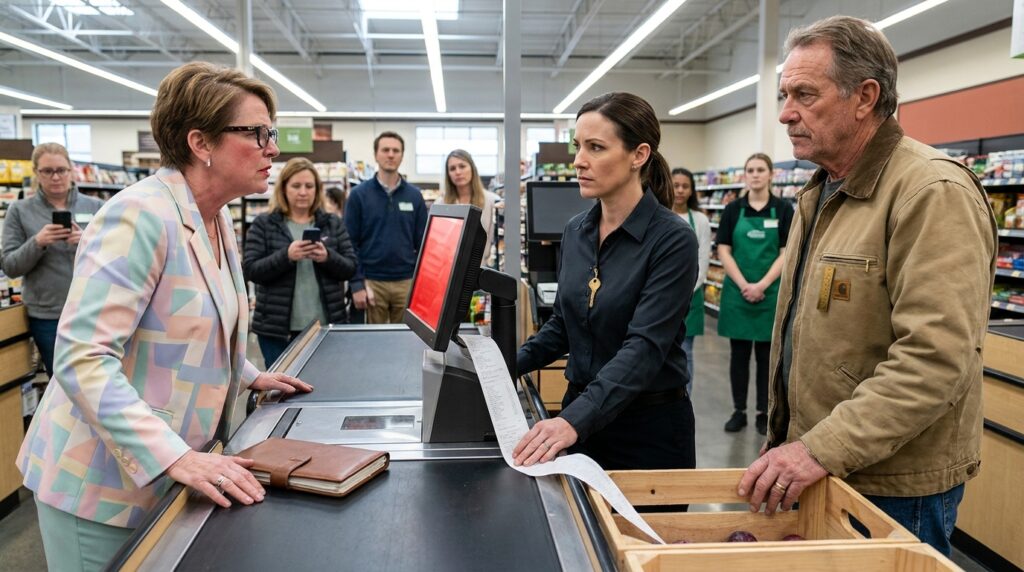
Connie Fitzpatrick stepped into the narrow line barrier, her wide silhouette clad in a pastel geometric blazer that caught the glare of the high industrial skylights. The leather-bound ledger she carried under her arm didn’t touch the counter—she slammed it directly onto the glass scanner window, a deliberate physical breach that caused the teenage cashier to yank his fingers back from the conveyor belt.

“This transaction is frozen,” she announced, not to me, but to the six people waiting behind me in the queue. Her voice carried the flat, uninflected authority of a self-appointed auditor who had spent seven years turning the market’s compliance committee into a personal fiefdom. “This individual is attempting to clear a tier-four commercial corporate allotment without localized verification. Under rule twelve, I am taking custody of these assets for an immediate inventory audit.”

I looked at her designer glasses, the frames thick and dark against her rigid cheekbones, before my gaze dropped to the pocket of my canvas jacket. My thumb brushed the cool, grooved edge of the brass calibration rule tucked near my pen pocket. The metal was steady. It did not expand or contract based on the volume of a room.

Behind me, the line shifted. The wheels of a metal grocery cart squeaked against the polished concrete floor as a shopper lowered a basket of organic greens to get a clearer view. The cashier’s green apron crinkled as he took a step back, his hands rising slightly in the universal gesture of a low-wage worker recognizing a corporate threat he wasn’t paid to resolve.

“The terminal has already processed the authorization token,” I said, keeping my tone within the flat, low register of a systems evaluation report. “The encrypted barcode was scanned three seconds ago. You should check the database before you touch that cart, Mrs. Fitzpatrick.”

She let out a short, rhythmic laugh that had nothing to do with humor. It was a tactical sound, designed to reframe my restraint as confusion for the people watching from the next aisle. She pulled her smartphone from her pocket with a sharp click of her fingernails against the case. “I am well aware of what the terminal shows, Mr. Mercer,” she said, her eyes narrowing as she read my primary identification off the pending transaction field. “But a tier-four account belongs to the regional developers who fund this cooperative, not to casual sub-letters who look like they walked off a construction site. This space remains exclusive because some of us enforce the boundaries.”

She raised the phone, the lens catching the gray noon light as she pointed it directly at my face. In the reflection of her glasses, I watched the blue loading bar of the market’s internal network community app begin to cycle. A paradigm-shifting piece of information caught my eye on her screen—the notification header on her open intranet app displayed a flashing red override code that I had written myself five winters ago during the system’s structural deployment, a code that should only appear if the terminal had detected a massive, unresolved internal corporate default linked directly to the committee’s own domestic ledger.


CHAPTER 2: THE LOGIC OF THE LEDGER

“The local network doesn’t drop an infrastructure override code for a routine verification check, Connie,” I said, my voice cutting flatly through the rising hum of the checkout floor.

She didn’t lower the phone. Her thumb remained pressed against the side button, her knuckles white against the gold-trimmed casing as she stepped deeper into the metal lane guide. The heat haze rising off the terminal’s older processing unit carried the distinct, synthetic smell of warm solder and dust. The concrete beneath my boots was worn gray, pitted by decades of heavy pallet jacks shifting weight from the loading docks to the retail floor. Every inch of the market’s layout was designed to look organic, but the skeleton beneath it was rigid, heavy-gauge steel and network cabling that I had mapped line by line.

Connie adjusted the heavy leather ledger on the scanner glass, the corner of the cover grinding against the optic lens with a dry, scratching friction. “The committee handles its own operational defaults, Mr. Mercer,” she replied, her tone sharpening as she noticed a couple two lanes over look up from their cart. “What you’re seeing on this terminal is an explicit compliance failure flag. This lane is locked because the regional network has flagged your account code as an unverified entity. If your foundation actually funded this cooperative, you’d be on the local executive white-list, not setting off database exceptions in the middle of Saturday morning.”

I didn’t answer with words. I took the brass calibration rule from my pocket, its weight familiar and dense in my palm, and tapped the cold edge once against the metal rail of the register. The sound was sharp, transactional, a small piece of objective metric logic dropped into the middle of her performance. Through the glare of her designer glasses, I could see the reflection of the terminal’s status line. The green authorization light had shifted to a rhythmic, amber pulse—the exact sequence the system uses when a transaction is held in a remote network queue by an external database administrator.

The cashier behind the counter had stopped moving entirely. His green apron hung loose, stained with the juice of crushed organic berries, his eyes locked on the digital invoice fields on his master display. “Mr. Mercer,” he murmured, his voice cracking slightly under the weight of the lane’s silence. “The mainframe isn’t letting me clear the item weight. It’s requesting a physical paper log entry from the compliance ledger. I can’t override it from here.”

“He knows he can’t override it,” Connie said, her posture stiffening as she leaned forward, using her silhouette to frame the register counter like an enforcement wall. “Because three days ago, the executive board issued a proxy note specifically blacklisting this exact tier-four allocation series for structural review. Your foundation has been siphoning operational margins under the guise of an agricultural grant, Mr. Mercer, and today the balance sheet catches up with the asset.”

The accusation hung in the warm air between us, heavy and smelling of old iron. It was a decoy—a beautifully constructed bit of administrative misdirection that would have broken a standard shopper under the weight of public shame. Behind us, the murmur of the Lane Four witness layer grew louder, the rustle of paper bags and the low, irritated shifting of feet marking the growing bottleneck. A man in a tailored gray suit two places back pulled out his phone, his thumb flicking upward as he opened a recording app, the lens focused squarely on Connie’s leather ledger and my canvas tote.

I checked the timestamp on my screen. 10:14 AM. The system was running out of buffer time before the automated diagnostic routine would ping the manager’s office. I looked closely at the flashing red line on Connie’s phone, which she had laid flat on the counter to display the alleged proxy note. The account number listed under the blacklist entry wasn’t the master registration code for the Northwest Agricultural Foundation. It was an off-shore corporate entity registered under an identical phonetic name—a shell setup built to mirror the foundation’s logistics routing, masking an internal transfer of funds that had been authorized by the compliance committee’s own internal signature stamp.

“That’s a very specific ledger entry, Connie,” I said, my voice dropping an octave as I leaned slightly over the counter, the dry heat of the register unit warming the sleeve of my canvas jacket. “But you’re reading the wrong side of the ledger. The proxy note you’re holding doesn’t lock the account from the outside. It locks the terminal because the system is attempting to print an audit trail for a duplicate registration that doesn’t exist on our master server.”

Connie’s hand jerked slightly, her fingers brushing the edge of the leather ledger as if to cover the screen. The confidence in her silhouette didn’t vanish, but her jaw tightened, the muscle along her neck turning rigid as she looked toward the main office stairs at the back of the market. “The committee doesn’t make accounting errors, Mr. Mercer. We protect the community’s assets from people who think they can use our infrastructure for free. The general manager is already on her way down, and she has the keys to the physical vault log.”

I kept my hand flat on the canvas strap of my bag, my thumb tracking the steady pulse of the amber light on the terminal. The trap she had set was built out of policy language and social pressure, a framework designed to make the target flee before the actual logs could be pulled. But the physics of the architecture were already moving against her. The register’s cooling fan began to whine louder, a high-pitched mechanical strain that signaled the database was executing a full data-dump to the local supervisor terminal. The first clue was laid, the decoy was locked in place on her screen, but the true master deed was still buried three layers deep in the encrypted core, waiting for the supervisor key to turn the lock.

CHAPTER 3: THE GATHERING CROWD AND DIGITAL DEFAMATION

The terminal’s cooling fan hit a high, screaming pitch, vibrating against the stainless steel counter with the frantic energy of a machine trying to process a contradictory logic loop. The amber authorization light strobed across the rough weave of my canvas jacket. We were caught in the friction point between a physical space and a digital absolute, and the weight of that stall was beginning to warp the air in Lane Four.

Behind me, the line of weekend shoppers compressed. The physical boundary of personal space dissolved as curiosity and irritation pushed them forward. A man standing two carts back—wearing a tailored gray suit and a silver dive watch—let out a sharp exhale. His phone screen cast a pale blue glow upward against his jaw.

“Is this a joke?” the man asked, his voice cutting through the ambient hum of the industrial refrigerators. He stepped past the metal lane divider, closing the distance to the register, and held his smartphone out so the screen faced me. “Are you the guy in this post? Because my app is blowing up with push notifications.”

I didn’t lean in, but my eyes tracked the pixels. On his screen was the market’s private intranet forum. At the top was the photograph Connie had taken ninety seconds ago—my face, the canvas tote, the locked terminal. Beneath it was a block of heavy, red-tagged text bearing the compliance committee’s official digital seal. The caption read: Emergency Stop at Lane 4. Unauthorized individual attempting to drain Tier-Four foundation assets using a blacklisted proxy token. Commencing physical inventory seizure.

Connie stood a foot away, her posture rigid, the pastel fabric of her blazer pulled tight across her shoulders. She was breathing shallowly, her eyes darting from the man’s phone to the crowd gathering in the adjacent aisles. She had weaponized the neighborhood’s fear of corporate exploitation, banking on the crowd’s instinct to protect their sanctuary.

But as I looked at the image on the man’s phone, my gaze caught on a micro-detail buried in the attached proxy document she had uploaded. It was a digital stamp in the bottom left corner. The routing signature didn’t say Northwest Agricultural Foundation. It read Oakridge-Agri-Holdings-LLC.

The decoy secret clicked into place like a heavy deadbolt sliding home.

It wasn’t a glitch. It wasn’t a misunderstanding. The compliance committee hadn’t accidentally flagged my master account; they had deliberately inserted a mirrored shell corporation into the local database. They were using the proxy note to create a fake administrative default, giving them the bureaucratic cover to seize high-value allocations straight off the retail floor. Connie wasn’t just enforcing a rule; she was executing a manual override to redirect the foundation’s regional assets into her committee’s private ledger.

“I need those items moved to the holding cart immediately,” Connie ordered, her voice louder now, aiming for the back rows of the crowd. She pointed a manicured finger at the two wooden crates of heirloom plums sitting by my bag. “The community has been notified. The assets are frozen.”

The teenage cashier, sweating heavily under the collar of his green apron, reached out with trembling hands toward the crates.

I didn’t raise my voice, and I didn’t make a sudden movement. I simply slid my left hand forward two inches, letting my palm come to rest flat against the raw, splintered edge of the wooden crate. The physical mass of my arm, anchored by the leverage of my shoulder, formed an immovable structural barrier. The cashier’s fingertips brushed the back of my knuckles, and he instantly recoiled as if he had touched a live wire.

“The items remain on the scale,” I said. My voice was a low, even rasp, grinding against the rising panic in the lane. “You are looking at a forged routing signature, Mrs. Fitzpatrick. Oakridge-Agri-Holdings is not the foundation. It’s a domestic LLC. If you force him to touch this inventory, you are compelling an employee to commit physical theft on a logged system.”

Connie’s face flushed a deep, mottled red. The thick frames of her designer glasses slipped slightly down the bridge of her nose. “How dare you,” she hissed, slamming her leather ledger against the metal guardrail. “The committee’s logs are absolute! You are a fraud, and this community sees exactly what you are.”

But the community was reading the data.

A sharp, metallic ping echoed from the phone of the man in the gray suit, followed by another, and then a cascade of chimes rippled down the checkout line. The digital tide was reversing. I watched the man’s eyes scan the rapidly updating comment section under Connie’s post.

“Wait a minute,” an older woman’s voice rang out from the edge of Lane Three. It was a retired schoolteacher, leaning heavily on the handle of her cart, her phone held out like a lantern. “Connie, what gives you the right to confiscate groceries on the main floor? Section nine of the bylaws only applies to the wholesale loading docks. Since when do you have executive authority over the retail registers?”

“She doesn’t,” the man in the suit added, his tone shifting from irritated to openly accusatory. “And who authorized a committee chair to post customer photos on the internal feed? That’s a massive liability violation.”

The friction in the room was palpable. The air smelled of ozone from the overheating terminal and the sour tang of nervous sweat. Connie looked at the crowd, her mouth opening and closing as the realization hit her that the structural integrity of her social authority was fracturing in real-time. She had expected a mob to fall in line behind her clipboard; instead, she had given them the exact documentation they needed to dismantle her.

“This is a secured operation!” Connie yelled, her voice finally cracking, losing the polished veneer of the corporate gatekeeper. She lunged forward, her hand reaching past the scanner glass, aiming directly for the handle of my canvas tote bag.

Before her fingers could make contact, the amber light on the register terminal stopped pulsing.

It flashed to a solid, blinding, violent red.

The cooling fan died with a heavy, metallic clunk. A loud buzzer tore through the lane, a sustained, flatline tone that meant the system had completely timed out and locked the physical cash drawer. The terminal screen refreshed, displaying a massive, blinking command prompt: CRITICAL SYSTEM FAULT. MANUAL SUPERVISOR KEY REQUIRED. ASSET FORFEITURE INITIATED TO LOCAL COMMITTEE LEDGER.

She hadn’t just stopped the transaction. Her phone’s proximity override had triggered an automated theft protocol built directly into the store’s infected sub-network.

At the far end of the warehouse, a heavy steel door slammed open against a concrete wall. The sound cracked like a rifle shot over the heads of the crowd. The heavy, rhythmic strike of hard-soled shoes began descending the iron staircase from the elevated manager’s office.

I kept my hand anchored on the raw wood of the crate, my eyes fixed on the red glare of the locked screen. The decoy was in the open, but the master key was walking down the stairs, and the absolute truth of who owned the concrete beneath our feet was about to be pulled from the dark.

CHAPTER 4: THE MANAGERS INTERVENTION

The iron grating of the overhead catwalk vibrated against the concrete pillars as Elena Rostova descended, each heel strike ringing out with the cold, measured cadence of a pressure test. The air inside the register box grew heavy, thick with the smell of ozone from the fried processor and the stale scent of dried citrus from the packing crates. The red glare of the terminal screen cast long, distorted shadows across Connie Fitzpatrick’s pale geometric blazer, turning the intricate patterns into jagged edges that matched the tension in her jaw.

Elena stepped off the final tread, her dark corporate uniform immaculate, the gold nameplate pinned to her lapel catching the high glare of the skylights. She didn’t look at the crowd, nor did she look at Connie’s ledger. Her eyes went straight to the blinking terminal display, then down to my hand, which remained anchored flat against the rough, unsanded grain of the wooden crate.

“The register queue has been deadlocked for seven minutes, Mrs. Fitzpatrick,” Elena said, her voice dropping into the precise, low register of an administrator tracking a critical infrastructure failure. “The backline logs indicate a forced systemic lock. Explain why terminal four is executing a restricted asset forfeiture protocol on a weekend checkout shift.”

Connie smoothed the lapel of her blazer, her fingers trembling slightly against the cloth before she grabbed the heavy leather ledger from the scanner glass. She drew herself up, using the physical bulk of her silhouette to reframe the narrow space between the counter and the exit gate. “Elena, this individual is operating under a compromised allocation token,” she declared, pointing her phone at my jacket. “The compliance committee pulled the proxy note from the central intranet three days ago. Oakridge-Agri-Holdings has officially blacklisted this tier-four identifier for margin manipulation. I am executing an administrative freeze to secure the cooperative’s inventory before these high-value assets are removed from the premises.”

Elena didn’t nod. She drew a small brass supervisor key from her uniform pocket, the metal tarnished around the barrel from years of industrial contact, and inserted it into the manual override slot beneath the conveyor housing. “Let me see the network routing,” she said.

I watched the lines tighten around Connie’s eyes as Elena leaned over the console. This was the moment the decoy secret was supposed to hold—the beautifully prepared balance sheet that linked my name to the blacklisted LLC. If the system processed the proxy note under standard compliance rules, the manager would have no choice but to sign off on the asset seizure, leaving the true ownership of the distribution facility buried deep within the network’s legacy files.

“The database alignment matches the committee’s filing,” Elena murmured, her thumb tracking the lines of amber text that began to scroll up the terminal’s backup screen. She paused, her gold nameplate catching the red light of the system fault. “The identifier is associated with the proxy blacklist note. Mr. Mercer, according to this interface log, your foundation’s operational access has been suspended by a majority vote of the local governance board.”

A low murmur rippled through the Lane Four witness layer. The man in the tailored gray suit lowered his phone slightly, his expression hardening as he looked from the terminal to me. The schoolteacher three spaces back shifted her weight, the wheels of her cart grinding against a patch of rough concrete. The social gravity of the room was balancing on a single point: the physical document on the screen said I was a fraud. The decoy had functioned perfectly. The system had accepted the lie, and my operational authority was dead in the water.

“The board’s action is absolute, Elena,” Connie said, her voice reclaiming its hard, institutional edge as she stepped closer to my bag. “The logic is clear. He has no standing to hold these items. Complete the forfeiture so we can clear the lane.”

I did not pull my hand back from the crate. I reached into my canvas vest, my fingers closing around the cold, grooved edge of the brass calibration rule. I drew it out, the dull metal catching the dim light, and laid it flat against the scanner glass right next to the ledger.

“The logic is incomplete,” I said, my voice cutting through the mechanical hum with the flat precision of a structural inspection log. “The manager isn’t looking at a network failure, Mrs. Fitzpatrick. She’s looking at an infrastructure lockout. Look at line forty-two of the log output, Elena. Check the central mainframe access code that authorized that proxy note.”

Elena frowned, her hand hovering over the key. She tapped three keys on the secondary numeric pad, forcing the terminal to drop its standard retail user interface and display the raw system configuration level. As the code scrolled by, the general manager’s fingers went entirely still. The professional indifference in her posture fractured, replaced by a sudden, rigid focus that made the gold plate on her chest rise and fall with a sharp intake of air.

The micro-mystery of the routing stamp didn’t lead to a simple corporate default. The access code used to execute the proxy blacklist wasn’t an executive board key at all. It was an internal maintenance token assigned exclusively to the compliance committee’s private real estate syndicate—a token that had been used to access the mainframe’s core structure to mask a massive, unrecorded transfer of building equity.

“This token didn’t come from the central system office,” Elena said, her voice dropping into a dangerous, level whisper that made the cashier freeze mid-breath. She turned slowly to face Connie, her eyes locked onto the leather-bound ledger. “Connie, this configuration file shows that your committee proxy note is trying to override the master facility registration. Why is your real estate group attempting to clear an equity transfer on a retail terminal?”

“It’s an automated cross-reference error,” Connie stammered, her face losing its flush, turning a dull, chalky white under the high skylights. She took a step back, her heel hitting the metal frame of the lane barrier with a sharp, hollow clang. “The committee has the right to secure the registry. The board approved the audit framework.”

“The board approved a retail inventory check, not an infrastructure manipulation,” Elena said, her voice rising as she pulled the supervisor key out with a vicious click. The terminal screen flickered, the red fault light remaining solid, but a new line of text began to print across the bottom of the black screen—a deep system warning that Connie’s forced block had triggered an automated corporate fraud alert that could not be cleared from the store floor.

The decoy secret was shattered, but the impact of the crash had locked the entire system down. We were stuck in a dead state, the inventory frozen, the line behind me extending into the main aisles, and the true nature of the master deed was now completely trapped behind an ironclad, system-wide corporate lockout that threatened to shut down every terminal in the valley.

CHAPTER 5: THE SYSTEM AUDIT REVERSAL

The solid red bloom of the terminal screen did not waver. It cast a bloody, static glare across the polished scanner glass, illuminating the grain of the wooden plum crates like raw meat on a butcher’s block. The sustained, flatline buzz of the hardware lockout tore through Lane Four, drowning out the ambient rattle of shopping carts and the collective indrawn breath of forty waiting neighbors.

Connie Fitzpatrick stepped back, her heels grinding against the steel base of the lane gate with a dry, screeching slide. The leather ledger slipped from her fingers, striking the edge of the conveyor belt with a dull, hollow thud. “Elena, override this,” she commanded, her voice ascending into a thin, desperate register that carried no institutional weight. “The system is acting outside protocol. The committee’s proxy is the primary document.”

Elena Rostova did not move her hand away from the supervisor slot. Her dark uniform was completely still under the harsh glare of the warehouse skylights, her jaw locked into a rigid line. “The retail mainframe isn’t executing a store protocol, Connie,” Elena said, her voice dropping into a level, glacial whisper. “It’s processing an absolute corporate security breach. The network trace didn’t stop at the store server. It just went out to the regional database.”

I took my palm off the top of the wooden crate. The rough wood had left deep, red indentations across my skin, a physical reality that grounded the room against the flashing digital chaos. I reached down, bypassed the ledger entirely, and tapped a single command sequence directly onto the terminal’s manual hardware keypad. Three keys. A simple diagnostic dump I had hard-coded into the cooperative’s baseline architecture when the first servers were bolted to the floorboards.

The flatline buzzer cut out instantly. The silence that followed took up physical space in the lane, heavy and thick with the smell of warm copper and scorched paper.

“The system isn’t deadlocked, Elena,” I said, my voice dry, grinding out the words with the flat cadence of a machine returning an expected result. “It’s waiting for the master hardware token verification. Run the cross-reference code against the cooperative’s physical brick-and-mortar property ledger. Not the membership file. The land deed.”

Elena looked at me, her fingers freezing on the key barrel. The gold nameplate on her chest rose and fell in a single, sharp expansion. She didn’t ask questions; she was a creature of operational efficiency, and the raw logic string displaying on the lower status bar left no room for interpretation. She pressed the command enter key.

The thermal printer beneath the register counter did not click; it exploded into action with a loud, mechanical whine, the small gears spinning with frantic velocity. A thick, white ribbon of high-density paper began rolling out of the slot, cascading down over the scanner glass like a long, pale snake. One foot. Two feet. Three feet of dense, uncompressed system log lines, the fresh ink smelling sharp and metallic as it hit the hot morning air.

Elena gripped the edges of the printout, her eyes tracking the lines of black text. The professional indifference fell away from her face completely, leaving her features hollowed out under the high lights. She turned the paper so the master registry column faced the checkout aisle, her thumb pointing to the primary account line printed in bold system font.

“This isn’t an agricultural grant allocation,” Elena announced, her voice projected clearly across the rows of waiting carts and the cashiers who had frozen mid-scan in the adjacent lanes. “The master account token scanned at this register doesn’t draw from a commercial sub-allotment. Mr. Mercer doesn’t hold a local committee registry card because his foundation owns the physical deed to this entire distribution facility. The cooperative operates on land leased directly from his corporate grant.”

Connie’s hand slapped against the metal guardrail, her fingers sliding uselessly over the smooth steel. Her face was entirely bloodless now, a pale, chalky mask behind the dark frames of her glasses. “That’s impossible,” she whispered, her voice failing to carry past the register box. “The committee handles the regional grants. We authorized the development fund. The documentation says—”

“The documentation you uploaded is an explicit fraud trail, Mrs. Fitzpatrick,” I said, my voice cutting through her explanation like a cold chisel through soft iron. I picked up my canvas tote bag, the weight balancing cleanly against my shoulder. “You used a mirrored shell corporation to flag this transaction because you needed an administrative excuse to seize the foundation’s distribution tokens before the quarterly audit. You thought a man carrying a canvas sack wouldn’t understand the routing architecture of his own servers.”

The turn in the lane was instantaneous and total.

The man in the tailored gray suit let out a loud, mocking laugh, his smartphone held high as he recorded Connie’s face in real-time. “Unbelievable,” he shouted to the shoppers behind him. “She’s been running a real estate scam out of the front office while we’ve been waiting twenty minutes in line for groceries.”

“Get her off the floor!” the retired schoolteacher yelled from Lane Three, her cart shoved forward to block Connie’s path toward the exit doors. “We want a full audit of every committee notice she’s posted this year!”

A dozen phones rose simultaneously in the queue, the lenses catching the bright glare of the skylights as the murmurs shifted into a roar of collective exclusion. The cashiers in their green aprons turned away from Connie, their arms crossed, completely refusing to offer a single word of support. The market security guard who had been standing by the main exit took three steps backward, his hands resting on his utility belt, leaving Connie standing completely isolated against the red glow of the terminal she had tried to subvert.

Elena Rostova looked up from the three-foot thermal printout, her expression flat, her eyes hard as flints. “Mrs. Fitzpatrick, your access tokens are suspended effective immediately. I am locking your committee ledger into the store vault for legal review by the executive board at noon. Leave the property now.”

Connie looked at the crowd, her lips moving without sound, her hand clutching at the empty air where her clipboard used to rest. She turned on her heel, her pastel blazer catching the red light of the terminal one last time as she stumbled through the exit gates, fleeing under the heavy, silent judgment of the neighborhood she had spent seven years attempting to dominate.

I reached out, took the long thermal receipt from Elena’s hand, and folded the white paper into four precise, even increments. I slid it next to the crates of plums inside my canvas tote bag, adjusted the strap, and gave the general manager a short, functional nod.

“The logic is clean, Elena,” I said, my voice low and steady as I stepped past the counter. “A clipboard doesn’t change the structure of the frame. The system always purges the noise.”

I walked out of Lane Four, my boots striking the cold concrete with a slow, unhurried rhythm. The sun outside was bright and level, hitting the asphalt with a clean, blinding clarity that smelled of dry earth and open road. My truck was packed, the manuals were organized, and the twelve-day retreat was waiting. The lane was clear, the boundaries were set, and the engine was running exactly as it was designed to do.

Similar Posts

Leave a Reply

Your email address will not be published. Required fields are marked *






