
CHAPTER 4: THE MANAGERS INTERVENTION
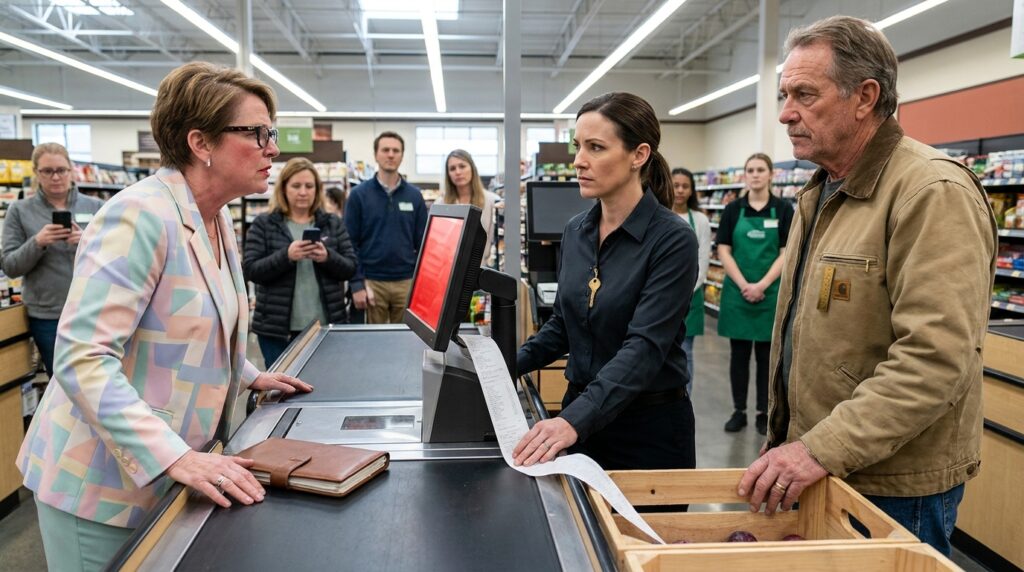
The iron grating of the overhead catwalk vibrated against the concrete pillars as Elena Rostova descended, each heel strike ringing out with the cold, measured cadence of a pressure test. The air inside the register box grew heavy, thick with the smell of ozone from the fried processor and the stale scent of dried citrus from the packing crates. The red glare of the terminal screen cast long, distorted shadows across Connie Fitzpatrick’s pale geometric blazer, turning the intricate patterns into jagged edges that matched the tension in her jaw.
Elena stepped off the final tread, her dark corporate uniform immaculate, the gold nameplate pinned to her lapel catching the high glare of the skylights. She didn’t look at the crowd, nor did she look at Connie’s ledger. Her eyes went straight to the blinking terminal display, then down to my hand, which remained anchored flat against the rough, unsanded grain of the wooden crate.
“The register queue has been deadlocked for seven minutes, Mrs. Fitzpatrick,” Elena said, her voice dropping into the precise, low register of an administrator tracking a critical infrastructure failure. “The backline logs indicate a forced systemic lock. Explain why terminal four is executing a restricted asset forfeiture protocol on a weekend checkout shift.”
Connie smoothed the lapel of her blazer, her fingers trembling slightly against the cloth before she grabbed the heavy leather ledger from the scanner glass. She drew herself up, using the physical bulk of her silhouette to reframe the narrow space between the counter and the exit gate. “Elena, this individual is operating under a compromised allocation token,” she declared, pointing her phone at my jacket. “The compliance committee pulled the proxy note from the central intranet three days ago. Oakridge-Agri-Holdings has officially blacklisted this tier-four identifier for margin manipulation. I am executing an administrative freeze to secure the cooperative’s inventory before these high-value assets are removed from the premises.”
Elena didn’t nod. She drew a small brass supervisor key from her uniform pocket, the metal tarnished around the barrel from years of industrial contact, and inserted it into the manual override slot beneath the conveyor housing. “Let me see the network routing,” she said.
I watched the lines tighten around Connie’s eyes as Elena leaned over the console. This was the moment the decoy secret was supposed to hold—the beautifully prepared balance sheet that linked my name to the blacklisted LLC. If the system processed the proxy note under standard compliance rules, the manager would have no choice but to sign off on the asset seizure, leaving the true ownership of the distribution facility buried deep within the network’s legacy files.
“The database alignment matches the committee’s filing,” Elena murmured, her thumb tracking the lines of amber text that began to scroll up the terminal’s backup screen. She paused, her gold nameplate catching the red light of the system fault. “The identifier is associated with the proxy blacklist note. Mr. Mercer, according to this interface log, your foundation’s operational access has been suspended by a majority vote of the local governance board.”
A low murmur rippled through the Lane Four witness layer. The man in the tailored gray suit lowered his phone slightly, his expression hardening as he looked from the terminal to me. The schoolteacher three spaces back shifted her weight, the wheels of her cart grinding against a patch of rough concrete. The social gravity of the room was balancing on a single point: the physical document on the screen said I was a fraud. The decoy had functioned perfectly. The system had accepted the lie, and my operational authority was dead in the water.
“The board’s action is absolute, Elena,” Connie said, her voice reclaiming its hard, institutional edge as she stepped closer to my bag. “The logic is clear. He has no standing to hold these items. Complete the forfeiture so we can clear the lane.”
I did not pull my hand back from the crate. I reached into my canvas vest, my fingers closing around the cold, grooved edge of the brass calibration rule. I drew it out, the dull metal catching the dim light, and laid it flat against the scanner glass right next to the ledger.
“The logic is incomplete,” I said, my voice cutting through the mechanical hum with the flat precision of a structural inspection log. “The manager isn’t looking at a network failure, Mrs. Fitzpatrick. She’s looking at an infrastructure lockout. Look at line forty-two of the log output, Elena. Check the central mainframe access code that authorized that proxy note.”
Elena frowned, her hand hovering over the key. She tapped three keys on the secondary numeric pad, forcing the terminal to drop its standard retail user interface and display the raw system configuration level. As the code scrolled by, the general manager’s fingers went entirely still. The professional indifference in her posture fractured, replaced by a sudden, rigid focus that made the gold plate on her chest rise and fall with a sharp intake of air.
The micro-mystery of the routing stamp didn’t lead to a simple corporate default. The access code used to execute the proxy blacklist wasn’t an executive board key at all. It was an internal maintenance token assigned exclusively to the compliance committee’s private real estate syndicate—a token that had been used to access the mainframe’s core structure to mask a massive, unrecorded transfer of building equity.
“This token didn’t come from the central system office,” Elena said, her voice dropping into a dangerous, level whisper that made the cashier freeze mid-breath. She turned slowly to face Connie, her eyes locked onto the leather-bound ledger. “Connie, this configuration file shows that your committee proxy note is trying to override the master facility registration. Why is your real estate group attempting to clear an equity transfer on a retail terminal?”
“It’s an automated cross-reference error,” Connie stammered, her face losing its flush, turning a dull, chalky white under the high skylights. She took a step back, her heel hitting the metal frame of the lane barrier with a sharp, hollow clang. “The committee has the right to secure the registry. The board approved the audit framework.”
“The board approved a retail inventory check, not an infrastructure manipulation,” Elena said, her voice rising as she pulled the supervisor key out with a vicious click. The terminal screen flickered, the red fault light remaining solid, but a new line of text began to print across the bottom of the black screen—a deep system warning that Connie’s forced block had triggered an automated corporate fraud alert that could not be cleared from the store floor.
The decoy secret was shattered, but the impact of the crash had locked the entire system down. We were stuck in a dead state, the inventory frozen, the line behind me extending into the main aisles, and the true nature of the master deed was now completely trapped behind an ironclad, system-wide corporate lockout that threatened to shut down every terminal in the valley.








