
CHAPTER 5: THE SYSTEM AUDIT REVERSAL
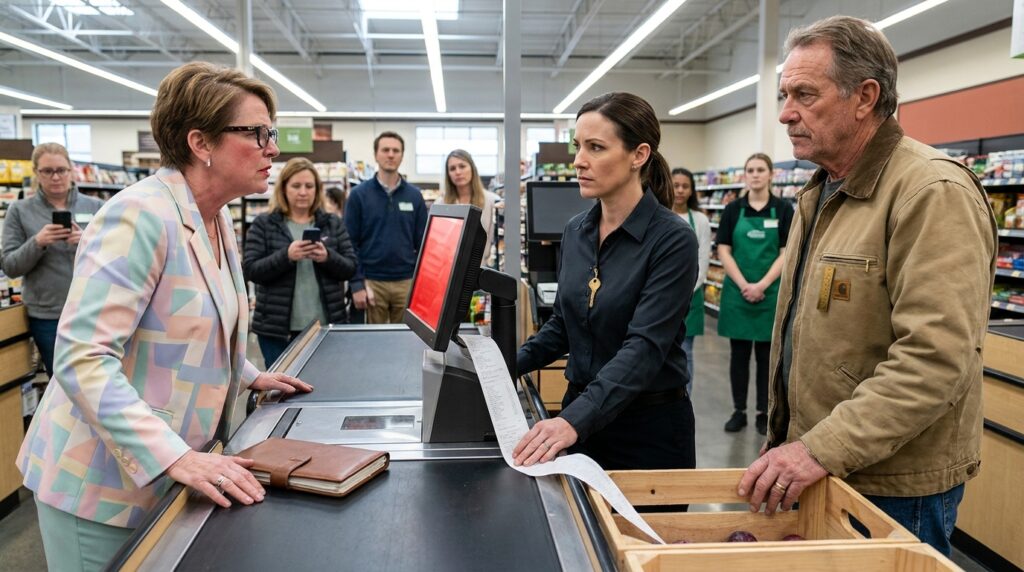
The solid red bloom of the terminal screen did not waver. It cast a bloody, static glare across the polished scanner glass, illuminating the grain of the wooden plum crates like raw meat on a butcher’s block. The sustained, flatline buzz of the hardware lockout tore through Lane Four, drowning out the ambient rattle of shopping carts and the collective indrawn breath of forty waiting neighbors.
Connie Fitzpatrick stepped back, her heels grinding against the steel base of the lane gate with a dry, screeching slide. The leather ledger slipped from her fingers, striking the edge of the conveyor belt with a dull, hollow thud. “Elena, override this,” she commanded, her voice ascending into a thin, desperate register that carried no institutional weight. “The system is acting outside protocol. The committee’s proxy is the primary document.”
Elena Rostova did not move her hand away from the supervisor slot. Her dark uniform was completely still under the harsh glare of the warehouse skylights, her jaw locked into a rigid line. “The retail mainframe isn’t executing a store protocol, Connie,” Elena said, her voice dropping into a level, glacial whisper. “It’s processing an absolute corporate security breach. The network trace didn’t stop at the store server. It just went out to the regional database.”
I took my palm off the top of the wooden crate. The rough wood had left deep, red indentations across my skin, a physical reality that grounded the room against the flashing digital chaos. I reached down, bypassed the ledger entirely, and tapped a single command sequence directly onto the terminal’s manual hardware keypad. Three keys. A simple diagnostic dump I had hard-coded into the cooperative’s baseline architecture when the first servers were bolted to the floorboards.
The flatline buzzer cut out instantly. The silence that followed took up physical space in the lane, heavy and thick with the smell of warm copper and scorched paper.
“The system isn’t deadlocked, Elena,” I said, my voice dry, grinding out the words with the flat cadence of a machine returning an expected result. “It’s waiting for the master hardware token verification. Run the cross-reference code against the cooperative’s physical brick-and-mortar property ledger. Not the membership file. The land deed.”
Elena looked at me, her fingers freezing on the key barrel. The gold nameplate on her chest rose and fell in a single, sharp expansion. She didn’t ask questions; she was a creature of operational efficiency, and the raw logic string displaying on the lower status bar left no room for interpretation. She pressed the command enter key.
The thermal printer beneath the register counter did not click; it exploded into action with a loud, mechanical whine, the small gears spinning with frantic velocity. A thick, white ribbon of high-density paper began rolling out of the slot, cascading down over the scanner glass like a long, pale snake. One foot. Two feet. Three feet of dense, uncompressed system log lines, the fresh ink smelling sharp and metallic as it hit the hot morning air.
Elena gripped the edges of the printout, her eyes tracking the lines of black text. The professional indifference fell away from her face completely, leaving her features hollowed out under the high lights. She turned the paper so the master registry column faced the checkout aisle, her thumb pointing to the primary account line printed in bold system font.
“This isn’t an agricultural grant allocation,” Elena announced, her voice projected clearly across the rows of waiting carts and the cashiers who had frozen mid-scan in the adjacent lanes. “The master account token scanned at this register doesn’t draw from a commercial sub-allotment. Mr. Mercer doesn’t hold a local committee registry card because his foundation owns the physical deed to this entire distribution facility. The cooperative operates on land leased directly from his corporate grant.”
Connie’s hand slapped against the metal guardrail, her fingers sliding uselessly over the smooth steel. Her face was entirely bloodless now, a pale, chalky mask behind the dark frames of her glasses. “That’s impossible,” she whispered, her voice failing to carry past the register box. “The committee handles the regional grants. We authorized the development fund. The documentation says—”
“The documentation you uploaded is an explicit fraud trail, Mrs. Fitzpatrick,” I said, my voice cutting through her explanation like a cold chisel through soft iron. I picked up my canvas tote bag, the weight balancing cleanly against my shoulder. “You used a mirrored shell corporation to flag this transaction because you needed an administrative excuse to seize the foundation’s distribution tokens before the quarterly audit. You thought a man carrying a canvas sack wouldn’t understand the routing architecture of his own servers.”
The turn in the lane was instantaneous and total.
The man in the tailored gray suit let out a loud, mocking laugh, his smartphone held high as he recorded Connie’s face in real-time. “Unbelievable,” he shouted to the shoppers behind him. “She’s been running a real estate scam out of the front office while we’ve been waiting twenty minutes in line for groceries.”
“Get her off the floor!” the retired schoolteacher yelled from Lane Three, her cart shoved forward to block Connie’s path toward the exit doors. “We want a full audit of every committee notice she’s posted this year!”
A dozen phones rose simultaneously in the queue, the lenses catching the bright glare of the skylights as the murmurs shifted into a roar of collective exclusion. The cashiers in their green aprons turned away from Connie, their arms crossed, completely refusing to offer a single word of support. The market security guard who had been standing by the main exit took three steps backward, his hands resting on his utility belt, leaving Connie standing completely isolated against the red glow of the terminal she had tried to subvert.
Elena Rostova looked up from the three-foot thermal printout, her expression flat, her eyes hard as flints. “Mrs. Fitzpatrick, your access tokens are suspended effective immediately. I am locking your committee ledger into the store vault for legal review by the executive board at noon. Leave the property now.”
Connie looked at the crowd, her lips moving without sound, her hand clutching at the empty air where her clipboard used to rest. She turned on her heel, her pastel blazer catching the red light of the terminal one last time as she stumbled through the exit gates, fleeing under the heavy, silent judgment of the neighborhood she had spent seven years attempting to dominate.
I reached out, took the long thermal receipt from Elena’s hand, and folded the white paper into four precise, even increments. I slid it next to the crates of plums inside my canvas tote bag, adjusted the strap, and gave the general manager a short, functional nod.
“The logic is clean, Elena,” I said, my voice low and steady as I stepped past the counter. “A clipboard doesn’t change the structure of the frame. The system always purges the noise.”
I walked out of Lane Four, my boots striking the cold concrete with a slow, unhurried rhythm. The sun outside was bright and level, hitting the asphalt with a clean, blinding clarity that smelled of dry earth and open road. My truck was packed, the manuals were organized, and the twelve-day retreat was waiting. The lane was clear, the boundaries were set, and the engine was running exactly as it was designed to do.








