
CHAPTER 3: THE GATHERING CROWD AND DIGITAL DEFAMATION
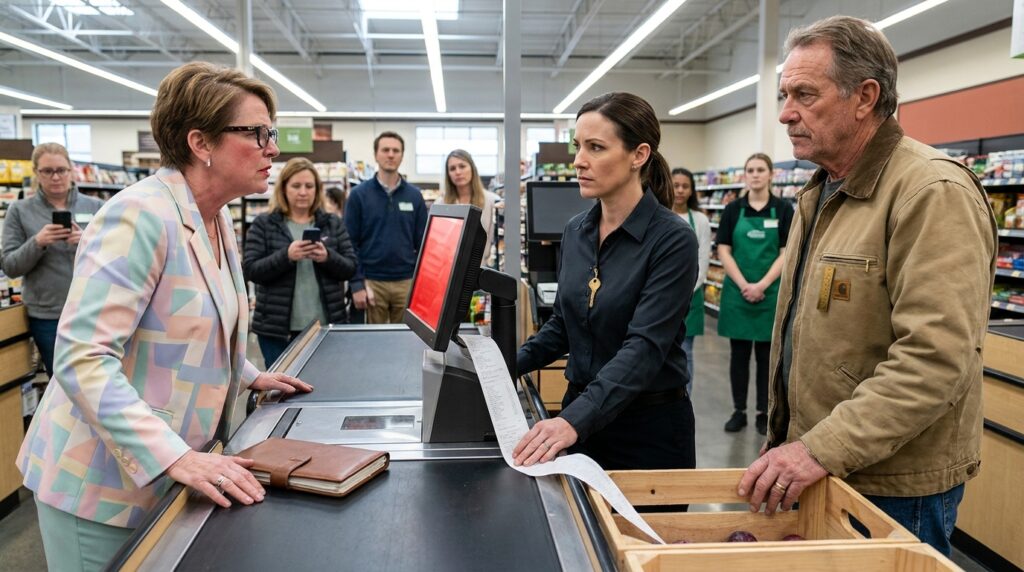
The terminal’s cooling fan hit a high, screaming pitch, vibrating against the stainless steel counter with the frantic energy of a machine trying to process a contradictory logic loop. The amber authorization light strobed across the rough weave of my canvas jacket. We were caught in the friction point between a physical space and a digital absolute, and the weight of that stall was beginning to warp the air in Lane Four.
Behind me, the line of weekend shoppers compressed. The physical boundary of personal space dissolved as curiosity and irritation pushed them forward. A man standing two carts back—wearing a tailored gray suit and a silver dive watch—let out a sharp exhale. His phone screen cast a pale blue glow upward against his jaw.
“Is this a joke?” the man asked, his voice cutting through the ambient hum of the industrial refrigerators. He stepped past the metal lane divider, closing the distance to the register, and held his smartphone out so the screen faced me. “Are you the guy in this post? Because my app is blowing up with push notifications.”
I didn’t lean in, but my eyes tracked the pixels. On his screen was the market’s private intranet forum. At the top was the photograph Connie had taken ninety seconds ago—my face, the canvas tote, the locked terminal. Beneath it was a block of heavy, red-tagged text bearing the compliance committee’s official digital seal. The caption read: Emergency Stop at Lane 4. Unauthorized individual attempting to drain Tier-Four foundation assets using a blacklisted proxy token. Commencing physical inventory seizure.
Connie stood a foot away, her posture rigid, the pastel fabric of her blazer pulled tight across her shoulders. She was breathing shallowly, her eyes darting from the man’s phone to the crowd gathering in the adjacent aisles. She had weaponized the neighborhood’s fear of corporate exploitation, banking on the crowd’s instinct to protect their sanctuary.
But as I looked at the image on the man’s phone, my gaze caught on a micro-detail buried in the attached proxy document she had uploaded. It was a digital stamp in the bottom left corner. The routing signature didn’t say Northwest Agricultural Foundation. It read Oakridge-Agri-Holdings-LLC.
The decoy secret clicked into place like a heavy deadbolt sliding home.
It wasn’t a glitch. It wasn’t a misunderstanding. The compliance committee hadn’t accidentally flagged my master account; they had deliberately inserted a mirrored shell corporation into the local database. They were using the proxy note to create a fake administrative default, giving them the bureaucratic cover to seize high-value allocations straight off the retail floor. Connie wasn’t just enforcing a rule; she was executing a manual override to redirect the foundation’s regional assets into her committee’s private ledger.
“I need those items moved to the holding cart immediately,” Connie ordered, her voice louder now, aiming for the back rows of the crowd. She pointed a manicured finger at the two wooden crates of heirloom plums sitting by my bag. “The community has been notified. The assets are frozen.”
The teenage cashier, sweating heavily under the collar of his green apron, reached out with trembling hands toward the crates.
I didn’t raise my voice, and I didn’t make a sudden movement. I simply slid my left hand forward two inches, letting my palm come to rest flat against the raw, splintered edge of the wooden crate. The physical mass of my arm, anchored by the leverage of my shoulder, formed an immovable structural barrier. The cashier’s fingertips brushed the back of my knuckles, and he instantly recoiled as if he had touched a live wire.
“The items remain on the scale,” I said. My voice was a low, even rasp, grinding against the rising panic in the lane. “You are looking at a forged routing signature, Mrs. Fitzpatrick. Oakridge-Agri-Holdings is not the foundation. It’s a domestic LLC. If you force him to touch this inventory, you are compelling an employee to commit physical theft on a logged system.”
Connie’s face flushed a deep, mottled red. The thick frames of her designer glasses slipped slightly down the bridge of her nose. “How dare you,” she hissed, slamming her leather ledger against the metal guardrail. “The committee’s logs are absolute! You are a fraud, and this community sees exactly what you are.”
But the community was reading the data.
A sharp, metallic ping echoed from the phone of the man in the gray suit, followed by another, and then a cascade of chimes rippled down the checkout line. The digital tide was reversing. I watched the man’s eyes scan the rapidly updating comment section under Connie’s post.
“Wait a minute,” an older woman’s voice rang out from the edge of Lane Three. It was a retired schoolteacher, leaning heavily on the handle of her cart, her phone held out like a lantern. “Connie, what gives you the right to confiscate groceries on the main floor? Section nine of the bylaws only applies to the wholesale loading docks. Since when do you have executive authority over the retail registers?”
“She doesn’t,” the man in the suit added, his tone shifting from irritated to openly accusatory. “And who authorized a committee chair to post customer photos on the internal feed? That’s a massive liability violation.”
The friction in the room was palpable. The air smelled of ozone from the overheating terminal and the sour tang of nervous sweat. Connie looked at the crowd, her mouth opening and closing as the realization hit her that the structural integrity of her social authority was fracturing in real-time. She had expected a mob to fall in line behind her clipboard; instead, she had given them the exact documentation they needed to dismantle her.
“This is a secured operation!” Connie yelled, her voice finally cracking, losing the polished veneer of the corporate gatekeeper. She lunged forward, her hand reaching past the scanner glass, aiming directly for the handle of my canvas tote bag.
Before her fingers could make contact, the amber light on the register terminal stopped pulsing.
It flashed to a solid, blinding, violent red.
The cooling fan died with a heavy, metallic clunk. A loud buzzer tore through the lane, a sustained, flatline tone that meant the system had completely timed out and locked the physical cash drawer. The terminal screen refreshed, displaying a massive, blinking command prompt: CRITICAL SYSTEM FAULT. MANUAL SUPERVISOR KEY REQUIRED. ASSET FORFEITURE INITIATED TO LOCAL COMMITTEE LEDGER.
She hadn’t just stopped the transaction. Her phone’s proximity override had triggered an automated theft protocol built directly into the store’s infected sub-network.
At the far end of the warehouse, a heavy steel door slammed open against a concrete wall. The sound cracked like a rifle shot over the heads of the crowd. The heavy, rhythmic strike of hard-soled shoes began descending the iron staircase from the elevated manager’s office.
I kept my hand anchored on the raw wood of the crate, my eyes fixed on the red glare of the locked screen. The decoy was in the open, but the master key was walking down the stairs, and the absolute truth of who owned the concrete beneath our feet was about to be pulled from the dark.








