
CHAPTER 2: THE LOGIC OF THE LEDGER
“The local network doesn’t drop an infrastructure override code for a routine verification check, Connie,” I said, my voice cutting flatly through the rising hum of the checkout floor.
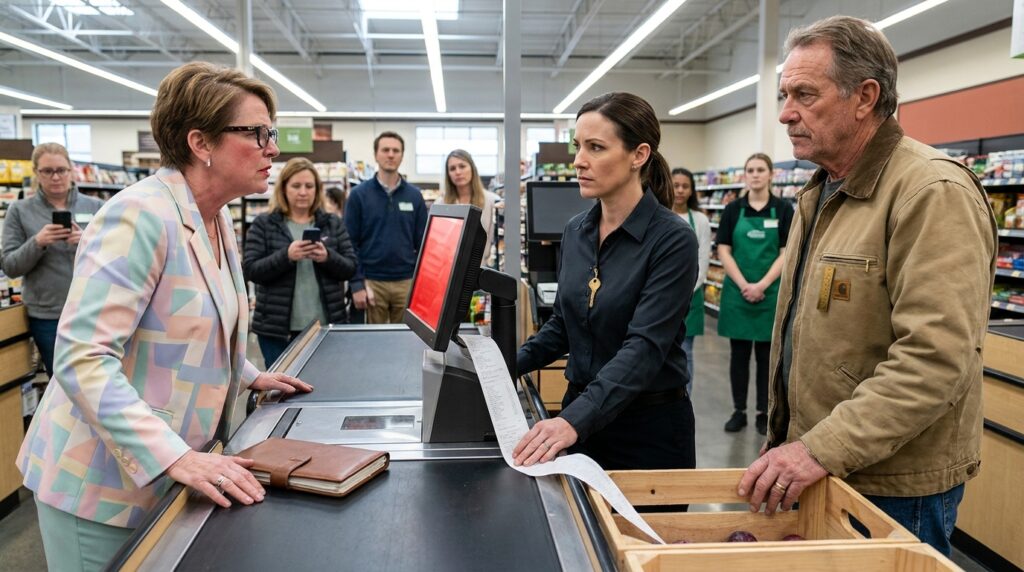
She didn’t lower the phone. Her thumb remained pressed against the side button, her knuckles white against the gold-trimmed casing as she stepped deeper into the metal lane guide. The heat haze rising off the terminal’s older processing unit carried the distinct, synthetic smell of warm solder and dust. The concrete beneath my boots was worn gray, pitted by decades of heavy pallet jacks shifting weight from the loading docks to the retail floor. Every inch of the market’s layout was designed to look organic, but the skeleton beneath it was rigid, heavy-gauge steel and network cabling that I had mapped line by line.
Connie adjusted the heavy leather ledger on the scanner glass, the corner of the cover grinding against the optic lens with a dry, scratching friction. “The committee handles its own operational defaults, Mr. Mercer,” she replied, her tone sharpening as she noticed a couple two lanes over look up from their cart. “What you’re seeing on this terminal is an explicit compliance failure flag. This lane is locked because the regional network has flagged your account code as an unverified entity. If your foundation actually funded this cooperative, you’d be on the local executive white-list, not setting off database exceptions in the middle of Saturday morning.”
I didn’t answer with words. I took the brass calibration rule from my pocket, its weight familiar and dense in my palm, and tapped the cold edge once against the metal rail of the register. The sound was sharp, transactional, a small piece of objective metric logic dropped into the middle of her performance. Through the glare of her designer glasses, I could see the reflection of the terminal’s status line. The green authorization light had shifted to a rhythmic, amber pulse—the exact sequence the system uses when a transaction is held in a remote network queue by an external database administrator.
The cashier behind the counter had stopped moving entirely. His green apron hung loose, stained with the juice of crushed organic berries, his eyes locked on the digital invoice fields on his master display. “Mr. Mercer,” he murmured, his voice cracking slightly under the weight of the lane’s silence. “The mainframe isn’t letting me clear the item weight. It’s requesting a physical paper log entry from the compliance ledger. I can’t override it from here.”
“He knows he can’t override it,” Connie said, her posture stiffening as she leaned forward, using her silhouette to frame the register counter like an enforcement wall. “Because three days ago, the executive board issued a proxy note specifically blacklisting this exact tier-four allocation series for structural review. Your foundation has been siphoning operational margins under the guise of an agricultural grant, Mr. Mercer, and today the balance sheet catches up with the asset.”
The accusation hung in the warm air between us, heavy and smelling of old iron. It was a decoy—a beautifully constructed bit of administrative misdirection that would have broken a standard shopper under the weight of public shame. Behind us, the murmur of the Lane Four witness layer grew louder, the rustle of paper bags and the low, irritated shifting of feet marking the growing bottleneck. A man in a tailored gray suit two places back pulled out his phone, his thumb flicking upward as he opened a recording app, the lens focused squarely on Connie’s leather ledger and my canvas tote.
I checked the timestamp on my screen. 10:14 AM. The system was running out of buffer time before the automated diagnostic routine would ping the manager’s office. I looked closely at the flashing red line on Connie’s phone, which she had laid flat on the counter to display the alleged proxy note. The account number listed under the blacklist entry wasn’t the master registration code for the Northwest Agricultural Foundation. It was an off-shore corporate entity registered under an identical phonetic name—a shell setup built to mirror the foundation’s logistics routing, masking an internal transfer of funds that had been authorized by the compliance committee’s own internal signature stamp.
“That’s a very specific ledger entry, Connie,” I said, my voice dropping an octave as I leaned slightly over the counter, the dry heat of the register unit warming the sleeve of my canvas jacket. “But you’re reading the wrong side of the ledger. The proxy note you’re holding doesn’t lock the account from the outside. It locks the terminal because the system is attempting to print an audit trail for a duplicate registration that doesn’t exist on our master server.”
Connie’s hand jerked slightly, her fingers brushing the edge of the leather ledger as if to cover the screen. The confidence in her silhouette didn’t vanish, but her jaw tightened, the muscle along her neck turning rigid as she looked toward the main office stairs at the back of the market. “The committee doesn’t make accounting errors, Mr. Mercer. We protect the community’s assets from people who think they can use our infrastructure for free. The general manager is already on her way down, and she has the keys to the physical vault log.”
I kept my hand flat on the canvas strap of my bag, my thumb tracking the steady pulse of the amber light on the terminal. The trap she had set was built out of policy language and social pressure, a framework designed to make the target flee before the actual logs could be pulled. But the physics of the architecture were already moving against her. The register’s cooling fan began to whine louder, a high-pitched mechanical strain that signaled the database was executing a full data-dump to the local supervisor terminal. The first clue was laid, the decoy was locked in place on her screen, but the true master deed was still buried three layers deep in the encrypted core, waiting for the supervisor key to turn the lock.








