
The Iron Perimeter: A Story of Hard Lines, Shared Concrete, and the Heavy Weight of Paid Assets
CHAPTER 1: THE REAR COUNTER PRINT
“The transaction is already hard-cleared, Marcus,” the pro desk associate muttered, his thumb pressing down on the manual feed button of the thermal printer. The machine let out a rhythmic, high-pitched whine, spitting out a foot-long strip of paper that curled over the scarred zinc edge of the commercial counter. “If you need the extra heavy-duty string line, you’ll have to grab it from aisle twelve before the midday rush hits. Once the contractor accounts log off, the floor belongs to the weekenders.”
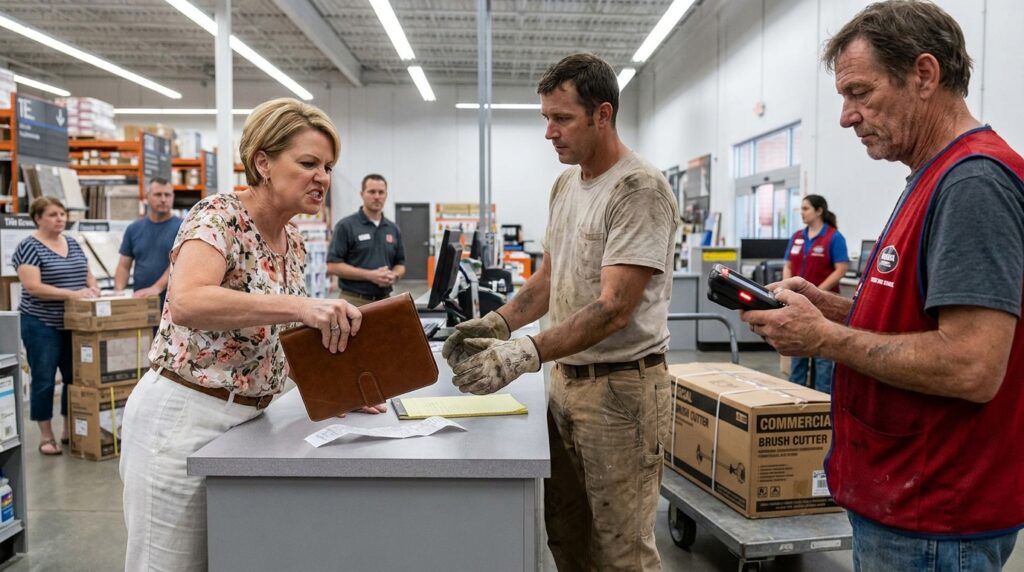
Marcus Boyd didn’t look back at the main floor. He kept his gloved hand flat against the heavy corrugated box resting on the steel flatbed cart. Inside the cardboard sleeve lay twelve hundred dollars of solid, cast-iron engineering—the last commercial-grade brush cutter within three counties. His knuckles were gray with dry topsoil from his morning evaluation job at the medical pavilion, the dust settled into the fine lines of his canvas work pants.
He didn’t move until he tucked the folded paper receipt into his rear pocket, right behind his leather wallet. A familiar, rhythmic clink sounded from his left hip—the heavy, tarnished brass key-clip hanging from his belt loop. It was a sensory anchor he touched every time property changed hands. Five years ago, he hadn’t checked the papers. Five years ago, his partner had left him with an empty warehouse and a mountain of civil liens. Now, Marcus didn’t leave a counter until the digital checkmark on his smartphone screen lit up green.
“I’m good on the line,” Marcus said. His voice was sparse, low, carrying the raspy gravel of someone who spent ten hours a day breathing engine exhaust and cut fescue. “Just need to clear the perimeter before the loading docks plug up.”
He leaned his weight into the handlebar of the flatbed. The heavy urethane wheels groaned against the concrete floor, tracking a faint line of dry red clay toward the main center corridor. The store smelled of damp fertilizer, sulfurous zinc bolts, and the sharp, pine-heavy exhaust of the massive overhead climate units. Every fifty feet, the light changed from the cold blue glare of industrial LEDs to the sickly yellow glow of older halogen tubes hanging over the clearance bays.
As he cleared the transition threshold near aisle nine, a sharp clatter cut through the ambient drone of forklift backup beeps. A large, chrome-plated retail cart was shoved sideways into the intersection ahead, its front casters spinning uselessly as they hit the expansion joint.
Behind the cart stood Evelyn Vance.
She didn’t look like someone shopping for timber. Her white linen trousers were pristine, completely untouched by the airborne sawdust that coated the lower shelves. A heavy gold-plated watch caught the harsh glare of the ceiling lights as she adjusted an oversized leather planner against her ribs. Her short, lacquer-sprayed hair didn’t move as she stepped forward, her leather-soled sandals snapping against the gray concrete like small, precise pistol shots.
“Boyd,” she said. It wasn’t a greeting; it was an intersection check. She didn’t look at his face. Her eyes dropped immediately to the bold stencil lettering on the side of the box. “That unit is flagged. The historic district committee has an emergency requisition order for the North Park clearing this morning. Leave the flatbed where it is.”
Marcus stopped the cart six inches from her basket line. He didn’t unclip his keys. He didn’t shift his gaze. He simply looked at the sharp edge of her leather planner, noticing how her fingers left slight grease prints on the expensive calfskin. The warehouse went small around them, the air thickening with the smell of old iron and dry earth.

CHAPTER 2: THE CORRIDOR ENCROACHMENT
“This machine isn’t leaving the floor under a private name, Marcus,” Evelyn Vance said. She didn’t raise her voice, but her tone had the sharp, practiced edge of someone used to clearing rooms by simply standing in the doorway. She tilted her head slightly, the heavy halogen light catching the amber tint of her sunglasses. “The committee’s authorization comes directly from the district enhancement fund. If you check the internal municipal registry, you’ll find our voucher takes structural precedence over any standard contractor line.”
Marcus didn’t move his boots. They remained flat against the gray concrete, two anchors of stained leather catching the low draft from the automated bay doors behind him. He let his right arm hang loose, his fingers brushing the cool, notched teeth of the brass key-clip on his hip. The steady, mechanical clink was the only sound between them, rhythmic and dry.
“The pro desk cleared the ledger five minutes ago,” Marcus said. He kept his eyes on the center seam of her leather planner. “The inventory count is zero behind this box. It’s paid, it’s signed, and it’s on my truck’s log for Monday morning. Move the cart, Evelyn.”
“We are currently seven days behind on the North Park perimeter because independent crews keep soaking up the local supply chains,” she replied, her fingers tightening across the calfskin binder. As she shifted her weight, the planner flared open slightly. Marcus’s gaze dropped to the exposed page—not a standard retail order form, but a yellow legal pad covered in hasty, handwritten columns. At the bottom of the sheet, half-obscured by her thumb, was a stamped municipal account string, but a thick red ink line had been drawn straight through the primary ledger code, accompanied by a small, hand-scribbled notation: Hold – Pending Reconciliation.
Marcus didn’t call attention to the ink. In his line of work, you learned to read the rust before you blamed the engine. He knew the historic district’s financial signatures; he’d seen them on county bid sheets for three years. The red line meant a structural freeze.
“I don’t do business with committees,” Marcus said softly. He leaned his forearms against the heavy steel handlebar of his flatbed, his weight shifting forward until the thick urethane tires ground audibly against a patch of dried red clay on the floor. “I do business with the register. The register says the machine belongs to Boyd Landscaping. If your volunteer crew forgot to log their winter pre-orders, that’s a conversation for the board meeting next month. Not this aisle.”
Evelyn’s jaw tightened, the skin around her mouth graying under the fluorescent lighting. She took half a step closer, her pristine white trousers brushing against the gritty wire mesh of her own retail basket. She didn’t look back to see if the checkout lines were watching, but Marcus could already hear the subtle alteration in the store’s background noise. A regular contractor in a high-vis vest paused two aisles over, his hand resting on a stack of pressure-treated four-by-fours, his eyes narrowing as he tracked the spatial stalemate.
“You’re being short-sighted, Marcus,” Evelyn said, her voice dropping into a transactional hiss. “The historic committee controls the vetting process for every commercial property easement along the Main Street corridor. If you make this simple equipment transfer difficult, I will personally ensure your pavilion clearing contract undergoes a full zoning compliance audit by Monday afternoon. We can handle this right here with a manager’s override, or we can let the county inspector lock your project gate.”
It was an old play, the same administrative leverage his former partner had used to freeze his equipment accounts during the split. But Marcus didn’t blink. He felt the cold iron of his cart handle under his palms, the physical reality of a paid asset.
“The gate opens at six o’clock on Monday,” Marcus said, his voice level, entirely devoid of the anger she was trying to provoke. He reached down, his fingers locking onto the cold steel frame of the flatbed, preparing to pivot the heavy cart around her chrome barrier. “And the county doesn’t audit paid receipts. Step back from the wheels.”
Instead of moving, Evelyn shoved her planner deep into her basket, her gold watch flashing as her hand flew to the small radio clip on her shoulder, her eyes locked onto his with an icy, calculated calculation that told him she wasn’t preparing to retreat—she was preparing to close the lane entirely.
CHAPTER 3: THE CHANNELS OF THE BOTTLENECK
“This register is locked until we verify the allocation papers,” Evelyn Vance said, her hand flattening against the chrome divider bar of checkout lane four. Her voice carried over the sharp, rhythmic chirp of a nearby barcode scanner. She didn’t drop her glare, her posture rigid as she leaned her pelvis against the front frame of her metal cart, weighting the left wheels into the narrow yellow lane line painted on the floor. “This isn’t a retail choice, young man. It’s a civil preservation priority.”
Marcus Boyd felt the cold vibration of the main air handler trembling through the handlebar of his steel flatbed. He didn’t ease his grip on the square iron frame. His boots scraped across a patch of loose floor sealant, the small gritty particles crunching beneath his thick soles. Behind him, the queue was already compressing. A young couple carrying four boxes of interlocking slate tiles stopped three feet back, their heavy cardboard box sagging between them, their breath catching as the lane bottlenecked.
“The register doesn’t clear municipal overrides, ma’am,” the young cashier murmured. Her fingers hovered two inches above the rubber keyboard, her eyes tracking the massive, red-clad shape of a floor supervisor who was currently forty yards away, dealing with a forklift tag near the lumber tier. “If the commercial desk already stamped the barcode, the inventory is locked to the account holder’s name. I can’t void an active pro-tier ledger without a key-turn from the back office.”
“Then you fetch the back office,” Evelyn replied. She didn’t look back at the cashier. She kept her eyes on the heavy cardboard box on Marcus’s cart, her fingers tapping against the edge of her oversized leather planner. As she adjusted the binder, a small, pale blue slip of paper detached from her legal pad and fluttered into the bottom of her wire shopping basket. It landed directly on top of a glossy landscape brochure detailing private garden designs for multi-acre country estates—not public parks. The brochure was marked with a hand-drawn pencil boundary line that precisely matched the square footage requirements of a commercial-grade brush cutter.
Marcus observed the blue slip. His mind didn’t jump to conclusions; it calculated the friction. He knew how city code worked when a non-profit group tried to skip the regional supply chain. They used internal vouchers to freeze stock, then left the paperwork to settle over a ninety-day billing cycle while private accounts took the loss. His former partner had used those exact three-part carbon sheets to clear out their collective tool cage during the county road audit.
“The register works fine,” Marcus said. His voice remained flat, catching the dry, dusty air coming off the fertilizer aisles. He didn’t shift his balance. “The transaction cleared five minutes ago at the commercial desk. The box stays on this steel until I wheel it past the glass. If you want a manager, use the lane phone, Evelyn. Otherwise, clear the casters.”
Evelyn’s jaw set into a hard, linear line beneath her sunglasses. She turned her torso completely, her arm shoving her metal cart three inches further into the gap, the rubber bumpers scraping hard against the painted steel wrapper of the impulse-buy rack. A row of heavy-duty utility knives clattered against their wire pegs, the small metal packages swinging like pendulums under the bright fluorescent tubes.
“I am trying to prevent an unauthorized asset leak before the weekend committee logs are finalized, Marcus,” she said, her voice dropping into a transactional rhythm that was low, sharp, and narrow. “The historic district has an active maintenance easement over every commercial layout on Main Street. If this store releases professional clearing machinery to an unvouched private contractor during a scheduled municipal beautification window, it violates our bulk supply agreement with the county. I don’t need a key-turn to freeze a suspected delivery deviation.”
The cashier’s hand dropped from the keyboard. She looked at Marcus’s dusty canvas pants, then at the gold-plated watch flashing on Evelyn’s wrist, her expression freezing into the neutral caution of an hourly employee caught between a contractor’s receipt and a prominent resident’s mouth. The murmurs behind the tile box were growing louder now, the sharp tang of weekend impatience beginning to cut through the heavy smell of treated pine and industrial grease.
Marcus didn’t check the line behind him. He kept his eyes on the locked casters of her cart, his fingers tracking the small cold notches of the brass key-clip against his thigh. He knew every turn of the store’s policy book; he’d read it when he registered his commercial tax ID after the audit. An HOA coordinator or a district committee head had no structural authority inside a private commercial business once the printed receipt hit the contractor’s hand.
“The delivery isn’t a deviation,” Marcus said, his arm muscles tightening as he prepared to shove the heavy flatbed forward through the narrow clearance gap she had left near the register screen. “The delivery is mine. If your crew is short on iron for the park, you can take a number at the pro counter and wait for the Tuesday freight truck like everybody else.”
Instead of yielding the space, Evelyn reached down and gripped the wire flank of her basket, her knuckles turning white against the gray zinc coating as she leaned her entire weight against his cart’s front wheels, her face darkening as she prepared to make the lane a public perimeter.
CHAPTER 4: THE SACRIFICE OF FALSE LAWS
“This store serves the community first, and my committee requires that equipment today,” Evelyn Vance said, her voice rising an octave to cut through the heavy, mechanical hum of the ceiling fans. She turned her torso completely toward the expanding queue behind Marcus, her hand lifting to point a rigid, manicured finger at the box. “Hand over the cart before I have security remove you for theft. We are not letting private commercial greed deplete municipal resources.”
Marcus Boyd didn’t shift his boots an inch. He kept his palms clamped over the cold iron handlebar of his flatbed, his thumbs catching the rough, unground weld marks where the steel plate met the frame. The wire edge of Evelyn’s cart was wedged hard against his front urethane wheels, locking them into the narrow gutter between the cash register counter and the industrial display racks. The smell of cedar mulch and stale floor wax hung thick in the dead air between them.
“I’ve already paid for this property,” Marcus said. His voice was too quiet for the cavernous rafters, forcing the shoppers behind him to lean forward to catch the words. He felt the heavy brass keys on his hip press cold against his thigh as he tilted his pelvis toward the barrier. “Step away from my cart so I can leave.”
A murmur broke out from the couple with the slate tiles. The man shifted the sagging cardboard box against his hip, his face slick with dust. “Lady, some of us have crews waiting on jobs right now. Move the basket or let the guy bypass you.”
Evelyn didn’t glance back at the line. Her chin remained lifted, her oversized sunglasses reflecting the harsh grid of the overhead halogens like two blank, silver panels. “This individual is actively obstructing an authorized civic maintenance unit. This center-aisle lane is under regional historic preservation jurisdiction during public beautification cycles. If this register pushes through a non-vouched sale of a restricted inventory unit, the store manager will answer to the district council by five o’clock.”
She leaned over her wire cart, her crisp floral blouse brushing the dusty steel edge of the register belt. As she moved, her leather planner slipped completely flat, exposing the top sheet of her yellow legal pad. Marcus didn’t tilt his head, but his eyes tracked the bold, black ink of the municipal tax index number stamped at the top of her requisition ledger. It didn’t carry the “P-9” prefix designated for public parks or city-owned greenways. The string began with “R-22″—the exact zone code for private, multi-acre residential estates on the western ridge where the town’s oldest money kept its perimeters hidden behind thick hemlock screens.
The cashier’s fingers remained dead over the terminal keys. She looked toward the high-vis vests congregating two lanes down, her throat shifting as she swallowed back an entry log. “Ma’am, if the pro counter cleared the funds, the barcode is dead to the floor. I can’t pull an asset back into the active pool without a manual inventory release form from the main desk.”
“Then you hit the override switch,” Evelyn snapped, her fingers digging into the wire rim of her basket until the cheap zinc coating flaked off in tiny, dull gray scales under her nails. She pulled her phone from her pocket, the screen lighting up with a half-drafted email addressed to the county building inspector’s office. “I am already logged into the regional compliance portal. If this flatbed moves another foot toward the sliding doors without an administrative review, I will file a site-line violation report against the medical pavilion project before Marcus can even back his trailer up to the dock.”
Marcus took a slow, deep breath, the dry powder of old cement dust coating his throat. He recognized the tactical weight of the threat. A site-line audit from the historic board could hold up his equipment clearance for three weeks, long enough for the medical pavilion developers to void his contract and hand the clearing job to a larger, unionized firm from the city. His former partner had used that exact bureaucratic net to stall his trucks until the bank pulled his equipment lines.
He didn’t lift his hands from the iron. He looked at the edge of the residential zone code on her pad, then at the frantic, twitching rhythm of her thumb against her phone screen. She wasn’t acting with the calm weight of an institutional official; she was moving with the erratic, narrow speed of someone whose clock was running down to a zero balance.
“The pavilion contract is cleared through county zoning, Evelyn,” Marcus said. He shifted his weight to his rear boot, using his heel to lock the flatbed’s trailing casters against the concrete floor, ensuring she couldn’t shove his cart backward into the queue. “And the county doesn’t take enforcement cues from a neighborhood beautification group. Call whoever you want on that phone. The machine is paid for, the receipt is in my pocket, and the lane is open.”
Evelyn’s face went from pale to a dark, congested red beneath her makeup. She shoved her shopping cart an inch forward, the metal bumper screaming as it ground into the steel base of the register screen, her eyes narrowing until they were two dark slits behind her glass lenses, her entire posture signaling that she would drop the cart onto its side before she allowed him to clear the exit line.
CHAPTER 5: THE WEIGHT OF THE RECOVERY COUNTER
“Clear the lane line,” a low, gravelly voice cut through the administrative cross-fire.
David Miller stepped into the yellow border of checkout lane four, his boots tracking a fresh film of black grease from the rear service bay. He didn’t look at Evelyn’s phone or Marcus’s box. His red store vest was unzipped, the fabric worn thin around the pocket seams where his heavy inventory radio dragged the hem down. His thumb remained flat against the talk button of his earpiece, a low hiss of static spilling into the narrow space between the high impulse shelves.
“We have an active terminal freeze here, David,” Evelyn said, her sunglasses slipping a fraction of an inch down her nose as she pivoted toward the manager. Her leather planner clicked against the side of her wire basket like iron hitting slate. “This commercial contractor is removing specialized machinery that has been flagged for the historic district’s municipal greenway allocation. I’ve already initialized a regional compliance review on his pavilion work order.”
Miller didn’t answer her. He reached out with one broad, blunt-fingered hand, his palm flattening against the side of Evelyn’s chrome cart basket. With a steady, effortless shift of his shoulder weight, he shoved the entire metal frame six inches back, forcing the spinning casters to screech against the expansion joint until the path cleared.
“Move the flatbed down to the main service desk, Marcus,” Miller said. He didn’t raise his voice, but it had the hollow, unblinking density of a man who had cleared ten thousand retail bottlenecks before the noon whistle. “We don’t arbitrate ledger variances in the exit lane. Cashier, reset the terminal string for the tile line.”
Marcus didn’t ease his grip on the iron handlebar. He let the flatbed roll forward, the heavy urethane wheels rumbling across the newly cleared concrete gap as he followed the manager toward the wider customer service counter near the main entry glass. Evelyn kept pace on the opposite side of the structural partition wall, her sandals snapping against the floor with aggressive, rhythmic impact, her leather planner clutched against her ribs like a piece of salvaged timber.
The customer service counter was a six-foot block of reinforced particle board, its gray laminate surface gouged and pitted by decades of dropped chain links and heavy pipe fittings. Miller walked behind the high counter, his hand dropping onto a rugged, rubber-encased handheld terminal that sat in a black charging cradle. As he lifted the device, a tiny red indicator light near the battery seal began to blink in rapid, irregular patterns—a local system alert tracking an unverified administrative hold.
“Now,” Miller said, his boots settling into the anti-fatigue mat behind the desk as he looked across the laminate at both of them. “Let’s look at the actual iron.”
“The allocation paperwork is perfectly clear on my ledger sheet,” Evelyn said, slamming her yellow legal pad down onto the gouged gray surface. Her gold watch rattled against the particle board. “The historic district committee holds a permanent municipal priority voucher for all commercial-grade landscaping units in this district. If Boyd Landscaping has cleared this barcode through a backdoor pro account, it constitutes a direct violation of our civic infrastructure agreement.”
Marcus reached into his rear pocket. He didn’t pull out his phone first; his fingers found the crumpled, foot-long strip of thermal paper receipt. He laid it flat on the laminate between them, his thumb resting over the bold black ink of the transaction total: $1,200.00. The clink of his brass key-clip died against the counter’s rubber edge.
“The receipt is timed at eight-forty,” Marcus said, his eyes tracking the fine layer of sawdust that had settled into the deep cuts on the desk. “The pro desk ran the tax ID, cleared the corporate card, and logged the asset to my pavilion contract. There is no backdoor string, David. The stock count was one, and the one belongs to my truck.”
Miller reached for the thermal paper, his rough thumb sliding over the printed barcode. He didn’t look up at Evelyn’s legal pad or the residential zone number stamped on her page. Instead, he raised the handheld terminal, the small red light casting a faint, rhythmic glow across his weathered knuckles as he lined up the laser guide with Marcus’s receipt.
The warehouse went quiet around the desk, the distant rumble of a delivery truck out on Main Street vibrating through the massive front glass panes. Marcus stood perfectly still, his boots square on the floor, his mind tracking the exact mechanical loop of the conflict. He knew what a system audit looked like when the paperwork went sideways; he had watched the bank inspectors scan his old yard cages three years ago while his former partner sat in a legal office across town, signing away the company’s fuel credits. He wasn’t going to let an administrative fake-out unhook his iron a second time.
“This barcode is fully live,” Miller muttered, his eyes narrowing as the handheld terminal let out a sharp, discordant triple-beep—the system warning for a high-priority account conflict. He clicked the side scroll button with his thumb, his face hardening as the screen began to project a series of internal municipal log flags that neither Marcus nor Evelyn could see from the opposite side of the counter.
Evelyn leaned forward, her elbows locking over her leather binder as she pressed her torso against the laminate. “Scan the committee voucher string, David. It overrides the retail register. If that cutter leaves this building on a private flatbed, I will have the district council pull the store’s regional occupancy permit before the weekend is over.”
Marcus didn’t back away from the ledge. He looked at the flashing red light on Miller’s device, noticing how the manager’s fingers had tightened against the rubber casing until the plastic groaned, the real weight of an institutional collapse beginning to register in the deep lines around the older man’s mouth.
CHAPTER 6: THE OVERRIDE DISCREPANCY
“Run the administrative token string, David,” Evelyn Vance said, her leather planner dropping flat onto the gray particle-board counter. The heavy corner piece of the binder caught the edge of Marcus’s thermal paper, pinning it to the scarred laminate like a surveyor’s stake. “The historic district’s emergency allotment fund is fully backed by the county treasurer’s office. If you check the secondary municipal index code, you’ll see our line item takes absolute precedence over an unvouched contractor balance.”
Marcus Boyd didn’t shift his fingers from his belt line. His thumb remained hooked over the smooth, notched edge of his brass key-clip, the tiny metallic weight hanging motionless against his work pants. He kept his eyes on the small handheld terminal in David Miller’s hand. The red indicator light near the battery frame had shifted from a fast blink to a solid, dull crimson, throwing a thin wedge of red reflection across the pitted counter space.
Miller didn’t glance at her pad. He swiped his thumb across the rugged screen, a low beep sounding from the terminal internal speaker as he forced a manual system refresh. On the high-resolution monitor mounted above the register, a white system dialogue window began to flash against the standard corporate inventory matrix, its borders pulsing with an alert code that Marcus had never seen on a pro counter display before.
“The allocation line isn’t showing an open balance, Evelyn,” Miller said. His voice was thick with the gravelly exhaustion of a ten-hour shift, his fingers tapping a fast five-digit string into the side buttons of the handheld unit. “The ledger is showing an active override attempt from an outside IP address at eight o’clock this morning, but the treasury block didn’t clear the automated compliance audit. The voucher number you wrote on this yellow pad is flagged as a suspended internal file.”
Evelyn’s chin snapped up, the silver panels of her sunglasses catching the stark reflection of the front exit glass. “That is an administrative lag from the municipal billing office. The committee approved the North Park greenway budget seventy-two hours ago. If the store’s backend server hasn’t updated its local registry file, you use the manual manager token to override the hold. I am not having my crew lose a Saturday because of a database glitch.”
Marcus took half a step closer, his dusty boot leather catching a stray ridge of the rubber floor mat. He leaned his forearm against the side of his flatbed box, his gaze settling on the monitor. Beneath the pulsing white dialogue box, a tiny sub-line of metadata was scrolling across the display grid. It wasn’t an official city procurement string; it was a personal line item labeled under a localized non-profit estate index. He knew the format from the county tax assessor’s ledger sheets—his former partner had used a very similar private non-profit shell to transfer three of their commercial dump trailers into a personal family trust while the partnership liquidation suit was still sitting on a clerk’s desk.
“The system doesn’t lag on verified vouchers,” Marcus said. His voice was level, deadened by the heavy hum of the building’s central heating unit. He kept his eyes on the red light on Miller’s terminal. “A municipal hold means the line has been drained or frozen at the bank. If your committee string was clear, the pro desk would have seen the allocation marker when they pulled the serial number forty minutes ago.”
Evelyn turned her head toward him, her floral blouse rustling against the particle-board ledge. “Your pavilion job is a commercial development, Marcus. It has no civic standing. The only reason your card cleared is because the front office doesn’t check the easement lines before they run the magnetic strip. If I call the building department right now and report that this store is actively diverting commercial hardware to a flagged zoning plot, David won’t just lock your flatbed—he’ll have to hold the entire regional freight shipment for a county inspection.”
“The pavilion isn’t a flagged plot,” Marcus replied, his knuckles remaining perfectly loose against his hip. “And the tax index on your legal pad doesn’t match the North Park layout. The North Park perimeter belongs to district nine. Your yellow sheet is stamped for zone twenty-two. That’s the western ridge, Evelyn. That’s your backyard fence line.”
A heavy, dead silence dropped over the customer service desk. Two floor associates who were re-stacking heavy boxes of framing nails three lanes over stopped their hammers, their heads turning toward the gray counter. The young cashier from lane four stepped into the wide corridor, her eyes widening as she watched the evening manager freeze behind his terminal screen.
Miller slowly lowered the handheld unit, his rough thumb releasing the talk button on his earpiece. He didn’t look at Evelyn’s legal pad. He reached under the counter ledge, his fingers finding a thick, plastic-bound binder containing the store’s regional commercial account rules, his face settling into a hard, defensive calculation that made the red fabric of his store vest look tight across his shoulders.
“Evelyn,” Miller said, his voice dropping into a narrow, transactional clip that cut through the background whine of the overhead air units. “The terminal just completed the network trace. The override string you tried to use this morning isn’t a city voucher. It’s a personal line item attached to the historic district non-profit fund, and the county treasurer didn’t lag the paperwork—they placed a third-tier statutory lien on the account at five o’clock yesterday afternoon because of unpaid private clearing debts from your ridge development. If I turn this manager key right now, I’m logging a fraudulent commercial transaction into the main state register.”
Evelyn’s fingers stiffened against her calfskin binder, her face graying beneath her tinted lenses as the entire administrative framework she had built across the counter began to tip into the gray concrete.
CHAPTER 7: THE TERMINAL COLLAPSE
“Run the administrative override, David,” Evelyn Vance said, her leather planner dropping flat onto the gray particle-board counter. The heavy corner piece of the binder caught the edge of Marcus’s thermal paper, pinning it to the scarred laminate like a surveyor’s stake. “The historic district’s emergency allotment fund is fully backed by the county treasurer’s office. If you check the secondary municipal index code, you’ll see our line item takes absolute precedence over an unvouched contractor balance.”
Marcus Boyd didn’t shift his fingers from his belt line. His thumb remained hooked over the smooth, notched edge of his brass key-clip, the tiny metallic weight hanging motionless against his work pants. He kept his eyes on the small handheld terminal in David Miller’s hand. The red indicator light near the battery frame had shifted from a fast blink to a solid, dull crimson, throwing a thin wedge of red reflection across the pitted counter space.
Miller didn’t glance at her pad. He swiped his thumb across the rugged screen, a low beep sounding from the terminal internal speaker as he forced a manual system refresh. On the high-resolution monitor mounted above the register, a white system dialogue window began to flash against the standard corporate inventory matrix, its borders pulsing with an alert code that Marcus had never seen on a pro counter display before.
“The allocation line isn’t showing an open balance, Evelyn,” Miller said. His voice was thick with the gravelly exhaustion of a ten-hour shift, his fingers tapping a fast five-digit string into the side buttons of the handheld unit. “The ledger is showing an active override attempt from an outside IP address at eight o’clock this morning, but the treasury block didn’t clear the automated compliance audit. The voucher number you wrote on this yellow pad is flagged as a suspended internal file.”
Evelyn’s chin snapped up, the silver panels of her sunglasses catching the stark reflection of the front exit glass. “That is an administrative lag from the municipal billing office. The committee approved the North Park greenway budget seventy-two hours ago. If the store’s backend server hasn’t updated its local registry file, you use the manual manager token to override the hold. I am not having my crew lose a Saturday because of a database glitch.”
Marcus took half a step closer, his dusty boot leather catching a stray ridge of the rubber floor mat. He leaned his forearm against the side of his flatbed box, his gaze settling on the monitor. Beneath the pulsing white dialogue box, a tiny sub-line of metadata was scrolling across the display grid. It wasn’t an official city procurement string; it was a personal line item labeled under a localized non-profit estate index. He knew the format from the county tax assessor’s ledger sheets—his former partner had used a very similar private non-profit shell to transfer three of their commercial dump trailers into a personal family trust while the partnership liquidation suit was still sitting on a clerk’s desk.
“The system doesn’t lag on verified vouchers,” Marcus said. His voice was level, deadened by the heavy hum of the building’s central heating unit. He kept his eyes on the red light on Miller’s terminal. “A municipal hold means the line has been drained or frozen at the bank. If your committee string was clear, the pro desk would have seen the allocation marker when they pulled the serial number forty minutes ago.”
Evelyn turned her head toward him, her floral blouse rustling against the particle-board ledge. “Your pavilion job is a commercial development, Marcus. It has no civic standing. The only reason your card cleared is because the front office doesn’t check the easement lines before they run the magnetic strip. If I call the building department right now and report that this store is actively diverting commercial hardware to a flagged zoning plot, David won’t just lock your flatbed—he’ll have to hold the entire regional freight shipment for a county inspection.”
“The pavilion isn’t a flagged plot,” Marcus replied, his knuckles remaining perfectly loose against his hip. “And the tax index on your legal pad doesn’t match the North Park layout. The North Park perimeter belongs to district nine. Your yellow sheet is stamped for zone twenty-two. That’s the western ridge, Evelyn. That’s your backyard fence line.”
A heavy, dead silence dropped over the customer service desk. Two floor associates who were re-stacking heavy boxes of framing nails three lanes over stopped their hammers, their heads turning toward the gray counter. The young cashier from lane four stepped into the wide corridor, her eyes widening as she watched the evening manager freeze behind his terminal screen.
Miller slowly lowered the handheld unit, his rough thumb releasing the talk button on his earpiece. He didn’t look at Evelyn’s legal pad. He reached under the counter ledge, his fingers finding a thick, plastic-bound binder containing the store’s regional commercial account rules, his face settling into a hard, defensive calculation that made the red fabric of his store vest look tight across his shoulders.
“Evelyn,” Miller said, his voice dropping into a narrow, transactional clip that cut through the background whine of the overhead air units. “The terminal just completed the network trace. The override string you tried to use this morning isn’t a city voucher. It’s a personal line item attached to the historic district non-profit fund, and the county treasurer didn’t lag the paperwork—they placed a third-tier statutory lien on the account at five o’clock yesterday afternoon because of unpaid private clearing debts from your ridge development. If I turn this manager key right now, I’m logging a fraudulent commercial transaction into the main state register.”
Evelyn’s fingers stiffened against her calfskin binder, her face graying beneath her tinted lenses as the entire administrative framework she had built across the counter began to tip into the gray concrete. She looked at the red light on Miller’s terminal, the reality of her exposure dawning in the sharp, panicked intake of breath. She wasn’t fighting for a public park anymore; she was fighting to keep a lien from being printed on the official state record.
CHAPTER 8: THE UNBLOCKED PERIMETER
“Evelyn,” David Miller said, his voice dropping into a register so low and flat it seemed to vibrate against the metal backing of the counter. He didn’t reach for the phone. He simply stepped back, his hand retreating to his own radio, his fingers moving with the precise, rhythmic competence of a man who dealt in physical realities, not administrative ghost-stories. “I’m not logging a transaction. I’m logging a trespass. If you don’t clear the egress lane, the security feed is going to hit the regional police precinct in ninety seconds.”
Evelyn Vance’s face froze. The red flush of her earlier aggression drained away, leaving her skin a sallow, chalky gray under the harsh warehouse glare. She looked at the handheld unit in Miller’s hand—the small, red status light blinking a rapid, rhythmic warning against the dark rubber casing. The terminal wasn’t just showing a debt; it was signaling an active lockout. The historic committee’s entire procurement access had been revoked by the county treasurer’s office at 5:00 p.m. the previous evening.
The silence in the store was total. Three aisles over, the two floor associates had stopped their work entirely, their hammers held mid-air as they stared toward the service desk. The couple with the slate tiles had stepped forward, their eyes locked on Evelyn, their expressions shifting from irritation to a cold, observant contempt.
Marcus Boyd didn’t move. He kept his hand firmly on the iron handle of his flatbed, his fingers tracing the rough, unground weld marks where the steel plate met the frame. He watched the way Evelyn’s shoulders sagged, the way her oversized planner—the shield she had used to hold the entire store hostage for twenty minutes—seemed to lose all its structural weight against the counter. She wasn’t fighting for a municipal park anymore; she was fighting to keep a private financial ruin from being broadcast to every neighbor on the Main Street corridor.
“I have the voucher,” Evelyn whispered, her voice failing, the syrupy, authoritative confidence completely stripped away. She tried to pull the yellow legal pad toward her, but Miller had already tucked the handheld unit into his vest, his posture shifting into a stance of absolute, immovable resolve.
“The voucher is tied to a lien,” Miller said, his eyes hard and unblinking. “Take your basket. Exit the lane. If you touch this counter again, I’m locking the glass.”
Evelyn stared at him for a second longer, her pupils dilated as she scanned the room, searching for a face, a voice, or a social anchor that would rise to support her. But the shoppers in the lane were just people holding boxes of tile, their faces closed off and impassive. She was no longer the district coordinator; she was just a woman with a cart full of empty threats, standing in a warehouse that didn’t know her name.
She reached down, her hands trembling as she grabbed the wire handle of her basket. She didn’t look at Marcus. She didn’t look at the manager. She spun her cart around so violently that the front casters screamed against the polished concrete, and she marched toward the exit, her white trousers catching the dust of the aisle, her stride uneven and frantic.
Marcus watched her go, his eyes following her until she disappeared through the sliding glass doors, her silhouette merging into the bright, hazy light of the parking lot. He didn’t feel a rush of triumph. He felt only the heavy, grounded weight of the machine in his hands—a piece of iron that was going to earn him his keep, and which he now owned, outright, by the sheer, stubborn physics of a paid receipt and a refusal to move.
“Take the machine out,” Miller said, his voice returning to the neutral drone of a retail manager as he stepped away from the terminal. “The load is clear.”
Marcus nodded, a brief, sharp motion, and began to move. He shoved his flatbed forward, the casters rolling smoothly over the spot where Evelyn had blocked his path. As he pushed the weight toward the wide, open mouth of the front entrance, he felt the heavy brass keys clinking against his hip—the sound of a perimeter that was finally, truly, his own to defend.
He stepped out into the parking lot. The air was crisp, tasting of distant storm clouds and dry pavement, the sky above the ridge an unblemished, expansive blue. He didn’t look back at the warehouse. He simply pushed his equipment toward his waiting truck, the steel wheels leaving clean, parallel tracks in the dirt, the iron perimeter holding firm behind him.







