
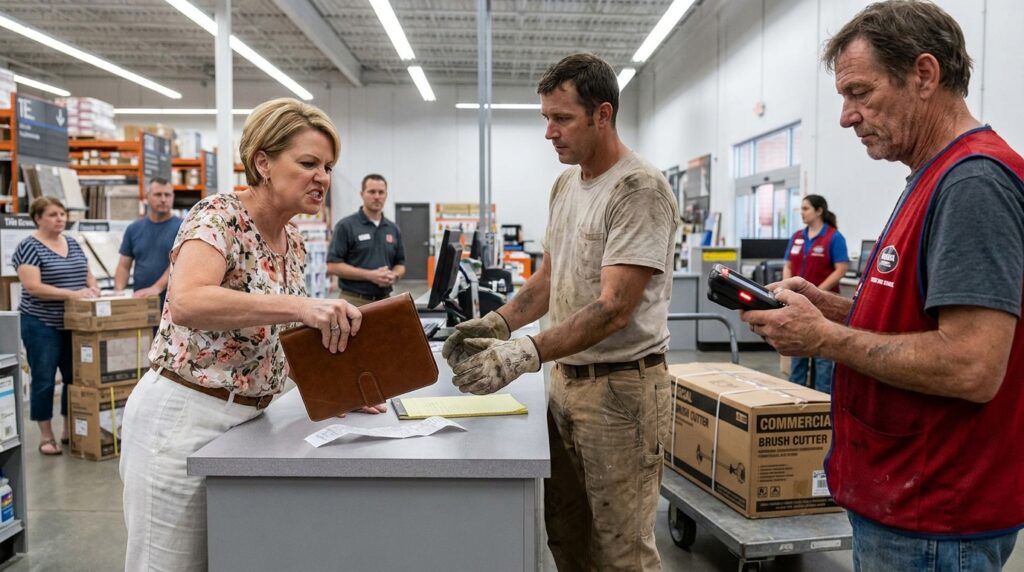
CHAPTER 5: THE WEIGHT OF THE RECOVERY COUNTER
“Clear the lane line,” a low, gravelly voice cut through the administrative cross-fire.
David Miller stepped into the yellow border of checkout lane four, his boots tracking a fresh film of black grease from the rear service bay. He didn’t look at Evelyn’s phone or Marcus’s box. His red store vest was unzipped, the fabric worn thin around the pocket seams where his heavy inventory radio dragged the hem down. His thumb remained flat against the talk button of his earpiece, a low hiss of static spilling into the narrow space between the high impulse shelves.
“We have an active terminal freeze here, David,” Evelyn said, her sunglasses slipping a fraction of an inch down her nose as she pivoted toward the manager. Her leather planner clicked against the side of her wire basket like iron hitting slate. “This commercial contractor is removing specialized machinery that has been flagged for the historic district’s municipal greenway allocation. I’ve already initialized a regional compliance review on his pavilion work order.”
Miller didn’t answer her. He reached out with one broad, blunt-fingered hand, his palm flattening against the side of Evelyn’s chrome cart basket. With a steady, effortless shift of his shoulder weight, he shoved the entire metal frame six inches back, forcing the spinning casters to screech against the expansion joint until the path cleared.
“Move the flatbed down to the main service desk, Marcus,” Miller said. He didn’t raise his voice, but it had the hollow, unblinking density of a man who had cleared ten thousand retail bottlenecks before the noon whistle. “We don’t arbitrate ledger variances in the exit lane. Cashier, reset the terminal string for the tile line.”
Marcus didn’t ease his grip on the iron handlebar. He let the flatbed roll forward, the heavy urethane wheels rumbling across the newly cleared concrete gap as he followed the manager toward the wider customer service counter near the main entry glass. Evelyn kept pace on the opposite side of the structural partition wall, her sandals snapping against the floor with aggressive, rhythmic impact, her leather planner clutched against her ribs like a piece of salvaged timber.
The customer service counter was a six-foot block of reinforced particle board, its gray laminate surface gouged and pitted by decades of dropped chain links and heavy pipe fittings. Miller walked behind the high counter, his hand dropping onto a rugged, rubber-encased handheld terminal that sat in a black charging cradle. As he lifted the device, a tiny red indicator light near the battery seal began to blink in rapid, irregular patterns—a local system alert tracking an unverified administrative hold.
“Now,” Miller said, his boots settling into the anti-fatigue mat behind the desk as he looked across the laminate at both of them. “Let’s look at the actual iron.”
“The allocation paperwork is perfectly clear on my ledger sheet,” Evelyn said, slamming her yellow legal pad down onto the gouged gray surface. Her gold watch rattled against the particle board. “The historic district committee holds a permanent municipal priority voucher for all commercial-grade landscaping units in this district. If Boyd Landscaping has cleared this barcode through a backdoor pro account, it constitutes a direct violation of our civic infrastructure agreement.”
Marcus reached into his rear pocket. He didn’t pull out his phone first; his fingers found the crumpled, foot-long strip of thermal paper receipt. He laid it flat on the laminate between them, his thumb resting over the bold black ink of the transaction total: $1,200.00. The clink of his brass key-clip died against the counter’s rubber edge.
“The receipt is timed at eight-forty,” Marcus said, his eyes tracking the fine layer of sawdust that had settled into the deep cuts on the desk. “The pro desk ran the tax ID, cleared the corporate card, and logged the asset to my pavilion contract. There is no backdoor string, David. The stock count was one, and the one belongs to my truck.”
Miller reached for the thermal paper, his rough thumb sliding over the printed barcode. He didn’t look up at Evelyn’s legal pad or the residential zone number stamped on her page. Instead, he raised the handheld terminal, the small red light casting a faint, rhythmic glow across his weathered knuckles as he lined up the laser guide with Marcus’s receipt.
The warehouse went quiet around the desk, the distant rumble of a delivery truck out on Main Street vibrating through the massive front glass panes. Marcus stood perfectly still, his boots square on the floor, his mind tracking the exact mechanical loop of the conflict. He knew what a system audit looked like when the paperwork went sideways; he had watched the bank inspectors scan his old yard cages three years ago while his former partner sat in a legal office across town, signing away the company’s fuel credits. He wasn’t going to let an administrative fake-out unhook his iron a second time.
“This barcode is fully live,” Miller muttered, his eyes narrowing as the handheld terminal let out a sharp, discordant triple-beep—the system warning for a high-priority account conflict. He clicked the side scroll button with his thumb, his face hardening as the screen began to project a series of internal municipal log flags that neither Marcus nor Evelyn could see from the opposite side of the counter.
Evelyn leaned forward, her elbows locking over her leather binder as she pressed her torso against the laminate. “Scan the committee voucher string, David. It overrides the retail register. If that cutter leaves this building on a private flatbed, I will have the district council pull the store’s regional occupancy permit before the weekend is over.”
Marcus didn’t back away from the ledge. He looked at the flashing red light on Miller’s device, noticing how the manager’s fingers had tightened against the rubber casing until the plastic groaned, the real weight of an institutional collapse beginning to register in the deep lines around the older man’s mouth.








