
CHAPTER 3: THE CHANNELS OF THE BOTTLENECK
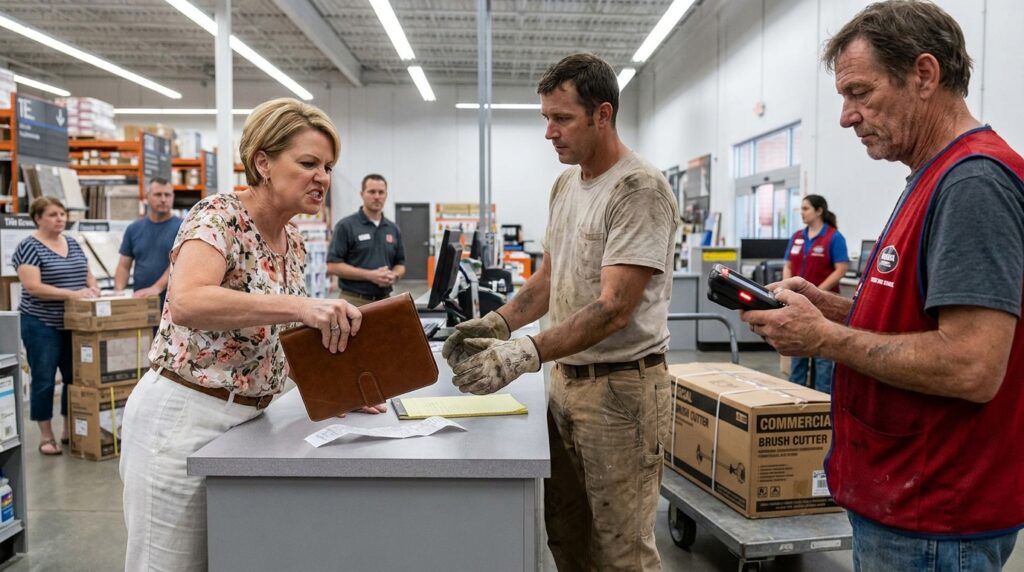
“This register is locked until we verify the allocation papers,” Evelyn Vance said, her hand flattening against the chrome divider bar of checkout lane four. Her voice carried over the sharp, rhythmic chirp of a nearby barcode scanner. She didn’t drop her glare, her posture rigid as she leaned her pelvis against the front frame of her metal cart, weighting the left wheels into the narrow yellow lane line painted on the floor. “This isn’t a retail choice, young man. It’s a civil preservation priority.”
Marcus Boyd felt the cold vibration of the main air handler trembling through the handlebar of his steel flatbed. He didn’t ease his grip on the square iron frame. His boots scraped across a patch of loose floor sealant, the small gritty particles crunching beneath his thick soles. Behind him, the queue was already compressing. A young couple carrying four boxes of interlocking slate tiles stopped three feet back, their heavy cardboard box sagging between them, their breath catching as the lane bottlenecked.
“The register doesn’t clear municipal overrides, ma’am,” the young cashier murmured. Her fingers hovered two inches above the rubber keyboard, her eyes tracking the massive, red-clad shape of a floor supervisor who was currently forty yards away, dealing with a forklift tag near the lumber tier. “If the commercial desk already stamped the barcode, the inventory is locked to the account holder’s name. I can’t void an active pro-tier ledger without a key-turn from the back office.”
“Then you fetch the back office,” Evelyn replied. She didn’t look back at the cashier. She kept her eyes on the heavy cardboard box on Marcus’s cart, her fingers tapping against the edge of her oversized leather planner. As she adjusted the binder, a small, pale blue slip of paper detached from her legal pad and fluttered into the bottom of her wire shopping basket. It landed directly on top of a glossy landscape brochure detailing private garden designs for multi-acre country estates—not public parks. The brochure was marked with a hand-drawn pencil boundary line that precisely matched the square footage requirements of a commercial-grade brush cutter.
Marcus observed the blue slip. His mind didn’t jump to conclusions; it calculated the friction. He knew how city code worked when a non-profit group tried to skip the regional supply chain. They used internal vouchers to freeze stock, then left the paperwork to settle over a ninety-day billing cycle while private accounts took the loss. His former partner had used those exact three-part carbon sheets to clear out their collective tool cage during the county road audit.
“The register works fine,” Marcus said. His voice remained flat, catching the dry, dusty air coming off the fertilizer aisles. He didn’t shift his balance. “The transaction cleared five minutes ago at the commercial desk. The box stays on this steel until I wheel it past the glass. If you want a manager, use the lane phone, Evelyn. Otherwise, clear the casters.”
Evelyn’s jaw set into a hard, linear line beneath her sunglasses. She turned her torso completely, her arm shoving her metal cart three inches further into the gap, the rubber bumpers scraping hard against the painted steel wrapper of the impulse-buy rack. A row of heavy-duty utility knives clattered against their wire pegs, the small metal packages swinging like pendulums under the bright fluorescent tubes.
“I am trying to prevent an unauthorized asset leak before the weekend committee logs are finalized, Marcus,” she said, her voice dropping into a transactional rhythm that was low, sharp, and narrow. “The historic district has an active maintenance easement over every commercial layout on Main Street. If this store releases professional clearing machinery to an unvouched private contractor during a scheduled municipal beautification window, it violates our bulk supply agreement with the county. I don’t need a key-turn to freeze a suspected delivery deviation.”
The cashier’s hand dropped from the keyboard. She looked at Marcus’s dusty canvas pants, then at the gold-plated watch flashing on Evelyn’s wrist, her expression freezing into the neutral caution of an hourly employee caught between a contractor’s receipt and a prominent resident’s mouth. The murmurs behind the tile box were growing louder now, the sharp tang of weekend impatience beginning to cut through the heavy smell of treated pine and industrial grease.
Marcus didn’t check the line behind him. He kept his eyes on the locked casters of her cart, his fingers tracking the small cold notches of the brass key-clip against his thigh. He knew every turn of the store’s policy book; he’d read it when he registered his commercial tax ID after the audit. An HOA coordinator or a district committee head had no structural authority inside a private commercial business once the printed receipt hit the contractor’s hand.
“The delivery isn’t a deviation,” Marcus said, his arm muscles tightening as he prepared to shove the heavy flatbed forward through the narrow clearance gap she had left near the register screen. “The delivery is mine. If your crew is short on iron for the park, you can take a number at the pro counter and wait for the Tuesday freight truck like everybody else.”
Instead of yielding the space, Evelyn reached down and gripped the wire flank of her basket, her knuckles turning white against the gray zinc coating as she leaned her entire weight against his cart’s front wheels, her face darkening as she prepared to make the lane a public perimeter.








