
CHAPTER 8: THE UNBLOCKED PERIMETER
“Evelyn,” David Miller said, his voice dropping into a register so low and flat it seemed to vibrate against the metal backing of the counter. He didn’t reach for the phone. He simply stepped back, his hand retreating to his own radio, his fingers moving with the precise, rhythmic competence of a man who dealt in physical realities, not administrative ghost-stories. “I’m not logging a transaction. I’m logging a trespass. If you don’t clear the egress lane, the security feed is going to hit the regional police precinct in ninety seconds.”
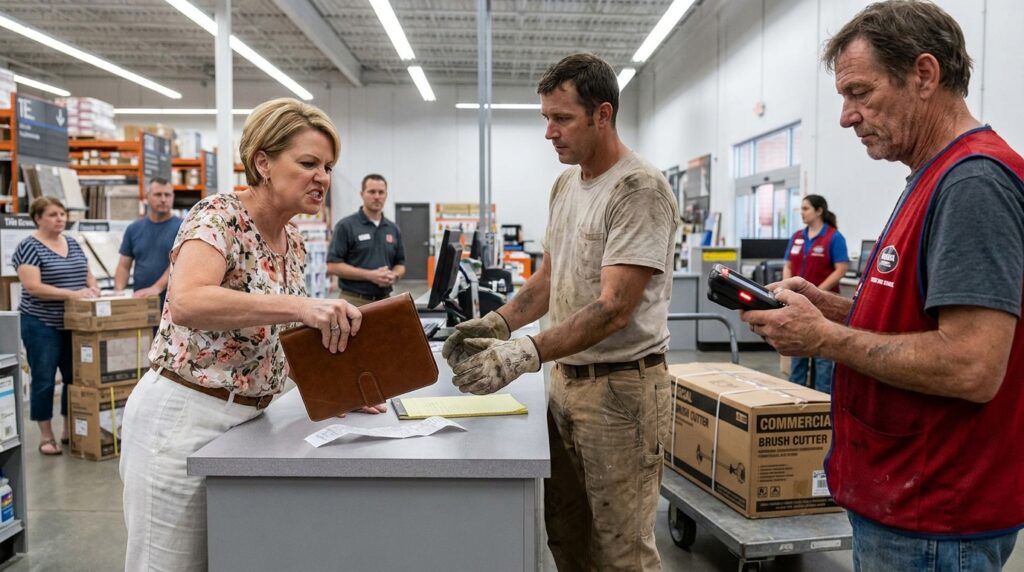
Evelyn Vance’s face froze. The red flush of her earlier aggression drained away, leaving her skin a sallow, chalky gray under the harsh warehouse glare. She looked at the handheld unit in Miller’s hand—the small, red status light blinking a rapid, rhythmic warning against the dark rubber casing. The terminal wasn’t just showing a debt; it was signaling an active lockout. The historic committee’s entire procurement access had been revoked by the county treasurer’s office at 5:00 p.m. the previous evening.
The silence in the store was total. Three aisles over, the two floor associates had stopped their work entirely, their hammers held mid-air as they stared toward the service desk. The couple with the slate tiles had stepped forward, their eyes locked on Evelyn, their expressions shifting from irritation to a cold, observant contempt.
Marcus Boyd didn’t move. He kept his hand firmly on the iron handle of his flatbed, his fingers tracing the rough, unground weld marks where the steel plate met the frame. He watched the way Evelyn’s shoulders sagged, the way her oversized planner—the shield she had used to hold the entire store hostage for twenty minutes—seemed to lose all its structural weight against the counter. She wasn’t fighting for a municipal park anymore; she was fighting to keep a private financial ruin from being broadcast to every neighbor on the Main Street corridor.
“I have the voucher,” Evelyn whispered, her voice failing, the syrupy, authoritative confidence completely stripped away. She tried to pull the yellow legal pad toward her, but Miller had already tucked the handheld unit into his vest, his posture shifting into a stance of absolute, immovable resolve.
“The voucher is tied to a lien,” Miller said, his eyes hard and unblinking. “Take your basket. Exit the lane. If you touch this counter again, I’m locking the glass.”
Evelyn stared at him for a second longer, her pupils dilated as she scanned the room, searching for a face, a voice, or a social anchor that would rise to support her. But the shoppers in the lane were just people holding boxes of tile, their faces closed off and impassive. She was no longer the district coordinator; she was just a woman with a cart full of empty threats, standing in a warehouse that didn’t know her name.
She reached down, her hands trembling as she grabbed the wire handle of her basket. She didn’t look at Marcus. She didn’t look at the manager. She spun her cart around so violently that the front casters screamed against the polished concrete, and she marched toward the exit, her white trousers catching the dust of the aisle, her stride uneven and frantic.
Marcus watched her go, his eyes following her until she disappeared through the sliding glass doors, her silhouette merging into the bright, hazy light of the parking lot. He didn’t feel a rush of triumph. He felt only the heavy, grounded weight of the machine in his hands—a piece of iron that was going to earn him his keep, and which he now owned, outright, by the sheer, stubborn physics of a paid receipt and a refusal to move.
“Take the machine out,” Miller said, his voice returning to the neutral drone of a retail manager as he stepped away from the terminal. “The load is clear.”
Marcus nodded, a brief, sharp motion, and began to move. He shoved his flatbed forward, the casters rolling smoothly over the spot where Evelyn had blocked his path. As he pushed the weight toward the wide, open mouth of the front entrance, he felt the heavy brass keys clinking against his hip—the sound of a perimeter that was finally, truly, his own to defend.
He stepped out into the parking lot. The air was crisp, tasting of distant storm clouds and dry pavement, the sky above the ridge an unblemished, expansive blue. He didn’t look back at the warehouse. He simply pushed his equipment toward his waiting truck, the steel wheels leaving clean, parallel tracks in the dirt, the iron perimeter holding firm behind him.








