
CHAPTER 4: THE SACRIFICE OF FALSE LAWS
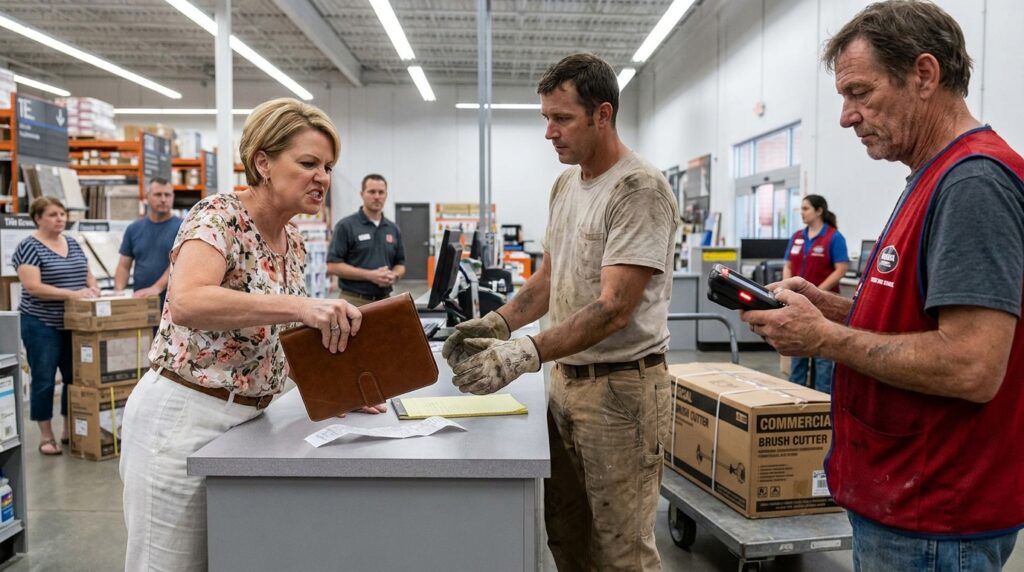
“This store serves the community first, and my committee requires that equipment today,” Evelyn Vance said, her voice rising an octave to cut through the heavy, mechanical hum of the ceiling fans. She turned her torso completely toward the expanding queue behind Marcus, her hand lifting to point a rigid, manicured finger at the box. “Hand over the cart before I have security remove you for theft. We are not letting private commercial greed deplete municipal resources.”
Marcus Boyd didn’t shift his boots an inch. He kept his palms clamped over the cold iron handlebar of his flatbed, his thumbs catching the rough, unground weld marks where the steel plate met the frame. The wire edge of Evelyn’s cart was wedged hard against his front urethane wheels, locking them into the narrow gutter between the cash register counter and the industrial display racks. The smell of cedar mulch and stale floor wax hung thick in the dead air between them.
“I’ve already paid for this property,” Marcus said. His voice was too quiet for the cavernous rafters, forcing the shoppers behind him to lean forward to catch the words. He felt the heavy brass keys on his hip press cold against his thigh as he tilted his pelvis toward the barrier. “Step away from my cart so I can leave.”
A murmur broke out from the couple with the slate tiles. The man shifted the sagging cardboard box against his hip, his face slick with dust. “Lady, some of us have crews waiting on jobs right now. Move the basket or let the guy bypass you.”
Evelyn didn’t glance back at the line. Her chin remained lifted, her oversized sunglasses reflecting the harsh grid of the overhead halogens like two blank, silver panels. “This individual is actively obstructing an authorized civic maintenance unit. This center-aisle lane is under regional historic preservation jurisdiction during public beautification cycles. If this register pushes through a non-vouched sale of a restricted inventory unit, the store manager will answer to the district council by five o’clock.”
She leaned over her wire cart, her crisp floral blouse brushing the dusty steel edge of the register belt. As she moved, her leather planner slipped completely flat, exposing the top sheet of her yellow legal pad. Marcus didn’t tilt his head, but his eyes tracked the bold, black ink of the municipal tax index number stamped at the top of her requisition ledger. It didn’t carry the “P-9” prefix designated for public parks or city-owned greenways. The string began with “R-22″—the exact zone code for private, multi-acre residential estates on the western ridge where the town’s oldest money kept its perimeters hidden behind thick hemlock screens.
The cashier’s fingers remained dead over the terminal keys. She looked toward the high-vis vests congregating two lanes down, her throat shifting as she swallowed back an entry log. “Ma’am, if the pro counter cleared the funds, the barcode is dead to the floor. I can’t pull an asset back into the active pool without a manual inventory release form from the main desk.”
“Then you hit the override switch,” Evelyn snapped, her fingers digging into the wire rim of her basket until the cheap zinc coating flaked off in tiny, dull gray scales under her nails. She pulled her phone from her pocket, the screen lighting up with a half-drafted email addressed to the county building inspector’s office. “I am already logged into the regional compliance portal. If this flatbed moves another foot toward the sliding doors without an administrative review, I will file a site-line violation report against the medical pavilion project before Marcus can even back his trailer up to the dock.”
Marcus took a slow, deep breath, the dry powder of old cement dust coating his throat. He recognized the tactical weight of the threat. A site-line audit from the historic board could hold up his equipment clearance for three weeks, long enough for the medical pavilion developers to void his contract and hand the clearing job to a larger, unionized firm from the city. His former partner had used that exact bureaucratic net to stall his trucks until the bank pulled his equipment lines.
He didn’t lift his hands from the iron. He looked at the edge of the residential zone code on her pad, then at the frantic, twitching rhythm of her thumb against her phone screen. She wasn’t acting with the calm weight of an institutional official; she was moving with the erratic, narrow speed of someone whose clock was running down to a zero balance.
“The pavilion contract is cleared through county zoning, Evelyn,” Marcus said. He shifted his weight to his rear boot, using his heel to lock the flatbed’s trailing casters against the concrete floor, ensuring she couldn’t shove his cart backward into the queue. “And the county doesn’t take enforcement cues from a neighborhood beautification group. Call whoever you want on that phone. The machine is paid for, the receipt is in my pocket, and the lane is open.”
Evelyn’s face went from pale to a dark, congested red beneath her makeup. She shoved her shopping cart an inch forward, the metal bumper screaming as it ground into the steel base of the register screen, her eyes narrowing until they were two dark slits behind her glass lenses, her entire posture signaling that she would drop the cart onto its side before she allowed him to clear the exit line.








