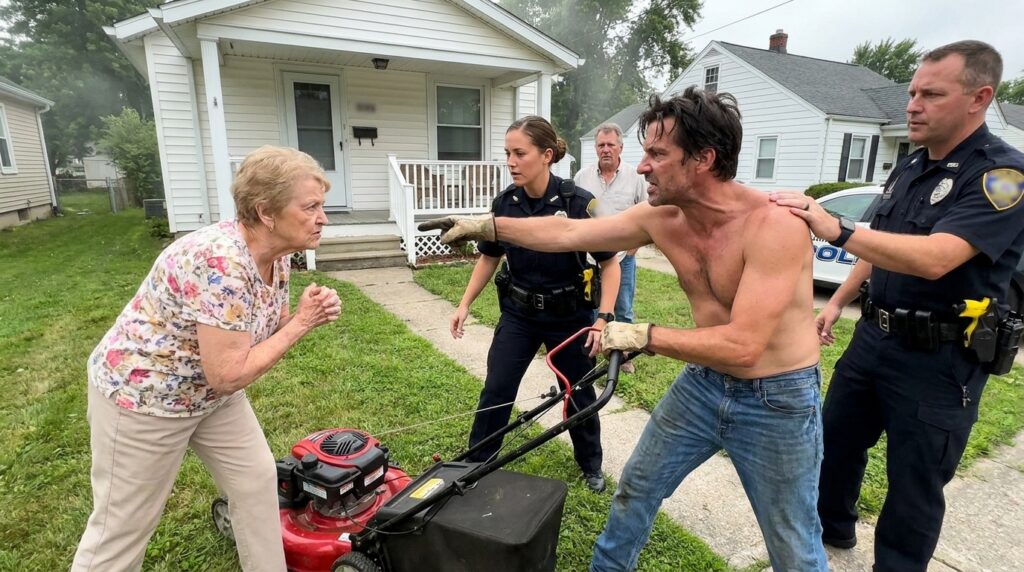
The Iron Below the Turf: A Tale of Bitter Boundaries and the Weight of Unyielding Earth
CHAPTER 1: THE FIRST RESISTANCE
The heat in the valley didn’t rise; it settled, thick with the smell of scorched fescue and the dry, metallic tang of two-stroke oil. The yellow push mower vibrated against the calluses on my palms, a steady, numbing shudder that went up my forearms and stopped at the elbows. It was an old machine, heavy-decked and prone to pulling left where the wheel-bolts had rusted thin, but it cut clean if you held the line straight. I kept my eyes three feet ahead, tracking the graying, splintered slats of the wooden privacy fence that divided the two lots. The grass along the boundary was thick—un-edged for three seasons, growing sideways into the rotted bottom rails of the pine panels.
Then the shadow broke the sun on the left side of the fence.
“Shut it down! I said, turn that damn thing off!”
Through the dust-coated lenses of my glasses, the pink floral blouse looked like a smear of wet paint against the parched dirt of the driveway. She was seventy, maybe seventy-five, her short blonde hair sprayed into an unyielding, artificial ridge that didn’t move even as she leaned her torso completely over the top rail of the wood. Her knuckles were white where they gripped the rough pine, and her index finger was already locked, jabbing into the air inches from my blue cap.
I didn’t release the safety bar immediately. I let the machine run for three more seconds, the blade spinning at three thousand revolutions per minute over the property line, chewing through the coarse dandelions that grew exactly two inches on the lot-owner’s side of the wood. The vibration under my fingers felt like a small, trapped clock ticking down.
“Ma’am?” I pulled the cap brim lower, shielding my eyes from the glare off her silver-framed bifocals.
“You heard me, boy. You’re trespassing,” she spat, her voice thin and dry, like paper scraping against a brick wall. She didn’t look at my face; she looked down at the yellow housing of the mower, her chest heaving against the floral cotton. “This isn’t Miller’s land. He told you it was, but he’s a liar. Everything from that post to the ditch belongs to my family. You take one more pass with that deck and I’m calling the county marshal for property damage.”
I let the bar snap back. The engine died with a wet, heavy cough, the blade whistling against the compressed air under the deck until it settled into a dead, iron silence. The quiet that followed was immediate and hostile, broken only by the distant, hollow click of an automatic sprinkler three houses down.
My left hand remained on the black rubber grip. With my right, I reached into my back pocket and pulled out the tri-folded work order, the edges soft and gray from my own sweat. The paper was crisp, stamped by the city code enforcement office four days ago for standard residential maintenance. I didn’t hand it over the fence. I held it flat against my thigh, letting her see the blue ink of the signature.
“Mr. Miller’s out until five, ma’am,” I said, keeping my breath steady, the words flat and dry as the dirt under my boots. “The work order says to clear the fence-line. Three feet out from the wood. It’s what the city requires for the fire lane access.”
“The city doesn’t know where the stakes are,” she said, her finger jabbing lower, almost touching the yellow paint of the shroud. Her skin was spotted with sun-damage, her breath smelling faintly of stale peppermints. “The fence is wrong. My husband set those posts thirty years ago just to keep the dogs out, but the line is three feet into your side. You’re cutting my grass. You’re stealing my topsoil.”
I looked down. Below the blade casing, tucked into the dark crevice where the fence posts met the red clay, a rusted corner of iron was barely visible through the matted weeds—a fraction of an old surveyor’s pipe, half-melted into the earth by decades of runoff. It wasn’t where her finger was pointing.

CHAPTER 2: PAPER BORDERS
“You look at this screen, boy. You look at it right now and tell me you have the right to pull that starter cord again.”
The glare from her smartphone was a blinding, blue-white square in the thick noon heat. She thrust the device forward, her wrist shaking slightly, the silver bracelets around her arm clicking like dry cicadas. On the glass, a standard satellite navigation app showed a pixelated green patch bisected by a bright red, computer-generated line. According to the satellite’s rough rendering, the yellow mower deck was sitting dead center inside a zone marked as her private parcel. The digital boundary looked clean, sharp, and absolute.
I didn’t reach for the phone. I kept my fingers wrapped around the coarse, pitted rubber of the mower handle, feeling the grit of dry topsoil beneath my skin. I looked past the glowing screen to the fence post directly behind her shoulder. The wood there was different. The other posts were spaced exactly eight feet apart, weathered uniformly by thirty years of valley rain, but this particular upright was rough-hewn, set closer to the hedge, its base choked by a dense, unpruned cluster of blue hydrangeas. The iron hardware holding the rail to the timber was flaky with bright orange rust, the scale peeling away in brittle layers that dropped into the dirt.
“That app’s running on a consumer-grade GPS grid, ma’am,” I said, my voice dropping into the low, monotonous rhythm of someone who spent his weeks reading land records instead of arguing with neighbors. “It has a margin of error up to fifteen feet near residential canopy. It’s not a legal plat.”
“It’s the county map,” she snapped, her thumb jabbing the glass so hard the screen went white under her pressure. “The homeowners association uses it. The tax office uses it. My husband verified it before he passed. You think your little piece of sweaty paper overrides the county grid?”
I flattened the work order against the steel shroud of the engine block. The heat from the cooling fins was already baking the ink on the page, the smell of warm oil rising between us like an invisible wall. “Mr. Miller’s deed isn’t based on a satellite ping. It’s tied to the benchmark at the intersection of Old Creek Road. I spent three hours in the assessor’s basement on Tuesday before I loaded the trucks.”
Her expression didn’t soften, but her arm dropped an inch, the phone screen tilting away from my face. For a split second, her eyes flicked toward the base of the hydrangeas—not at the grass I was supposed to cut, but at the dark, sunken depression where the earth dipped slightly beneath the root balls. There was a faint, sour odor rising from that patch of soil, something heavier than rotting mulch, a dampness that didn’t belong in a three-week drought.
“You’re a contractor,” she said, her voice dropping from a shriek into a tight, defensive hiss. Her fingers tightened around the top rail of the pine fence, the gray splinters digging into her palms. “You don’t care about the integrity of the block. You just want to clear your square footage and cash Miller’s check. If you touch those roots with that steel blade, you’re destroying forty years of cultivation.”
“I’m not touching the shrubs,” I said, my boots shifting on the dry turf. The ground felt hard beneath my soles, but when I pressed my heel down near the fence line, the earth gave way with an unnatural, spongy elasticity. It was a minor discrepancy, a small pocket of moisture beneath a sun-baked crust, but it ran parallel to the irregular fence line. “But the fire lane easement requires three feet of clear clearance from the structure of the wood. If the city inspector drives through that alley on Friday and sees these weeds choking the bottom rail, Mr. Miller gets the five-hundred-dollar citation. Not you.”
She leaned in closer, the pink floral cotton of her blouse catching on a jagged splinter along the top rail. She didn’t seem to notice the fabric tear. Her eyes were fixed on my tool belt, specifically on the brass-bound folding rule tucked into the side pocket.
“The fence is the border,” she whispered, her voice tightening with an intensity that had nothing to do with municipal ordinances. “The wood has been here since before you were born, boy. The community accepts the wood. You don’t get to come in here with a piece of paper and re-draw the world just because it makes your morning faster.”
I reached down, my fingers brushing the cool, heavy iron of the mower’s height-adjustment lever. The metal was burning from the sun, the spring-loaded notch snapping into place with a sharp, heavy clank that echoed off her concrete driveway.
“The wood is thirty inches out of alignment with the iron in the ground, ma’am,” I said, pointing directly at the rusted tip of the surveyor’s pipe buried in the fescue. “We can measure it by the link chain right now, or we can wait for the state line to verify it. But I have three more yards to drop before the sun hits the ridge, and this grass is getting cut.”
Her face went pale, the artificial ridge of her hair silhouetted sharply against the clear, white sky. She didn’t look at the rusted pipe I was pointing to; instead, her hand went into her dark pocket, her fingers closing around the phone once more with a slow, deliberate finality.
“I gave you your warning,” she said.
CHAPTER 3: THE CALL TO THE LINE
“Dispatch, I have an uncooperative subject actively destroying private landscape structures at forty-two-twelve Meadow Lane. He is aggressive, he is ignoring the boundary limits, and he is threatening my safety.”
She didn’t lower the phone. Her voice had changed—no longer the high, frantic screech she had leveled at me over the pine rail, but a measured, rhythmic reporting that sounded practiced, almost bureaucratic. She held the black plastic casing inches from her mouth, her knuckles white, her silver bracelets frozen against the graying grain of the wood. Her gaze remained pinned to my hands, watching for any sudden movement toward the mower handle, tracking the heavy brass buckles of my tool belt as if they were tactical hardware.
I stayed still. The midday sun hit the back of my neck like an iron bar, baking the dust into the sweat under my collar. I didn’t reach for my keys, and I didn’t pull the starter cord. In the three-foot gap between the yellow machine deck and the hydrangeas, the ground had begun to sweat too. The sour, heavy odor of stale water had grown sharper since the engine died, pooling in the low depression where the grass felt like wet foam under my work boots.
“The subject is refusing to clear the workspace,” she continued into the receiver, her eyes narrowing as I took a slow, deliberate step to the right, adjusting my weight on the hard-packed clay. “He has an altered document. Send a unit out before he cuts through the main utility line.”
The line went dead with a soft, mechanical click. She slid the phone back into the pocket of her dark pants, her palm lingering on the fabric as if to ensure the weapon of the state remained within reach. The pink cotton of her blouse rustled with her breathing, the small tear along the splintered top rail pulling wider, revealing a pale, trembling patch of skin near her collarbone.
“You should have loaded that trailer when I told you to,” she said. Her tone was lower now, steady with the cold confidence of someone who had spent decades using the city’s resources to carve out her own small sovereignty on this block. “The county doesn’t tolerate code violations from day laborers. They’ll impound that machine before the afternoon is out.”
“I’m not a day laborer, ma’am,” I said, my voice flat, matching the unyielding weight of the dry air. I reached down, slowly lifting the brass folding rule from my side pocket. I didn’t expand the sections; I just held the heavy metal block across my palm, letting her see the stamped industrial grading along its edge. “And the only utility line within six feet of this fence is the old clay main from the fifties. It’s supposed to run six feet under the gravel alley, not beneath these shrubs.”
Her fingers twitched against the wood. Her eyes flicked down to the base of the irregular post once more, her boots shifting back an inch into her own gravel driveway. A low, dull vibration seemed to hum through the soil beneath the mower—not the high-frequency rattle of an engine, but a deep, hollow thrumming that caused the grey water in the sunken patch to ripple slightly against the red clay roots. It was an old sound, the kind that came from fluid moving through a collapsed pipe under pressure.
“The infrastructure here is private,” she said quickly, her words clipping together as she tried to crowd out the sound from below. “My husband laid the drainage tiles himself. He cleared it with the developer in eighty-four. We have the variance locked in the house.”
“The developer didn’t have the authority to grant a variance on a municipal fire lane, ma’am,” I answered, my fingers tracing the cold, zinc-plated hinge of the rule. I looked toward the street corner, where the heat was already distorting the asphalt into a shimmering, oil-slick mirror. “If those tiles are crossing into Miller’s parcel, they aren’t a variance. They’re an encroachment.”
She didn’t answer. She just tightened her grip on the fence line, her posture hardening into a defensive block as the distant, rising wail of a siren cut through the dead valley air. It started low, two miles out near the state highway, a thin, mechanical screech that began to bounce off the vinyl siding of the surrounding tract houses.
I didn’t move the mower. I grounded my boots into the red dirt, my thumbs hooked into the webbing of my tool belt, waiting for the blue lights to break the glare at the end of the lane. The iron below the turf was still ticking, and the paper in my pocket was starting to feel like the only solid thing left on the block.
CHAPTER 4: THE SEPARATION LANE
“Ma’am, step back, let us handle this now.”
The words didn’t cut through the heat; they dropped into it like lead weights. The heavy sole of a tactical boot crunched down onto the dry gravel strip right where the driveway met the grass. The primary officer was wide, his stocky build framed in rigid black nylon that didn’t yield to the midday glare. His short dark hair was damp along the temples, his clean-shaven jaw set into a hard line as he swung his torso around, effectively cutting off the neighbor’s line of sight to my hands. His left arm came up, an unyielding bar of black cloth that forced her back toward her side of the pine rail.
Behind him, the secondary officer—younger, leaner, his hands resting loose but ready near the plastic retention clips of his utility belt—took up a support lane by the curb. The black-and-white cruiser sat idling twenty feet away, its roof-mounted light bars throwing rhythmic, silent flashes of blue across the parched white vinyl siding of the Miller house.
“Officer, he’s ignoring a civil notice,” she began, her hand flashing out of her pocket, her trembling index finger pointing directly over the officer’s shoulder at my blue cap. The pink cotton of her floral blouse wrinkled and pulled tight across her shoulder blades as she tried to lean around his bulk. “He’s destroying private improvements. He was told to vacate the parcel and he refused.”
The primary officer didn’t look at her phone. He didn’t look at the map she was trying to shove into his chest. His eyes stayed on me, tracking my posture, assessing the heavy brass hinges of the folding rule still resting across my palm.
“Drop the tool on the deck, son,” he said, his voice flat, professional, and entirely devoid of neighborly sympathy. “Step three paces back from the machine.”
I didn’t argue. I let the brass rule drop onto the steel casing of the mower engine with a sharp, metallic clink. I took three steps backward into the sun-baked yard, my rubber soles slipping slightly on the matted fescue until I felt my heels hit the firmer, un-mowed clay closer to the Miller porch. My forearms were still buzzing from the residual vibration of the two-stroke engine, but my chest felt cold.
“I have a valid work order, Officer,” I said, keeping my hands clear of my belt, my thumbs hooked loosely into my pockets. “It’s signed by code enforcement. The fire lane requires three feet of clear clearance from the wood line.”
“I don’t care about the fire lane right now,” the officer said, his head turning five degrees to check my position before he turned fully toward the fence. He planted his boots wide, creating a living wall in the two-foot gap between the yellow mower shroud and the hydrangeas. “Ma’am, I need you to lower the phone and keep your hands where I can see them. We’re establishing a separation lane here until we get the property holder on site.”
“The property holder is a fool who doesn’t know his own boundaries!” she screamed, her voice cracking as the performance of controlled civic authority finally broke. She slammed both her palms down onto the top rail of the weathered fence, the old pine groaning under her weight. “My husband spent forty years protecting this block from people like him. You have no right to stop me from securing my own dirt!”
“Everyone stay back and give him space,” the primary officer barked, his voice rising to mask her shouts as he turned his attention toward the driveway. He wasn’t looking at her anymore; he was looking at a gray sedan that had just pulled up behind the idling cruiser.
The car door clicked open. Mr. Miller stepped out, his thin face drawn, his fingers gripping a faded blue plastic folder with a desperate, white-knuckled intensity. He didn’t look at the neighbor. He walked straight toward the secondary officer at the curb, his breath coming in short, ragged gasps that showed through his grease-stained work shirt.
“Officer,” Miller called out, his voice shaking as he unzipped the folder. “I have the deed. I have the certified plat from the eighty-four closing. It’s all right here.”
I stepped closer, my eyes tracking the folder as Miller pulled out a sheet of brittle, yellowed paper that looked older than the house itself. It wasn’t a standard modern blueprint. It was a hand-drawn utility easement modification from 1984, the lines drawn in fading blue ink, showing an irregular hatch pattern right where the fence post sat.
The primary officer took the paper, his rough fingers tracing the border of the sketch. I leaned in slightly, my eyes catching a handwritten notation along the margin: Temporary bypass allowance—subject to municipal review upon line termination.
“What is that?” I asked, my voice dropping.
The officer didn’t answer. He just looked from the paper down to the dark, spongy depression beneath the hydrangeas, where the sour smell of stagnant moisture was growing thicker by the minute under the crushing heat. The decoy had just landed, and the ground below us was shifting.
CHAPTER 5: EXCAVATING THE IRON
“Get away from those roots! Don’t you dare touch that soil!”
Her scream was different now. The thin, paper-dry sharpness had warped into an erratic panic as Mr. Miller dropped to his knees in the dry fescue. He didn’t look at her. His thin fingers, black with engine grease from his shift, tore at the matted weeds around the base of the irregular pine post. He jammed a short steel trowel into the red clay, the blade striking something solid with a dull, hollow thud that didn’t sound like rock.
The primary officer stepped closer, his heavy leather utility belt creaking under the strain of his movement. He held the yellowed 1984 easement sketch open in one palm, his eyes tracking the handwritten hatch marks from the paper down to the hole Miller was clearing. The black nylon sleeve of his uniform was stained with red dust, his stocky frame casting a wide shadow over the excavation lane.
“Hold on, sir,” the officer ordered, his voice flat but turning sharp as a dark, thick moisture began to well up from the puncture mark in the dirt. “Let’s verify the marker before you dig any deeper.”
“The marker is right here,” Miller muttered. His voice was raw, his face flushed a deep, dangerous crimson under the noon glare. He wrenched a thick hydrangea root aside, his knuckles scraping against the rough bark. “The county blueprint says the easement lane was modified for a stormwater overflow. But look at this. This isn’t stormwater.”
A heavy, low gurgle vibrated through the ground beneath my work boots—the same deep thrumming I had felt under the yellow mower deck, but louder now, un-muffled by the soil. The black mud at the bottom of the shallow trench began to bubble, a thick, dark fluid oozing out around the fractured edge of an un-stamped plastic pipe. The stench hit us a second later: a foul, sulfurous wave of untreated septic waste, heavy and suffocating, instantly killing the clean scent of chopped fescue and dry pine resin.
The neighbor froze. Her hands, still clamped onto the top rail of the weathered fence, began to tremble so violently that the old pine panels rattled against their rusted nails. The pink cotton of her floral blouse looked stark and absurd against the black mud pooling at her feet. She tried to step back into her gravel driveway, but her rubber sole slipped on the slick moss encroaching from the boundary, her hip checking hard against the wooden rail.
“It’s an old line,” she whispered, her face draining of color until her skin looked as gray as the rotted cedar posts. Her eyes darted from the primary officer to the secondary officer, who was already pulling his radio from his shoulder strap. “The developer laid it. It was part of the eighty-four variance. We have the right to drain the runoff.”
“This isn’t runoff, ma’am,” I said, taking a step toward the fence. I pointed my work boot at the broken pipe. The fluid wasn’t clear; it was thick, grey-black, and it was pumping directly from the direction of her foundation, crossing underneath the weathered fence line by exactly thirty inches before draining into Miller’s yard. “Your husband didn’t set this fence to mark a boundary. He set it to hide the bypass. He buried his sewer line three feet into this lot because the county wouldn’t let him build over his own septic field.”
The primary officer looked down at the hand-drawn sketch, his thumb rubbing the fading blue ink along the margin. The “temporary bypass allowance” wasn’t a county-sanctioned utility easement at all. It was a private, un-recorded deal scribbled on the back of an old plot map, a thirty-year-old deception designed to keep the health department from condemning her property. The false framework she had used to bully the block for decades had just collapsed into the mud.
“Call code enforcement and the health department out here,” the primary officer directed over his shoulder, his voice dropping into a cold, transactional register. The secondary officer nodded, his radio spitting a static-heavy confirmation into the hot valley air. The officer turned his full bulk back toward the neighbor, his black uniform cutting off her path to the house. “Ma’am, you need to step away from the fence and stay on your driveway. This is an active code violation site now.”
She didn’t move. Her mouth opened, but no sound came out—no more accusations, no more county maps, no more threats of the marshal. The performance was over, the script had run out, and the unyielding iron truth was finally rising through the turf.
CHAPTER 6: THE ENGINES RETURN
The plastic handle of the starter cord was cold, slicked with a thin film of grit and un-combusted fuel. I wrapped three fingers around the T-grip, set my work boots wide into the red clay outside the drainage pool, and pulled. The cord came out with a sharp, metallic hiss, the flywheels catching the spark on the first upward stroke. The heavy steel deck of the yellow push mower erupted into a deafening, twin-stroke roar that tore through the stagnant, sulfurous air of the alley lane, masking the radio chatter of the secondary officer and the low, wet gurgle of the leaking pipe.
The vibration hit my calluses instantly, a violent, high-frequency thrumming that cleared the numbness from my forearms. I didn’t look at the neighbor. I didn’t check her face to watch the gray defeat settle into the lines around her mouth, and I didn’t track the movement of the pink floral blouse as she drifted backward into the deep shadow of her concrete porch. Her screen door clicked shut with a small, hollow metallic snap that was completely swallowed by the mechanical thrash of the three-thousand-RPM blade below my feet.
The primary officer stayed by the trench, his stocky frame silhouetted against the bright glare of the black-and-white cruiser’s light bar. He didn’t order me to drop the tool this time. He just gave a brief, single nod of his head, his heavy thumb resting flat over the edge of the yellowed 1984 sketch, keeping the paper pinned securely against his tactical belt.
Mr. Miller remained on his knees near the hedge, his hands covered in the foul, grey-black sludge that continued to ooze from the fractured plastic line. But his face was clear. He reached down into the red mud at the base of the irregular pine timber and struck something iron—the true surveyor’s pin, a solid, two-inch core of rust-resistant steel stamped with the official county registration number from forty years ago. It sat exactly thirty-six inches to the left of her old fence posts. The unyielding boundary marker was fully exposed to the sun, its stamped numbers readable through the grease.
I gripped the black rubber safety throttle and shoved the machine forward.
The heavy rubber wheels bit into the overgrown fescue along the true edge. The steel blade hit the dense, three-foot wall of wild dandelions and tangled wire-grass that she had claimed as her private estate, chewing through the coarse green stalks with an aggressive, spraying crunch. Bright green chaff and wet, sun-baked topsoil flew from the side discharge chute, coating the bottom rails of her illegal fence in a thick layer of fresh mulch.
The work was heavy, the friction of the wet grass dragging at the rusted wheel bolts of the old machine, but I kept my weight pressed hard against the handle, forcing the deck to clear a straight, clean lane right to the iron marker. The engine heated up, the smell of burning oil and fresh-cut vegetation finally crowding out the rotten stench of the hidden septic line.
Porch watchers three houses down shifted their positions behind their screens, their window blinds dropping back into place as the street returned to the standard rhythm of an ordinary Tuesday afternoon. The authority-faking performance that had policed this fence line since the sub-division was paved had evaporated into the red dirt, replaced by the simple, measurable reality of iron pipes and legal plats.
I finished the final pass, turning the yellow deck around at the curb line to clear the last of the weeds near the street index. The mower ran smooth now, the resistance gone as the tires tracked along the newly established border. Mr. Miller stood up, wiping his black hands on a scrap of rag, his eyes fixed on the neat, three-foot clearance lane that now ran entirely on his side of the iron pin.
I let the safety bar snap back. The engine died with a sharp, heavy pop, the blade whistling against the casing for a brief three seconds before settling into absolute stillness. The silence that followed was clean, free of shrieked warnings and fraudulent maps.
“Turn the mower back on,” Miller said, his voice dropping into a quiet, steady register as he looked over the clean sod to the closed screen door across the driveway. “This yard is exactly where it belongs.”
I reached for the handle again, my calluses sinking into the worn rubber. The valley sun was still high over the ridge, the heat indices showing no sign of dropping, but the line was cut, the iron was found, and the turf was finally settled.