The Weight of the Iron Pin: A Narrative of Sovereign Boundaries and Rusted Realities in the American Suburbs
CHAPTER 1: THE FAULT LINE
The rubber grips of the push mower were hot, sticky with melted black polymer that left dark stains across the palms of his hands. He didn’t wipe them off. The midday sun was a flat, white weight pressing down on the narrow corridor between the two foundations, baking the cedar privacy slats until the smell of old wood resin filled the tight air. Every turn of the blade through the crabgrass felt like dragging an iron anchor through wet clay.
Then the shadow broke the glare.
“Get that machine out of my sight before I have the county marshal take it from you,” she said, her voice cutting through the thick heat of the afternoon like a dry saw blade.
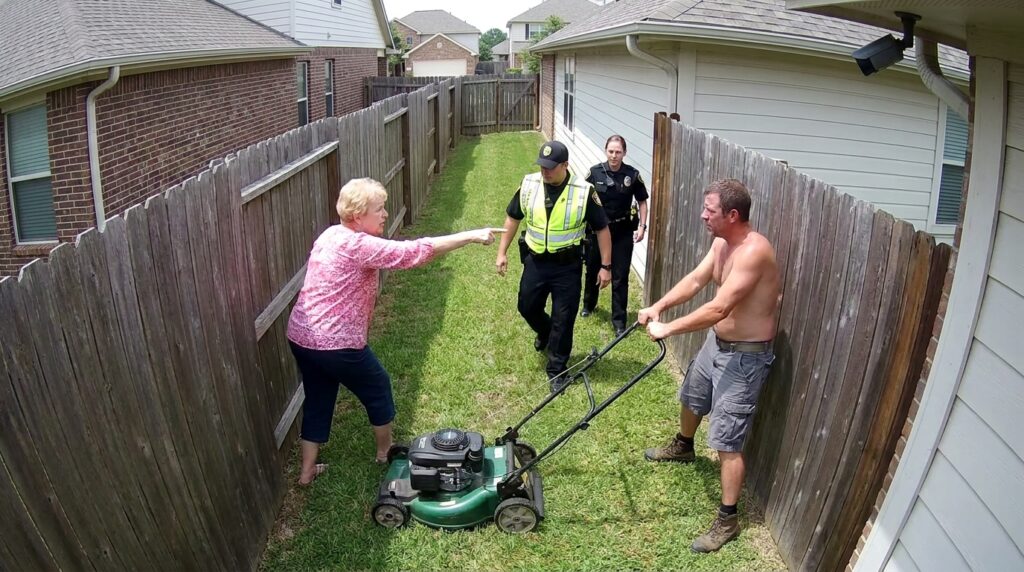
Mrs. Gable stood directly at the fence line, her short blonde hair stiff under the blinding light. She wore a pink patterned blouse that looked aggressively sterile against the grey, weathered grain of the cedar posts. Her oversized sunglasses reflected two small, distorted versions of his own shirtless torso. One of her arms was already extended, a pale, liver-spotted finger jabbing into the air inches from his face, pointing down at the wheels of the green mower.
He released the safety bail. The engine gave a short, sputtering gasp and died, the sudden silence of the neighborhood settling over the side yard like heavy dust. The only sound left was the metallic tink-tink-tink of the cooling exhaust manifold.
“The markers are right here, Mrs. Gable,” he said. His voice was low, flat, matching the dry texture of the soil beneath his boots. He didn’t lower his hands from the handlebar. He kept them clamped there, a defensive block between his chest and her forward lean. “I’m just cutting my own grass.”
“This isn’t your grass. It has never been your grass,” she spat back, her lower lip tightening into a hard, pale line. She didn’t look at the small pink plastic flag fluttering near her left shoe. She looked past it, her posture stiffening with the practiced authority of someone who had spent thirty years monitoring the square footage of the street from behind a set of closed blinds. “You bought a foreclosure, young man. You didn’t buy the township. I know exactly where the deed draws the line, and if you take one more step with that machine, it’s criminal trespass.”
He didn’t move an inch backward. His work boots remained sunk into the packed earth of the lane, his eyes locked on the sharp edge of her jawline. He could see the slight tremor in her extended finger—not from fear, but from the raw voltage of an old, deeply nurtured entitlement. She wanted a reaction. She wanted him to curse, to swing the deck of the mower, or to retreat back to his porch so she could file the standard nuisance report with the code enforcement desk before dinner.
Instead, she reached into the deep pocket of her cropped pants and pulled out a sleek, black smartphone. Her thumb swiped the glass with an aggressive, rhythmic snap.
“We’ll let the department sort it out,” she said, holding the screen up like a badge. “They’re already on their way.”
He stayed silent, his knuckles white against the black rubber grip. Beneath the overgrown weeds right under his front left tire, something hard and metallic caught the glare of the sun—a tiny, grey glint of old iron buried deep in the root system that she hadn’t noticed yet.

CHAPTER 2: THE APPARATUS OF THE LAW
“Yes, dispatch, he is still refusing to move the equipment,” Mrs. Gable said into the glass rectangle pressed against her cheek. Her voice didn’t shake. It had the flat, rhythmic precision of a court reporter reading back a bankruptcy filing. She stepped closer to the cedar slats, her oversized sunglasses catching the white glare of the noon sun, turning her face into a blank, mirrored mask. “He’s shirtless. He’s aggressive. He’s standing directly on my property line, and he’s refusing to let me clear my access corridor.”
The younger homeowner didn’t break his grip on the black rubber handlebar. His palms were slick with hot grease from the mower’s throttle cable, but he kept his boots anchored six inches deep into the high crabgrass on his side of the line. The green deck of the push mower sat between them like a rusted shield, its engine silent, its cooling shroud radiating a thick, oily heat that smelled of scorched gaskets and unwashed denim.
“The markers are right here, Mrs. Gable,” he said again, his throat dry, spitting out the grit that the hot breeze kicked up from the gravel driveway behind him. He didn’t raise his voice. In the three years he’d spent pulling this cottage out of foreclosure, he’d learned that the county didn’t reward volume; they rewarded documentation. “I’m just cutting my own grass. The pink ribbon is exactly three feet from your retaining wall.”
“That ribbon is a self-serving decoration, and you know it,” she said, lowering the phone just enough to glare over the plastic rims. The phone’s small speaker gave a faint, tinny squawk—the voice of an overworked dispatcher five miles away in a basement municipal building, logged into a computer terminal that categorized human spite by zip code. “The county map from seventy-two shows the easement belongs to the original parcel. Your lot was an add-on. A junk sliver.”
He didn’t argue the history. Instead, his eyes drifted down to the front left wheel of the mower. The edge of the rubber tread was pinned against a dense clump of wild onion, and beneath the green stalks, that pale grey glint remained. It wasn’t a modern surveyor’s nail. It was thicker, pitted with sixty years of groundwater acidity—the square head of an old foundational tie-rod. It was positioned nearly half a yard onto his side of the current cedar fence line, buried like a tooth in the clay. If the tie-rod was here, the fence wasn’t just slightly off; the entire spatial logic of the driveway corridor was warped.
A low, heavy rumble vibrated through the asphalt at the end of the lane.
The white crown of a Ford Explorer patrol unit rounded the corner, its roof-mounted light bar dark but its engine humming with the distinct, heavy-duty thrum of a city vehicle on active patrol. It didn’t rush. The tires crunched slowly against the loose gravel at the curb, stopping at a perfect diagonal that blocked both driveways, its front bumper inches from the mailbox post.
Mrs. Gable didn’t step back. Her posture grew longer, her heels sinking into the soft turf as she prepared to receive the institutional reinforcement she’d summoned. She held the phone aloft like a smoking flare, her finger jabbing once more across the green metal body of the mower.
Through the tinted glass of the cruiser, the dark outline of a police cap shifted. The driver’s side door swung open with a heavy, mechanical click, the hydraulic hinge groaning under the heat. The responding officer emerged first—a large man in his late thirties, his black uniform crisp despite the ninety-degree weather, his yellow safety vest casting a neon reflection across the polished metal of his duty belt. His boots hit the grass with a solid, deliberate thud, the leather creaking as he adjusted the weight of his radio. Behind him, from the passenger side, the backup officer stepped out, her dark hair tied tight, her eyes already scanning the layout of the foundations before she even closed her door.
The neighborhood seemed to shrink. Curtains in the split-level across the street twitched, the white fabric separating by two inches as a pair of eyes locked onto the narrow side-yard lane. The silence that followed the arrival of the state was absolute, broken only by the rhythmic chug-chug-chug of the cruiser’s idle exhaust.
The responding officer didn’t draw a weapon, nor did he quicken his pace. He walked with the heavy, unhurried gait of a man who spent his afternoons separating adults who had forgotten how to share dirt. His hand rested naturally near his hip, his fingers tapping the edge of his nylon holster with a slow, administrative beat.
“Alright,” the officer said as he reached the mouth of the narrow corridor, his voice a deep baritone that carried no anger, only the exhaustion of a long shift. He stepped squarely into the center lane, his large torso breaking the direct line of sight between the pink blouse and the shirtless young man. He turned his head slightly toward Mrs. Gable, his arm rising to create a physical barrier. “Everyone stop, step back, and let me understand this.”
The younger homeowner didn’t retreat, but he let his shoulders drop two inches, his boots remaining fixed beside the buried grey iron. He knew the protocol. The first thirty seconds belonged to the person who called the line in; the remaining time belonged to whoever had the paperwork.
“Officer, thank goodness,” Mrs. Gable began, her voice instantly dropping the aggressive edge, replaced by the shaky, high-pitched strain of an elderly resident under siege. She reached down, her liver-spotted hand grabbing the top rail of the cedar fence for balance, leaning her weight toward his uniform. “He’s been out here since noon. He’s deliberately destroying the landscaping I planted with my late husband, and when I asked him to stop, he came at me with the machine.”
The officer looked at the green push mower. He looked at the front wheels angled into the wild onion. Then his eyes shifted to the young man’s bare chest, noting the sweat, the grease, and the total absence of forward momentum.
“Ma’am,” the officer said, his right hand rising in a slow, downward motion that was less a request and more a direct command to lower the volume of the street. “Stay right there for me. Don’t move across that line until I talk to both of you.”
He turned his face toward the younger homeowner, the black brim of his cap shading his eyes. “Son, turn the machine completely off if it isn’t already, step away from the handles, and tell me what we’re doing out here today.”
The young man didn’t reach for the survey folder yet. He kept his eyes on the officer’s vest, his voice dropping into the same flat, rhythmic register as the cooling engine. “I’m cutting the grass, officer. My name is on the deed to thirty-four. And the real line isn’t where she thinks it is.”
Behind the responding officer, the female backup took two steps toward the side wall of Mrs. Gable’s house, her boots brushing against a thick, unpruned cluster of old rhododendron bushes that grew along the foundation. She stopped, her eyes dropping to a strange, rotting piece of wood that had been shoved deep into the dirt behind the branches—a weathered, square stake with faded red paint clotted at the top, hidden completely from the view of the main street.
CHAPTER 3: THE CHILL OF THE SHADOW
“Officer, look at this branch,” Mrs. Gable said, her voice rising an octave, snapping thin and brittle in the dead air. She took a half-step sideways, her white orthopedic shoes grinding into the dry dirt at the edge of the patch. “He’s been hacking away at the roots of my prize shrubs. That fence has stood as the boundary since the Carter administration, and he thinks he can just unearth forty years of history because he has a machine.”
The responding officer didn’t look at the bushes. He kept his eyes on the younger homeowner’s hands, which were still resting flat against the black rubber handlebar of the idle green mower. His duty belt gave a slow, metallic creak as he shifted his weight, his black boots compressing a high clump of dandelions.
“Hold on, ma’am,” the responding officer said, his hand remaining steady near his hip, his fingers tapping the edge of his nylon holster with a measured, administrative rhythm. “We’re going to look at everything. Just keep your distance like I asked.”
The backup officer stayed crouched near the foundation wall of thirty-six. Her gloved fingers parted the heavy, dark green leaves of the rhododendrons, her boots sunk deep into the old hardwood mulch. The dry bark crackled beneath her soles. She didn’t look up at the argument; her gaze was fixed on the rotting square of pine she had just exposed. The wood was split along the grain, the red paint at the tip long since faded to a dull, chalky pink, but the stamped metal tag pinned to its side was still readable under the shadow of the brickwork.
The younger homeowner watched her from behind the mower handle. His chest rose and fell in a slow, controlled cadence. He could feel the grease on his palms turning cold as the sweat dried under the sudden shade of a passing cloud, but his mind remained centered on the logic of the dirt. He had spent months digging through the county registrar’s basement, tracing every deed transfer back to the original subdivision plat. He knew what she was hiding behind those roots.
“Officer,” the younger man said, his voice flat, retaining the hard, pragmatic texture of the lane. He didn’t point; he simply shifted his gaze toward the brush. “There’s an old survey marker under those leaves. It doesn’t match the current fence. It never did.”
Mrs. Gable’s hand tightened on the top rail of the cedar fence until her knuckles turned the color of old candle wax. Her sunglasses slipped a fraction of an inch down the bridge of her nose, revealing the sharp, dark heat in her eyes. “That is an old clothesline post from the previous family, you arrogant little transplant. It has nothing to do with where my property ends.”
The backup officer stood up slowly, brushing a dry leaf from the sleeve of her black uniform. Her face remained a professional void, but she caught the eye of the responding officer and gave a brief, horizontal nod—a silent signal between partners that the call had just drifted out of the realm of a standard neighbor dispute.
“Sir,” the backup officer said, her voice carrying a dry, professional clip that vibrated in the tight corridor. “Let’s take a look at whatever paperwork you brought out here. You mentioned a certified folder?”
“In the driveway. Under the truck seat,” the younger man replied. He didn’t break his stance until the responding officer offered a slow, permissive gesture with his hand.
He stepped away from the green mower, his work boots crunching against the dry earth as he moved past the machine. The metal of the deck was still radiating heat, warping the air directly above the grass blades. As he walked toward his rusted Chevrolet parked at the curb, he could feel the eyes of the neighborhood following him—the twitching curtains across the street had opened wider now, a white face pressed flat against the glass of the second-story window.
The air in the cab of the truck was sweltering, smelling of old fleece and stale coffee. He reached under the torn vinyl of the driver’s seat and pulled out the heavy plastic blueprint cylinder. The zipper was corroded with salt, giving a loud, harsh riiiip as he forced it back. Inside, the thick linen pages of the 1954 township plat map were stiff, the edges yellowed and frayed like old rope.
When he stepped back out into the sun, the two officers were standing together near the mower, their black caps nearly touching as they looked down at the spot where the front wheel was pinned. Mrs. Gable had moved closer to her porch steps, her phone held against her patterned blouse like an unexploded round, her head tilted to catch the murmur of their radios.
The younger man unrolled the linen sheet across the flat hood of his truck, the metal of the vehicle groaning under the pressure of his forearms. He pointed to the thick black ink at the corner of the lot line, where a small circle was marked with the historical initials of the state surveyor.
“The fence is off by thirty-six inches,” he said, his finger tracking the line through the grit on the paper. “But that’s not the problem. Look at where the old stake sits. The previous owners didn’t just move the line to steal a lawn. They used it to mask an old field drainage line that isn’t on the public record.”
The responding officer leaned over the hood, his yellow safety vest blocking the light, his eyes scanning the technical dimensions. He didn’t speak for three long seconds. The silence hung over the driveway, heavy and metallic, until a sudden gust of wind caught the corner of the linen sheet, flipping it up against the officer’s dark sleeve with a sharp, paper snap.
CHAPTER 4: THE FRACTURED UNROLL
The heavy linen of the 1954 township plat map rasped against the rusted sheet metal of the Chevy’s hood. A fine layer of quartz road dust grit scraped under the younger homeowner’s forearms as he smoothed down the curling, yellowed corners of the document. The truck’s engine block beneath the steel panel was tick-ticking with residual cooling heat, radiating a warm wave of unwashed oil and old iron that distorted the sharp midday light between their faces.
“Look right here at the southwest iron monument benchmark,” the younger man said, his thumb tracking the ink work where the lines converged at a perfect, geometric intersection. His skin was dry, embedded with black grease from the mower’s chassis. “The original corner stake calls for thirty-six inches of clearance from her brick foundation. That means the entire cedar fence is pushed into my lot line. The pink markers are right.”
The responding officer didn’t look at the ink. He was holding a handheld digital terminal hooked to his utility belt, its heavy rubberized casing scuffed along the bumper edges. His thumb pressed a yellow button on the side of the device, the screen throwing a flat blue glare into the shade of his police cap.
“The county GIS registry doesn’t show a 1954 monument validation for this block, son,” the responding officer said. His voice was cold, transactional, stripped of any neighborly nuance. “Your document has the historical tract seal, but the township ran a digital update back in ninety-eight when they widened the secondary utility access lane. According to the city engineering index right here on my screen, your line matches the fence line.”
The words hit the hot driveway like iron weights.
The younger man’s chest tightened, a sharp, bitter knot forming behind his ribs as he stared at the digital display. The bright blue pixel lines on the officer’s screen showed a completely different alignment—the original boundary line had been legally overwritten, flattened by decades of administrative adjustments that had never been transferred to his foreclosure paperwork. The calculated defense he had spent three months building in the basement archives of the county recorder was turning to ash on the hood of his truck. He wasn’t just losing the three feet of grass; he was facing a documented violation for moving survey markers without city authorization.
Across the gravel lane, the sharp, rhythmic tap of Mrs. Gable’s orthopedic shoes accelerated. Her oversized sunglasses flashed under the sun as she took three deliberate paces forward, her posture rigid with an immediate, defensive triumph. The pink patterned blouse she wore seemed to expand against the grey backdrop of the cedar privacy boards.
“I told you, officer,” she said, her voice a sharp, cutting saw blade that echoed off the brickwork of thirty-six. “He’s been out here playing amateur surveyor because he bought a bank house on the cheap. He pulled up the old stakes behind my bushes to manufacture a claim. It’s deliberate vandalism.”
The backup officer walked back from the rhododendrons, her boots kicking up small fragments of old hardwood mulch onto the lawn. Her fingers were stained with gray moss from the rotting square stake she had inspected behind the roots, but her face remained a professional void. She reached down to her utility belt, her leather duty gear creaking as she unclipped a yellow tape measure, its steel blade extending with a harsh, metallic clack-clack-clack.
“Sir,” the backup officer said, her gaze fixed entirely on the younger homeowner’s face. “The pink stakes you drove into the sod this morning are sitting directly inside the municipal right-of-way if we go by the ninety-eight ordinance. That’s a hundred-dollar fine per marker if the code enforcer writes the ticket. And you’ve blocked her secondary access lane with that green machine.”
The younger man looked down at his work boots, his soles sunk into the dry earth beside the lawn mower. He could feel the eyes of the neighborhood tightening around him like a noose—the curtains across the street were fully pulled back now, three distinct silhouettes watching the police cruiser’s light bar from behind the double-paned glass. The institutional apparatus he had tried to weaponize had turned its teeth toward him. He had active title documents, but they were the wrong era, the wrong layer of history.
He didn’t make a speech. He didn’t yell across the lawn. He clamped his jaw tight until his teeth ground against the grit in his mouth, his calloused hands slowly rolling the yellowed linen map back into its protective plastic cylinder. The plastic end-cap went on with a dull, hollow thwack.
“There’s still the tie-rod,” he muttered, his voice dropping into a low, stubborn frequency that didn’t leave the perimeter of the truck hood. “The 1954 coordinate system uses physical iron pins driven into the bedrock. They don’t change because an office clerk swiped a digital brush over a map in ninety-eight.”
The responding officer didn’t reply. He turned his torso back toward the narrow grass corridor, his hand resting flat against his nylon holster as he began typing a digital incident log into his handheld terminal. The small keys clicked with an unsettling, mechanical speed, recording a failure that would remain attached to the title of thirty-four long after the sun went down.
CHAPTER 5: EXHUMING THE FOUNDATION
The flat steel blade of the trenching shovel bit into the compacted clay with a dull, hollow thud. The younger homeowner drove his weight down onto the metal step of the spade, his mud-stained work boots scraping against the rusted throat of the tool. The earth was dry on top, a pale, sun-baked crust, but six inches down it turned into a dark, greasy muck that clung to the iron scoop like wet cement.
“You can keep digging until you reach the water table, young man,” Mrs. Gable said, her voice dropping down from her porch steps like a heavy sheet of corrugated tin. She had uncrossed her arms, her fingers now tapping against the smooth plastic frame of her smartphone. The pink patterned blouse she wore was stark against the dark green shadow of her house wall. “The officer already told you what the township computer says. You’re just destroying your own frontage now.”
The younger man didn’t look up to answer. His bare chest was smeared with a mixture of grey grit and sweat, his forearms burning from the resistance of the old roots blocking his path. He threw another clod of wet sod onto the gravel driveway, his eyes fixed on the narrow trench he was opening directly in front of the silent green mower. He wasn’t looking for a paper line anymore. He was looking for the physical anchor.
The responding officer stood three feet back, his black utility boots positioned just outside the line of flying dirt. He had closed the digital terminal on his belt, but his hand remained draped over the top of his nylon holster, his leather duty gear creaking every time he shifted his weight to watch the spade.
“Son,” the responding officer said, his deep baritone carrying a quiet, regulatory caution. “If you don’t find that marker in the next two minutes, I’m going to have to instruct you to fill this hole back in and clear the lane. We can’t have an open excavation inside the city right-of-way while an incident report is pending.”
The shovel blade struck something unyielding.
The sound wasn’t the soft crunch of a rotting root or the wet thunk of a field stone. It was a sharp, clear, metallic clink that vibrated straight up the ash handle of the shovel, stinging the calloused skin of his palms.
The backup officer stepped closer, her black cap tilting downward as she peered into the narrow trench. She reached down into the pocket of her safety vest and pulled out a heavy aluminum flashlight, its beam cutting through the dense shadow of the ditch.
“Hold on,” the backup officer muttered, her voice dropping its professional clip as she leaned over the edge of the hole. “Clear the loose dirt off the top. Let me see the cap.”
The younger man dropped to his knees in the grass. His bare fingers clawed through the wet clods, scraping away the fibrous roots of the crabgrass until the cold, solid reality of the object was exposed. It wasn’t a temporary stake. It was a thick, two-inch-wide cylinder of solid structural iron, its surface heavily pitted with sixty years of rust, but its top face was perfectly flat, stamped with an old three-digit code that had been driven into the bedrock before the houses were built.
The pin didn’t line up with the digital map on the officer’s terminal. It didn’t line up with the 1998 utility ordinance. It sat exactly twenty-eight inches further to the left, deep inside the strip of land Mrs. Gable had claimed as her exclusive access lane.
But as the younger man cleared the dirt further back toward her foundation wall, the iron didn’t stop at a single point. The pin was welded to a thick, rusted steel tie-beam that ran horizontally through the earth, passing directly under the concrete footer of Mrs. Gable’s porch steps.
The responding officer knelt down beside the trench, his yellow vest brushing the wet grass. He took the aluminum flashlight from his partner and shined it down the length of the iron beam, his eyes tracing the line of the rusted metal as it disappeared straight under the brickwork of thirty-six.
“What is that?” the backup officer asked, her brow furrowing under the brim of her cap.
The younger homeowner wiped his muddy hands on his shorts, his voice flat, steady, carrying the cold weight of a man who had finally reached the bedrock truth.
“That’s the original 1954 structural tie-rod for the entire block’s retaining system,” he said, pointing a dirty finger into the shadow of the brick foundation. “The digital map from ninety-eight adjusted the surface lines for the utility poles, but they never moved the iron. Mrs. Gable’s house wasn’t built on the line. Her foundation was poured four inches past the legal setback limit. The fence isn’t the problem. Her whole house is sitting on my lot.”
The silence that followed was absolute. Across the gravel driveway, the smartphone in Mrs. Gable’s hand gave a small, distinct click as her thumb went slack against the glass screen.
CHAPTER 6: THE BEDROCK BOUNDARY
“That is impossible,” Mrs. Gable said. Her voice didn’t cut this time. It slipped across the narrow space like a wet tire on gravel, losing its traction completely. She took three uneven, uncoordinated steps down from the concrete porch riser, her orthopedic shoes sinking into the unpruned thatch of her own lawn edge. The sunglasses had slid completely down past the bridge of her nose, exposing two pale, wide circles of skin under the blinding glare of the afternoon sun. “The house has been here for fifty years. My husband built those steps himself. The records are clear.”
The responding officer didn’t look at the small handheld screen on his belt. He remained crouched in the dirt, his large hands resting flat against the edge of the freshly opened trench. The neon yellow fabric of his safety vest hung inches from the exposed iron tie-beam, catching the gray reflection of the sixty-year-old steel cap. He reached into his pocket, pulled out a small wire brush with a frayed wooden handle, and ran it across the stamped numbers near the weld point. The harsh, rhythmic scritch-scritch-scritch of the metal bristles against the rusted scale was the only sound left in the side yard.
“The numbers match the original industrial tract blueprint, ma’am,” the responding officer said slowly. He stood up, his leather utility gear groaning under the weight of his shift, his boots leaving two deep, flat impressions in the loose mud near the green push mower. “This isn’t a property line variance from ninety-eight. This is the structural foundation framework driven into the bedrock from fifty-four. The younger gentleman is correct. Your concrete footer is sitting four inches over his deed line, which means your structural entrance is technically an unpermitted encroachment on his parcel.”
The silence that followed was heavy, ancient, filled with the sharp scent of damp subsoil and old grease radiating from the dead engine of the mower.
Across the street, the double-paned window of the split-level house rose with a low, wooden creak. Three distinct figures leaned out over the sill, their eyes locked onto the narrow corridor between the foundations, watching the absolute reversal of the block’s authority structure unfold in the dirt. The neighborhood watchers who had spent years answering Mrs. Gable’s calls about unclipped lawns and parked trailers were now observing her entire domestic footprint turn into a documented municipal violation.
The backup officer stepped into the center lane, her black cap tilting toward Mrs. Gable. Her gloved fingers held a clean, white carbon pad, her pen hovering an inch above the text lines with a cold, administrative finality.
“Ma’am,” the backup officer said, her voice dropping into a flat, professional clip that left no room for negotiation. “I’m logging this as an active civil encroachment with a verified structural marker. That means any further attempts to block this resident from maintaining his lot, or any further calls to emergency dispatch regarding this specific boundary strip, will be handled as a knowingly false police report. If you step across his line again to obstruct his equipment, you will be cited for criminal trespass on the spot.”
Mrs. Gable’s hand went completely limp against her patterned blouse. The smartphone she had used to summon the authority of the state slipped from her liver-spotted fingers, dropping with a dull, hollow thud onto the patch of wild onion near her shoe. She didn’t look down to retrieve it. Her chest rose and fell in short, shallow gasps, her sharp expression dissolving into the pale, blank exhaustion of a ruler who had just discovered her throne was built on someone else’s land.
The younger homeowner didn’t offer a grin. He didn’t lift his hands from the rubber handlebar of the mower to gloat. He simply stood behind the green machine, his athletic, sweat-streaked torso dark against the white sun, his work boots firmly anchored into the dirt on his side of the iron tie-rod. He had paid for every square inch of this soil with three months of research and a year of grueling manual labor, and the rusted pin buried beneath the roots had finally settled the account.
“Ma’am,” the responding officer added, turning his large frame toward the porch steps, his voice imposing a final, permanent distance between the two properties. “Stay right there for me. Walk back up to your porch and let this man finish his work. If I have to bring the code enforcement unit out here to check the foundation setback compliance, the township will have you clearing those concrete risers off his lot by next week.”
She didn’t answer. Her mouth opened slightly, but no sound came out—no historical references, no county ordinances, no threats of municipal marshals. She turned slowly, her heels dragging through the unkempt weeds as she retreated up the steps and disappeared behind the heavy storm door of thirty-six. The glass panel slammed shut with a sharp, metallic clack that vibrated through the old cedar slats of the fence line.
The responding officer turned back to the younger man, offering a single, slow nod of acknowledgement before adjusting his cap. “Son, keep your trench marked until you put a permanent cap on it. Let’s get that machine out of the middle of the lane.”
“Yes, sir,” the younger man replied.
He waited until the two police officers walked back down the gravel driveway, their heavy boots crunching rhythmically against the loose stones until the doors of the white patrol vehicle clicked shut. The engine of the Ford Explorer rumbled back to life, its tires tracking slowly away from the curb, leaving the street to return to its afternoon quiet.
The younger man reached down, gripped the pull-cord of the green push mower, and gave it one sharp, practiced yank. The motor sparked instantly, a loud, violent roar that shattered the lingering silence of the corridor and sent a thin cloud of blue exhaust rolling across the fault line in the grass. He engaged the safety bail, stepped forward, and drove the steel deck straight through the remaining weeds, clearing his land all the way to the edge of the unyielding iron.