CHAPTER 3: THE CHILL OF THE SHADOW
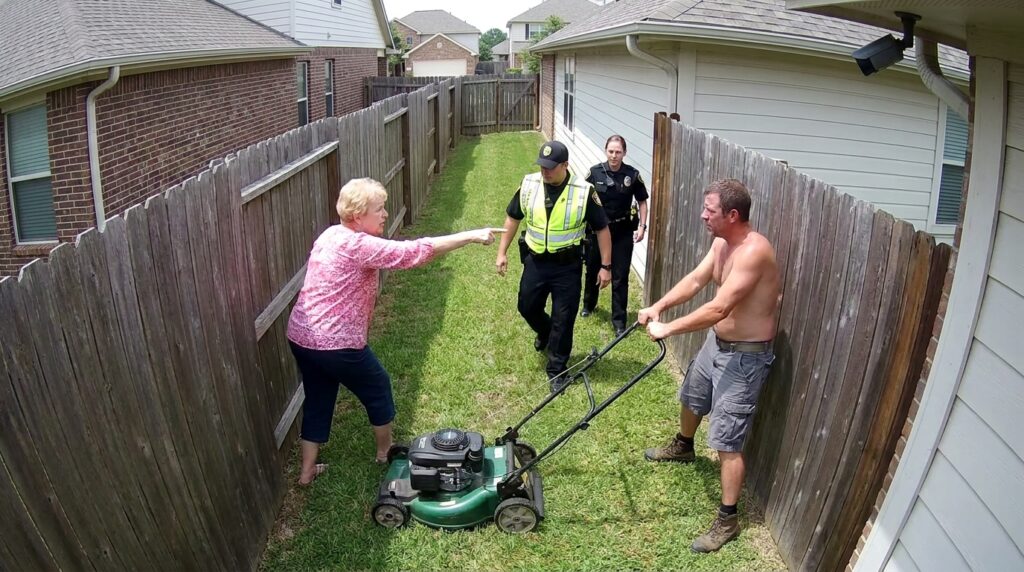
“Officer, look at this branch,” Mrs. Gable said, her voice rising an octave, snapping thin and brittle in the dead air. She took a half-step sideways, her white orthopedic shoes grinding into the dry dirt at the edge of the patch. “He’s been hacking away at the roots of my prize shrubs. That fence has stood as the boundary since the Carter administration, and he thinks he can just unearth forty years of history because he has a machine.”
The responding officer didn’t look at the bushes. He kept his eyes on the younger homeowner’s hands, which were still resting flat against the black rubber handlebar of the idle green mower. His duty belt gave a slow, metallic creak as he shifted his weight, his black boots compressing a high clump of dandelions.
“Hold on, ma’am,” the responding officer said, his hand remaining steady near his hip, his fingers tapping the edge of his nylon holster with a measured, administrative rhythm. “We’re going to look at everything. Just keep your distance like I asked.”
The backup officer stayed crouched near the foundation wall of thirty-six. Her gloved fingers parted the heavy, dark green leaves of the rhododendrons, her boots sunk deep into the old hardwood mulch. The dry bark crackled beneath her soles. She didn’t look up at the argument; her gaze was fixed on the rotting square of pine she had just exposed. The wood was split along the grain, the red paint at the tip long since faded to a dull, chalky pink, but the stamped metal tag pinned to its side was still readable under the shadow of the brickwork.
The younger homeowner watched her from behind the mower handle. His chest rose and fell in a slow, controlled cadence. He could feel the grease on his palms turning cold as the sweat dried under the sudden shade of a passing cloud, but his mind remained centered on the logic of the dirt. He had spent months digging through the county registrar’s basement, tracing every deed transfer back to the original subdivision plat. He knew what she was hiding behind those roots.
“Officer,” the younger man said, his voice flat, retaining the hard, pragmatic texture of the lane. He didn’t point; he simply shifted his gaze toward the brush. “There’s an old survey marker under those leaves. It doesn’t match the current fence. It never did.”
Mrs. Gable’s hand tightened on the top rail of the cedar fence until her knuckles turned the color of old candle wax. Her sunglasses slipped a fraction of an inch down the bridge of her nose, revealing the sharp, dark heat in her eyes. “That is an old clothesline post from the previous family, you arrogant little transplant. It has nothing to do with where my property ends.”
The backup officer stood up slowly, brushing a dry leaf from the sleeve of her black uniform. Her face remained a professional void, but she caught the eye of the responding officer and gave a brief, horizontal nod—a silent signal between partners that the call had just drifted out of the realm of a standard neighbor dispute.
“Sir,” the backup officer said, her voice carrying a dry, professional clip that vibrated in the tight corridor. “Let’s take a look at whatever paperwork you brought out here. You mentioned a certified folder?”
“In the driveway. Under the truck seat,” the younger man replied. He didn’t break his stance until the responding officer offered a slow, permissive gesture with his hand.
He stepped away from the green mower, his work boots crunching against the dry earth as he moved past the machine. The metal of the deck was still radiating heat, warping the air directly above the grass blades. As he walked toward his rusted Chevrolet parked at the curb, he could feel the eyes of the neighborhood following him—the twitching curtains across the street had opened wider now, a white face pressed flat against the glass of the second-story window.
The air in the cab of the truck was sweltering, smelling of old fleece and stale coffee. He reached under the torn vinyl of the driver’s seat and pulled out the heavy plastic blueprint cylinder. The zipper was corroded with salt, giving a loud, harsh riiiip as he forced it back. Inside, the thick linen pages of the 1954 township plat map were stiff, the edges yellowed and frayed like old rope.
When he stepped back out into the sun, the two officers were standing together near the mower, their black caps nearly touching as they looked down at the spot where the front wheel was pinned. Mrs. Gable had moved closer to her porch steps, her phone held against her patterned blouse like an unexploded round, her head tilted to catch the murmur of their radios.
The younger man unrolled the linen sheet across the flat hood of his truck, the metal of the vehicle groaning under the pressure of his forearms. He pointed to the thick black ink at the corner of the lot line, where a small circle was marked with the historical initials of the state surveyor.
“The fence is off by thirty-six inches,” he said, his finger tracking the line through the grit on the paper. “But that’s not the problem. Look at where the old stake sits. The previous owners didn’t just move the line to steal a lawn. They used it to mask an old field drainage line that isn’t on the public record.”
The responding officer leaned over the hood, his yellow safety vest blocking the light, his eyes scanning the technical dimensions. He didn’t speak for three long seconds. The silence hung over the driveway, heavy and metallic, until a sudden gust of wind caught the corner of the linen sheet, flipping it up against the officer’s dark sleeve with a sharp, paper snap.