
CHAPTER 5: EXHUMING THE FOUNDATION
The flat steel blade of the trenching shovel bit into the compacted clay with a dull, hollow thud. The younger homeowner drove his weight down onto the metal step of the spade, his mud-stained work boots scraping against the rusted throat of the tool. The earth was dry on top, a pale, sun-baked crust, but six inches down it turned into a dark, greasy muck that clung to the iron scoop like wet cement.
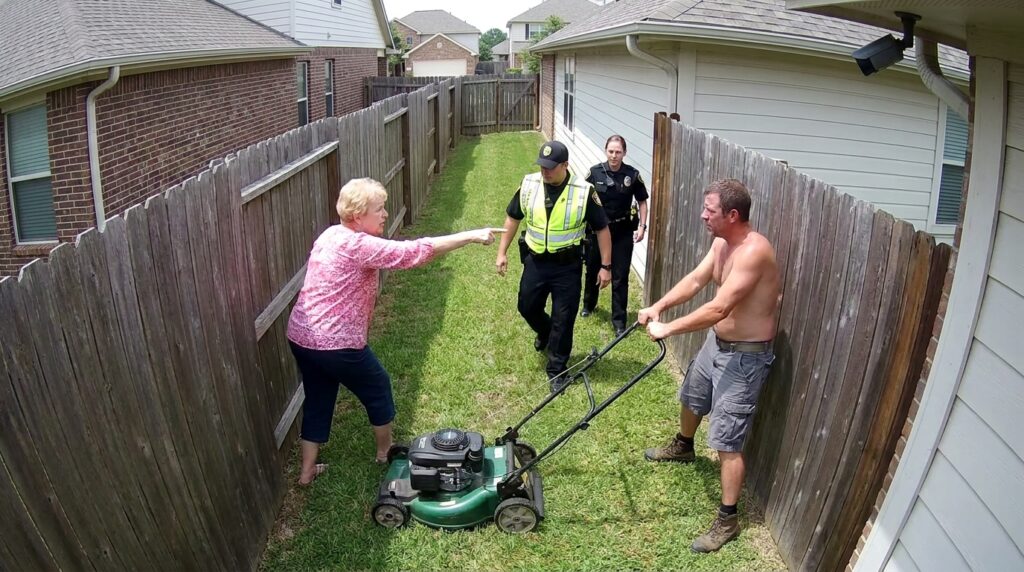
“You can keep digging until you reach the water table, young man,” Mrs. Gable said, her voice dropping down from her porch steps like a heavy sheet of corrugated tin. She had uncrossed her arms, her fingers now tapping against the smooth plastic frame of her smartphone. The pink patterned blouse she wore was stark against the dark green shadow of her house wall. “The officer already told you what the township computer says. You’re just destroying your own frontage now.”
The younger man didn’t look up to answer. His bare chest was smeared with a mixture of grey grit and sweat, his forearms burning from the resistance of the old roots blocking his path. He threw another clod of wet sod onto the gravel driveway, his eyes fixed on the narrow trench he was opening directly in front of the silent green mower. He wasn’t looking for a paper line anymore. He was looking for the physical anchor.
The responding officer stood three feet back, his black utility boots positioned just outside the line of flying dirt. He had closed the digital terminal on his belt, but his hand remained draped over the top of his nylon holster, his leather duty gear creaking every time he shifted his weight to watch the spade.
“Son,” the responding officer said, his deep baritone carrying a quiet, regulatory caution. “If you don’t find that marker in the next two minutes, I’m going to have to instruct you to fill this hole back in and clear the lane. We can’t have an open excavation inside the city right-of-way while an incident report is pending.”
The shovel blade struck something unyielding.
The sound wasn’t the soft crunch of a rotting root or the wet thunk of a field stone. It was a sharp, clear, metallic clink that vibrated straight up the ash handle of the shovel, stinging the calloused skin of his palms.
The backup officer stepped closer, her black cap tilting downward as she peered into the narrow trench. She reached down into the pocket of her safety vest and pulled out a heavy aluminum flashlight, its beam cutting through the dense shadow of the ditch.
“Hold on,” the backup officer muttered, her voice dropping its professional clip as she leaned over the edge of the hole. “Clear the loose dirt off the top. Let me see the cap.”
The younger man dropped to his knees in the grass. His bare fingers clawed through the wet clods, scraping away the fibrous roots of the crabgrass until the cold, solid reality of the object was exposed. It wasn’t a temporary stake. It was a thick, two-inch-wide cylinder of solid structural iron, its surface heavily pitted with sixty years of rust, but its top face was perfectly flat, stamped with an old three-digit code that had been driven into the bedrock before the houses were built.
The pin didn’t line up with the digital map on the officer’s terminal. It didn’t line up with the 1998 utility ordinance. It sat exactly twenty-eight inches further to the left, deep inside the strip of land Mrs. Gable had claimed as her exclusive access lane.
But as the younger man cleared the dirt further back toward her foundation wall, the iron didn’t stop at a single point. The pin was welded to a thick, rusted steel tie-beam that ran horizontally through the earth, passing directly under the concrete footer of Mrs. Gable’s porch steps.
The responding officer knelt down beside the trench, his yellow vest brushing the wet grass. He took the aluminum flashlight from his partner and shined it down the length of the iron beam, his eyes tracing the line of the rusted metal as it disappeared straight under the brickwork of thirty-six.
“What is that?” the backup officer asked, her brow furrowing under the brim of her cap.
The younger homeowner wiped his muddy hands on his shorts, his voice flat, steady, carrying the cold weight of a man who had finally reached the bedrock truth.
“That’s the original 1954 structural tie-rod for the entire block’s retaining system,” he said, pointing a dirty finger into the shadow of the brick foundation. “The digital map from ninety-eight adjusted the surface lines for the utility poles, but they never moved the iron. Mrs. Gable’s house wasn’t built on the line. Her foundation was poured four inches past the legal setback limit. The fence isn’t the problem. Her whole house is sitting on my lot.”
The silence that followed was absolute. Across the gravel driveway, the smartphone in Mrs. Gable’s hand gave a small, distinct click as her thumb went slack against the glass screen.








