CHAPTER 4: THE FRACTURED UNROLL
The heavy linen of the 1954 township plat map rasped against the rusted sheet metal of the Chevy’s hood. A fine layer of quartz road dust grit scraped under the younger homeowner’s forearms as he smoothed down the curling, yellowed corners of the document. The truck’s engine block beneath the steel panel was tick-ticking with residual cooling heat, radiating a warm wave of unwashed oil and old iron that distorted the sharp midday light between their faces.
“Look right here at the southwest iron monument benchmark,” the younger man said, his thumb tracking the ink work where the lines converged at a perfect, geometric intersection. His skin was dry, embedded with black grease from the mower’s chassis. “The original corner stake calls for thirty-six inches of clearance from her brick foundation. That means the entire cedar fence is pushed into my lot line. The pink markers are right.”
The responding officer didn’t look at the ink. He was holding a handheld digital terminal hooked to his utility belt, its heavy rubberized casing scuffed along the bumper edges. His thumb pressed a yellow button on the side of the device, the screen throwing a flat blue glare into the shade of his police cap.
“The county GIS registry doesn’t show a 1954 monument validation for this block, son,” the responding officer said. His voice was cold, transactional, stripped of any neighborly nuance. “Your document has the historical tract seal, but the township ran a digital update back in ninety-eight when they widened the secondary utility access lane. According to the city engineering index right here on my screen, your line matches the fence line.”
The words hit the hot driveway like iron weights.
The younger man’s chest tightened, a sharp, bitter knot forming behind his ribs as he stared at the digital display. The bright blue pixel lines on the officer’s screen showed a completely different alignment—the original boundary line had been legally overwritten, flattened by decades of administrative adjustments that had never been transferred to his foreclosure paperwork. The calculated defense he had spent three months building in the basement archives of the county recorder was turning to ash on the hood of his truck. He wasn’t just losing the three feet of grass; he was facing a documented violation for moving survey markers without city authorization.
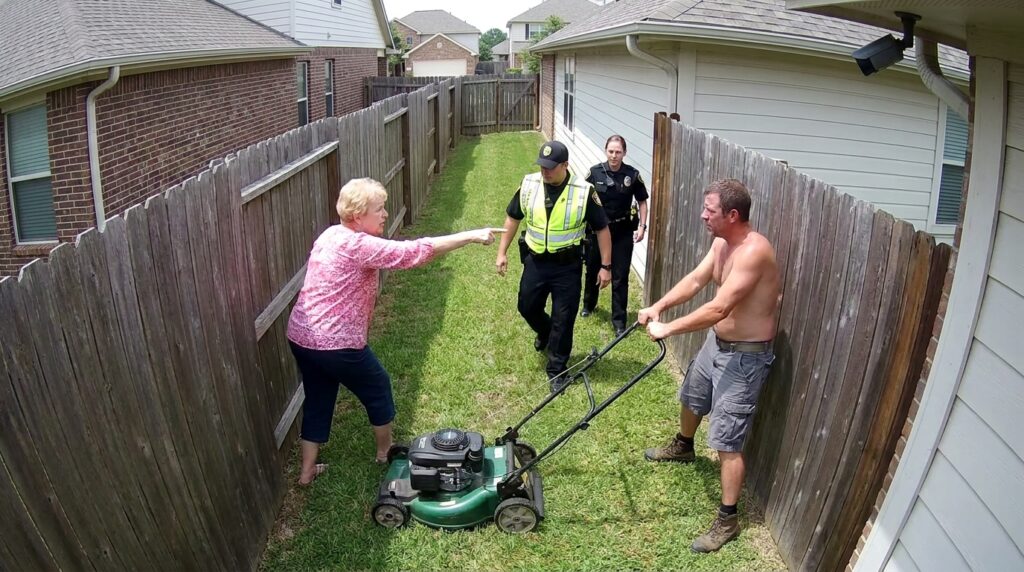
Across the gravel lane, the sharp, rhythmic tap of Mrs. Gable’s orthopedic shoes accelerated. Her oversized sunglasses flashed under the sun as she took three deliberate paces forward, her posture rigid with an immediate, defensive triumph. The pink patterned blouse she wore seemed to expand against the grey backdrop of the cedar privacy boards.
“I told you, officer,” she said, her voice a sharp, cutting saw blade that echoed off the brickwork of thirty-six. “He’s been out here playing amateur surveyor because he bought a bank house on the cheap. He pulled up the old stakes behind my bushes to manufacture a claim. It’s deliberate vandalism.”
The backup officer walked back from the rhododendrons, her boots kicking up small fragments of old hardwood mulch onto the lawn. Her fingers were stained with gray moss from the rotting square stake she had inspected behind the roots, but her face remained a professional void. She reached down to her utility belt, her leather duty gear creaking as she unclipped a yellow tape measure, its steel blade extending with a harsh, metallic clack-clack-clack.
“Sir,” the backup officer said, her gaze fixed entirely on the younger homeowner’s face. “The pink stakes you drove into the sod this morning are sitting directly inside the municipal right-of-way if we go by the ninety-eight ordinance. That’s a hundred-dollar fine per marker if the code enforcer writes the ticket. And you’ve blocked her secondary access lane with that green machine.”
The younger man looked down at his work boots, his soles sunk into the dry earth beside the lawn mower. He could feel the eyes of the neighborhood tightening around him like a noose—the curtains across the street were fully pulled back now, three distinct silhouettes watching the police cruiser’s light bar from behind the double-paned glass. The institutional apparatus he had tried to weaponize had turned its teeth toward him. He had active title documents, but they were the wrong era, the wrong layer of history.
He didn’t make a speech. He didn’t yell across the lawn. He clamped his jaw tight until his teeth ground against the grit in his mouth, his calloused hands slowly rolling the yellowed linen map back into its protective plastic cylinder. The plastic end-cap went on with a dull, hollow thwack.
“There’s still the tie-rod,” he muttered, his voice dropping into a low, stubborn frequency that didn’t leave the perimeter of the truck hood. “The 1954 coordinate system uses physical iron pins driven into the bedrock. They don’t change because an office clerk swiped a digital brush over a map in ninety-eight.”
The responding officer didn’t reply. He turned his torso back toward the narrow grass corridor, his hand resting flat against his nylon holster as he began typing a digital incident log into his handheld terminal. The small keys clicked with an unsettling, mechanical speed, recording a failure that would remain attached to the title of thirty-four long after the sun went down.