CHAPTER 2: THE APPARATUS OF THE LAW
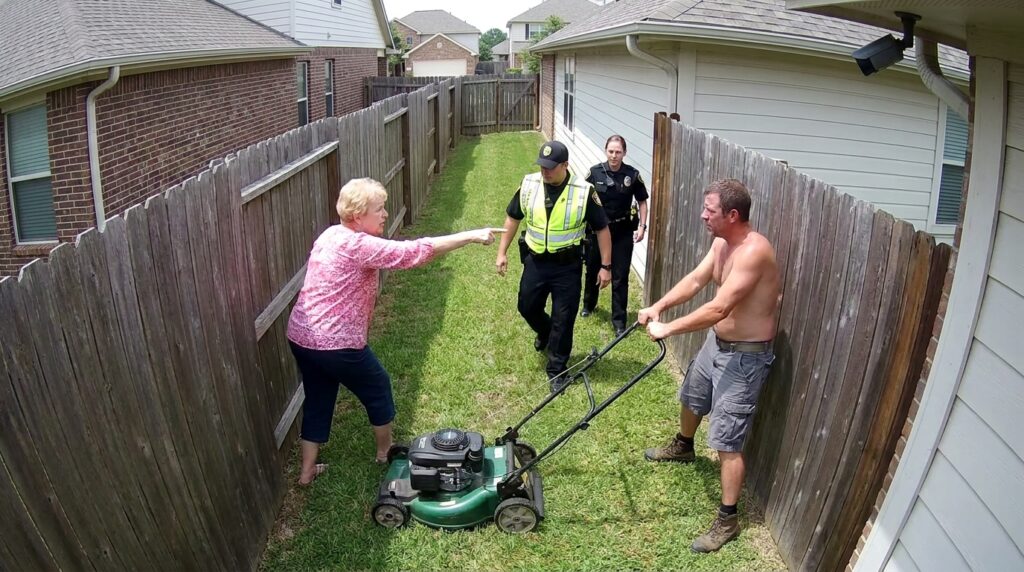
“Yes, dispatch, he is still refusing to move the equipment,” Mrs. Gable said into the glass rectangle pressed against her cheek. Her voice didn’t shake. It had the flat, rhythmic precision of a court reporter reading back a bankruptcy filing. She stepped closer to the cedar slats, her oversized sunglasses catching the white glare of the noon sun, turning her face into a blank, mirrored mask. “He’s shirtless. He’s aggressive. He’s standing directly on my property line, and he’s refusing to let me clear my access corridor.”
The younger homeowner didn’t break his grip on the black rubber handlebar. His palms were slick with hot grease from the mower’s throttle cable, but he kept his boots anchored six inches deep into the high crabgrass on his side of the line. The green deck of the push mower sat between them like a rusted shield, its engine silent, its cooling shroud radiating a thick, oily heat that smelled of scorched gaskets and unwashed denim.
“The markers are right here, Mrs. Gable,” he said again, his throat dry, spitting out the grit that the hot breeze kicked up from the gravel driveway behind him. He didn’t raise his voice. In the three years he’d spent pulling this cottage out of foreclosure, he’d learned that the county didn’t reward volume; they rewarded documentation. “I’m just cutting my own grass. The pink ribbon is exactly three feet from your retaining wall.”
“That ribbon is a self-serving decoration, and you know it,” she said, lowering the phone just enough to glare over the plastic rims. The phone’s small speaker gave a faint, tinny squawk—the voice of an overworked dispatcher five miles away in a basement municipal building, logged into a computer terminal that categorized human spite by zip code. “The county map from seventy-two shows the easement belongs to the original parcel. Your lot was an add-on. A junk sliver.”
He didn’t argue the history. Instead, his eyes drifted down to the front left wheel of the mower. The edge of the rubber tread was pinned against a dense clump of wild onion, and beneath the green stalks, that pale grey glint remained. It wasn’t a modern surveyor’s nail. It was thicker, pitted with sixty years of groundwater acidity—the square head of an old foundational tie-rod. It was positioned nearly half a yard onto his side of the current cedar fence line, buried like a tooth in the clay. If the tie-rod was here, the fence wasn’t just slightly off; the entire spatial logic of the driveway corridor was warped.
A low, heavy rumble vibrated through the asphalt at the end of the lane.
The white crown of a Ford Explorer patrol unit rounded the corner, its roof-mounted light bar dark but its engine humming with the distinct, heavy-duty thrum of a city vehicle on active patrol. It didn’t rush. The tires crunched slowly against the loose gravel at the curb, stopping at a perfect diagonal that blocked both driveways, its front bumper inches from the mailbox post.
Mrs. Gable didn’t step back. Her posture grew longer, her heels sinking into the soft turf as she prepared to receive the institutional reinforcement she’d summoned. She held the phone aloft like a smoking flare, her finger jabbing once more across the green metal body of the mower.
Through the tinted glass of the cruiser, the dark outline of a police cap shifted. The driver’s side door swung open with a heavy, mechanical click, the hydraulic hinge groaning under the heat. The responding officer emerged first—a large man in his late thirties, his black uniform crisp despite the ninety-degree weather, his yellow safety vest casting a neon reflection across the polished metal of his duty belt. His boots hit the grass with a solid, deliberate thud, the leather creaking as he adjusted the weight of his radio. Behind him, from the passenger side, the backup officer stepped out, her dark hair tied tight, her eyes already scanning the layout of the foundations before she even closed her door.
The neighborhood seemed to shrink. Curtains in the split-level across the street twitched, the white fabric separating by two inches as a pair of eyes locked onto the narrow side-yard lane. The silence that followed the arrival of the state was absolute, broken only by the rhythmic chug-chug-chug of the cruiser’s idle exhaust.
The responding officer didn’t draw a weapon, nor did he quicken his pace. He walked with the heavy, unhurried gait of a man who spent his afternoons separating adults who had forgotten how to share dirt. His hand rested naturally near his hip, his fingers tapping the edge of his nylon holster with a slow, administrative beat.
“Alright,” the officer said as he reached the mouth of the narrow corridor, his voice a deep baritone that carried no anger, only the exhaustion of a long shift. He stepped squarely into the center lane, his large torso breaking the direct line of sight between the pink blouse and the shirtless young man. He turned his head slightly toward Mrs. Gable, his arm rising to create a physical barrier. “Everyone stop, step back, and let me understand this.”
The younger homeowner didn’t retreat, but he let his shoulders drop two inches, his boots remaining fixed beside the buried grey iron. He knew the protocol. The first thirty seconds belonged to the person who called the line in; the remaining time belonged to whoever had the paperwork.
“Officer, thank goodness,” Mrs. Gable began, her voice instantly dropping the aggressive edge, replaced by the shaky, high-pitched strain of an elderly resident under siege. She reached down, her liver-spotted hand grabbing the top rail of the cedar fence for balance, leaning her weight toward his uniform. “He’s been out here since noon. He’s deliberately destroying the landscaping I planted with my late husband, and when I asked him to stop, he came at me with the machine.”
The officer looked at the green push mower. He looked at the front wheels angled into the wild onion. Then his eyes shifted to the young man’s bare chest, noting the sweat, the grease, and the total absence of forward momentum.
“Ma’am,” the officer said, his right hand rising in a slow, downward motion that was less a request and more a direct command to lower the volume of the street. “Stay right there for me. Don’t move across that line until I talk to both of you.”
He turned his face toward the younger homeowner, the black brim of his cap shading his eyes. “Son, turn the machine completely off if it isn’t already, step away from the handles, and tell me what we’re doing out here today.”
The young man didn’t reach for the survey folder yet. He kept his eyes on the officer’s vest, his voice dropping into the same flat, rhythmic register as the cooling engine. “I’m cutting the grass, officer. My name is on the deed to thirty-four. And the real line isn’t where she thinks it is.”
Behind the responding officer, the female backup took two steps toward the side wall of Mrs. Gable’s house, her boots brushing against a thick, unpruned cluster of old rhododendron bushes that grew along the foundation. She stopped, her eyes dropping to a strange, rotting piece of wood that had been shoved deep into the dirt behind the branches—a weathered, square stake with faded red paint clotted at the top, hidden completely from the view of the main street.