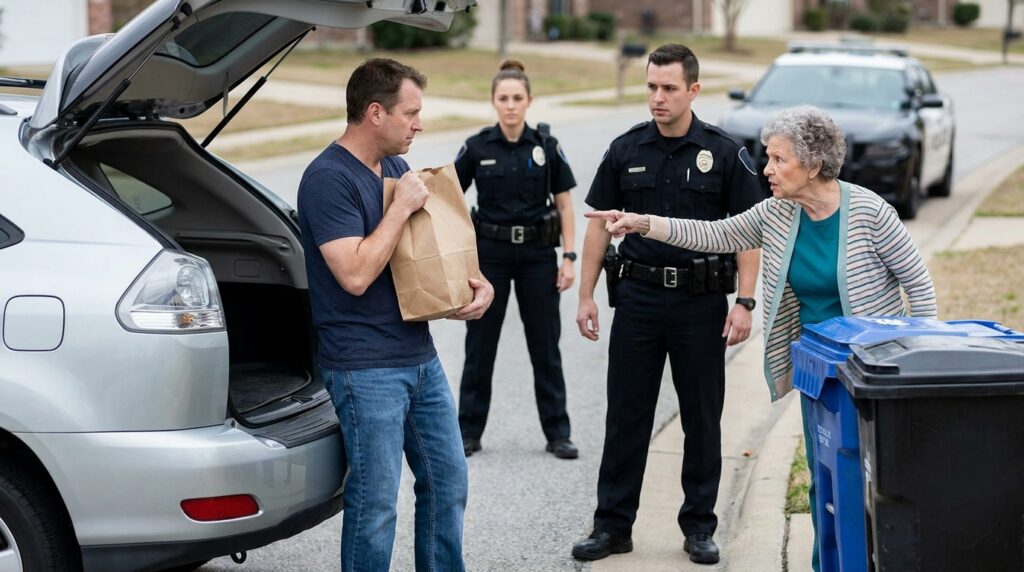
The Measured Weight of a Curbside Standoff and the Line That Could Not Be Crossed

CHAPTER 1: THE TORN EDGE

The thick, yellow adhesive of the sticky note did not want to peel cleanly from the windshield glass. It tore across the center, leaving a jagged scar of white paper that detailed a single, typed warning: Move it, or the city will.

David stood in the damp dawn air, his thumb scraping against the residue until the gray skin of his fingernail went white. The street was dead, silent save for the low, rhythmic thrum of a distant highway and the sharp click-clack of a plastic lawn sprinkler three houses down. He did not look toward the dark windows of the house next door. He did not have to. He knew the precise angle of the blinds in the front parlor, the three-inch gap where the plastic slats dipped under the weight of an old woman’s hand.

He folded the remaining scrap of yellow paper into his pocket, his movements deliberate, almost clinical. This was the fourth note in six days. Each one arrived between four and five in the morning, always left without a signature, always placed with the exact same geometric precision against the lower black border of his wiper blade. It was a calculated intimidation tactic, a minor structural pressure designed to wear down his patience until he surrendered the twenty feet of public asphalt bordering the curb.

Turning on his heel, he looked down at the physical line of defense. Two massive municipal waste containers—one bright blue for recycling, one midnight black for trash—sat side by side on the street. They weren’t just out for collection; they were parked three feet deep into the roadway, spaced precisely far enough apart to ensure no vehicle could parallel park between them without touching their scuffed plastic hulls. It was a masterclass in petty territorial sovereignty.

David checked his watch. 06:12. The work trip required him to be on the interstate by seven, his trunk loaded with the heavy, unprinted schematics currently sitting on his kitchen island. He had two choices: park forty yards down the hill and carry the cargo through the morning dew, or breach the perimeter.

He pulled his car keys from his jeans pocket. The remote unlock triggered a sharp, double-chirp from his silver SUV that cut through the neighborhood silence like a scalpel. He climbed into the driver’s seat, the cold vinyl stiff against his back. He didn’t pump the gas. He shifted straight into reverse, his eyes locked on the rearview mirror as the vehicle crept backward toward the gap.

The rear bumper came within six inches of the black bin. Through the glass, he watched the plastic container shudder slightly as the displacement of air hit it. He killed the engine. The silence returned, heavier now, pregnant with the immediate consequence of his placement. He had not broken a single city ordinance, but as he stepped out of the cabin and opened the rear hatch, the front door of the neighboring house clicked open.

The cold iron of the SUV’s cargo latch felt heavy in his palm. He stood his ground by the open bumper, his chest rising evenly as the shadow of a striped cardigan moved down the concrete driveway toward his space.


CHAPTER 2: THE CURTAIN LINE

“You think because you have a legal registration on that windshield, the road belongs to you, David?”

The voice was thin, reedy, but carried the sharp, practiced carrying power of someone who spent forty years projecting over committee meetings. Evelyn stood at the edge of her driveway, her small frame rigid beneath a striped knit cardigan that flapped slightly in the exhaust of a passing delivery truck two streets over. Her oversized sunglasses were pushed back into her short, curly gray hair like a plastic crown, catching the flat, white glint of the early morning sun.

David didn’t stop sliding the heavy nylon straps of his travel pack over his shoulders. He adjusted the weight, feeling the rigid plastic edge of the internal frame press against his spine through his navy t-shirt. He kept his eyes on the rear cargo floor of the silver SUV, checking the alignment of the cardboard boxes containing the schematics.

“Good morning, Evelyn,” he said. His voice remained level, a flat, uninflected baseline designed to give her no conversational leverage. “The street is clear. The vehicle is legally parked.”

“Legally is a word people use when they don’t have respect,” she snapped, stepping down from the concrete apron onto the raw asphalt of the gutter. Her white orthotic sneakers made a soft, gritty crunch against the accumulation of old sycamore seeds. She pointed a single, liver-spotted index finger toward the rear bumper of his SUV, her hand shaking with either age or a deeply nurtured anger. “Those bins are set according to the district management layout. You’re blocking the collection path. You’re creating a hazard for the municipal trucks.”

David took a slow breath through his nose, the scent of cold morning dew mixed with the faint, metallic tang of his car’s catalytic converter filling his chest. He looked down at the physical space between his bumper and her blue recycling container. There were six inches of clear daylight. The city code required three. He knew the handbook text by heart; he had downloaded the PDF three months ago after the first tire-valve cap went missing.

“The bins have eighteen inches of clearance on either side from the driveway line,” David replied, his internal clock ticking toward 06:18. Every second spent on the asphalt was a variable he hadn’t budgeted for. He reached for the handle of the silver hatch, his fingers wrapping around the cold, textured plastic. “The truck has automated arms that extend five feet. They won’t touch the bumper.”

“I have the plat maps, David. I know where the easement transitions.” Evelyn took another step forward, her chest rising under the teal fabric of her blouse. She pulled a small, black smartphone from her cardigan pocket with her left hand, her thumb hovering over the screen with a practiced, muscle-memory familiarity. Her right hand remained extended, a rigid indicator pointing toward the ground near his rear tire. “You think you’re the first person to try and squeeze an oversized utility vehicle into this turn? The city gave this block a specific allocation for clearance in eighty-four. I have the notarized seals.”

David shifted his weight. His left foot was planted near the curb, right on top of a weathered, circular brass disc stamped into the concrete—a surveyor’s marker he’d noticed three days ago while weeding the property edge. The brass was green with oxidation, its edges chipped by decades of edgers and lawnmowers, but the center bore a series of stamped numbers that didn’t match the modern county records he’d checked online.

He looked at Evelyn’s phone. The screen wasn’t dark. It was glowing with the green-and-white user interface of the local non-emergency dispatch application. She wasn’t just threatening; her thumb was already pressing the digital submission field.

“I’m loading for a commercial delivery, Evelyn,” he said, keeping his forearms flat against his chest as he reached into the rear seat to pull a final, heavy brown paper bag toward his torso. The thick paper crinkled sharply, the sound loud in the enclosed space of the cul-de-sac. “I will be gone in four minutes.”

“You won’t be gone anywhere until the supervisor looks at what you’re putting in that cabin,” she whispered, her voice dropping into a rhythmic, rhythmic hiss as she held the phone up between them like a shield. “I saw the markings on those crates last night. Unlabeled commercial freight in a residential zoning district. I’ve already sent the digital attachment to the code compliance desk.”

David closed his fingers tightly around the top of the paper bag, the raw edge of the cardboard folders inside digging into his palms through the paper. He didn’t blink. He watched the reflection of the gray suburban sky in her oversized lenses, calculating the time it would take for a low-priority traffic car to clear the precinct station three miles east.

Behind Evelyn’s shoulder, the white lace curtains of the corner house twitched. Another pair of eyes. The neighborhood was waking up, its silent, invisible machinery turning its focus toward the twenty feet of gray asphalt where the two of them stood locked in position.

CHAPTER 3: THE DECOY ENVELOPE

The rusted hinge of the black iron mailbox gave a thin, metallic squeal as David pulled it open. He had four minutes before the digital ticket Evelyn submitted would likely populate on a dispatcher’s screen, but his hand moved by instinct toward the heavy steel post at the edge of his grass line. Inside the dark cavity lay a single, oversized cream envelope. It hadn’t been processed by the United States Postal Service; there was no stamp, no cancellation mark, only his address printed in rigid, typewriter-style courier font across the face.

He slipped his thumb under the unsealed top flap. The paper was heavy, a high-rag bond with a distinct, textured grain that felt cold against his skin. When he pulled the document out, the top of the page bore a bold, embossed seal from the County Registrar of Deeds, dated October 14, 1984. It was a notarized property easement survey. A bright red ink stamp across the lower quadrant declared it a Permanent Right-of-Way Restriction for Municipal Access and Adjacent Visual Preservation.

According to the clean, hand-drawn lines of the plat map attached to the back, the very curb strip where his silver SUV was currently idling did not belong to his parcel’s public buffer. It was marked in dense, cross-hatched ink as an exclusive access corridor tied directly to the deed of the property next door. Evelyn’s property.

David’s chest tightened slightly, his eyes tracking the geometric coordinates laid out in the legal text. If this document was valid, his vehicle wasn’t just violating a friendly neighborhood understanding—it was legally trespassing on a non-public utility easement managed by his neighbor. The strategic advantage he thought he held under the standard city parking handbook vanished beneath the weight of a forty-two-year-old notarized covenant.

“I told you I had the papers, David.”

Evelyn’s voice cut through the damp morning air from ten feet away. She hadn’t moved from her position by the blue recycling bin, her small frame still pulled taut, her phone held down at her side but her finger resting firmly against the glass perimeter. She was watching him read, her chin tilted upward, her oversized sunglasses reflecting the pale white light of the rising sun. There was no hesitation in her posture now; she stood with the rigid certainty of someone who had spent decades waiting for the right moment to deploy an absolute boundary.

“You think because you bought that house from a corporate flipper three years ago that the history just disappears?” she continued, her tone dropping into a dry, mocking rhythm. “That corridor was legally assigned before your foundation was poured. The city doesn’t change its lines just because you have a heavy load to carry.”

David did not look up from the high-rag paper. He focused on the signature block at the bottom—a faded blue ink signature from a registrar named Marcus Vance, sealed with a physical, raised gold-foil wafer that felt completely authentic under his fingertip. The document looked ironclad. It was exactly the kind of physical evidence that would make a responding municipal worker or code enforcement officer side with her instantly, minimizing his defense to a simple misunderstanding of modern boundaries.

Yet, as he turned the page to check the legal description of the coordinates, his thumb brushed the very bottom edge of the backing sheet. There was a tiny, clean rectangular line where a secondary attachment had once been stapled, but the wire teeth were gone, leaving only two microscopic, rusted holes in the cream fiber. Something had been separated from the main file.

He folded the document back into its exact creases, slipping it into his rear pocket. He had to keep his posture neutral, hiding the sudden calculation running through his mind. Evelyn was watching his hands, looking for the telltale drop in his shoulders that signaled surrender. He refused to give it to her.

“The registration is old, Evelyn,” he said, keeping his voice flat, his forearms resetting against his chest as he stepped back toward the bumper of his car. “Old papers don’t always hold the current right-of-way.”

“They hold when they’re notarized, sir,” she replied, her thumb tapping the phone screen once, a sharp, electronic chime signaling the completion of an online report. “And the city truck is already on its morning loop. We’ll see what the officer says when he reads the county seal.”

The distant, low rumble of a heavy engine turned the corner at the end of the block. It wasn’t the garbage truck. The sound was too smooth, accompanied by the distinct, high-frequency hum of a modern alternator and the faint, rhythmic click of a service belt. David turned his head toward the entrance of the cul-de-sac. Two vehicles were approaching through the gray morning mist, their roof-mounted light bars dark but their black-and-white silhouettes unmistakable against the uniform green of the suburban lawns.

CHAPTER 4: THE CONTAINMENT ZONE

The sirens didn’t build; they arrived in a singular, physical wall of noise. Two black-and-white cruisers surged around the corner of the cul-de-sac, their light bars strobing with a relentless, rhythmic intensity that turned the morning mist into a sickening dance of blue and white. David stood his ground, but his pulse spiked, a sharp, cold jab of adrenaline hitting the center of his chest. He saw the cruiser tires bite into the asphalt, the rubber screaming as the drivers threw them into a tactical maneuver that blocked the street entirely.

Evelyn was no longer just standing; she was vibrating. Her posture had shifted from the static threat of a neighbor to the performative agitation of a witness. She was already pointing at him as the driver’s side door of the lead unit opened.

The primary officer stepped out. He was built like a piston, his uniform pressed into sharp, unforgiving lines that seemed to absorb the strobing light. He didn’t move toward Evelyn. He didn’t look at the trash bins. He looked at David, his gaze scanning the area with a clinical, tactical detachment. Behind him, the second officer, a younger woman with her hair pulled back into a severe knot, had already positioned herself in the gap between the SUV and the trash containers, effectively severing the line of communication between David and the street.

“Turn off the engine, sir,” the primary officer commanded. His voice was a calm, low-frequency rumble that cut effortlessly through the fading siren wail.

David hadn’t even started the car, but he didn’t argue. He held his hands out, palms open and visible, the brown paper bag still clutched in his left forearm. “Engine is off, Officer. I’m just packing for a departure.”

Evelyn darted forward, her voice rising to a frantic, thin-pitched shriek. “He’s been unloading hazardous materials since four in the morning! I’ve told the board, I’ve told the city—he’s compromising the easement. He’s got unlabeled industrial chemicals in that bag, Officer, look at the way he’s holding it! He’s trying to hide it.”

The officer’s head snapped toward Evelyn, his expression a mask of professional, practiced indifference. He held up a single, gloved palm, silencing her mid-sentence. “Ma’am, step back behind the blue bin. Now.”

She recoiled as if struck, her mouth opening and closing in a jagged, surprised rhythm. She didn’t retreat, though. She pivoted, locking her eyes on David with a triumphant, malicious intensity, her lips thinning into a line of victory. She believed she had him. She believed the notarized paper in his back pocket was about to become his death warrant.

The officer turned his focus back to David, his eyes dropping to the brown paper bag. “Sir, I need you to step away from the hatch. Leave the bag on the rear bumper. Put your hands behind your head.”

David felt the friction of the world narrowing down to this single, metallic moment. The asphalt beneath his boots felt uneven, treacherous. He looked at the officer’s utility belt—the matte-black finish of the equipment, the rigid, organized pouches—and realized the utter absurdity of his position. He was a man with nothing more than schematics and personal items, yet here he was, treated like a tactical threat because an elderly woman with a 1984 permit and a grudge had mastered the art of bureaucratic weaponization.

He eased the bag down onto the cold, dented silver surface of the bumper. The paper crinkled loudly, a sound that seemed to echo against the suburban siding of the neighboring houses. As David stepped back, his boots crunching on the loose grit of the street, the officer approached the hatch. He didn’t reach for his sidearm, but his hand moved to the heavy flashlight at his hip, his stance wide and defensive.

“Don’t move, sir,” the officer said, his voice dropping into the cold, transactional register of a man who dealt in facts.

The second officer began moving toward Evelyn, her hand gesturing for her to withdraw further. “Ma’am, you’re interfering with a live scene. Move back toward the driveway.”

Evelyn’s face went splotchy with red, the color crawling up her neck in a blotched, uneven tide. “Look in the bag! He has no business being here! Check the deed, check the county registry—that property is mine to supervise!”

The primary officer ignored her. He reached out with a single, gloved hand and gripped the top of the brown paper bag. He flipped the opening wide. David watched the officer’s eyes track downward, his brow furrowing as he peered into the dark cavity of the bag. The suspense in the air was a physical weight, thick enough to make David’s throat ache.

The officer pulled out a thick, plastic-wrapped bundle of blueprints. He tilted his head, pulling one out and letting the light catch the technical schematics. He paused. A long, agonizing beat of silence followed, during which the only sound was the distant ticking of the cruisers’ cooling engines.

The officer didn’t look at David. He looked at Evelyn. The expression on his face didn’t soften; it hardened, the professional mask peeling away to reveal a deep, simmering frustration.

“Officer,” David said, his voice steadying, “I am a professional contractor. Those are project schematics. That bag contains my lunch and my transit files.”

The officer turned to his partner. He didn’t need to speak. The second officer had already stopped guiding Evelyn; she was now standing directly in front of the neighbor, her body language shifting from mediator to enforcer. The power dynamic in the cul-de-sac didn’t just shift—it inverted. The officer looked at the brass survey disc near his own feet, then back at Evelyn, who had suddenly gone very still.

“Ma’am,” the officer said, the word dripping with sudden, sharp authority. “I’m looking at a public street. I’m looking at a man loading blueprints into his car. And I’m looking at a dispatch log that says you reported an active hazmat threat.”

He tossed the bundle of blueprints back into the bag and set it on the bumper with a heavy, final thud. The silence that followed was total, and for the first time, David saw the neighborhood for what it was: a cage, and the bars were finally starting to bend.

CHAPTER 5: THE EVIDENCE HANDOFF

“Sir, back up, I need that bag now.”

The primary officer didn’t wait for compliance. His hand closed around the crinkled throat of the brown paper bag before David could fully unwrap his forearms. It was a swift, defensive motion that used the physical bulk of the SUV’s open hatch as a pivot point. The paper groaned under the pressure of the heavy leather glove, the sharp edges of the interior cardboard folders catching against the heavy high-rag bond paper he had just tucked into his back pocket.

David stepped back an exact half-step, his boots finding the crisp concrete lip of the gutter. He kept his palms empty, held at chest height, tracking the movement of the athletic officer who immediately crouched into the curb-side evidence lane. The man’s focus was microscopic, completely tuned to the contents of the cargo area.

Behind them, the second officer moved her body into the line of sight, creating a rigid human wall between the open hatch and Evelyn. Her black uniform fabric rustled softly, her utility belt clicking as she shifted her weight to manage the proximity. “Ma’am, you need to step behind the blue bin. Right now. This is an active assessment.”

“He has the old plat maps!” Evelyn’s voice shattered the lower register of the idling cruiser engines. She was stepping sideways, trying to clear the second officer’s shoulder, her small frame twisting inside the striped cardigan. Her finger remained hooked like a talon toward the bumper. “He knows exactly what he’s doing. Check his pockets! He just took the official county file out of my mailbox!”

David’s jaw remained set. He felt the cold edge of the cream document pressing against his lower spine through the denim of his jeans. He didn’t look at Evelyn. He watched the primary officer lift the folders out of the bag, the white sheets of the schematics fluttering slightly in the cold slipstream of air between the houses.

The officer didn’t offer an evaluation. He pulled a matte-black digital tablet from his side holster, the screen throwing a sharp blue glare against his focused chin. His thumb began scrolling through the active dispatch records, cross-referencing the emergency call with the physical vehicle identification number visible through the SUV’s lower windshield strip.

“Sir,” the officer said without looking up, his tone clipped and analytical. “This vehicle is registered to your corporate entity, correct?”

“Correct,” David said, his internal calculation running the risk profiles of every municipal ordinance he had memorized. “It’s a commercial transport vehicle for local logistics. The curb parking is authorized under section twelve for active loading.”

The officer’s thumb stopped. He held the tablet closer, his brow furrowing as he looked at the missing data fields on the screen. The dispatch code Evelyn had generated didn’t have an associated city incident number—it was flagged as an unverified private report, a digital ghost that had bypassed the standard routing protocols. He tilted the screen toward his partner, a silent communication passing between them in the space of a single second.

“Evelyn,” the second officer said, her voice dropping into the flat, dangerous territory of an official warning. She stepped directly into the older woman’s escape lane, her hand resting lightly on her hip near the radio casing. “Did you tell the dispatcher this was an active commercial zoning violation with hazardous materials?”

“It is!” Evelyn’s sunglasses slipped down her nose, revealing the small, hard circles of her eyes. Her skin had turned the color of dry skim milk. “Look at the crates in the rear! Look at the markings from the eighty-four expansion! He’s overriding the permanent covenant!”

The primary officer slid the schematics back into the heavy paper bag, his movements slowing down, losing the tactical urgency of a live threat. He stood up to his full height, the black nylon of his uniform catching the first direct rays of the morning sun as it cleared the rooflines. He looked at the brass survey disc near David’s boot, then at the blue recycling container that Evelyn had used to anchor her claim on the asphalt.

“The bag is clear,” the officer said, his voice carrying down the sidewalk where two more garage doors were now lifting. He looked directly at David, his face expressionless but his posture holding the scene steady. “You’re clear, sir, give us one minute.”

He didn’t return the bag. He kept his fingers locked around the paper throat, angling it away from everyone as he turned his back to David and stepped toward the driveway line where Evelyn stood trapped against her own bins. The strategic calculation had shifted completely; the resident was no longer the subject of the perimeter. He was the witness to its dismantling.

CHAPTER 6: THE CITATION LINE

“This is the last time you call city dispatch out to this curb.”

The words fell flat and heavy against the concrete. The primary officer didn’t shout. He stood entirely still between the two municipal bins, his gloved fingers releasing the brown paper bag back into David’s hands with a single, structural rustle. The blue glare of his tablet screen reflected cleanly across his face, illumination tracking a history of digital entries that Evelyn could no longer erase or overwrite with performative panic.

David took the bag, the weight of the cardboard drawing folders grounding his stance. He reached into his back pocket, pulling out the folded cream document with the gold wafer seal. He didn’t offer it as an excuse; he handed it to the primary officer as a specific diagnostic reference.

“The easement she’s referencing is in that packet,” David said, his voice dropped into an unyielding, rhythmic cadence. “But if you check the municipal database reference code stamped beside the registrar’s name, you’ll find it correlates to the old water main extension. The temporary construction window closed forty-two years ago.”

The officer snatched the high-rag paper, his index finger tapping a rapid sequence into the tablet glass. The mechanical sound of his utility belt was the only vibration on the street. Evelyn stood trapped behind the plastic lip of her blue recycling bin, her shoulders hitching upward as her small frame seemed to shrink inside the striped cardigan. The oversized sunglasses had slipped entirely down the ridge of her nose, exposing two pale, frantic rings of skin around her eyes.

“That’s county record,” she whispered, her reedy voice breaking against the low hum of the idling cruisers. “It’s a notarized boundary. The neighborhood has to keep the clearance. I am the only one who records the placement.”

“Ma’am, look at me,” the primary officer commanded, turning the tablet screen so the glow caught her face. A series of red highlight bars mapped her phone number across eighteen separate historical complaints, all flagged as unverified code enforcement requests. “This document is a temporary construction permit from nineteen eighty-four. It expired three hundred and sixty days after Marcus Vance signed it. It carries zero modern municipal authority.”

The second officer pulled a thick, carbon-backed citation book from her side pouch, the metallic snap of the binder crisp in the morning air. “We’ve got you down for four separate false emergency deployments this season, Evelyn. You told dispatch there was a hazardous material spill on public asphalt to force a priority response for a personal parking dispute.”

“I was protecting the block,” she gasped, her hands bunching the teal fabric of her blouse as she backed away toward her concrete driveway apron. Her white sneakers left dry, scuffed tracks through the fallen sycamore seeds. “The standards have to be maintained. If he parks there, the whole line breaks down.”

“The only thing breaking down is your access to city dispatch,” the primary officer said, his voice a cold, sharp edge that cut through her remaining illusions of authority. He gestured to his partner, who was already dragging her pen across the carbon paper with a rhythmic, scratching friction. “This is a formal administrative citation for misuse of emergency services and a second-degree nuisance order. If your number hits the panel again without an active fire or a physical injury, a deputy will be out here with a transport van.”

David didn’t smile. He watched the final, physical collapse of her gatekeeping structure from beside his silver SUV bumper. The neighborhood porches were no longer silent; two separate front doors down the block had clicked shut, the watchers withdrawing now that the performative authority faker had been stripped of her leverage right on the pavement.

The second officer stepped forward, ripping the yellow copy of the citation from the book with a violent, paper tear. She pressed it against the plastic surface of Evelyn’s clipboard notice, forcing her to take the weight of the document. Evelyn didn’t look up. She clutched the yellow slip against her cardigan, her posture hunched, her small silhouette looking entirely hollow under the wide, desaturated suburban sky. She turned without another word, her sneakers dragging heavily as she retreated up her driveway line, her absolute sovereignty over the twenty feet of gray asphalt broken into unrecognizable fragments.

The primary officer turned to David, his expression returning to the flat, transactional detachment of his profession. He gave a single, palm-down gesture toward the open hatch. “You’re clear to load, sir. Have a safe transit.”

“Thank you, Officer,” David replied.

He slid the brown paper bag neatly into the center slot of the cargo bay, the cardboard folders settling into place with a firm, solid thud. He brought the heavy silver door down, the iron latch clicking shut with an absolute, permanent finality that echoed down the quiet cul-de-sac. He didn’t look back at the dark windows of the house next door. He climbed into the driver’s seat, adjusted his mirrors, and shifted into drive, his tires rolling cleanly over the exact patch of public asphalt he had earned, leaving the curb line entirely empty behind him.

Similar Posts

Leave a Reply

Your email address will not be published. Required fields are marked *