
The Measured Line: A Tale of Rusted Iron, Cold Digital Receipts, and Broken Boundaries at Register Four

CHAPTER 1: THE WEIGHT OF CEDAR AND COPPER

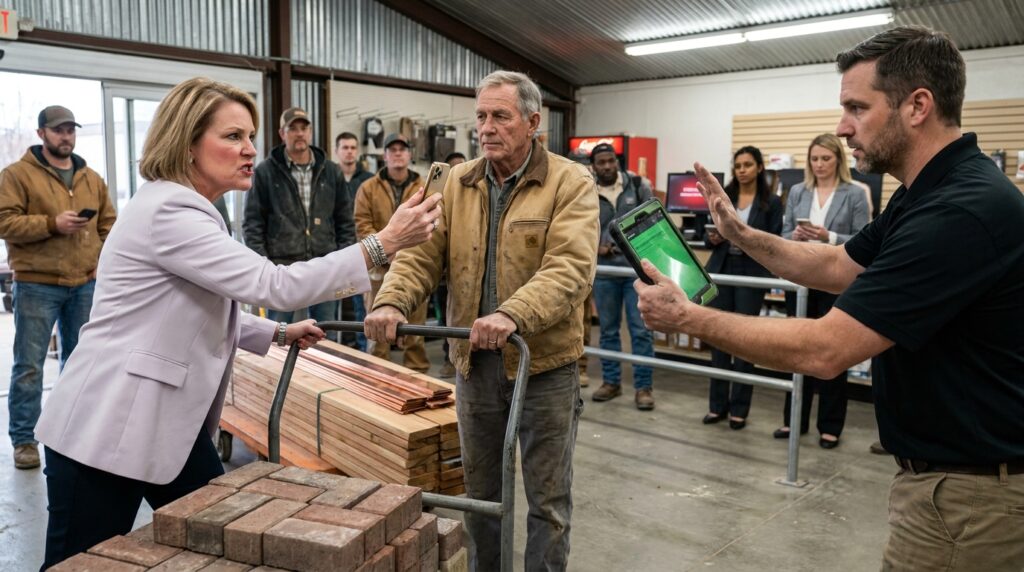
“Drop the camera, ma’am,” Arthur said, his calloused thumbs locked hard against the handle of his flatbed cart as the metal frame rattled against the checkout gate. “You’re blocking the lane, and the digital clock on the terminal is already running.”

The air in the Builder’s Outlet checkout corral was thick with the suffocating weight of three hundred shoppers trapped under corrugated iron roofing. The heat smelled of damp yellow pine and ozone from the overhead fans. Victoria Vance-Gable didn’t lower her phone. Her heavy silver bracelets clinked against the gold rim of her smartphone case, the lens catching the harsh glare of the fluorescent tubes above Register Four. Her pastel blazer was crisp, an aggressive contrast to the stained canvas of Arthur’s work jacket. She shoved her metal flatbed cart—stacked three layers deep with heavy, interlocking landscaping bricks—sideways across the exit path. The wheels ground into the concrete floor with a screech that stopped the barcode scanners cold.

“You didn’t stop at the courtyard kiosk, old man,” Victoria said, her voice cutting through the mechanical hum of the store. “I watched you wheel those three rolls of premium copper flashing right past the timber gate. You think because you’re dressed for the yard, the inventory rules don’t apply to you?”

Behind Arthur, a line of weekend contractors shifted weight, the heavy boxes of drywall screws and tool belts lowering to the ground like discarded armor. The cashier at Register Four froze, her fingers hovering above the scanner bed as the green light went dead. Arthur didn’t let his posture sag. His spine remained straight, a habit formed over thirty years of aligning structural grids to the exact millimeter. He didn’t look at the crowd turning their heads toward him; he looked only at the small, square digital screen of his phone held flat against his palm. A green confirmation block was glowing there, its digital clock displaying 11:04 AM, but the register terminal in front of them had just flashed a dark red sync-error code.

“The transaction is complete,” Arthur said, his voice dropping into the quiet, transactional register he used when a blueprint check revealed a bad foundation. “The yard account cleared the inventory ten minutes ago. If you look at the terminal ledger, you’ll see the yard block is already marked paid.”

“It says error, you liar,” Victoria hissed, stepping closer until her manicured nails practically touched the steel mesh of his cart. She pointed the phone directly at his face, her finger twitching on the screen. “Look at the screen! It’s blank. You loaded those rolls when the yard boy wasn’t looking, and now you’re trying to walk out before the system updates. Shut the register down!” she yelled toward the customer service desk.

The silence that followed was heavy with the smell of dry earth and rust. Arthur felt the familiar, cold pressure behind his eyes—the same frustration that came when a site foreman tried to alter a concrete calculation on the fly. He didn’t pull out his wallet. He didn’t raise his hands. He simply reached down and turned his screen toward the cashier, his thumb covering a small, unresolvable system anomaly at the bottom of the ledger code—a missing string of characters that shouldn’t have been there, a tiny, dark discrepancy that suggested the network hadn’t just delayed his receipt, but had actively split it in two.


CHAPTER 2: THE SIDEWAYS CART BARRICADE

The metal-on-concrete screech of Victoria’s cart echoed off the low corrugated iron roof, leaving a jagged gray score mark in the dust at Arthur’s feet. She didn’t budge an inch. Her designer sunglasses, caught in the greasy yellow glare of the high-ceiling tubes, cast long, distorted bars of shadow across her face. The phone in her right hand remained steady, its red recording dot pulsing like a small, angry eye.

“Don’t talk to me about terminal clocks,” Victoria said, her words dropping with the heavy, unyielding weight of the landscaping bricks behind her. “You shifted those three rolls of flashing while the loader was checking the pallet count at the north fence. I know the type. You buy twelve sticks of common utility pine, hide the architectural copper under a burlap tarp, and expect a sixteen-year-old cashier to blink you through the gate.”

Arthur’s thumbs stayed anchored to the worn rubber grip of his flatbed. He could feel the fine, gritty residue of industrial limestone coating the steel handle—the constant, abrasive dust of a high-volume supply house that ground down everything from machine gears to human patience. He didn’t blink. He didn’t look back at the three contractors whose heavy, steel-toed boots were now rhythmic hammers against the concrete.

“Look at the bottom line of the display, miss,” Arthur said. His voice was low, rhythmic, carrying the dry, unhurried cadence of an inspector checking the plumb line on a retaining wall that was already beginning to bow. “The terminal isn’t clear because the storefront server is dropping its packets. The counter indicator is pulling an automatic hold, not an unpaid alert. The code at the bottom is three digits short of a standard theft flag.”

The cashier, a young girl with a faded orange smock and a name tag that read Chloe, reached out with a trembling hand to tap the side of the register screen. The plastic casing creaked under her finger. “It’s… it’s not loading the yard ledger at all, Mrs. Vance-Gable,” she muttered, her eyes darting toward the customer service counter fifty feet away where a red light was spinning lazily above the returns desk. “The main frame is locked. I can’t clear the lane from here until the kiosk updates.”

“Because he jammed it,” Victoria snapped, her heavy silver bracelets clattering against the cart mesh as she stepped directly into the narrow gap between the metal guardrails. The scent of expensive, synthetic lavender perfume fought hard against the sour odor of damp fertilizer and old iron that rose from the floorboards. “They use those modified apps to spoof the courtyard checkout. They trigger the green validation screen on their personal devices, but the physical ledger never receives the transaction block. It’s an old commercial yard trick, and I’m not moving this cart until a manager performs a physical piece-by-piece audit of every single cedar length he’s got stacked there.”

Arthur looked down at the digital screen in his palm. The green confirmation square remained steady, its timestamp unblinking at 11:04 AM, but beneath the barcode, the string of text was truncated—broken off precisely where the terminal identifier should have been stamped. It was a clean break, a missing line of data that felt less like a delayed update and more like an intentional isolation. The phone felt heavy, cold, a solid block of glass and aluminum against his calloused skin. He knew the yard kiosk was three hundred yards away, situated behind a double-reinforced chain-link perimeter that separated the retail floor from the heavy contractor loading bays. If the storefront server had lost its sync line, the proof wasn’t missing; it was simply buried in the local cache of an isolated terminal out in the dirt.

“The inventory is clear, ma’am,” Arthur repeated, his eyes shifting from the screen to the rigid, pastel edge of Victoria’s shoulder. “If you force an audit now, you’re holding up four thousand dollars of commercial deliveries behind me for a structural line item that’s already been logged in the county assessor’s commercial discount system. My corporate account number is stamped on the base tier.”

A man three spaces back—a framing contractor with a sweat-stained baseball cap and a clip-on radio that hummed with static—stepped forward, his work boots leaving heavy, dark crescents on the dusty floor. “Hey, lady, some of us have a concrete pour scheduled for noon. If the guy’s got a green screen, let the store filters sort it out at the exit gate. Move the brick.”

Victoria turned her head just enough to catch the contractor in her camera’s frame, her chin tilting upward with a practiced, systemic arrogance. “The rule is visual verification at the register line for all bulk-class materials. Section four of the contractor manual. If you don’t like the delay, you can take it up with the district office, but this lane stays closed until the property is verified.”

Arthur let his breath out slowly through his nose. He didn’t argue. He reached into his jacket pocket, his fingers brushing the smooth, grease-darkened leather of his old draftsman’s wallet, feeling the sharp corners of the printed tax certificates he always kept pinned behind his license. He wasn’t looking at the crowd anymore. He was watching the little red error light on Chloe’s register terminal skip two beats, then drop into a steady, flat pulse—the exact signature of a hard network disconnect that was about to turn this entire crowded checkout corral into a closed box.

CHAPTER 3: THE FRAMING OF THE LENS

The steady, dull pulse of the register terminal’s red light cast a rusted hue across the stainless steel checkout counter. Victoria adjusted her grip on her phone, her thumb tapping the glass with a sharp click that cut through the low, ambient rumble of the crowding queue. She didn’t drop her arm; the lens remained leveled perfectly with Arthur’s eyes, catching the deep, gray fatigue lines etched around his temple.

“Look at the screen, everyone,” Victoria announced to the growing semi-circle of shoppers, her voice rising to carry over the sound of a forklift backing up in the plumbing aisle. Her gold-plated rings flashed against the black casing of her phone. “This is exactly how structural shrinkage happens. They take advantage of the weekend rush, stand in the high-volume lanes with a half-blank screen, and wait for the cashiers to get tired enough to press the manual bypass code. It’s an intentional drain on the store’s inventory, and it comes right out of the local tax base.”

Arthur felt the heavy iron handle of his flatbed push slightly against his palms as a family behind him shifted forward, their large orange buckets scraping the floor. The air was thick with the scent of damp topsoil and the dry, flinty taste of powdered grout. He could see his own reflection in the black glass of Victoria’s camera—a quiet man in an oil-stained work jacket, his silver hair uncombed under the harsh store lighting, looking precisely like the kind of target she had spent years clearing from her path.

“The server isn’t down because of a bypass request, ma’am,” Arthur said, keeping his fingers flat against the worn metal. He spoke without the sudden warmth of defensive anger, using the flat, uninflected tone of a man documenting a load-bearing failure on a concrete blueprint. “The register is dropping its handshake protocol. If the terminal line were an active theft lock, the main warning tone would be ringing at the exit gates. The system is waiting for the courtyard kiosk to dump its localized transaction blocks.”

“Don’t lecture me on store logic,” she said, her sunglasses slipping slightly down her nose to reveal wide, calculating eyes. She took half a step forward, her pastel sleeve brushing the rough, splintered edge of the cedar boards on Arthur’s cart. “I know how the contractor discounts operate. My husband’s firm handles three subdivisions in the upper basin. You don’t clear three hundred dollars of high-grade copper flashing without a signed paper manifest from the yard foreman. Chloe,” she turned sharply to the cashier, “call the floor manager. Tell him we have an unverified bulk carrier refusing to clear the path for premium account holders.”

Chloe’s hand shook as she reached for the gray store phone mounted below the register screen. The cord was coiled tight, coated in years of industrial dust. “I… I dialed Marcus,” she whispered, her eyes glued to the flashing sync-error display. “He’s coming from the receiving office. But the line is backing up all the way to the flooring displays.”

Arthur looked back at the rolls of copper flashing nestled between the structural cedar. The bright, polished metal gleamed underneath the dust, its clean orange surface showing the precise machine-stamped lot numbers from the yard. He knew exactly what was missing from the terminal screen below them: the tiny, four-digit sequence that verified the courtyard kiosk had securely isolated the funds before the store’s main database pipeline went dark. Without that string, the front register could only see a cart full of high-value materials that hadn’t technically crossed the primary electronic threshold. It was a perfect decoy—a physical error that looked like an undocumented removal, providing Victoria with all the leverage she needed to maintain her iron blockade in front of forty witnesses.

The contractor with the sweat-stained cap stepped closer, his heavy leather tool pouch thudding against the steel rail of the lane. “Look, lady, the old man told you the system is lagging. We’re all using the same self-scan network. My phone took four minutes to clear a box of galvanized framing nails out in the lot. Just pull your cart back so we can shift to Register Three.”

“No,” Victoria said, her mouth tightening into a thin, pale line as she turned the camera directly toward the contractor’s face. “If we move, the evidence changes. He walks out that door, the scan resets, and the store absorbs the discrepancy. We stay right here until the database is physically checked.”

Arthur didn’t pull his phone back. He let the green confirmation screen continue to glow against the dark metal counter, its steady light reflecting off the chrome trim of Victoria’s barricade. He could feel the small, hard weight of his old pocket scale pressing against his hip—a tool he had used for thirty years to verify the density of structural metals. He knew that if you applied enough pressure to a flawed boundary, the steel would eventually split along the line where the calculation was wrong. He was simply waiting for the structural manager to bring the scale.

CHAPTER 4: THE NETWORK LEDGER CONFLICT

The heavy squeak of rubber-soled supervisor boots cut through the thick hum of the register corral. Marcus Thorne moved through the gap between Register Three and Register Four like an iron wedge driving into a failing timber frame. His black store polo shirt was crisp, his wireless headset clicking as he pulled a ruggedized master tablet from his belt holster. The glare of the overhead high-bay lights caught the matte glass of the screen, reflecting a chaotic grid of red error indicators across his chest.

“Let’s clear the lane line,” Marcus said, his voice flat, carry-over authority from a decade spent managing regional distribution loops. He didn’t look at the phone Victoria was still holding level with Arthur’s face. He looked at the base parameters: the sideways cart, the stacked bricks, and the heavy rolls of architectural copper sitting exposed on Arthur’s flatbed. “We’ve got a tailback reaching the drywall aisles. Chloe, dump the terminal cache.”

“I tried, Marcus,” the cashier muttered, her finger resting on the gray plastic bezel of the monitor. “Register Four is pulling a hard network freeze. The localized transaction ledger won’t let me override the terminal lock while the yard system is flashing a failure code.”

Victoria stepped directly into Marcus’s line of sight, her pastel sleeve snapping as she lowered her smartphone just enough to display the live video frame to the manager. “The system isn’t failing, Marcus. It’s working exactly the way it’s supposed to when someone tries to bypass the commercial clearance gate. I watched this man wheel these three rolls of flashing through the northern gate without a stamped yard release. The register screen confirms the discrepancy. He’s using an unverified app screen to force his way past the floor staff.”

Arthur watched the manager’s fingers slide across the tablet. The screen cast a cold blue tint over the calloused skin of Marcus’s palms. Arthur did not shift his boots. He remained anchored to the metal frame of his cart, feeling the slight vibration of the store’s air conditioning unit rattling the corrugated roof plates far above them.

“The application ledger cleared the transaction at 11:04 AM,” Arthur said quietly, pointing his phone toward the manager’s tablet. “The entry is marked underneath the county assessor’s commercial account block. The missing sequence at the bottom isn’t a theft flag; it’s a network packet delay from the isolated courtyard server.”

Victoria let out a short, sharp laugh, her silver bracelets clinking hard against the cart rail. “An isolated server? You’re a customer, not an enterprise technician. Marcus, look at the main manifest on your terminal. The main storefront register doesn’t show a completed transaction for this account number anywhere in the morning ledger. If you let him push this timber past the security gate without a hard system clear, you’re verifying a fraudulent scan in front of fifty corporate account holders.”

Marcus didn’t answer. He stepped between the two carts, his boot heels grinding a stray piece of gravel into the dust. He connected a localized diagnostic cable from his tablet directly into the side port of Chloe’s register terminal. The screen flashed once, the dark red sync-error code disappearing, replaced by a cold, spinning gray icon that signaled a deep system check. The crowd behind Arthur had gone completely still, the heat in the corral growing heavier as the framing contractor leaned over the steel guide rail, his phone raised to capture the manager’s master display.

The tablet screen flickered. A long list of local account logs scrolled past, all marked in black text—except for Arthur’s commercial account line, which flashed a stark, unresolvable yellow warning line. The storefront database had absolutely no record of the payment authorization code. The decoy secret had solidified: according to the primary floor ledger, Arthur Pendelton was standing inside the exit lane with hundreds of dollars of premium construction materials and an entirely unverified receipt string.

“The account log is blank, Mr. Pendelton,” Marcus said, his brow furrowing as he checked the network routing code. He looked up, his tone dropping the initial customer-service warmth, replacing it with the rigid, standard protocol of an operational audit. “The terminal can’t pull the handshake token from the cloud interface. As far as the front desk is concerned, this material hasn’t been paid for at any retail point inside the building.”

Victoria took a step back, her posture straightening with a sharp, victorious snap as she turned her phone camera directly back toward Arthur’s face. “There it is,” she said to the room, her voice echoing off the concrete walls. “The system doesn’t lie. Move the cart to the security enclosure, old man. You’ve run this line as far as it goes.”

Arthur did not reach for his wallet, nor did he lower his device. His gaze remained fixed on the yellow warning code on Marcus’s screen. He noticed a single, three-letter prefix attached to the missing data column—a code that didn’t belong to the storefront system at all, but rather to the internal backup system of the independent courtyard yard gates. The decoy had cracked, but the truth was still locked inside a machine three hundred yards away through the dust.

CHAPTER 5: THE QUIET RETURN TO THE WOOD

“Hold the execution, Marcus,” Arthur said, his voice cutting under the shrill, rising tone of Victoria’s phone audio. He did not pull his flatbed back an inch from the steel lane gate. His weathered index finger reached out, tapping the edge of the supervisor’s master tablet, pointing directly to the three-letter prefix flashing beside the yellow indicator. “Look at the routing header. CYD-87. That’s the dedicated backup channel for the outdoor courtyard loop. When your main storefront server dropped its packets at eleven o’clock, the courtyard gateway swapped automatically to localized offline storage. The transaction didn’t fail; it isolated to the physical gate drive.”

Marcus Thorne paused, his thumb hovering over the tablet’s screen as his eyes traced the jagged line of the data prefix. The air inside the register corral seemed to contract, hot, still, thick with the dry scent of raw masonry lime and the metallic tang of old hydraulic fluid leaking from the forklift in the next aisle. Marcus tapped the yellow line, his manicured fingernail tapping the hard glass twice until a secondary, secure diagnostic utility opened beneath the main inventory ledger.

“Wait a second,” Marcus muttered. He stepped completely past Victoria’s cart, his body shifting to block her camera lens from the screen as he brought up the local cache records. He pulled a manual override key from his hip ring and slotted it into the base of Register Four.

“Marcus, this is completely against the protocol,” Victoria said, her heavy silver bracelets rattling aggressively as she took a sharp step forward, her pastel jacket brushing the gritty side of the cedar lumber. “You’re allowing an unverified account holder to stall this whole terminal line for an unmapped technical glitch. The document clearly shows—”

“The document shows he paid at the courtyard gate at exactly 11:04 AM, ma’am,” Marcus said, his voice dropping into the cold, flat register of a regional manager enforcing a zero-tolerance boundary. The tablet screen shifted from amber to a brilliant, solid green as the secure transaction block from the isolated courtyard kiosk finally forced its way through the storefront’s local cache sync. The terminal ledger updated instantly, displaying the full, itemized clearance manifest: twelve lengths of select structural cedar, three rolls of premium copper flashing, completely cleared under Arthur’s corporate account number with a fully matching transaction authorization token.

The silence that hit Register Four was absolute, heavy with the weight of forty people suddenly letting down their breath. Then the murmurs started. It began with the framing contractor behind Arthur, who let out a low, dry chuckle, his heavy work boots shifting in the gray concrete dust.

“Looks like you’re the one holding up the line, lady,” the contractor said, pointing his own phone camera directly at Victoria’s face. “Let the working men get through.”

Victoria’s face went entirely pale, then flushed a dark, angry crimson that reached the collar of her blazer. Her hand shook slightly as she finally lowered her smartphone, the red recording dot going dark as the crowd in the adjacent lanes turned their eyes toward her sideways cart. Two other shoppers in Register Three raised their devices, their lenses tracking her every movement as her calculated social leverage vanished into the dust-choked air.

“Clear the lane right now, Mrs. Vance-Gable,” Marcus said, his voice unyielding as he pointed his finger toward the wide main exit gates. “Your account usage will be audited by our corporate compliance team on Monday morning for intentional obstruction of customer traffic. If this metal cart isn’t out of the corral in ten seconds, I will personally signal the county sheriff detail at the front desk to remove you for criminal harassment.”

Faced with the weight of the turning corral, the unblinking lenses of the contractors, and the cold reality of the green screen ledger, Victoria’s composure broke down into pure, frantic motion. She grabbed the handle of her heavy metal flatbed cart, the iron wheels grinding into the floor with a desperate, ragged screech as she hauled it backward out of the lane bottleneck, nearly striking her own pallet of bricks against the concrete divider. She didn’t say a word. She didn’t look at Arthur. She kept her eyes locked on the dust-covered tiles as she hurried past the service desk, her phone shoved deep into her pocket and her designer sunglasses falling forgotten against her collar.

Arthur gave Marcus a short, precise nod, the kind of micro-acknowledgment a draftsman gives to a clean survey pin. He gripped the rubber handle of his flatbed and pushed it forward, the cart rolling smoothly across the threshold of Register Four and out into the blinding, open glare of the suburban parking lot.

The air outside was clean, hot, smelling of dry asphalt and remote pines instead of competitive noise. Arthur moved to the back of his old truck, his calloused hands working the familiar nylon straps over the clean, red cedar boards and the bright, unblemished rolls of copper flashing. He secured the tailgate with a satisfying, metallic click, checking the tension one last time before climbing into the driver’s seat. As he turned the key and pulled the truck out onto the long county road, he looked into his rearview mirror, watching the massive corrugated sign of Builder’s Outlet dissolve into the desaturated gray horizon. The lines were drawn, the numbers had held, and the long, quiet afternoon ahead of him was exactly where it belonged.

Similar Posts

Leave a Reply

Your email address will not be published. Required fields are marked *






